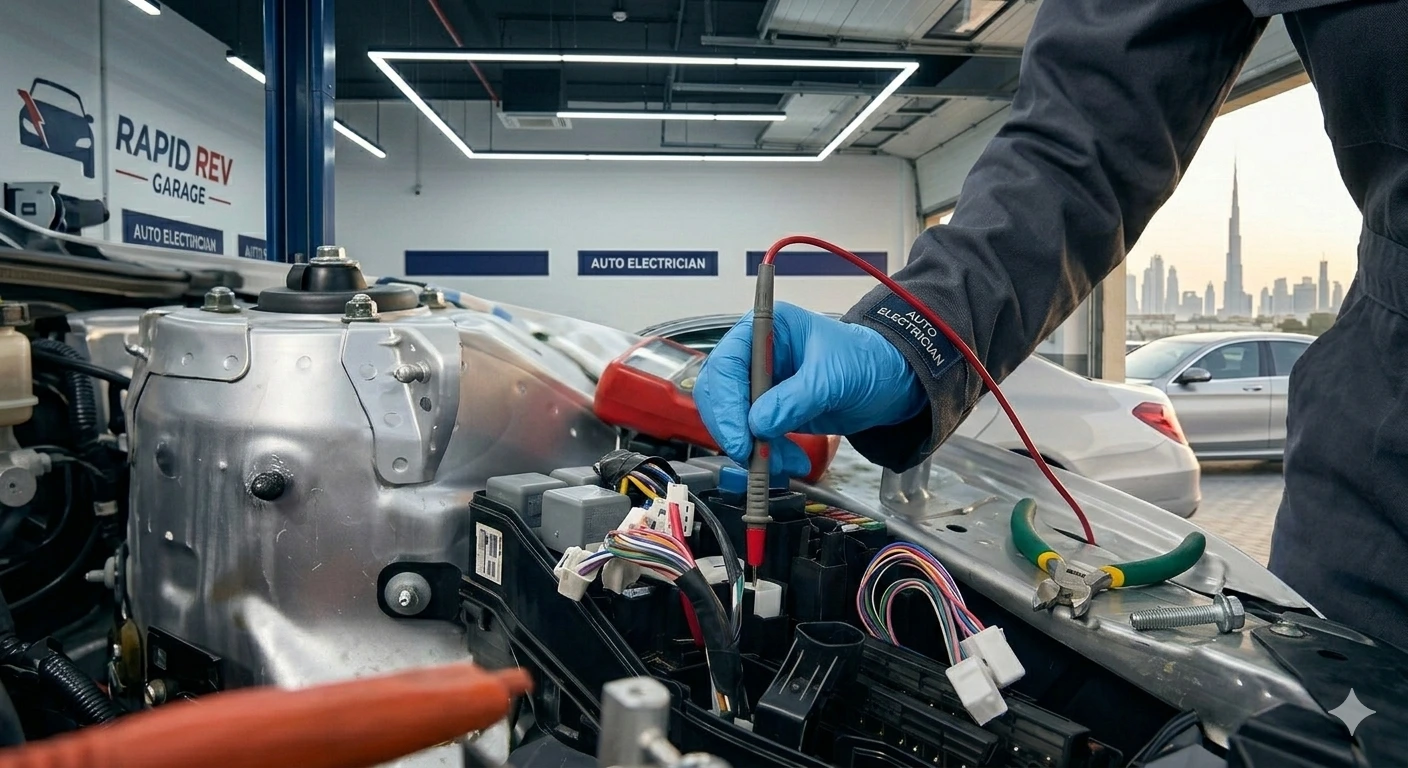
A car that develops an electrical fault in Dubai is a different problem from one that develops the same fault in a cooler climate. The heat accelerates everything — battery degradation, wiring insulation cracking, connector corrosion, relay failure, and control unit solder joint fatigue all happen faster here than the manufacturer’s design life assumes. And because modern vehicles are essentially rolling computer networks with mechanical components attached, a single electrical fault in the wrong place can create symptoms across multiple unrelated systems simultaneously.
Finding a qualified auto electrician in Dubai who can actually trace the root cause — rather than swap components until something changes — is the difference between a car that gets fixed and one that becomes a recurring expense. Most electrical misdiagnosis in Dubai’s workshop market happens not because technicians are incompetent, but because they’re working with inadequate diagnostic equipment. A generic scanner points at a symptom area. An experienced auto electrician Dubai with proper multi-system diagnostic access traces the actual cause.
This covers the most common electrical faults in Dubai’s market, what causes them, what proper diagnosis looks like, and what owners should expect from a workshop that genuinely knows what it’s doing.
Auto Electrician Dubai — Why Electrical Faults Are More Frequent Here
Dubai’s environment creates specific conditions that drive higher electrical fault rates than most other markets. Understanding the reasons helps owners recognise developing problems earlier and avoid the situations that cause unnecessary damage.
How Heat Destroys Electrical Components Faster in Dubai
Heat is the primary driver of electrical failures in UAE vehicles. Every electrical component operates within a designed temperature range — sustained ambient temperatures above 40°C push those limits daily across the entire vehicle.
Battery chemistry degrades significantly faster in heat. A battery that lasts five to six years in a European climate often shows serious capacity loss at three years in Dubai. The internal plate structure breaks down from thermal cycling, cold cranking capacity drops, and the battery fails to deliver sufficient current under load — typically showing up as a slow crank or no-start after the car has been parked in a hot outdoor lot for several hours.
Wiring insulation that remains flexible for a decade in a temperate climate becomes brittle and prone to cracking in four to five Dubai summers. Insulation cracks that develop around sharp edges, cable ties, or anywhere the harness is under slight tension create intermittent short circuits that are among the most difficult faults an auto electrician Dubai can trace.
Relay and fuse box contacts oxidise faster under heat. A relay that’s developing high contact resistance causes voltage drops across the circuit it feeds — creating symptoms that look like component failure when the actual problem is in the power delivery upstream.
How Dubai’s Roads Create Wiring Faults
Speed bumps are everywhere in Dubai, inconsistently sized, and frequently hit at speeds that transfer significant shock load through the vehicle structure. Every time a car hits a speed bump hard, every electrical connector in the vehicle flexes slightly. Over thousands of repetitions, connectors work loose, wiring harness clips break, and individual wire strands fatigue-crack at bend points and connector entries.
This is why intermittent electrical faults are so common in Dubai — the fault that appears when driving disappears the moment the car is stationary and someone starts looking for it. A proper auto electrician in Dubai knows to test under dynamic conditions, not just with the car sitting still on a ramp.
Short-Trip City Driving and Battery Drain
Most Dubai vehicles spend the majority of their time on short trips — school runs, supermarket visits, office commutes with significant idle time in traffic. Short trips never give the alternator sufficient time to fully restore charge after each cold start. Over weeks and months, battery state of charge gradually drops, the battery spends increasing time in a partially discharged state, and internal sulphation accelerates capacity loss.
A battery on a predominantly short-trip Dubai vehicle needs a full charge cycle — either from a proper battery charger or an extended highway drive — every two to three weeks to maintain health. Most owners don’t do this, and battery-related auto electrician Dubai callouts are the direct result.
What a Proper Auto Electrician in Dubai Should Be Able to Diagnose
The range of electrical work that falls under auto electrician Dubai services covers everything from a dead battery to a corrupted control unit. Here’s what a properly equipped workshop handles — and what the diagnostic process looks like for each.
Battery and Charging System Faults
Battery problems are the single most common electrical issue in Dubai, but proper diagnosis goes considerably beyond replacing the battery and hoping for the best.
A correct battery assessment uses a conductance tester — not a basic voltage reading. Resting voltage tells you almost nothing useful about a battery’s real condition. A conductance test measures actual available current delivery as the internal plate structure degrades. A battery showing 12.4 volts but 55% conductance health will start the car fine on a cool morning and fail completely after six hours in a summer parking garage. Voltage alone doesn’t show this.
The charging system needs separate assessment. An alternator delivering 13.1 volts instead of the correct 14.2–14.7 volts is under-charging — the battery slowly depletes on every drive regardless of its own condition. Fitting a new battery to a car with a weak alternator means the new battery starts degrading from day one. A proper auto electrician Dubai tests the alternator output under load, not just at idle with no electrical consumers running.
On European vehicles — Mercedes-Benz, BMW, Volkswagen Group, Audi, Land Rover — battery replacement requires registration coding after fitting. The engine management and power management systems need to be told the new battery’s specifications so the charging strategy adjusts correctly. Fitting a new battery without registration on these platforms causes premature battery failure, erratic start-stop behaviour, and fault codes across multiple systems. This is not an optional step.
A Nissan Patrol came through with a persistent no-start fault that two previous workshops had attributed to the battery. Two replacements in fourteen months, same problem recurring. Our diagnosis found a corroded chassis ground strap creating resistance in the battery return path — the battery was being charged but couldn’t deliver current effectively. Cleaned and replaced for AED 110. The third battery stayed healthy.
Wiring Faults and Harness Damage
Wiring faults are the most time-consuming work an auto electrician in Dubai handles — and the most commonly misdiagnosed category in Dubai’s workshop market.
Modern vehicles have wiring harnesses running through every section of the car. A single damaged wire in the wrong location creates fault codes across multiple systems that appear completely unrelated. An ABS warning, a stability control fault, and an engine management light appearing together sometimes trace to a single damaged ground wire near the rear axle. A technician who treats each warning light as a separate fault ends up replacing components that aren’t faulty.
The diagnostic approach for wiring faults: scan all systems and map which modules share common power, ground, or signal circuits. Look for the common thread. Then physically trace the harness sections most likely to have suffered damage — using wiring diagrams for that specific vehicle, testing continuity and resistance at multiple points, not just at the obvious ends of the circuit.
Common Wiring Fault Locations in Dubai
Engine bay harnesses suffer from heat cycling that hardens and cracks insulation over time. Wires routed near exhaust manifolds or turbocharger housings are particularly vulnerable. Rodent damage is also more common in Dubai than most owners expect — engine bays of cars parked in outdoor lots are attractive to rodents during cooler months, and chewed wiring creates faults that look electrical but are actually physical damage.
Door harness flex points — the wiring between the body and the door runs through a rubber boot that flexes on every door opening. Individual wires fatigue-crack at this point over years of use. Central locking faults, window faults, and mirror issues that work intermittently and resolve themselves usually trace here.
Underbody harness runs — physical damage from speed bump impacts, incorrect jacking, or displaced underbody protection causes wiring damage that shows up as intermittent and apparently random faults across systems fed by those circuits.
ECU and Control Unit Diagnosis
ECU faults are where the most expensive unnecessary parts replacement happens in Dubai’s market. Control units get replaced speculatively — at AED 2,000 to AED 15,000 depending on the vehicle — when the actual fault is a failed input sensor, a damaged connector, a power supply issue, or a software problem resolvable by reflashing.
The correct diagnostic sequence: verify the fault code and freeze frame data, check power and ground supply to the control unit, inspect the harness connector for corrosion or pin damage, test all input sensors for that circuit, and only after eliminating external causes consider whether the unit itself has failed. A qualified auto electrician Dubai follows this sequence. A parts-swapper skips it.
Specific control unit scenarios common in Dubai:
Software faults on European vehicles — certain BMW, Mercedes-Benz, and Volkswagen Group models have known software issues causing drivability symptoms. These are resolved by ECU reflashing or software updates, not hardware replacement. Requires manufacturer-level or equivalent software access.
Immobiliser and transponder faults — lost keys, failed transponders, and immobiliser antenna ring failures cause no-start conditions that present exactly like mechanical failures. Require manufacturer-level security access to resolve correctly. Not every auto electrician in Dubai has this capability — ask specifically before booking.
Moisture ingress into control units — less common but real. Control units in the engine bay or under the floor can suffer moisture damage from pressure washing, heavy rain events, or failed body seals. Internal corrosion causes intermittent or permanent faults. Sometimes recoverable with professional cleaning. Sometimes not — but always requires proper diagnosis before replacement.
An Audi A4 came in after another workshop had replaced the fuel pump and crank sensor chasing a no-start fault. Neither part was faulty. The actual cause was a failed immobiliser antenna ring around the ignition barrel — a AED 190 part. The owner had spent AED 1,800 on unnecessary components before reaching a proper auto electrician Dubai.
Sensor Faults — Diagnosis Before Replacement
Sensor faults are one of the highest-volume categories in auto electrician Dubai work, and also one of the most over-replaced without proper diagnosis.
A sensor fault code does not mean the sensor has failed. It means the control unit received a signal outside expected parameters from that circuit. The cause can be a failed sensor, a damaged wiring connection, a power supply issue to the sensor, contamination affecting the sensor’s measurement, or a mechanical fault affecting what the sensor is measuring.
Common sensor faults in Dubai’s market:
MAF sensor faults on petrol engines — often caused by over-oiled aftermarket air filters contaminating the sensing element, or simply by a split intake boot causing an unmetered air leak downstream of the sensor. Replacing the MAF without checking the intake system wastes the part.
Crankshaft and camshaft position sensor faults — can cause intermittent no-start, misfires, or stalling. These sensors are heat-sensitive and Dubai’s engine bay temperatures accelerate their degradation. Genuine sensor failures are common — but verify the wiring and connector condition first.
ABS wheel speed sensor faults — extremely common in Dubai from road debris damage, connector corrosion, and tone ring contamination from brake dust buildup. A used car inspection dubai or service visit that includes ABS sensor checks prevents the fault from developing into a complete ABS system disable.
Oxygen and lambda sensor faults — heat cycling degrades O2 sensors faster in Dubai than in cooler markets. Symptoms are increased fuel consumption, failed emissions tests, and rough running. Genuine sensor replacement is often the correct fix — but verify the exhaust system has no leaks before fitting new sensors.
Lighting and Ancillary Electrical Systems
Not every auto electrician Dubai job involves a breakdown or warning light. Common electrical work also covers lighting, comfort systems, and ancillary components.
Xenon and LED headlight faults — ballast failures on xenon systems are common on older European vehicles. LED matrix failures on newer models require diagnosis to distinguish between the LED module, the control unit, and the wiring supply. Incorrect headlight repairs affect both safety and RTA roadworthiness testing.
Parking sensor and camera faults — sensor damage from minor impacts is extremely common in Dubai’s parking-intensive urban environment. Replacement sensors need frequency matching and coding to the vehicle’s system — generic uncoded sensors cause persistent warnings and unreliable operation.
AC electrical faults — blend motor failures, evaporator temperature sensor issues, and compressor clutch relay faults all fall under auto electrician in Dubai work and directly affect daily livability in a city where AC is non-negotiable from May through September.
Start-stop system faults — erratic or disabled start-stop is usually a battery health issue rather than a system fault. But on some European platforms it involves the belt-starter generator or the dedicated start-stop battery as separate components from the main battery.
For wiring repairs alongside bodywork, car painting and electrical work handled at the same visit avoids duplicate labour and separate appointments.
When a fault leaves the car undriveable before it reaches the workshop, a qualified mobile car mechanic handles battery replacements with correct coding, minor fault resets, and basic diagnostics on-site. For recovery situations, proper roadside assistance ensures the vehicle is moved safely without stressing damaged electrical components further.
A full car service visit is the correct time to request a full electrical system health check alongside the mechanical inspection — battery conductance, alternator output, ground strap condition, and a complete control unit scan across all modules. Catching developing faults during a service costs far less than addressing them after failure.
For owners in Al Quoz and surrounding areas who need a reliable garage near me with genuine electrical diagnostic capability — not just a workshop with a basic code reader — the difference shows up immediately in the diagnostic approach and the accuracy of the repair.
FAQ
What are the most common auto electrical faults in Dubai?
Battery failure from heat degradation, wiring insulation cracking from UV and heat cycling, and sensor faults from connector corrosion are the most frequent issues.
How do I know if my car needs an auto electrician or a regular mechanic?
Warning lights, electrical components that work intermittently, slow cranking, or faults that appear unrelated to each other are signs of electrical issues requiring a specialist.
Why does my car battery keep failing in Dubai even after replacement?
Usually a charging system fault — weak alternator output, missing battery registration coding on European vehicles, or a parasitic drain from a module drawing current with the ignition off.
Can wiring faults cause multiple warning lights at the same time?
Yes — a single damaged ground wire or corroded connector can trigger fault codes across several unrelated systems simultaneously.
How long does an auto electrical diagnosis take in Dubai?
Battery and charging system checks take 30–45 minutes. Wiring fault tracing and ECU diagnosis can take 2–4 hours depending on the system complexity and fault location.
Conclusion
Electrical faults don’t stay contained and they don’t resolve themselves. A marginal battery becomes a no-start. An ignored wiring fault creates cascading control unit errors. A misdiagnosed ECU fault leads to unnecessary parts replacement at significant cost. Proper auto electrician Dubai work means real diagnosis with the right equipment — not guesswork dressed as expertise.
Rapid Rev Garage in Al Quoz handles the full range of auto electrical work — battery diagnostics and replacement, wiring fault tracing, ECU diagnosis, sensor testing, and complete electrical system health checks for all makes. Book your appointment on WhatsApp or find the workshop on Google Maps.