A long drive from Dubai — to Abu Dhabi, Al Ain, Hatta, Musandam, or further into Oman — puts sustained demands on a vehicle that daily stop-start city driving doesn’t produce. Sustained motorway speeds for two or three hours. Climbing grades on mountain roads. Extended AC operation under full ambient heat load. These conditions reveal developing faults that urban driving masks entirely.
A proper vehicle service check before a long drive isn’t pessimism about the car’s condition — it’s the practical step that prevents the breakdown on the Hatta road or the overheating situation on the Musandam climb that would have been caught in a 45-minute workshop assessment.
In Dubai’s conditions specifically, certain systems that function adequately in short-trip urban driving reveal their marginal condition under sustained highway load. A cooling system that manages fine in 20-minute city trips can show temperature anomalies on a two-hour desert highway run. A tyre with a developing sidewall weakness shows nothing on smooth city roads and fails on a rough mountain surface. A battery that starts the car reliably every morning fails to restart after a three-hour mountain hike in 43°C heat.
Vehicle Service Check Dubai — Why Long Drives Reveal What City Driving Hides
The physics of long-distance driving are different from stop-start urban use in several ways that matter for a pre-trip vehicle service check.
Sustained engine load at highway speed generates more heat than city driving — the engine works at a consistent output level for extended periods rather than the load variations of urban traffic. Systems that just manage in short trips reach temperature equilibrium under sustained load — and marginal systems reach their limits.
Sustained tyre rotation at highway speed is different from the low-speed rotation of city driving. A tyre with uneven wear, incorrect pressure, or a developing sidewall issue rotates through thousands more stress cycles per kilometre at 120 km/h than at 40 km/h. Highway speed rotation at sustained load is where developing tyre problems reveal themselves.
The battery and electrical system face different demands on a long drive. Extended AC operation under full ambient heat load, powered seat adjustments, navigation, infotainment, and sustained accessory use all draw from the electrical system consistently rather than in the start-stop pattern of city driving.
What a Proper Vehicle Service Check Should Cover
A complete vehicle service check before a long drive covers every system that highway driving stresses differently from city use.
Engine Oil and Cooling System
Engine oil condition and level is the first item of any vehicle service check. A car that’s approaching its oil service interval should have the oil changed before a long trip — not after. Oil that’s degraded from heat cycling in Dubai’s conditions provides reduced lubrication film protection under sustained highway load compared to fresh oil.
Coolant concentration testing with a refractometer confirms the system has adequate boiling point protection for sustained operation. In Dubai’s conditions, the correct coolant concentration for long-distance driving — particularly through mountain areas where the engine works harder on climbing grades — is 40–50% antifreeze by volume.
Cooling System Pressure Test
A cooling system pressure test as part of the vehicle service check catches developing leaks — hairline cracks in hose connections, weeping water pump seals, and early radiator seam failures — before they become roadside incidents. A system that holds pressure correctly in the workshop test will hold pressure on the highway. A system that shows slow pressure loss has a leak that will be somewhere on the Hatta road or the Musandam approach.
Coolant hose condition deserves physical inspection — not just visual assessment. Hoses that look acceptable from the outside can have internal degradation from heat cycling that makes them vulnerable to the sustained pressure of highway operation.
Brake System Assessment
The vehicle service check brake assessment matters specifically for mountain driving. Hatta Road and the Musandam approach both have sustained descents where the brakes are used more continuously than any Dubai city driving produces.
Brake fluid moisture content testing with a calibrated tester is a critical pre-trip check. Brake fluid with elevated moisture content has a reduced boiling point. Under sustained downhill braking — repeated applications over several minutes on a mountain descent — degraded brake fluid can vapourise, producing the spongy pedal and dramatically increased stopping distance that characterises brake fade.
Pad thickness measurement at all four corners before a mountain driving trip. A pad at 4mm is acceptable for city driving where individual brake applications are brief. A pad at 4mm heading into a sustained mountain descent is a different calculation.
Disc condition assessment — particularly for warping that produces pedal pulsation. A disc that produces mild pulsation on city roads produces increasingly pronounced pulsation as it heats under sustained mountain use. A warped disc on the way to Hatta isn’t dangerous at city speeds. The same disc on the descent is a different matter.
Tyre Inspection
Tyre condition is arguably the highest-priority item in any vehicle service check before a long drive.
Tread Depth Across the Full Width
Tread depth measurement at three points across each tyre — inner, centre, and outer — identifies uneven wear patterns that indicate alignment or suspension issues. A tyre showing good centre tread but worn inner edge has been running with significant negative camber or toe-out. This wear pattern produces heat at the inner shoulder under highway load — a combination that accelerates failure.
The legal minimum tread depth is 1.6mm across the central 75% of the tyre width. The practical safe minimum for Dubai’s highway driving — particularly in the event of a sudden rain event that produces the surface water that Dubai’s sporadic downpours create — is 3mm across the full width.
Tyre Age — DOT Code Check
In a vehicle service check for long-distance driving, tyre age from the DOT code stamped on the sidewall deserves specific attention. The DOT code’s last four digits indicate the week and year of manufacture — a tyre stamped 2419 was manufactured in the 24th week of 2019.
Tyres over five years old in Dubai’s UV and heat environment should be assessed for sidewall cracking and rubber compound degradation regardless of remaining tread depth. A tyre with 5mm of tread but seven years of Dubai summer exposure has rubber compound that’s harder and more brittle than the original — with reduced grip and increased risk of sidewall failure under sustained highway load.
Tyre Pressure — Cold Inflation
Tyre pressure for a long drive should be set cold — before the car has been driven — to the manufacturer’s specification for the loaded condition. Vehicles loaded with luggage and passengers for a family road trip should use the higher pressure specification for loaded conditions that appears in the owner’s manual or on the door jamb sticker.
Pressure set hot after city driving is already above cold specification from thermal expansion. Pressure set correctly cold and then increasing slightly as the tyre heats on the highway is the correct pattern.
Battery Health Assessment
A vehicle service check battery assessment before a long drive is particularly important if the battery is more than three years old.
Conductance testing rather than voltage testing — measuring actual current delivery capacity rather than surface charge. A battery showing 12.5 volts but 62% conductance health starts the car reliably from a cool engine in the morning and fails to restart after three hours in 45°C heat at a mountain viewpoint.
A battery below 70% conductance health on a pre-trip vehicle service check should be replaced before the trip rather than risked on it. The cost of a proactive battery replacement is a fraction of the cost of a recovery service from Hatta or a hotel night in Khasab while waiting for assistance.
Charging System Verification
Alternator output testing under load — confirming the charging system maintains 14.2–14.7 volts under full electrical load including AC, headlights, and other consumers. An alternator that shows adequate output at idle with minimal consumers but drops below 13.5 volts under full load is under-charging. Extended highway driving with full electrical load and an under-charging alternator depletes the battery progressively — fine for a city trip but a developing problem on a 300 km highway run.
Suspension and Steering Check
A vehicle service check suspension assessment for a long drive covers the components that mountain roads and rough highway surfaces stress specifically.
Ball joint and tie rod end condition matters on mountain roads where directional precision over rough surfaces requires correctly located steering geometry. A ball joint with developing play that’s masked by the smooth roads of Dubai city driving becomes a handling concern on the gravel road sections of the Hatta trails or the rough surfaces of the Musandam approach.
Shock absorber condition affects high-speed stability on motorway driving. A shock absorber with reduced damping capacity allows the vehicle to pitch and float over highway undulations — increasing driver workload and reducing safety margins at sustained highway speeds.
Wheel alignment verification is a pre-trip vehicle service check item if the car has recently sustained any significant kerb or speed bump impact. Misaligned geometry produces tyre wear and directional deviation that’s most apparent at sustained highway speed — and it increases tyre heat generation that adds to the load on a tyre already working hard at 120 km/h in 40°C ambient.
Lights and Visibility
A vehicle service check before a long drive includes every lighting system — headlights, tail lights, brake lights, indicators, and hazard lights.
Mountain driving after sunset on Hatta Road or the Musandam approach requires properly functioning headlights. A headlight with a failed low-beam bulb that the driver hasn’t noticed in Dubai’s well-lit urban environment is a serious visibility issue on unlit mountain roads.
Wiper blade condition for driving through the unexpected. Dubai’s rain is rare but intense — a wiper blade that smears or skips across the glass rather than clearing it cleanly creates a vision hazard during the heavy downpours that occasionally catch mountain drivers unexpectedly.
Washer fluid level and system function — the ability to clear road dust accumulated on the windshield during desert highway driving is a practical visibility item for any long trip outside Dubai.
Fluid Levels — Complete Check
A complete pre-trip vehicle service check verifies every fluid level:
Engine oil — level between minimum and maximum on the dipstick or electronic gauge. Coolant — level in the reservoir with the engine cold. Brake fluid — level in the master cylinder reservoir. Power steering fluid where applicable — level in the reservoir. Washer fluid — adequate for the trip distance. Transmission fluid where accessible — level check through the appropriate procedure for the specific transmission type.
A fluid level that’s visually at minimum acceptable may be below minimum acceptable after three hours of highway driving with the engine at sustained load. Pre-trip levels should ideally be at or near the maximum of the acceptable range.
Pre-Trip Vehicle Service Check — The Written Record
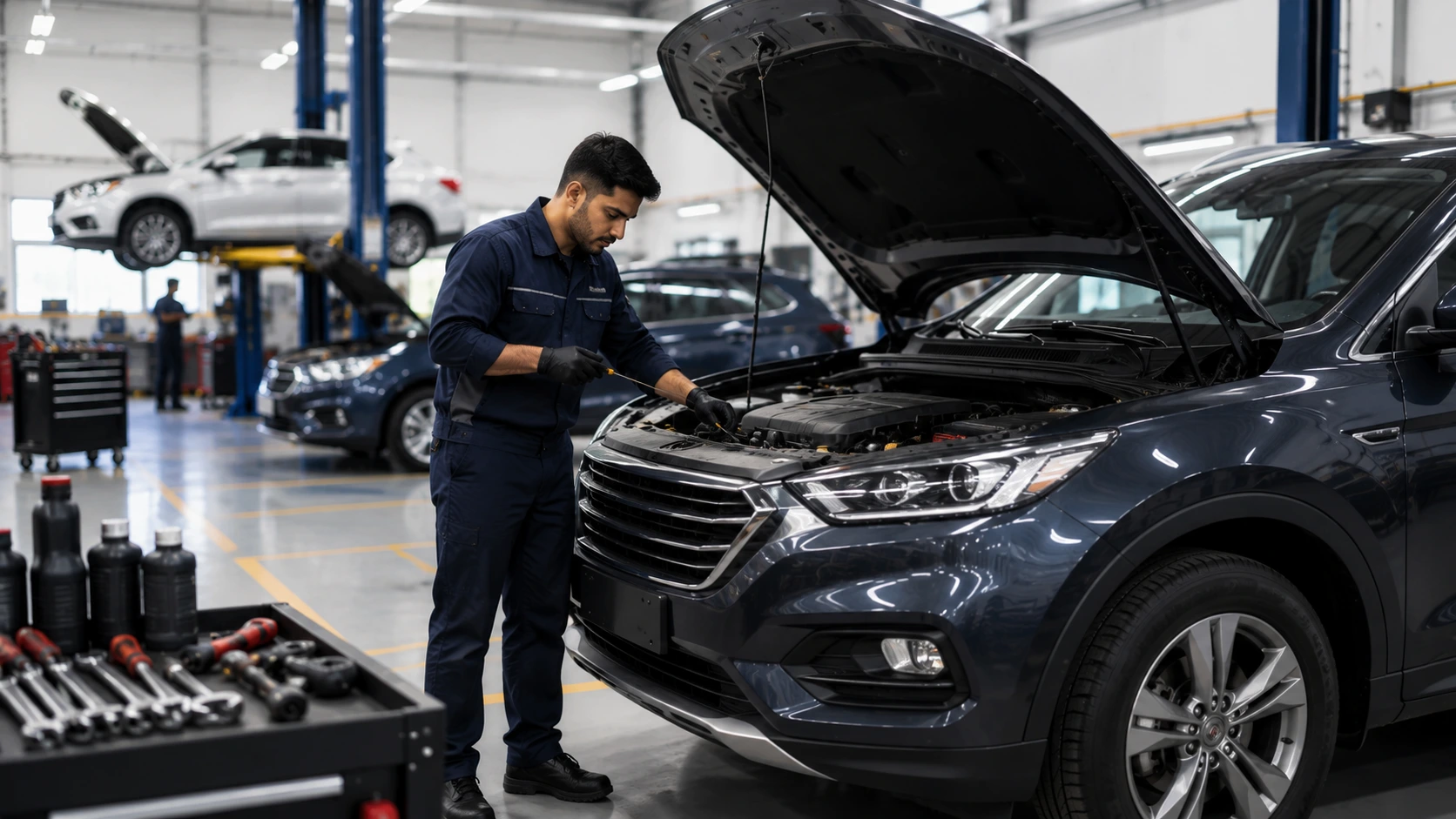
A vehicle service check conducted at a proper workshop produces a written assessment — not a verbal summary. Every system checked, findings on each, and any recommended actions with their urgency level.
This written record is the pre-trip baseline. If something develops on the trip — a tyre pressure warning, a temperature gauge reading higher than usual, a brake pedal that feels different after a mountain descent — the pre-trip assessment tells the driver and any assistance service exactly what the car’s condition was before departure.
A qualified car mechanic with diagnostic capability performs a pre-trip vehicle service check that covers the full scope — mechanical, electrical, and tyre condition together. For owners who want a complete service alongside the pre-trip inspection, a car service handles both in the same workshop visit — oil change, filter, fluid top-ups, and the pre-trip assessment items completed together.
For owners needing mobile support at the destination rather than the departure point, a mobile car mechanic handles battery assessment, tyre changes, and minor fault resets at the vehicle’s location. For genuine breakdown situations on a long drive, proper roadside assistance covers the full UAE road network — including mountain roads and cross-border routes into Oman where the trip’s remote sections create the most consequential breakdown scenarios.
For paint damage from stone chips accumulated on desert highway driving, professional car painting with manufacturer-matched colour codes handles bonnet and front section touch-up correctly after the trip. For owners in Al Quoz and surrounding areas looking for a garage near me that conducts thorough pre-trip vehicle service checks — covering every system that highway and mountain driving stresses specifically — the difference from a quick visual check is measured in confidence on the road.
FAQ
What does a vehicle service check before a long drive include?
Engine oil and cooling system assessment, brake system inspection including fluid moisture testing, tyre condition and pressure check, battery conductance test, suspension and steering assessment, lights verification, and complete fluid level check.
How far in advance should I get a vehicle service check before a long drive?
At least two to three days before departure — giving time to address any findings, particularly if items like tyres, brake pads, or battery require replacement.
Is a vehicle service check necessary if the car was recently serviced?
A recent service covers oil and fluids but may not include the specific pre-trip checks — particularly tyre DOT age assessment, brake fluid moisture content, and battery conductance testing under load.
What are the most important checks for mountain driving in the UAE?
Brake fluid moisture content and pad thickness for descent braking, tyre condition and age for rough surfaces, and cooling system pressure test for sustained climbing grade operation.
Can a vehicle service check be done the same day as the trip departure?
It can, but results requiring action — a low battery, marginal brake pads, or a failing tyre — need time to address. Booking two to three days before departure is always better.
Conclusion
A vehicle service check before a long drive is the 45-minute workshop investment that prevents the three-hour roadside wait. Dubai’s specific conditions — sustained heat, mountain driving demands, remote desert highways — make the systems that a pre-trip check covers exactly the ones that fail when pushed beyond the gentle demands of daily city driving. A car that’s known to be in correct condition before departure is a car that completes the journey.
Rapid Rev Garage in Al Quoz conducts thorough pre-trip vehicle service checks for all makes — engine, cooling, brakes, tyres, battery, suspension, and lighting assessed and documented. Book your inspection on WhatsApp or find the workshop on Google Maps.