Your exhaust colour is a direct diagnostic signal. Black smoke vs blue smoke from exhaust aren’t interchangeable problems — each colour points to a completely different system failure, requires a different diagnosis, and carries a different urgency level. Getting this Black smoke vs blue smoke distinction right is what prevents an expensive repair on the wrong system.
At Rapid Rev Garage, our engine repair in Dubai team diagnoses exhaust smoke colour with live data and physical inspection before recommending any repair.
Black smoke vs blue smoke — Quick Answer
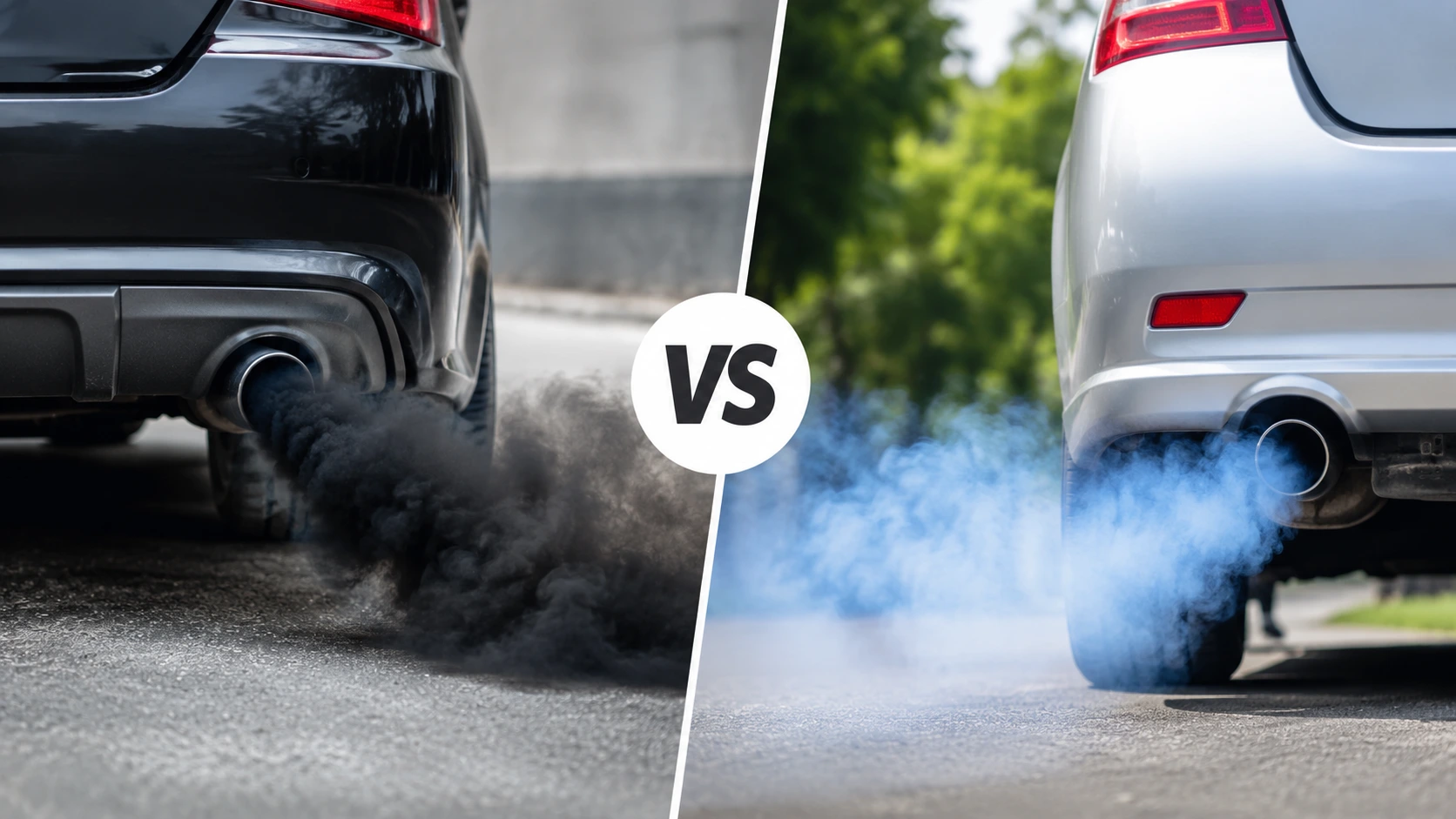
In any Black smoke vs blue smoke comparison, black smoke means the engine is burning too much fuel — a rich fuel mixture from a faulty injector, clogged air filter, failing MAF sensor, or oxygen sensor fault. Blue smoke means the engine is burning oil — from worn piston rings, worn valve stem seals, or in turbocharged engines, failing turbo oil seals. Black smoke is a performance and emissions issue that worsens over time. Blue smoke is an internal engine wear or seal issue that risks bearing damage if oil consumption goes unmanaged. Both require diagnosis and repair, but blue smoke is generally more urgent.
A correctly running engine produces exhaust that is nearly colourless under normal conditions. Any persistent colour in the exhaust — black, blue, or white — indicates that something other than, or in addition to, the intended air-fuel mixture is being burned in the combustion chamber. Each colour corresponds to a specific substance entering combustion where it shouldn’t be.
Black exhaust means excess fuel. Blue exhaust means engine oil. White exhaust means coolant. This guide covers the first two in detail because they are frequently confused with each other and because their causes, consequences, and repairs are entirely different.
Black Smoke from Exhaust — Causes and Diagnosis
Black smoke from the exhaust indicates a rich fuel mixture — the engine is receiving more fuel than it can efficiently burn. The unburned fuel exits as black, sooty smoke. This affects fuel economy, produces increased emissions, and leaves carbon deposits inside the combustion chamber that cause further problems over time.
Clogged Air Filter
The combustion process requires a specific ratio of air to fuel. When the air filter is severely clogged, the engine can’t draw in enough air to balance the fuel being injected, producing a consistently rich mixture and black smoke. In Dubai’s dusty environment — particularly for vehicles parked or driven near Al Quoz — air filters clog faster than any European replacement interval assumes.
Why This Is the Simplest Cause to Check First
A clogged air filter is the lowest-cost cause of black exhaust smoke and the first thing to rule out before any deeper diagnosis. Visual inspection of the filter takes two minutes. A filter that’s dark grey or black with accumulated dust is overdue for replacement regardless of mileage.
What Happens If It’s Left Too Long
An engine running on a restricted air supply causes the fuel management system to compensate, which eventually fouls spark plugs and oxygen sensors — turning a filter replacement into a broader service job.
Faulty Fuel Injectors
A fuel injector that’s stuck partially open, or that produces a poor spray pattern from carbon buildup on the tip, delivers more fuel than the engine management system commanded. One misfiring injector affects that cylinder’s combustion efficiency; multiple affected injectors produce noticeable black smoke, a rough idle, and reduced power.
How Injector Faults Show Up on a Diagnostic Scan
A scan reads per-cylinder fuel trim corrections — the adjustments the engine management system is making to compensate for fuelling errors. An injector fault shows up as a specific cylinder’s fuel trim running significantly outside normal range, which distinguishes it from a sensor fault that affects all cylinders equally.
Failing MAF Sensor
The Mass Airflow sensor measures the volume of air entering the intake and communicates it to the engine management system, which uses that data to calculate how much fuel to inject. A MAF sensor reading low — reporting less air than is actually entering — causes the system to under-inject, resulting in a lean mixture. One reading high causes over-fuelling and black smoke.
Why MAF Sensor Faults Are Commonly Misdiagnosed
A failing MAF sensor produces fault codes that reference fuel mixture or oxygen sensor readings rather than the sensor itself, which leads some workshops to replace an oxygen sensor when the MAF is the actual cause. Live data review — watching the MAF’s airflow reading during a road test and comparing it against expected values for the engine speed and throttle position — is what confirms the actual fault.
Oxygen Sensor Fault
Oxygen sensors monitor the exhaust gas composition and feed that information back to the engine management system in a continuous loop that fine-tunes fuelling. A failing oxygen sensor that stops responding correctly causes the system to lose its ability to maintain the correct mixture — with a stuck-rich reading producing over-fuelling and black smoke.
Blue Smoke from Exhaust — Causes and Diagnosis
Blue or blue-grey smoke from the exhaust means engine oil is entering the combustion chamber and being burned alongside the fuel. This is a fundamentally different problem from black smoke — it’s an internal engine wear or seal failure, not a fuelling issue.
Worn Piston Rings
The piston rings seal the combustion chamber from the crankcase below. Worn or damaged rings allow oil from the crankcase to bypass the rings and enter the combustion chamber, where it burns as blue smoke. This is one of the most common causes of Black smoke vs blue smoke confusion — because the smoke appears at the exhaust tip, drivers sometimes don’t realise the cause is internal engine wear rather than a fuelling problem.
How Piston Ring Wear Presents in Dubai Conditions
High mileage combined with extended oil change intervals — particularly common on vehicles doing Dubai’s short-trip commuting, where oil degrades faster than the service reminder suggests — accelerates ring wear. Blue smoke visible on startup that reduces as the engine warms up is a classic piston ring symptom.
Why Compression Testing Confirms This Fault
A cylinder compression test measures how well each cylinder’s rings are sealing. Cylinders with worn rings show significantly lower compression than the specification — and lower than adjacent healthy cylinders. A leak-down test further confirms whether the loss is through the rings specifically.
Worn Valve Stem Seals
The valve stem seals prevent oil from the cylinder head from entering the combustion chamber along the valve stems. When these seals harden and crack — accelerated by Dubai’s heat — they allow oil to be drawn down into the combustion chamber, particularly during the intake stroke.
How This Differs From Piston Ring Failure
Valve stem seal failure produces blue smoke most noticeably on cold starts, when the seals haven’t yet expanded with heat, and after a period of engine braking — decelerating from speed with the throttle closed creates high intake vacuum that draws oil past degraded seals. Piston ring failure, by contrast, produces blue smoke more consistently under acceleration and load. This distinction helps direct the diagnosis before any disassembly.
Turbocharger Oil Seal Failure
Turbocharged engines have additional oil seals within the turbocharger itself that prevent oil from the bearing housing from entering the intake or exhaust. When these seals fail, oil enters the combustion process directly from the turbo — producing blue smoke specifically under boost, often accompanied by an oil consumption increase and possibly a slight boost pressure reduction.
Why This Is Specific to Turbocharged Engines
Most current vehicles sold in Dubai are turbocharged — the EA888 TSI in Volkswagen and Audi vehicles, the B48 and B58 in BMW, the Ingenium in Jaguar and Land Rover. Turbocharger oil seal failure is a relevant possibility on any of these platforms, and distinguishing it from piston ring or valve seal failure requires specific diagnosis rather than assumption.
Our car mechanic team uses compression testing, leak-down testing, and VCDS or equivalent live data to confirm the specific source before recommending any engine work.
How to Tell Black Smoke from Blue Smoke in Practice
In a Black smoke vs blue smoke situation, the two colours can sometimes look similar in certain lighting conditions or at certain engine temperatures. A few practical observations help distinguish them reliably.
Smell Is a Reliable Differentiator
Black smoke from rich combustion has a fuel smell — petrol or diesel depending on the engine. Blue smoke from burning oil has a distinctly different, more acrid smell — the smell of burning engine oil is recognisable once you know what you’re looking for.
When the Smoke Appears
Black smoke from a fuelling fault is typically consistent across different operating conditions. Blue smoke from piston rings tends to be worse under load and acceleration. Blue smoke from valve stem seals is most visible on a cold start and after coasting to a stop.
Oil Level Change Confirms Blue Smoke
If the engine oil level is dropping between services and no external oil leak is present, oil is being burned internally — confirming blue smoke is the right category even if the colour itself was ambiguous.
For any breakdown on the road, our roadside assistance covers Al Quoz and nearby Dubai areas.
Repair Process
The repair depends entirely on which colour and which specific cause the diagnosis confirms.
Repairs for Black Smoke
Air filter replacement is the simplest and most immediate. Injector cleaning or replacement addresses a fuel delivery fault. MAF sensor replacement resolves a sensor-caused mixture fault. Oxygen sensor replacement where confirmed by live data. All of these are manageable repairs when addressed before the fuelling fault has caused secondary damage to spark plugs or the catalytic converter.
Repairs for Blue Smoke
Valve stem seal replacement is the least invasive internal repair — the cylinder head requires partial disassembly but the engine doesn’t need to be removed. Piston ring replacement is a more involved job requiring engine disassembly. Turbocharger replacement where the oil seals have failed within the unit.
Our car service packages include air filter and oil condition checks at every scheduled visit, which catch the early stages of both fault categories before they produce visible exhaust smoke.
Risks of Ignoring Exhaust Smoke
Both types of Black smoke vs blue smoke exhaust worsen progressively if ignored rather than staying at the same level.
Black Smoke Risks
Carbon deposits from chronic rich combustion accumulate on intake valves, spark plugs, and inside the combustion chamber, reducing compression efficiency and eventually causing misfires and catalytic converter damage. What starts as a sensor or filter replacement becomes a broader engine carbon clean and potentially a catalytic converter job.
Blue Smoke Risks
Oil consumption from worn piston rings or valve seals is self-accelerating — as oil level drops, the remaining oil is worked harder and degrades faster, which accelerates the wear that’s causing the consumption. A bearing that loses oil pressure from sustained low-level oil consumption can fail catastrophically, turning an engine repair into an engine replacement.
Prevention Tips
Prevention of both Black smoke vs blue smoke fault types comes down to consistent maintenance habits.
For Black Smoke Prevention
Air filter replacement on Dubai-appropriate intervals rather than factory specifications addresses the single most common and simplest cause. Correct fuel specification for the engine — using the octane rating the manufacturer specifies — prevents combustion inefficiency that contributes to carbon buildup over time.
For Blue Smoke Prevention
Oil changes at the shorter intervals appropriate for Dubai city driving — 8,000 km rather than factory maximum intervals — keep oil in the condition needed to protect seals and rings. Monthly oil level checks catch developing consumption before it risks low oil pressure. For exterior repairs alongside any engine work, our car painting team handles colour-matched repairs in the same visit.
Dubai-Specific Advice
Both Black smoke vs blue smoke fault types are more common in Dubai’s conditions than the same vehicles experience in their original markets. Air filters clog faster in Al Quoz’s dust. Oil degrades faster in stop-start heat. Turbocharger seals face more thermal cycling between underground parking cool and peak engine heat. These facts argue for shorter service intervals and more frequent fluid checks than any European service schedule suggests. Our mobile car mechanic covers Al Quoz and nearby Dubai areas for on-site assessment before driving in.
Why Rapid Rev Garage?
We use live diagnostic data to confirm which Black smoke vs blue smoke system is at fault before recommending any repair — distinguishing a MAF sensor from an injector fault, and a valve stem seal from a piston ring failure, requires specific test data rather than a best guess from the symptom alone. Every exhaust smoke complaint goes through diagnostic scanning and physical testing before the repair scope is confirmed.
FAQ — Black smoke vs blue smoke
These are the questions drivers most frequently ask when they notice Black smoke vs blue smoke from their exhaust.
What causes black smoke from a diesel exhaust specifically?
Diesel black smoke is almost always from over-fuelling — a faulty injector, a clogged DPF (diesel particulate filter), or a boost leak that reduces combustion air. The same rich-mixture principle applies, but the diagnostic approach differs from petrol engines.
Can blue smoke go away on its own?
No — the underlying cause is mechanical wear or seal failure, and neither resolves without repair. The oil consumption and blue smoke will worsen progressively over time.
Is a car with blue smoke safe to drive?
In the short term, carefully — but oil consumption must be monitored closely and oil level maintained above minimum. A vehicle burning significant amounts of oil risks low oil pressure, which causes bearing damage rapidly.
How much does it cost to fix blue smoke from valve stem seals versus piston rings?
Valve stem seal replacement is significantly less expensive because it doesn't require full engine disassembly. Piston ring replacement requires engine teardown and is a more involved job — confirmed by compression and leak-down testing before being recommended.
Can a clogged DPF cause black smoke?
Yes — a severely blocked diesel particulate filter prevents proper exhaust flow, causing unburned fuel to exit as black smoke. DPF regeneration or replacement resolves this specific cause.
Conclusion
Black smoke vs blue smoke from your exhaust are not the same problem. Black is fuel — a rich mixture from a sensor, filter, or injector fault. Blue is oil — from internal engine wear or seal failure. The distinction determines the entire repair approach, which is why exhaust colour identification and proper diagnostic testing always happen before any repair is recommended at Rapid Rev Garage in Al Quoz.
Rapid Rev Garage is in Al Quoz, serving drivers across nearby Dubai areas. Find us through a garage near me search, book your appointment on WhatsApp, or find us on Google Maps.
Rapid Rev Garage — Black smoke vs blue smoke from Exhaust | Al Quoz, Dubai