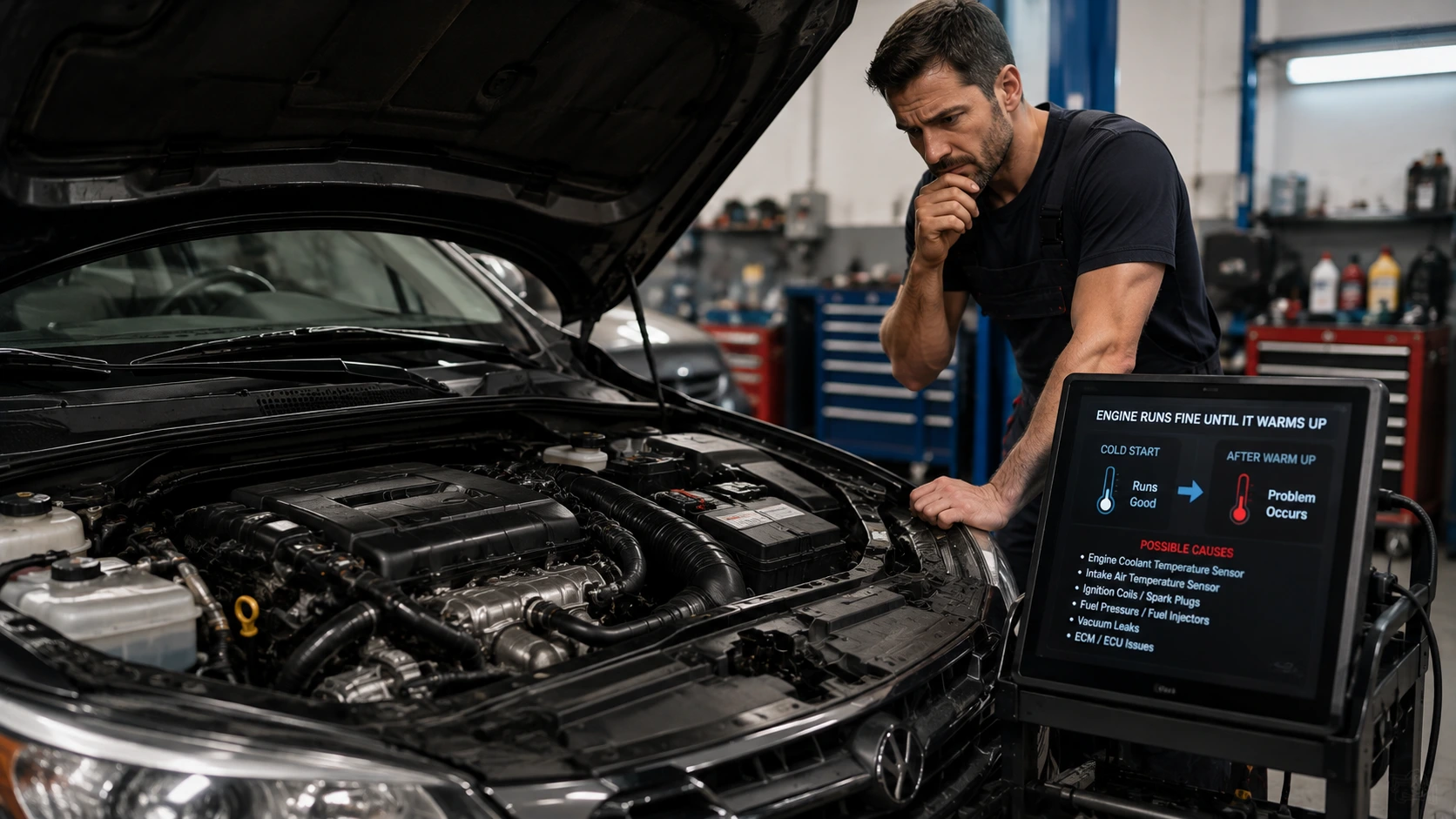
An engine runs fine until it warms up — then develops a rough idle, a misfire, a loss of power, or a warning light that wasn’t there on the cold run — is one of the more specific fault patterns a driver can describe. If any engine runs fine until it warms up case, the temperature-dependence is the key diagnostic information: something that only manifests at operating temperature is failing under heat, and the list of components that behave this way is specific and knowable.
At Rapid Rev Garage in Al Quoz, warm-up-dependent symptoms are diagnosed with a combination of live sensor data at cold and at operating temperature, and a road test that specifically replicates the conditions where the symptom appears.
Engine Runs Fine Until It Warms Up — Quick Verdict
When an engine runs fine until it warms up, the most likely causes are a thermostat stuck open or failing at the wrong temperature, a fuel injector that develops a leak or changes its flow characteristic at temperature, a sensor — oxygen sensor, coolant temperature sensor, or MAF — that reads correctly when cold but drifts or fails under heat, or on diesel engines, an EGR valve that sticks open at operating temperature and disrupts combustion. Each cause produces a specific warm symptom pattern. Live sensor data during the warm-up phase identifies exactly which sensor or component is behaving incorrectly as temperature rises.
Table of Contents
- Why Temperature Changes What a Fault Does
- What the Symptom Looks Like at Operating Temperature
- The Components That Fail Under Heat
- How Dubai’s Conditions Create Warm-Up Faults
- How We Catch the Fault at the Right Temperature
- Getting It Fixed — Repairs for Each Cause
- What Happens If This Pattern Is Ignored
- Is It Safe to Drive?
- How Long the Repair Takes
- What the Repair Costs in Dubai
- Preventing Warm-Up Faults in Dubai
- Why Rapid Rev Garage?
- FAQ
- Conclusion
Why Temperature Changes What a Fault Does
Understanding why an engine runs fine until it warms up situation develops explains why they are harder to diagnose than constant faults — and why the correct diagnostic approach is different.
Thermal Expansion and Component Tolerance
Metal components expand as they heat up. A crack in an exhaust manifold that is closed at ambient temperature opens as the manifold heats and expands — producing a tick that appears at operating temperature rather than on a cold start. A fuel injector O-ring that seals correctly when cold may swell excessively at temperature and alter the injector’s flow characteristics. These are physical dimension changes that are temperature-driven.
Sensor Drift Under Heat
Electronic sensors have defined operating characteristics that degrade at extremes of temperature. A coolant temperature sensor that reports correctly when cold but drifts high or low at operating temperature causes the engine management system to act on incorrect data — enriching or leaning the fuel mixture incorrectly based on a temperature it believes is different from what it actually is.
Dubai Makes Temperature Effects More Pronounced
In Dubai’s heat, the operating temperature that triggers these faults is reached faster, is sustained for longer, and is at a higher absolute value than in a temperate climate. A sensor that drifts slightly at 90°C in a European vehicle may drift significantly at 105°C in the same vehicle in Dubai’s stop-start traffic. This makes warm-up faults more common and more pronounced here.
What the Symptom Looks Like at Operating Temperature
The specific symptom in an engine runs fine until it warms up case helps identify which component is failing.
Rough Idle or Misfire at Temperature Only
An engine that idles smoothly from cold but develops a rough idle or misfire after 10–15 minutes of driving has a fuelling, ignition, or compression fault that manifests specifically under heat. A misfire on a warm engine that wasn’t present when cold typically points to a sensor providing incorrect data at temperature, a fuel injector that changes its flow at temperature, or a compression fault that is masked by cold-start fuel enrichment.
Loss of Power After Warm-Up
A car that accelerates normally from cold but feels noticeably less responsive after reaching operating temperature often has a thermostat or EGR fault. A thermostat stuck partially open prevents the engine from reaching its designed operating temperature — causing the engine management system to run in a cold-engine fuel strategy that is appropriate for warming up but reduces efficiency at operating temperature. An EGR valve stuck open at temperature reintroduces exhaust gas into the intake at the wrong moment, reducing effective combustion.
Check Engine Light After Warm-Up
A check engine light that appears after the engine has been running for a period but was absent on the cold start is a sensor that is reading out of range at operating temperature. The engine management system accepts the reading during cold conditions — where sensors have wider tolerance — but flags it as a fault once the engine should be operating in steady-state temperature range.
Overheating or Temperature Gauge Rising Only at Temperature
A temperature gauge that runs correctly during the warm-up phase but climbs higher than normal once fully warmed — particularly in stop-start traffic — indicates a cooling system fault that is only exposed under sustained heat load. This is typically a thermostat stuck partially closed, a marginally effective cooling fan, or a borderline-blocked radiator.
Our car mechanic team specifically notes symptom timing relative to the temperature gauge during every warm-up fault diagnosis — because the exact temperature at which the symptom appears identifies the failing component more precisely than the symptom alone.
The Components That Fail Under Heat
This section covers the key details for this topic.
Thermostat Fault — Stuck Open or Partially Closed
The thermostat controls when coolant flows to the radiator. A thermostat stuck open allows coolant to flow to the radiator continuously — preventing the engine from reaching its designed operating temperature. The engine management system detects that the coolant temperature is lower than expected after sufficient running time and activates a check engine light — code P0128 on most platforms.
How a Cold-Running Engine Feels to Drive
A thermostat stuck open produces an engine that never quite reaches its normal operating temperature — the temperature gauge sits lower than usual, fuel consumption is slightly higher from rich fuel strategy, and cabin heater output is reduced. The engine feels normal but slightly lazy.
Thermostat Partially Closed — Overheating Risk
A thermostat stuck partially closed produces the opposite — the engine reaches operating temperature correctly but then continues to climb as the restricted coolant flow can’t reject heat fast enough in sustained conditions. This produces the temperature gauge climbing pattern described above.
Oxygen Sensor Degradation at Temperature
Oxygen sensors begin functioning at approximately 300°C and provide fuel mixture feedback to the engine management system. A sensor that is degrading may function adequately when it first reaches operating temperature but drift in its readings as it continues to heat — producing increasingly incorrect fuel mixture corrections as the drive continues. The engine runs well initially but progressively roughens as the sensor drift accumulates.
Coolant Temperature Sensor Drift
The coolant temperature sensor informs the engine management system of the actual coolant temperature — which determines fuel injection quantity, idle speed strategy, ignition timing, and EGR operation. A sensor that reads 10°C lower than actual at operating temperature causes the system to continue cold-engine fuelling strategy — too much fuel, too retarded timing — producing rich running symptoms that appear once the engine is truly hot.
EGR Valve Sticking Open at Temperature
The EGR valve reintroduces exhaust gas into the intake to reduce combustion temperatures and emissions. When it sticks open — typically from carbon buildup on the valve seat — exhaust gas enters the intake continuously at operating temperature, diluting the intake charge and producing rough running, loss of power, and increased smoke.
Fuel Injector O-Ring Thermal Swelling
Some fuel injectors develop a fault where their O-rings, which seal the injector in its port, swell at operating temperature — partially restricting fuel flow or changing the spray pattern at temperature. A lean misfire that appears after warm-up and disappears when cold can trace to this specific fault, confirmed by comparing injector pulse width and fuel trim data between cold and warm conditions.
How Dubai’s Conditions Create Warm-Up Faults
Dubai’s operating environment makes engine runs fine until it warms up faults more common than in any temperate market.
Higher Sustained Operating Temperatures
Dubai’s stop-start summer traffic sustains engine coolant and oil temperatures significantly higher than the same vehicle experiences in European driving cycles. Components that drift or fail at elevated temperatures are exposed to those temperatures more often and for longer periods here than anywhere else.
Carbon Buildup Accelerated by Stop-Start Driving
EGR valves and oxygen sensors accumulate carbon deposits from combustion residue. Dubai’s stop-start driving pattern — which never allows sustained high combustion temperatures that burn off deposits — accelerates carbon accumulation on these components compared to highway-dominated driving.
Thermal Cycling Stresses Sensors
The daily cycle from underground parking cool to peak operating temperature in Dubai is a wider temperature swing than many sensors experience in moderate climates. Repeated wide-range thermal cycling accelerates the degradation of sensor materials and their calibrated response curves. For any breakdown caused by a warm-up fault that’s progressed to a stop situation, our roadside assistance covers Al Quoz and nearby Dubai areas.
How We Catch the Fault at the Right Temperature
Engine runs fine until it warms up faults require a different diagnostic approach from constant faults.
Cold-Start Baseline First
The diagnostic scan is run immediately on a cold engine — recording all sensor readings at ambient temperature. This cold baseline is what warm readings are compared against.
Live Data Monitoring Through the Warm-Up
The vehicle is run with live diagnostic data streaming — watching coolant temperature, oxygen sensor output, fuel trims, EGR position, and misfire counters throughout the warm-up phase. The specific temperature at which any parameter moves outside its expected range identifies the fault component as temperature rises.
Road Test at Operating Temperature
Where the symptom appears under driving conditions rather than at idle, the road test is conducted after full warm-up — replicating the exact conditions the driver describes. Data logged during the road test captures the fault in real conditions rather than an approximation.
Getting It Fixed — Repairs for Each Cause
Each confirmed fault has a specific repair.
Thermostat Replacement
A thermostat confirmed stuck open or closed is replaced with the correctly-specified unit for the engine. The coolant system is refilled and pressure-tested after replacement. Coolant temperature is monitored during a warm-up cycle to confirm the new thermostat opens at the correct temperature. Our car service packages include thermostat condition assessment at every major service.
Oxygen Sensor Replacement
A degrading oxygen sensor is replaced with the correct sensor for the specific sensor position — upstream and downstream sensors have different specifications and different fault effects. Post-replacement, fuel trim adaptation is monitored during a warm drive to confirm the system corrects to the expected range.
EGR Valve Cleaning or Replacement
Carbon-fouled EGR valves are cleaned using correct EGR cleaning procedures — removing carbon deposits from the valve seat and housing to restore correct operation. Where the valve itself is damaged beyond cleaning, replacement with a new unit is the correct repair.
Injector O-Ring Replacement
Confirmed injector O-ring thermal swelling is addressed by replacing the O-rings with heat-resistant specification units for the engine. This is typically completed without injector replacement unless the injector body itself shows damage.
What Happens If This Pattern Is Ignored
A warm-up fault that is monitored rather than repaired follows a predictable progression.
Sensor Drift Becomes Sensor Failure
An oxygen sensor that is drifting at temperature typically progresses to complete failure within months. At that point, the engine management system loses closed-loop fuel control entirely — producing significantly degraded fuel economy and emissions alongside the original symptom.
EGR Carbon Buildup Progresses
An EGR valve that is sticking open from carbon buildup accumulates more carbon with every drive. What was initially intermittent sticking becomes persistent open-valve operation — producing increasingly rough idle and power loss until the valve seizes completely.
Thermostat Fault Affects Engine Long-Term
An engine running consistently below its designed operating temperature from a stuck-open thermostat runs in cold-fuel strategy for longer periods per drive — producing accelerated fuel dilution of engine oil. Oil diluted with fuel loses its lubrication properties faster, accelerating internal engine wear.
Is It Safe to Drive?
Temperature-dependent faults vary significantly in urgency.
Check Engine Light After Warm-Up — Drive Carefully
A check engine light that appears after warm-up from an oxygen sensor or temperature sensor fault is typically safe for continued driving to a workshop within a few days. Monitor for the light changing from steady to flashing — a flashing check engine light is a different urgency category.
Temperature Gauge Rising After Warm-Up — Stop Promptly
A temperature gauge that continues rising after operating temperature is reached is a cooling system fault that could lead to overheating. Do not continue driving if the gauge enters the red zone.
How Long the Repair Takes
This section covers the key details for this topic.
Sensor Replacements
Oxygen sensor and coolant temperature sensor replacement: one to two hours including post-repair warm-up confirmation.
Thermostat Replacement
One to three hours depending on the engine and thermostat housing access.
EGR Cleaning or Replacement
EGR cleaning: one to two hours. EGR replacement: two to four hours depending on location and access on the specific engine.
What the Repair Costs in Dubai
This section covers the key details for this topic.
Sensor Work
Oxygen sensor replacement: AED 400–1,200 depending on sensor position and vehicle. Coolant temperature sensor: AED 250–600.
Thermostat and EGR Work
Thermostat replacement: AED 350–900 depending on vehicle. EGR cleaning: AED 400–800. EGR replacement: AED 800–2,500 depending on vehicle and component accessibility. For any exterior repairs needed alongside engine work, our car painting team handles colour-matched work in the same visit.
Preventing Warm-Up Faults in Dubai
Specific habits reduce the development of warm-up-dependent faults.
Regular EGR and Intake Cleaning
Periodic EGR cleaning during scheduled services prevents the carbon accumulation that causes the most common warm-up power loss fault. On direct-injection engines doing stop-start Dubai commuting, this is more frequent than factory schedules suggest.
Correct Coolant Maintenance
Coolant that is in good condition Our garage near me covers Al Quoz and nearby Dubai areas for assistance. — tested with a refractometer for concentration, replaced every two years — prevents the thermostat housing corrosion and coolant system degradation that produces thermal management faults. Our mobile car mechanic covers Al Quoz and nearby Dubai areas for on-site warm-up symptom assessment.
Why Rapid Rev Garage?
Engine runs fine until it warms up at Rapid Rev Garage follows a systematic diagnostic protocol. Warm-up faults are misdiagnosed when the vehicle is assessed at ambient temperature only — because the fault literally isn’t present until the engine is hot. Our diagnostic protocol specifically includes live data monitoring through the warm-up phase and a road test at operating temperature for every temperature-dependent symptom. This produces an accurate diagnosis rather than a cold-engine assumption.
FAQ — Engine Runs Fine Until It Warms Up
These are the most frequently asked questions about warm-up-dependent faults.
Why does my car only have a check engine light after it has been running for a while?
A sensor is drifting outside its accepted range at operating temperature — the engine management system accepts the reading when cold but flags it as a fault once the engine should be in steady-state conditions.
Can a thermostat cause a car to run roughly when hot?
Yes — both stuck open and stuck partially closed thermostats affect engine management behaviour at operating temperature. Stuck open keeps the engine in cold-run strategy; stuck partially closed causes overheating that degrades combustion.
Why does my car feel less powerful when the engine is fully warm?
Loss of power at operating temperature specifically points toward EGR valve sticking open, a thermostat fault preventing correct operating temperature, or a sensor providing incorrect data that causes retarded timing or lean running.
Is it normal for a car to run differently when warm versus cold?
Some difference is normal — engines use enriched fuelling when cold. A dramatic difference in idle quality, power, or noise between cold and warm is not normal and warrants investigation.
How do I know if my coolant temperature sensor is reading wrong?
A diagnostic scan showing coolant temperature significantly different from the actual engine feel — or a temperature gauge that reads differently from the scan data — confirms sensor inaccuracy. Live data comparison during warm-up identifies the drift precisely.
Conclusion
An engine runs fine until it warms up and then develops symptoms is a specific, diagnosable fault pattern — not a vague engine problem. The temperature at which the symptom appears identifies the failing component, and live data monitoring through the warm-up phase confirms exactly what is happening as temperature rises. Rapid Rev Garage in Al Quoz diagnoses warm-up-dependent faults with the correct protocol — cold baseline, warm-up monitoring, and operating-temperature road test — before any repair is recommended.
Rapid Rev Garage is in Al Quoz, serving drivers across nearby Dubai areas — Business Bay, Jumeirah, Downtown, Barsha, Satwa, and the Sheikh Zayed Road corridor. Book your appointment on WhatsApp or find us on Google Maps.
Rapid Rev Garage — Engine Runs Fine Until It Warms Up | Al Quoz, Dubai