Knowing what to check before buying a used car in Dubai is the most financially important step any buyer takes. The used car market here is enormous — and so is the variation in vehicle condition. A car that looks clean, drives reasonably, and has a believable story can still have a bent chassis, a cleared fault code history, or a transmission that is weeks from failure.
Everything you check before buying a used car determines whether you drive away with a sound vehicle or inherit someone else’s problem. Most of the things that matter are not visible in a showroom walkthrough. They require a physical inspection, a diagnostic scan, and a road test.
At Rapid Rev Garage in Al Quoz, we conduct pre-purchase inspections for Dubai buyers every week. This guide covers everything we check — and why each item matters.
Check Before Buying a Used Car — Quick Answer
What you should check before buying a used car in Dubai covers five categories. First, the body and paint — panel gaps, paint thickness variations, and visible repair history that indicate an undisclosed accident. Second, the mechanical systems — engine oil condition, coolant level and colour, transmission fluid, brake condition, and tyre age. Third, the electronics — a full diagnostic scan across all modules to read stored and historical fault codes. Fourth, the underside — frame condition, rust, fluid leaks, and suspension component wear. Fifth, a road test — how the car drives under acceleration, braking, and cornering. Each of these reveals specific faults that a visual walkthrough misses completely.
Table of Contents
- Why a Private Sale Carries More Risk in Dubai
- What to Check on the Body and Paint
- Reading Panel Gaps for Hidden Accident History
- Using a Paint Thickness Gauge on Every Panel
- What Fluid Conditions Tell You About Maintenance
- The Engine Oil Check That Reveals Internal Wear
- Tyre Age — The DOT Date That Most Buyers Miss
- The Diagnostic Scan — Reading What the Car Already Knows
- Under the Car — Frame, Leaks, and Suspension Wear
- The Road Test — What to Feel and Listen For
- Documents to Verify Before Any Money Changes Hands
- What a Pre-Purchase Inspection Costs in Dubai
- Why Rapid Rev Garage?
- FAQ
- Conclusion
Why a Private Sale Carries More Risk in Dubai
Dubai’s used car market operates across dealerships, classified platforms, and private sales. Private sales carry the highest risk.
A private seller has no obligation to disclose faults. Fault codes can be cleared from the ECU before a buyer’s test drive — they reappear within one to three drive cycles but look clean during the viewing. Accident history can be repainted to look factory. Service history documents can be fabricated.
None of these deceptions survive a thorough inspection. A paint thickness gauge finds the repainted panels. A scan run immediately after a test drive finds the codes that were cleared two days ago. A chassis measurement identifies a subframe that was straightened after an accident.
This is why knowing what to check before buying a used car in Dubai is worth more than any amount of test drive impressions. Impressions can be managed. Measurements cannot.
What to Check on the Body and Paint
The body inspection starts before the mechanical inspection. Walk around the entire car in good lighting — outdoor daylight is better than showroom fluorescent.
Panel fit and gap consistency. Stand at each corner and look along the body lines. Every panel gap — door to wing, bonnet to wing, bumper to body — should be even and consistent. An uneven gap at one corner that is wider at the top and narrower at the bottom indicates a panel that has been moved by an impact and not perfectly restored.
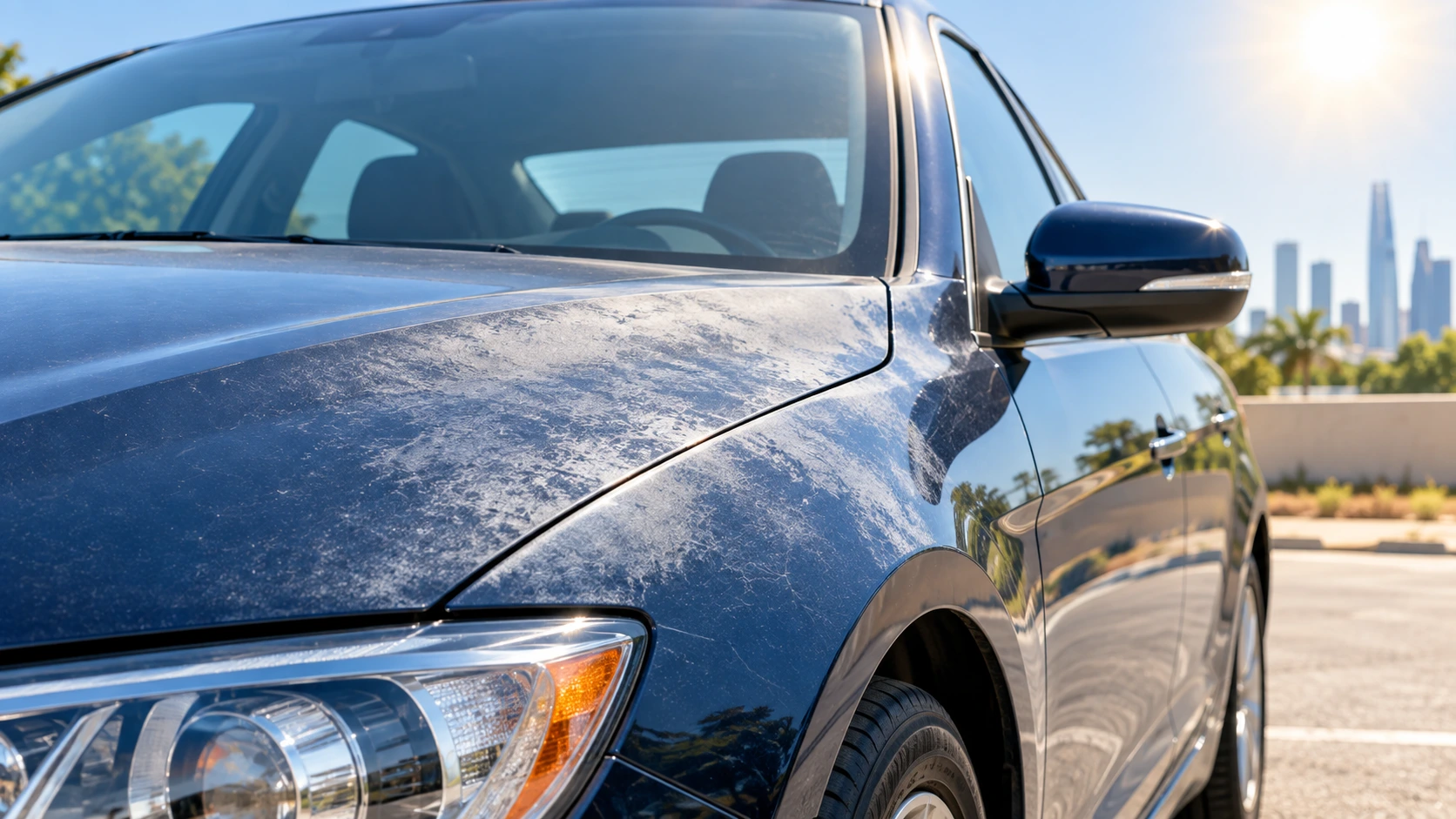
Surface condition. Look for orange peel texture — the dimpled appearance of paint that has been applied outside factory conditions. Factory paint is smoother. A repainted panel often has heavier orange peel and a slightly different sheen angle compared to the adjacent factory panels. Our car mechanic team assesses every panel for surface quality as part of every pre-purchase check.
Reading Panel Gaps for Hidden Accident History
Panel gaps are one of the most reliable indicators of accident history that has not been disclosed.
Factory panel gaps are set by jigs during assembly. Every gap around every door, bonnet, boot, and bumper is within a specific tolerance range. After a significant accident, panels are replaced or straightened — and the gaps are set by a bodyshop technician who is working by eye, not by factory jig.
A gap that varies across its length — wider at one end, narrower at the other — confirms the panel was either replaced or moved. A gap that is correct in size but misaligned in height — the panel surfaces are at slightly different levels — confirms a panel that was straightened after deformation.
Neither of these disqualifies the vehicle automatically. A properly repaired car with disclosed accident history is a legitimate purchase. The issue is when the accident history is not disclosed and the gap tells a different story from the seller’s account.
Using a Paint Thickness Gauge on Every Panel
A paint thickness gauge is the most important tool in a pre-purchase inspection. It measures the total thickness of paint on each panel in micrometres.
Factory paint — steel panels — typically reads 90–140 micrometres. A panel that has been repainted with bodyshop filler underneath reads 200–400+ micrometres. The difference is immediate and unambiguous.
Measure every panel: both front wings, both rear wings, all four doors, the bonnet, the boot, both bumpers. A car with consistent readings across all panels has not been significantly repainted. A car with two or three panels reading significantly higher than the others has had those panels repaired.
This test also finds filler — thick filler reads even higher than repaint alone. A panel with filler under the paint has been repaired after significant deformation.
What Fluid Conditions Tell You About Maintenance
Fluid condition is a direct record of how the car was maintained. Fluids that were changed regularly look correct. Fluids that were neglected show it immediately.
Engine oil. The dipstick tells two things. The level tells you whether the owner checks the car regularly. The colour tells you how long the oil has been in service. Fresh oil is amber. Old oil is black. Black oil on a car that supposedly has a recent service history is a contradiction worth probing.
Coolant. Fresh coolant is bright — green, blue, or orange depending on the brand. Brown or rust-coloured coolant indicates the inhibitor package is depleted and the cooling system has been running with degraded fluid. This often means the aluminium components in the cooling circuit — the radiator, the heater core — have been exposed to acidic coolant.
Brake fluid. A brake fluid moisture tester confirms whether the fluid has absorbed water. High moisture content means the fluid has not been changed in years and the caliper seals have been exposed to corrosive fluid.
Power steering fluid. Dark, burnt-smelling power steering fluid indicates heat damage to the seals inside the steering rack. A rack with damaged seals leaks progressively — a significant repair cost.
The Engine Oil Check That Reveals Internal Wear
Pull the dipstick and assess the oil. Then remove the oil filler cap and look inside.
Clean oil on a running engine that has been regularly serviced shows clear yellow-brown oil on the cap underside and in the visible fill area. Any grey or white milky residue inside the cap confirms coolant contamination — a head gasket fault. Any sludge — a thick black paste rather than liquid oil — confirms extended oil change intervals and likely sludge in the oil galleries, which clogs the very passages that lubricate the engine.
Both findings are significant repair costs. Both are visible in 30 seconds with no tools. Our car service packages include a full fluid condition assessment as part of every pre-purchase inspection report.
Tyre Age — The DOT Date That Most Buyers Miss
Every tyre has a DOT code on its sidewall. The last four digits are the manufacture date — two digits for the week and two for the year. A tyre reading 2420 was manufactured in week 24 of 2020.
In Dubai, tyre rubber hardens and degrades from UV and heat independently of tread wear. A tyre that is six years old has a hardened compound that reduces grip even if 5mm of tread remains. A tyre over five years old should be considered for replacement regardless of appearance.
Sellers rarely mention tyre age. Many buyers don’t know to check. A car with four tyres that are six years old has an immediate AED 1,000–3,000 replacement cost that should be factored into the purchase price negotiation.
Check all four tyres for their DOT date. Also check for sidewall cracking — fine hairline cracks in the sidewall rubber are a sign of age-related degradation that makes the tyre unsafe at highway speed.
The Diagnostic Scan — Reading What the Car Already Knows
A full multi-module diagnostic scan is the single most revealing tool in a pre-purchase inspection.
The car’s ECU logs every fault that has occurred — whether a warning light appeared or not, whether the fault has since cleared or not. Stored codes, pending codes, and historical codes all remain in memory even after a seller has cleared the visible warning lights.
What the scan reveals:
Active faults. Present now and producing symptoms. These are the most obvious — but a seller who clears codes before a sale removes these temporarily.
Pending faults. Detected once or twice but not yet confirmed. These are faults that are about to become active. A pending transmission fault code is a significant finding.
Historical codes. Faults that occurred in the past and are no longer active. These reveal the car’s reliability history — repeated misfires, ABS faults, airbag warnings. A car with a history of recurring airbag codes may have had a previous accident that triggered the airbag system.
Adaptation data. The ECU records how it has compensated for component degradation over time. A fuel trim that has been correcting significantly for months indicates a MAF sensor or vacuum fault. A transmission adaptation that shows maximum compensation indicates clutch pack wear.
This data is why the diagnostic scan is the centrepiece of any check before buying a used car — it cannot be faked. It can only be cleared — and recent clearing of a previously-full fault history is itself a red flag. For any vehicle assessment needed at your location, our mobile car mechanic covers Al Quoz and nearby Dubai areas for on-site pre-purchase inspections.
Under the Car — Frame, Leaks, and Suspension Wear
The underside of the car is where the car’s history is most honestly recorded.
Frame and chassis. Look for crush damage, straightening marks, or weld repairs on the chassis rails and subframe mounting points. A subframe that has been welded or heavily straightened indicates a significant accident beyond what paint and body repair conceals. A chassis straightening jig produces specific weld patterns that are identifiable on inspection.
Fluid leaks. Any oil, transmission fluid, coolant, or brake fluid on the underside is a leak. Fresh leaks are wet and shiny. Old leaks are dry and stained. Either is a finding to document and factor into the purchase.
Suspension wear. Check control arm bushings for cracking and splitting. Check ball joints by hand for play. Check shock absorbers for oil weeping from the shaft seal. Check the exhaust mountings and heat shields for condition. An older Dubai vehicle that has never had suspension service may have cracked bushings and seized shock absorbers that the buyer inherits.
Underbody rust. Dubai vehicles rarely rust as severely as European vehicles — but UAE coastal areas and construction-adjacent parking can produce surface rust on unprotected steel. Check the chassis rails, the floor pan, and the wheel arch areas. Surface rust is cosmetic. Structural rust in the chassis is a significant safety concern.
The Road Test — What to Feel and Listen For
The road test is the most important subjective part of the check before buying a used car process. Drive in the conditions that reveal faults.
Cold start. Ask to be present when the car is started cold — first start of the day. A cold start reveals timing chain rattle (disappears within 30 seconds in a healthy engine), a blue smoke puff (valve seal wear), and the transmission’s cold engagement quality.
Highway speed. Take the car to 100–120 km/h on a clear road. An imbalanced wheel vibrates at specific speeds. A misaligned car pulls to one side. A worn transmission shudders at cruise speed.
Full braking from 60 km/h. In a safe area, apply the brakes firmly from 60 km/h. The car should stop straight. Any pull under braking indicates brake imbalance — a seized caliper or uneven pad wear.
Tight turns. Take the car through a full-lock turn at low speed — a U-turn or a car park entry. A CV joint click appears here. A power steering whine at full lock appears here. A seized top mount bearing grinds here. For any issues found during a road test that require immediate assistance, our roadside assistance team covers Al Quoz and nearby Dubai areas.
Documents to Verify Before Any Money Changes Hands
Mulkiya (registration card). Confirms the vehicle’s registered owner, VIN, and current registration status. The VIN on the mulkiya must match the VIN on the chassis plate and door jamb sticker exactly.
Service history. Physical service stamps and records. Ask for the actual invoices — not a summary. Cross-check service dates against the mileage on those dates to confirm consistency.
RTA inspection history. A UAE vehicle with a full RTA inspection history has been checked annually. Any failed inspections and what was repaired is worth asking about.
Insurance history. If the seller has comprehensive insurance, the insurance claim history can sometimes be confirmed. A major claim — not small windscreen claims — indicates a significant accident.
Finance clearance. Confirm the vehicle is not under an active finance agreement before purchase. A car purchased while still under finance to a bank becomes complicated to re-register.
What a Pre-Purchase Inspection Costs in Dubai
A complete check before buying a used car inspection at Rapid Rev Garage covers paint thickness on all panels, full multi-module diagnostic scan, fluid condition assessment, ramp inspection of the underside, suspension component assessment, tyre age check, and a road test report.
Cost: AED 300–600 depending on vehicle complexity.
This cost is recoverable from a single negotiation point the inspection reveals. A car with worn rear bushings has an immediate AED 1,000 repair cost that the seller can be asked to address before purchase — or deduct from the price. The inspection cost pays for itself on the first finding.
Our car painting team can also provide a paint condition assessment and a repair estimate for any panels that need attention — giving the buyer a complete picture of the vehicle’s cosmetic costs before committing.
Our garage near me in Al Quoz serves drivers from Business Bay, Jumeirah, Barsha, Satwa, Downtown, and the Sheikh Zayed Road corridor.
Why Rapid Rev Garage?
What to check before buying a used car correctly requires specialist equipment and experience — not just a walkthrough. It requires a paint thickness gauge, a diagnostic scan tool with multi-module access, a ramp, and experience reading what each finding means.
We provide a written inspection report with the findings from every category — body, mechanical, electronic, underside, and road test. The report gives the buyer clear information on every finding, its likely repair cost, and whether the finding is minor, significant, or a reason to walk away.
Every buyer who uses the check before buying a used car report to negotiate recovers the inspection cost. Buyers who find a reason to walk away save significantly more.
FAQ — Check Before Buying a Used Car
Here are the questions Dubai buyers ask us most about pre-purchase inspections.
Can a seller refuse to allow a pre-purchase inspection?
Yes — and that refusal is itself a significant red flag. A seller with nothing to hide has no reason to refuse a third-party inspection. Any seller who declines an independent inspection should be removed from consideration regardless of how attractive the price is.
How long does a full pre-purchase inspection take?
Two to three hours for a complete inspection — paint thickness measurement on all panels, full diagnostic scan, fluid condition check, ramp inspection, and road test. A quick visual and scan without the road test takes 60–90 minutes.
Can I check before buying a used car without specialist equipment?
Partially. You can check fluid condition, tyre age, panel gaps visually, and do a basic road test yourself. But you cannot measure paint thickness without a gauge, read multi-module fault codes without a compatible scan tool, or assess suspension play without lifting the vehicle. The critical checks require the equipment.
What is the most important single check before buying a used car?
The diagnostic scan. Every other check can be partially deceived. Panel gaps can be close enough to look right. Fluid can be topped up before a viewing. But a diagnostic scan with historical code data reads the car's electronic memory — data that cannot be prepared for a viewing without completely clearing the ECU, which itself is a detectable action.
What should I do if the inspection reveals significant faults?
Three options: ask the seller to repair the confirmed faults before purchase, deduct the repair cost from the agreed price, or walk away. The inspection report provides the specific findings and cost estimates to support any of these conversations.
Conclusion
Everything you check before buying a used car in Dubai determines whether you make a sound purchase or inherit undisclosed problems. Paint thickness, diagnostic scan data, fluid condition, chassis condition, suspension wear, and a structured road test together give a complete picture of the vehicle’s actual condition — not its presented condition.
Rapid Rev Garage in Al Quoz provides a full written pre-purchase inspection report covering every one of these categories — giving Dubai buyers the information they need before any money changes hands.
Rapid Rev Garage is in Al Quoz, serving Business Bay, Jumeirah, Downtown, Barsha, Satwa, and the Sheikh Zayed Road corridor. Book your appointment on WhatsApp or find us on Google Maps.
Rapid Rev Garage — Check Before Buying a Used Car | Al Quoz, Dubai