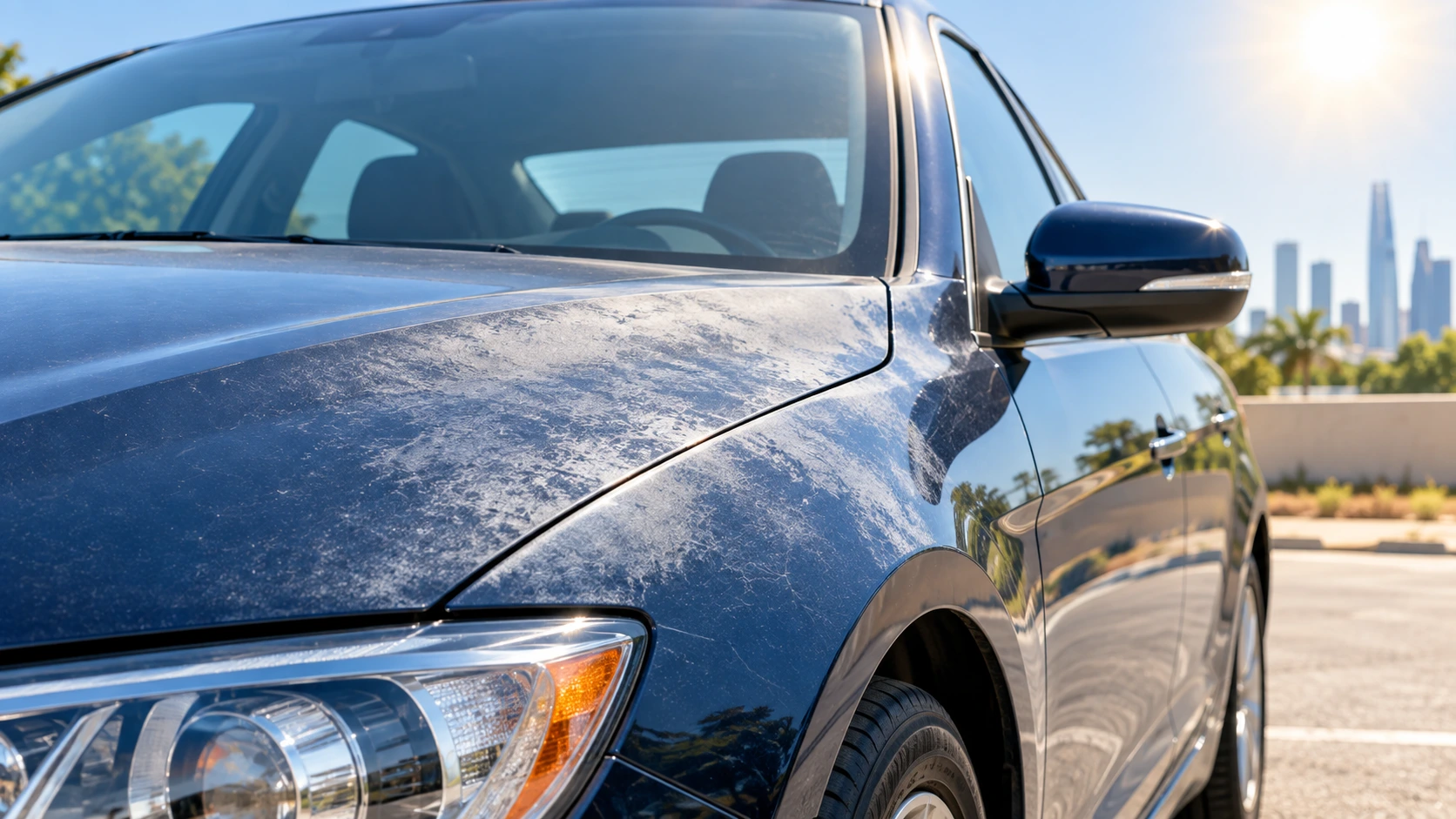
Can Sun damage affect car paint in Dubai faster than almost anywhere else on earth. The UV index here hits extreme levels for months at a time. Glass surface temperatures reach 80–90°C on a parked car in July. The paint system that protects the bodywork is under continuous attack from both UV radiation and intense heat — every single day.
Understanding how sun damage affect car paint explains why Dubai vehicles look older cosmetically faster than vehicles in cooler markets, and what specific steps protect against each type of damage.
At Rapid Rev Garage in Al Quoz, we see the full range of sun paint damage — from early clear coat dulling to advanced base coat fading — on vehicles across every make and age. This blog explains what’s happening chemically, what each stage looks like, and what can be done about it. Our car mechanic team assesses paint condition on every vehicle that comes in for a service.
Sun Damage Affect Car Paint — Quick Answer
Sun damage affects car paint through two distinct mechanisms. UV radiation breaks down the chemical bonds in the clear coat and base coat layers, causing the clear coat to oxidise and haze, and the base coat dyes and pigments to fade. Heat — particularly the thermal cycling between peak daytime temperatures and cooler overnight temperatures — causes the paint layers to expand and contract repeatedly, eventually causing micro-cracking in the clear coat and delamination between layers. In Dubai, both mechanisms operate at maximum intensity simultaneously. A vehicle parked outdoors daily in Dubai accumulates more cumulative UV and heat exposure in three years than a European vehicle accumulates in eight.
Table of Contents
- How Car Paint Is Structured — What Sun Damage Is Actually Attacking
- UV Radiation and Clear Coat Oxidation
- How Extreme Heat Causes Paint Layer Micro-Cracking
- What Faded or Chalky Paint Looks Like and Why It Happens
- Peeling Clear Coat — The Advanced Stage
- Which Paint Colours Fade Fastest in Dubai Sun
- How Roof and Bonnet Paint Degrades Before Side Panels
- The Role of Ceramic Coating in UAE Conditions
- How Wax and Sealant Protect Paint at Each Stage
- Can Sun-Damaged Paint Be Restored?
- What Paint Correction Costs in Dubai
- How to Protect Your Car Paint in Dubai Long-Term
- Why Rapid Rev Garage?
- FAQ
- Conclusion
How Car Paint Is Structured — What Sun Damage Is Actually Attacking
Modern car paint is a multilayer system. Understanding the layers helps explain exactly what UV and heat are damaging.
Primer. A corrosion-resistant layer applied directly to the bare metal. It bonds paint to the steel and prevents rust.
Base coat. The colour layer. This is where the pigments and metallic or pearl particles live. On solid colours, the base coat is relatively thick. On metallic paints, the aluminium flake orientation determines how the colour appears at different viewing angles.
Clear coat. A transparent layer of hard resin applied over the base coat. It provides the gloss and the protection. UV inhibitors are added to the clear coat during manufacture to slow UV degradation. In Dubai, these inhibitors are depleted faster than in any temperate market.
Sun damage affects car paint at the clear coat first. The base coat is protected as long as the clear coat remains intact. Once the clear coat fails, the base coat is directly exposed and fades rapidly.
UV Radiation and Clear Coat Oxidation
UV radiation is the primary mechanism by which sun damage affect car paint occurs in Dubai.
UV radiation breaks polymer chains in the clear coat resin. Each broken chain reduces the clear coat’s structural integrity slightly. Over thousands of hours of UV exposure, the surface layer of the clear coat becomes oxidised — the broken polymer chains react with oxygen and produce a whitish, chalky surface layer.
This is why severely sun-damaged car paint looks hazy or chalky rather than glossy. The oxidised surface layer scatters light instead of reflecting it cleanly.
Dubai’s UV index regularly hits 10–11 during summer — classified as extreme by the World Health Organisation. UV intensity at this level depletes the clear coat’s UV inhibitor package several times faster than in European conditions. A clear coat rated for 10 years in Germany may begin showing oxidation at 4–5 years in Dubai with outdoor parking.
The oxidation starts slowly and invisibly. The clear coat looks normal. Gradually, the gloss reduces. Then a slight haze appears. Then chalking. Each stage is deeper and harder to reverse than the previous one.
How Extreme Heat Causes Paint Layer Micro-Cracking
UV is not the only mechanism by which sun damage affect car paint. Heat cycling is the second way sun damage affect car paint — and it produces a different type of damage.
Every material expands when heated and contracts when cooled. Car paint layers — primer, base coat, and clear coat — each have slightly different thermal expansion rates. In a moderate climate, this difference is small and causes no problems over a vehicle’s lifetime.
In Dubai, where a car can reach 80°C on the panel surface during the day and cool to 25°C overnight, the expansion-contraction cycle is extreme. The different expansion rates of the paint layers produce shear stress at the interfaces between them. Over years of daily thermal cycling, this shear stress creates micro-cracks — hairline fractures that are invisible individually but produce a network of fine cracking across the panel surface.
This micro-cracking is what makes older Dubai vehicles’ paint look aged even when the colour itself hasn’t faded dramatically. The surface has a fine network of cracks that scatter light and reduce the paint’s depth of gloss. Our car painting team assesses paint layer condition using a paint thickness gauge and UV lamp inspection before recommending any correction treatment.
What Faded or Chalky Paint Looks Like and Why It Happens
Faded paint and chalky paint are two stages of the same progressive sun damage.
Faded paint is the early-to-mid stage. The colour appears lighter than it should be. Metallics lose their sparkle — the metallic flakes are still present but the clear coat haze above them reduces their reflective quality. On solid colours, the paint simply looks lighter and flatter than it did when new.
Chalky paint is the advanced stage. The surface is visibly dulled. Running a finger across it leaves a white residue — oxidised clear coat material transferring to the finger. The surface looks almost powdery in direct sunlight.
Both stages are caused by UV oxidation of the clear coat. Faded paint still has intact — if degraded — clear coat. Chalky paint has an advanced oxidation layer that needs to be removed for the underlying healthy clear coat to show.
This is why a machine polish sometimes dramatically restores heavily faded paint. The polish removes the thin oxidised surface layer and exposes the less-damaged clear coat beneath.
Peeling Clear Coat — The Advanced Stage
If faded and chalky paint is left untreated, the clear coat eventually reaches the stage of peeling or flaking.
At this point, the UV damage has penetrated beyond the surface oxidation layer. The clear coat’s bond to the base coat — which relies on the chemical integrity of the resin — has failed. The clear coat lifts away from the base coat in patches, sheets, or flakes.
Once the clear coat peels, the base coat is directly exposed. The base coat has no UV protection of its own. It fades rapidly — often within months in Dubai’s conditions. It also has no water resistance, so moisture reaches the primer and eventually the steel, beginning the rusting process.
A car with peeling clear coat cannot be corrected with polishing. The clear coat that has peeled is gone. A full respray of the affected panels is required to restore the protection and appearance.
This is the end stage of sun damage affect car paint — preventable at every earlier stage, but requiring a full paint repair at this point. For any stage of paint damage, our car service packages include a paint condition assessment at every major service.
Which Paint Colours Fade Fastest in Dubai Sun
Not all colours are equal in their UV resistance. The pigments used in different colours have different UV stability.
Red and yellow are the least UV-stable colours on most vehicles. The organic pigments used in red and yellow dyes have shorter polymer chains that are more vulnerable to UV breakdown. Red cars in Dubai can develop a pink, washed-out appearance within three to four years of outdoor parking.
Black absorbs more solar energy than any other colour. The surface temperature of a black car in Dubai summer sun can exceed 90°C. This extreme heat accelerates the thermal cycling damage described above. Black paint also shows surface oxidation more visibly than other colours — the chalky haze is most obvious against a black base.
White reflects more solar energy and stays cooler than dark colours. White paint tends to last longer than red, yellow, or black in Dubai’s conditions. It is one of the reasons white is the dominant car colour in UAE.
Silver and grey are relatively stable — the metallic flakes in silver provide some reflectivity and the pigments used in grey are generally more UV-stable than organic reds and yellows.
How Roof and Bonnet Paint Degrades Before Side Panels
In Dubai, the roof and bonnet receive direct perpendicular sunlight for the longest daily period. The sun’s angle during UAE summer midday means the roof panel receives near-direct radiation for hours.
A vehicle parked in direct sun accumulates significantly more UV hours on its roof and bonnet than on its side panels — which receive oblique sun for shorter periods and may be shaded by adjacent vehicles in a car park.
This is why sun-damaged Dubai vehicles typically show the roof and bonnet fading significantly earlier than the doors and rear. A car that looks fine from the side may have an obviously chalky or faded roof when viewed from above.
This differential fading pattern is also useful diagnostically — a vehicle whose side panels look good but whose roof is fading fast has been parked outdoors consistently. It tells the vehicle’s parking history before the owner confirms it.
The Role of Ceramic Coating in UAE Conditions
Ceramic coating is the most effective way to prevent sun damage affect car paint in Dubai’s extreme conditions. A professionally-applied ceramic coating creates a semi-permanent layer over the clear coat that provides UV blocking, thermal protection, and hydrophobic water-shedding.
The UV blocking reduces the rate at which UV radiation reaches the clear coat beneath. The hydrophobic surface sheds water rapidly — reducing the time water-borne minerals sit on the paint. The hardness of the ceramic layer protects against fine scratches and swirl marks from washing.
A quality ceramic coating applied to a vehicle in good paint condition extends the period before UV oxidation becomes visible. In Dubai’s conditions, a ceramic-coated vehicle parked outdoors retains its gloss significantly longer than an uncoated vehicle in the same conditions.
Ceramic coating should be applied before the paint shows oxidation — not after. A coating applied over chalky paint seals the damage in without correcting it.
How Wax and Sealant Protect Paint at Each Stage
Below ceramic coating in durability but accessible to every car owner, wax and paint sealant products provide UV protection.
Carnauba wax provides a warm, deep gloss and some UV protection. In Dubai’s conditions, it lasts four to eight weeks before the UV and heat deplete it. Regular wax application — monthly for outdoor-parked vehicles — provides meaningful continuous protection.
Synthetic paint sealant lasts longer than wax — two to four months in Dubai conditions. It provides a harder, more durable protective layer. It doesn’t give the same warm gloss as carnauba wax but provides better sustained protection.
Both are accessible, inexpensive, and effective when applied regularly. The key is consistency — a vehicle that is waxed twice a year has almost no protection for ten months of the year. For roadside help with any paint or vehicle issue, our roadside assistance team covers Al Quoz and nearby Dubai areas.
Can Sun-Damaged Paint Be Restored?
The answer depends on the stage of damage.
Early oxidation — hazy or slightly dull paint. Machine polishing with a cutting compound removes the oxidised surface layer and reveals the less-damaged clear coat beneath. The result can be dramatic — a visibly dull car can look nearly new after a professional machine polish. Follow with a paint sealant or ceramic coating to protect the freshly exposed clear coat.
Moderate oxidation — chalky surface with visible haze. A more aggressive cutting compound or a multi-stage polish is required. The result is good but not as dramatic as early-stage correction — some depth of clear coat has been permanently lost.
Advanced oxidation with micro-cracking. Polish improves the appearance but cannot repair the network of micro-cracks. The paint looks better but the structural damage remains. A partial or full respray is the only complete solution.
Peeling clear coat. Polishing cannot restore peeled clear coat. Affected panels require a full respray — primer, base coat, clear coat — to restore correct paint protection.
What Paint Correction Costs in Dubai?
| Service | Cost Range |
| Machine polish (single panel) | AED 200–500 |
| Full vehicle machine polish | AED 800–2,500 |
| Ceramic coating application | AED 1,500–6,000 |
| Paint sealant application | AED 300–800 |
| Panel respray (sun damage) | AED 600–2,000 per panel |
| Full vehicle respray | AED 8,000–25,000+ |
All costs confirmed after a paint condition assessment. The assessment identifies which panels need correction, which need respraying, and which are adequately protected.
Our mobile car mechanic covers Al Quoz and nearby Dubai areas for on-site paint condition assessment. Our garage near me in Al Quoz serves drivers from Business Bay, Jumeirah, Barsha, Satwa, Downtown, and the Sheikh Zayed Road corridor.
How to Protect Your Car Paint in Dubai Long-Term
Park in covered or underground parking whenever possible. Every hour out of direct Dubai sun is reduced UV and heat exposure. This single habit is more protective than any product applied to the surface.
Apply a ceramic coating to a new or recently corrected vehicle. The correct time to protect is before damage occurs. A ceramic coating on a vehicle with good paint lasts years. The same coating on damaged paint seals damage in.
Wash regularly with pH-neutral soap. Industrial dust, concrete particles, and bird droppings are acidic or abrasive. Leaving them on the paint in Dubai’s heat accelerates clear coat breakdown. Wash weekly or fortnightly.
Use a windscreen sunshade. A reflective sunshade reduces the interior temperature and indirectly reduces the temperature of the dashboard, door panels, and inner surfaces — reducing thermal cycling stress on the paint system from the inside.
Apply wax or sealant monthly for outdoor-parked vehicles. If covered parking is not available, monthly wax application is the most accessible ongoing protection habit.
Why Rapid Rev Garage?
Sun damage affect car paint progressively — from early dulling to advanced clear coat failure. Each stage has a different treatment. Polishing a car with early oxidation restores it. Polishing a car with peeling clear coat achieves nothing.
We assess the exact stage of damage before recommending any treatment. We don’t polish panels that need respraying or respray panels that need polishing. The assessment comes first. The treatment follows.
FAQ — Sun Damage Affect Car Paint
Here are the questions Dubai drivers ask us most about sun paint damage.
How quickly does sun damage affect car paint in Dubai?
An unprotected vehicle parked outdoors daily in Dubai can show the first signs of clear coat oxidation — subtle dulling of gloss — within two to three years. A vehicle with regular wax application and covered parking may go five to seven years before any visible degradation. The difference is entirely in UV exposure hours and the presence or absence of a protective layer.
Can I prevent sun damage with just regular washing?
Regular washing removes contaminants that would otherwise compound the UV damage — bird droppings, industrial particles, and water spot minerals. But washing alone provides no UV protection. You need a wax, sealant, or ceramic coating applied over the clean surface to provide UV blocking.
Is ceramic coating worth the cost in Dubai specifically?
Yes — ceramic coating is more cost-effective in Dubai than in any other climate, because the baseline damage rate is highest here. The cost of applying ceramic coating to a new vehicle is recovered in the reduced frequency of machine polishing and paint correction needed over the subsequent years.
My car paint looks fine but feels rough — what is that?
Surface contamination — industrial fallout, iron particles, and bonded mineral deposits — can be present on the paint surface without being visible to the eye. The paint looks glossy but feels rough because the contamination is embedded on the surface. A clay bar treatment removes this contamination and restores the smooth feel. This is a different issue from UV oxidation but often occurs alongside it on Dubai vehicles.
Can sun damage affect car paint under a cover?
A breathable car cover significantly reduces UV exposure and surface temperature compared to bare outdoor exposure. However, a cover that traps moisture underneath can cause condensation-related damage if the vehicle is frequently moved between hot outdoor conditions and cool indoor storage. A quality breathable cover used consistently is better than no cover — but not as effective as covered parking.
Conclusion
Sun damage affect car paint in Dubai through two relentless mechanisms — UV oxidation that degrades the clear coat from the surface inward, and thermal cycling that cracks the paint layers from within. Every vehicle parked outdoors in Dubai is experiencing both simultaneously.
The stages through which sun damage affect car paint — from dulling to chalking to peeling — are progressive and increasingly expensive to reverse. Protecting paint before damage occurs is always cheaper than restoring it after. Rapid Rev Garage in Al Quoz assesses every paint damage stage and recommends the correct treatment — polishing, coating, or respraying — based on what the paint actually needs.
Rapid Rev Garage is in Al Quoz, serving Business Bay, Jumeirah, Downtown, Barsha, Satwa, and the Sheikh Zayed Road corridor. Book your appointment on WhatsApp or find us on Google Maps.
Rapid Rev Garage — Sun Damage Affect Car Paint | Al Quoz, Dubai