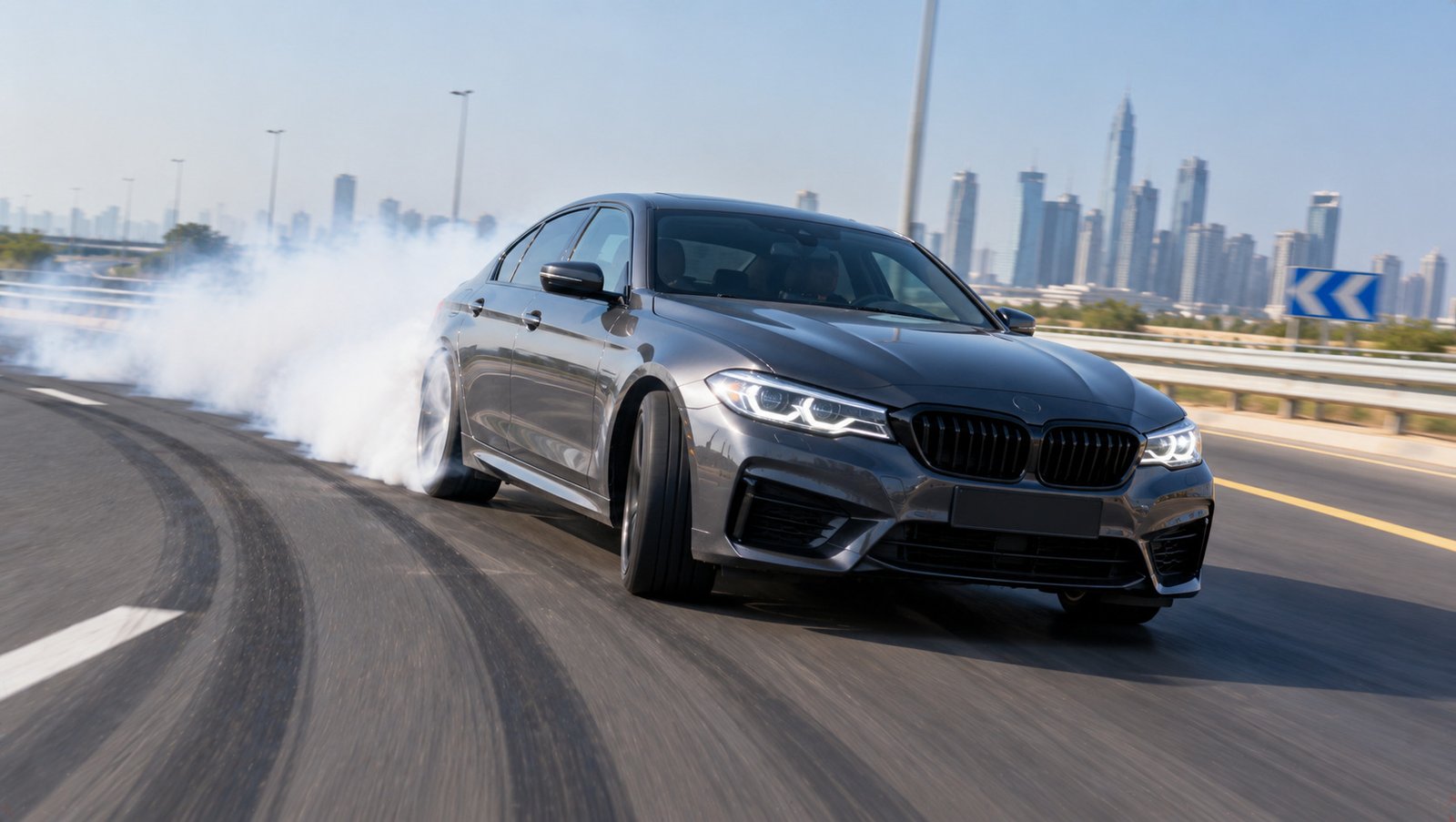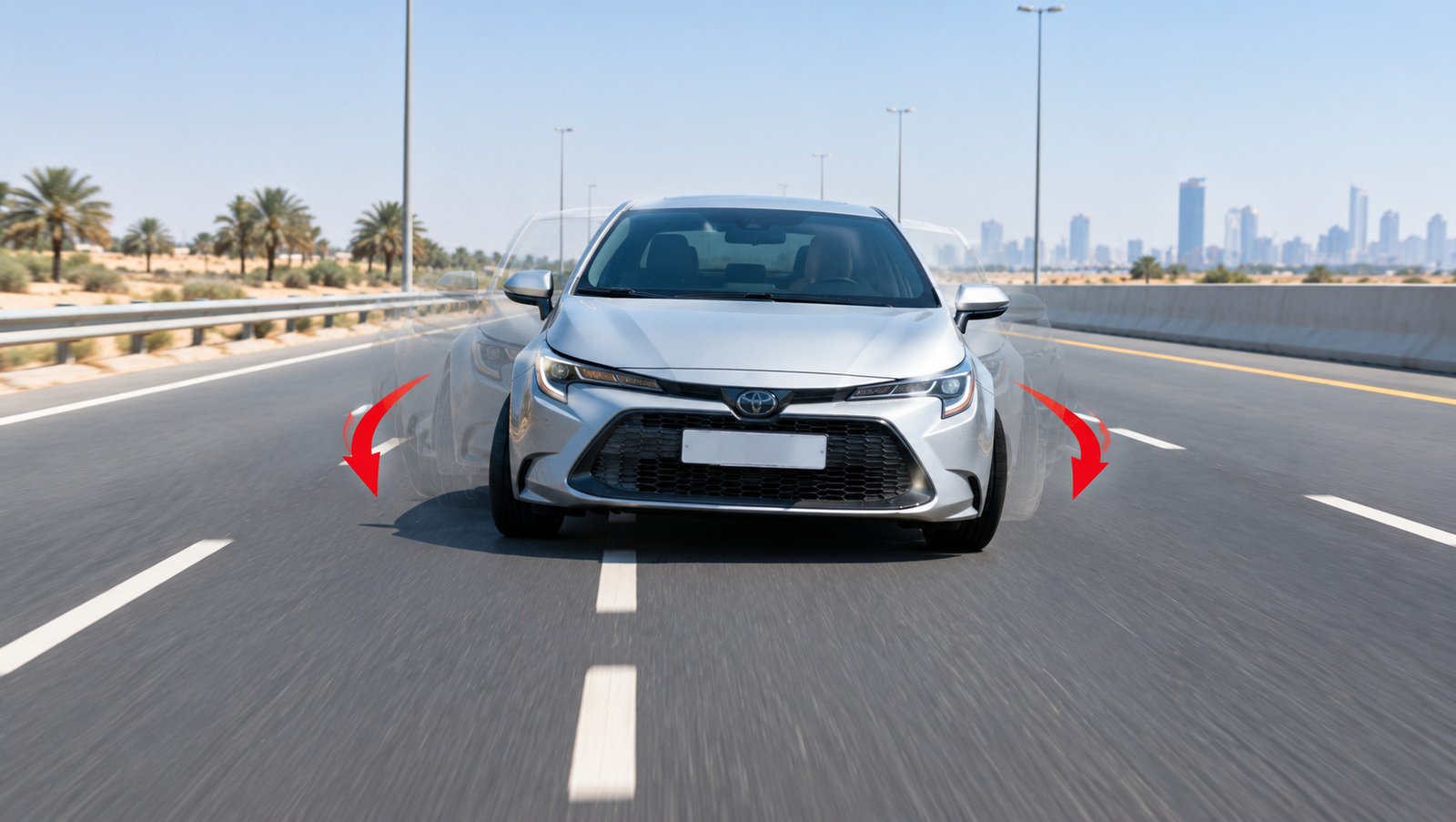
When a vehicle wanders on straight roads — drifting gradually left or right, requires constant small steering corrections, and never feels settled in a lane without the driver’s active input. This is distinct from a sharp pull to one side. Wandering is a continuous, vague instability that makes highway driving on the E611 or E311 mentally tiring over any significant distance.
In Dubai, vehicle wanders on straight roads is more common than in most markets than in most markets. The long, straight highway sections that make up the majority of intercity driving here expose wandering that would be less apparent on a winding European road where the driver is constantly steering. Dubai’s long straights expose the vehicle wanders on straight roads fault more clearly than any other road type — and a wandering car makes that impossible.
At Rapid Rev Garage in Al Quoz, every vehicle wanders on straight roads case is diagnosed systematically — from alignment to steering components to tyres.
Vehicle Wanders on Straight Roads — Quick Answer
A vehicle wanders on straight roads because it lacks the directional stability to maintain a straight course without constant steering input. The most common causes are toe misalignment that creates unequal lateral force between the front wheels, worn or loose tie rod ends with play that allows the steering angle to change without deliberate input, caster asymmetry where the self-centring force differs between the left and right steering axis, worn steering rack bushings that allow the rack to move slightly under road forces, or tyres with significantly different wear or pressure between sides that create unequal rolling resistance. In Dubai, impact-disturbed alignment from speed bumps and pothole strikes is the most frequent single cause of a vehicle that wanders on straight roads.
Table of Contents
- Wander vs Pull — Why They Feel Different and Mean Different Things
- Toe Misalignment and Its Effect on Straight-Line Tracking
- Worn Tie Rod Ends With Play in the Steering
- Caster Asymmetry and Weak Self-Centring
- Worn Steering Rack Bushings Allowing Rack Movement
- Tyre Pressure Imbalance Between Left and Right
- Tyre Wear Asymmetry Producing Unequal Rolling Resistance
- How Speed Bumps and Potholes Disturb Alignment in Dubai
- How We Diagnose a Vehicle That Wanders on Straight Roads
- The Services That Fix Confirmed Wander Causes
- What Does the Repair Cost in Dubai?
- Why Rapid Rev Garage?
- FAQ
- Conclusion
Wander vs Pull — Why They Feel Different and Mean Different Things
Understanding whether a vehicle wanders on straight roads or pulls in one direction directs the diagnosis from the start.
A pull is a consistent, constant force in one direction. Release the wheel and the car moves steadily to one side. The force is constant and directional. Causes: caster asymmetry, significant toe error on one side, dragging brake caliper.
Wander is different. The car doesn’t consistently go left or right — it drifts one way, then requires correction to go back, then drifts again. It feels like the car is not staying where you point it. Causes: steering play from worn tie rod ends, loose rack bushings, toe set close to but not at specification, or tyre pressure imbalance.
The distinction matters because the diagnosis and repair are different. A car that pulls needs alignment or brake work. A vehicle wanders on straight roads typically needs steering component assessment alongside alignment. Our car mechanic team confirms whether the symptom is wander, pull, or both before starting any measurement.
Toe Misalignment and Its Effect on Straight-Line Tracking
Toe is the angle at which the front wheels point relative to the vehicle’s centreline. Correct toe means both wheels point at a precisely specified angle — typically slightly toed in — that produces stable straight-line tracking.
When toe is incorrect — particularly when the left and right toe settings differ from each other — the wheels create unequal lateral forces as they roll. These unequal forces cause the front of the car to wander. The driver corrects. The forces act again. The correction must be repeated continuously.
A toe error of 2–3mm per side is enough to make a vehicle wanders on straight roads on any Dubai highway. An error of 5mm or more makes the vehicle feel actively unstable at highway speed.
Toe is the easiest alignment angle to correct and the most commonly disturbed by impacts. It is always the first angle checked on a vehicle wanders on straight roads complaint. A four-wheel alignment confirms toe at all four corners and corrects any out-of-specification readings. Our car service packages include a four-wheel alignment check at every major service for any vehicle with over 30,000 km.
Worn Tie Rod Ends With Play in the Steering
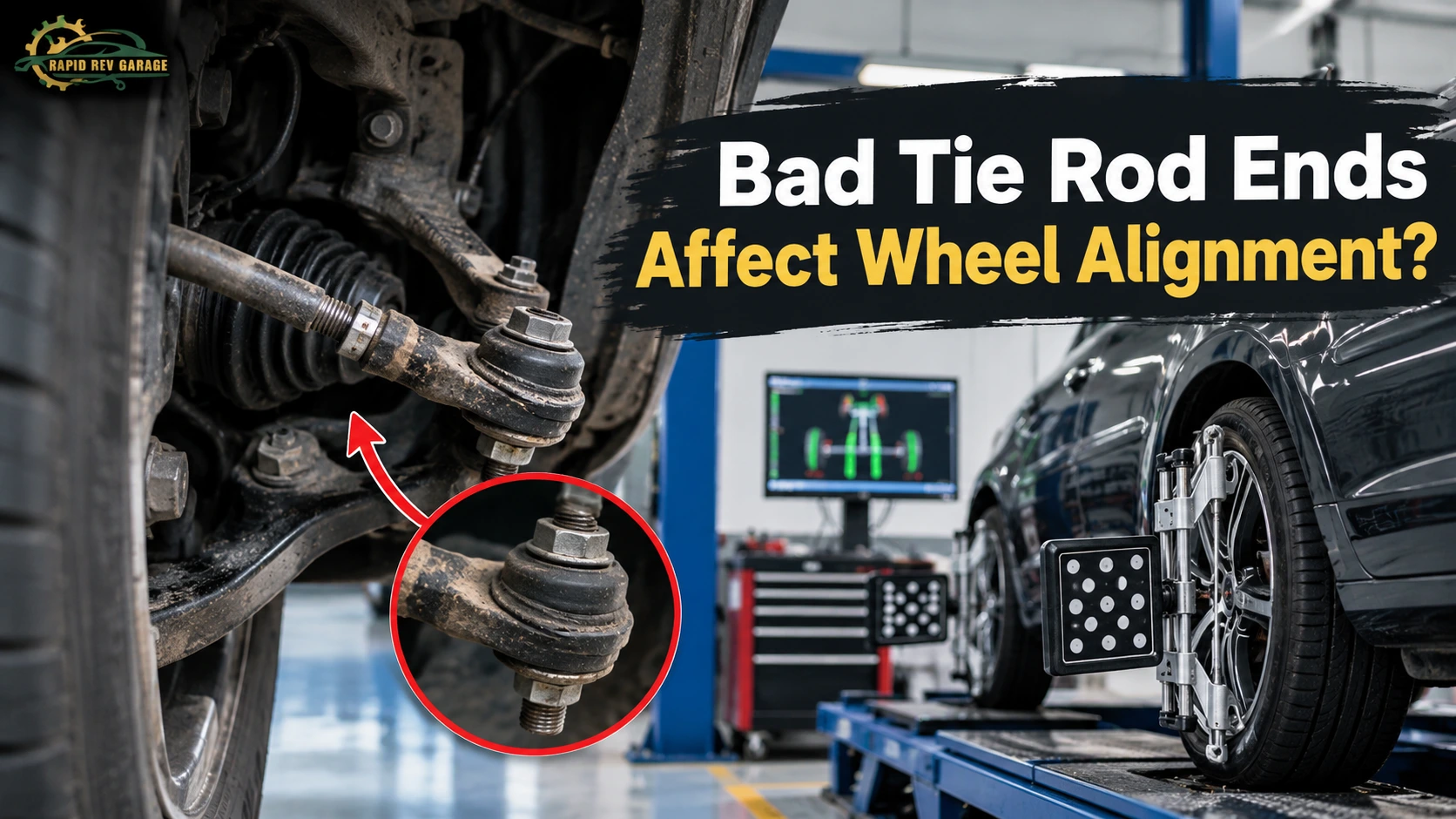
Tie rod ends connect the steering rack to the steering knuckle. They are ball-and-socket joints that allow the knuckle to steer while transmitting the rack’s lateral force.
A worn tie rod end has play in its socket — the ball moves within the socket beyond its designed clearance. When the vehicle encounters a road undulation or a crosswind at highway speed, this play allows the steering angle to change slightly without any deliberate steering input. The front wheel steers fractionally, the car begins to drift, the driver corrects, the road force acts through the play again.
The result is the characteristic highway wander — the car that never quite settles, requires constant micro-corrections, and feels vague and loose at speed.
The shake test confirms tie rod play: grasp the tyre at 3 and 9 o’clock and push and pull firmly. Any movement at the tyre without corresponding movement of the rack confirms tie rod end play. Replacement of confirmed worn tie rod ends — followed by four-wheel alignment — resolves this wander source completely.
Caster Asymmetry and Weak Self-Centring
Caster is the forward or rearward tilt of the steering axis. Correct, equal caster on both sides provides equal self-centring force — the automatic tendency of the steering to return to straight ahead.
When caster is unequal between the left and right side — from a bent strut, a shifted subframe, or a cracked strut mount from an impact — the self-centring force is stronger on one side than the other. The steering does not return to centre equally after a lane change or a corner. The driver must hold the wheel to maintain straight-ahead.
This asymmetric self-centring feels like wander — the car doesn’t hold its course the way a well-centred car does. The driver is essentially steering the car straight rather than the car holding straight on its own.
Caster asymmetry is visible on the four-wheel alignment printout. A difference of more than 0.5 degrees between left and right caster is significant. Where adjustment range allows, it is corrected. Where a bent component limits the range, replacement of that component is required before alignment can achieve correct caster.
Worn Steering Rack Bushings Allowing Rack Movement
The steering rack is mounted to the subframe through rubber bushings at each end of the rack housing. These bushings are compressed between the rack and its brackets. They allow no movement of the rack — the rack must be fixed relative to the subframe for the steering to be precise.
When the rack bushings wear, the rack can shift slightly in its brackets when road forces act on it. The driver turns left — the rack moves right relative to the subframe. The car steers slightly off the intended angle. At highway speed, this movement produces a vague, imprecise steering response that the driver experiences as wander.
Rack bushing wear is confirmed on the ramp by attempting to move the rack manually from below — any movement in the rack housing confirms bushing wear. Bushing replacement restores rack fixity and precision. For any bodywork or paint repairs alongside steering rack work, our car painting team handles exterior repairs at the same visit.
Tyre Pressure Imbalance Between Left and Right
A tyre with lower pressure than the opposite side has a different rolling radius — it is slightly smaller in diameter under load. The smaller tyre on one side causes the vehicle to drift toward that side, which the driver continuously corrects.
More relevant to wander is the difference in lateral stiffness between a correctly inflated and an underinflated tyre. An underinflated tyre deforms more under side loads — its contact patch shape is less stable. Under the constant small side forces of highway driving, the underinflated side tracks less precisely than the correctly inflated side.
This creates a subtle but continuous instability that the driver experiences as a vehicle that wanders on straight roads without a clear direction preference — it goes where the side forces push it rather than where the driver points it.
Check all four pressures cold before attributing wander to alignment or steering components. Correct pressure difference between sides is the simplest possible fix. For any roadside emergency from a tyre or handling fault, our roadside assistance team covers Al Quoz and nearby Dubai areas.
Tyre Wear Asymmetry Producing Unequal Rolling Resistance
Tyres on the same axle that have significantly different tread depths — from uneven wear produced by alignment faults, different ages, or different replacement dates — have different rolling resistance values.
The tyre with more tread has slightly higher rolling resistance than the worn tyre. This resistance imbalance creates a small but continuous lateral force difference that the vehicle must be steered to overcome. Over a long straight highway drive, this manifests as a vehicle that wanders on straight roads without clear directional preference.
Replacing tyres in axle pairs — both front or both rear at the same time — prevents wear asymmetry from developing. Where asymmetric wear has already occurred, pairing the new tyre with the most similar remaining tread depth minimises the effect until a full axle replacement can be scheduled.
How Speed Bumps and Potholes Disturb Alignment in Dubai
Dubai’s speed bump density and pothole edges at construction-adjacent roads produce frequent alignment-disturbing impacts. Every speed bump crossing at above-recommended speed applies a forward force to the front suspension that can shift caster. Every pothole edge applies a lateral force that can shift toe.
This cumulative impact explains why the vehicle wanders on straight roads complaint is common between services in Dubai. Alignment that was set correctly at the last service has been disturbed by dozens of alignment-relevant impacts since that service.
This is why a vehicle wanders on straight roads complaint appears on Dubai vehicles between services at a higher rate than in European markets. The service interval assumption of annual or 15,000 km alignment checks does not account for Dubai’s impact frequency. A vehicle used regularly in Al Quoz or residential Dubai may need alignment confirmation every six months.
How We Diagnose a Vehicle That Wanders on Straight Roads
Highway road test first. We replicate the wander at highway speed — confirming it is wander and not pull, and noting whether it is directional or genuinely vague and undirected.
Tyre pressure check at all four corners. Confirmed against the door jamb specification. Any pressure difference corrected and re-tested before alignment work.
Tie rod end shake test. Both front tie rod ends loaded at 3 and 9 o’clock. Any play confirmed and documented.
Rack bushing check. Rack movement attempted from below on the ramp. Any movement confirmed.
Four-wheel alignment measurement. All angles at all four corners. Toe, caster, and camber at both front corners compared for symmetry. Out-of-specification and asymmetric readings documented.
Tyre condition and wear pattern check. Tread depth at both edges and centre of each tyre. Asymmetric wear between left and right on the same axle noted.
The Services That Fix Confirmed Wander Causes
Four-wheel alignment. Corrects toe, caster, and camber where adjustment range allows. AED 200–400.
Tie rod end replacement. Worn tie rod ends replaced. Alignment performed after. AED 400–900 per side.
Rack bushing replacement. Worn bushings replaced. Rack fixity confirmed on the ramp before alignment. AED 300–700.
Tyre pressure correction. Immediate. AED 0–50.
Tyre replacement for asymmetric wear. Where tread depth difference between sides of the same axle is significant. AED 250–800 per tyre. Our mobile car mechanic covers Al Quoz and nearby Dubai areas for on-site wander assessment. Our garage near me in Al Quoz serves drivers from Business Bay, Jumeirah, Barsha, Satwa, Downtown, and the Sheikh Zayed Road corridor.
What Does the Repair Cost in Dubai?
| Service | Cost Range |
| Four-wheel alignment | AED 200–400 |
| Tie rod end replacement (per side) | AED 400–900 |
| Rack bushing replacement | AED 300–700 |
| Tyre pressure correction | AED 0–50 |
| Tyre replacement | AED 250–800 per tyre |
All costs confirmed after road test, pressure check, shake test, and alignment measurement.
Why Rapid Rev Garage?
A vehicle wanders on straight roads is diagnosed by separating pull from wander, confirming tyre pressure first, testing steering component play, measuring alignment, and checking for tyre asymmetry. Each step eliminates a category of cause before the next is investigated.
We don’t book an alignment on every wandering car without first confirming the tie rod ends are tight — an alignment set on loose tie rod ends shifts back within days as the loose joints allow the geometry to change under driving load.
FAQ — Vehicle Wanders on Straight Roads
Here are the questions Dubai drivers ask us most about straight-road wandering.
What's the difference between wandering and pulling?
A pull is a consistent force in one direction — release the wheel and the car goes steadily left or right. Wander is a vague instability — the car doesn't hold its course and requires constant micro-corrections without a clear directional preference. Both need attention but have different specific causes.
Can worn tyres cause a car to wander?
Yes. Tyres with significantly different tread depths on the same axle have different rolling resistance values. The imbalance produces a subtle but continuous lateral force difference that creates wander. Tyre pressure imbalance between sides produces a similar effect.
Will an alignment fix the wandering?
It depends on the cause. If the wander is from toe misalignment or caster asymmetry, alignment corrects it. If the wander is from worn tie rod ends with play, alignment set on loose joints shifts back within days. The tie rod ends must be replaced before alignment is set — otherwise the alignment result is temporary.
Is highway wandering dangerous?
Yes at high speed. A vehicle that requires continuous steering correction at 120 km/h is less safe than a vehicle that holds its course. Driver fatigue from constant micro-corrections increases over a long drive. A sudden road force — crosswind, road undulation — produces a larger deviation than on a stable vehicle. Address wander before the next highway trip.
How often should wheel alignment be checked in Dubai?
Every 10,000–15,000 km or after any significant impact — whichever comes first. Dubai's speed bump density and pothole frequency disturb alignment between standard service intervals regularly.
Conclusion
A vehicle wanders on straight roads because something in the steering or suspension system is failing to maintain the directional stability the vehicle was designed to provide. Toe misalignment, tie rod play, caster asymmetry, rack bushing wear, and tyre pressure imbalance all produce this wander — each through a slightly different mechanism.
Rapid Rev Garage in Al Quoz resolves every vehicle wanders on straight roads complaint through a structured sequence — road test, pressure check, tie rod test, rack check, and alignment measurement — confirming the cause before recommending any repair.
Rapid Rev Garage is in Al Quoz, serving Business Bay, Jumeirah, Downtown, Barsha, Satwa, and the Sheikh Zayed Road corridor. Book your appointment on WhatsApp or find us on Google Maps.
Rapid Rev Garage — Vehicle Wanders on Straight Roads | Al Quoz, Dubai