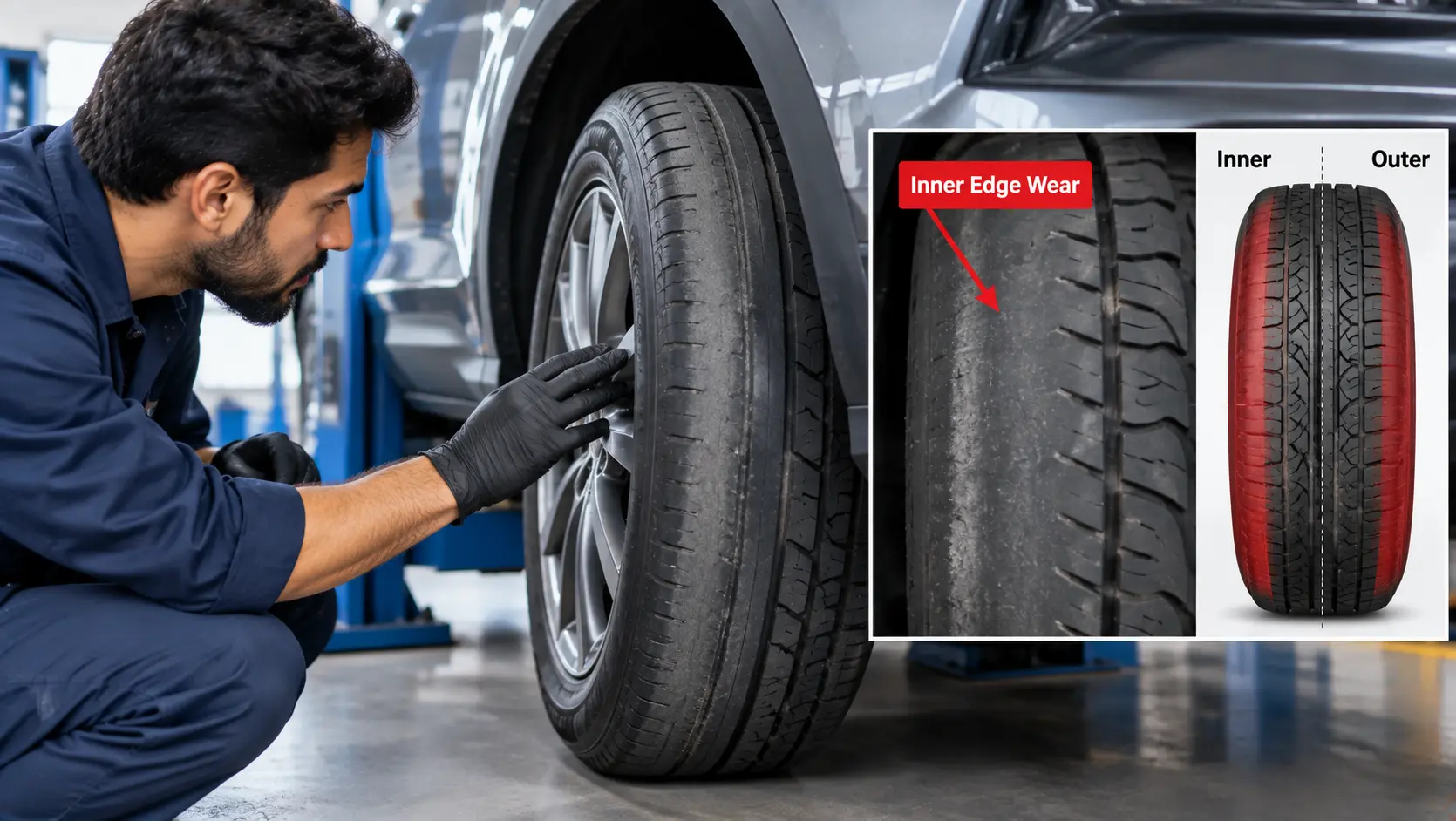
When tyres are wearing on the inside — the inner shoulder is significantly more worn than the centre or outer edge — is a problem that has a specific mechanical cause in every case. The tyre never wears on the inner edge by chance — tyres are wearing on the inside always has a specific geometry cause. Something in the alignment or suspension geometry is forcing the tyre to run at an angle that loads the inner edge more heavily than the rest of the contact patch.
In Dubai, tyres are wearing on the inside is the most common tyre wear complaint we see. The combination of speed bumps disturbing alignment, heat affecting suspension component condition, and the high mileage that Dubai city driving accumulates means that inner edge wear is found regularly on vehicles that look well-maintained from the outside.
At Rapid Rev Garage in Al Quoz, every tyres are wearing on the inside case gets a root-cause diagnosis — so the next set of tyres doesn’t wear the same way.
Tyres Are Wearing on the Inside — Quick Answer
Tyres wear on the inside because the tyre is running with excessive negative camber — the top of the tyre is leaning inward relative to the road surface. This shifts the tyre’s contact patch toward the inner edge and concentrates wear there. Excessive negative camber is most commonly caused by incorrect wheel alignment, worn control arm bushings that allow the control arm to drop below its correct position, worn ball joints that allow the hub to tilt inward, collapsed springs that lower the ride height and increase camber, or a bent suspension component from an impact that has changed the geometry. In Dubai, worn bushings and alignment disturbed by speed bump impacts are the two most frequent causes of inner edge tyre wear.
Table of Contents
- How Camber Angle Controls Where the Tyre Wears
- Negative Camber Explained — Why the Inner Edge Gets All the Load
- Incorrect Wheel Alignment as the Primary Cause
- Worn Control Arm Bushings Allowing the Arm to Drop
- Worn or Loose Ball Joints Allowing Hub Tilt
- Collapsed Springs Increasing Negative Camber
- Bent Suspension Components From Impact
- How Dubai’s Speed Bumps Accelerate Inner Tyre Wear
- How We Diagnose Tyres Wearing on the Inside
- The Services That Fix Inner Edge Wear
- What Does the Repair Cost in Dubai?
- Why Rapid Rev Garage?
- FAQ
- Conclusion
How Camber Angle Controls Where the Tyre Wears
Camber is the tilt of the tyre relative to a vertical line when viewed from the front of the vehicle. A tyre sitting perfectly vertical has zero camber. A tyre tilted inward at the top has negative camber. A tyre tilted outward at the top has positive camber.
The contact patch of the tyre — the area touching the road — is designed to be loaded evenly across its width when camber is at the correct specification. The entire tread width shares the vehicle’s weight equally.
When camber is excessively negative, the tyre leans inward. The inner edge of the contact patch presses harder into the road than the outer edge. The inner tread blocks carry more weight and generate more friction. They wear faster.
This geometry fault is the direct mechanism behind tyres are wearing on the inside — not from driving style, not from tyre quality, but from a geometry fault that puts more load on the inner edge than the tyre was designed to carry. Our car mechanic team measures camber at all four corners on every inner edge wear complaint before looking at any other component.
Negative Camber Explained — Why the Inner Edge Gets All the Load
A small amount of negative camber — typically 0 to -1 degree — is designed into most vehicles. This slight inward tilt improves cornering grip because the tyre leans slightly into the corner under body roll, maintaining a better contact patch angle.
This is when tyres are wearing on the inside becomes a confirmed fault — typically beyond -1.5 degrees. At -2 to -3 degrees of negative camber, the inner edge carries significantly more weight than the rest of the tread. Wear on the inner edge can be three to four times faster than the centre or outer edge.
The driver often doesn’t notice until the inner edge has worn to the wear indicators or beyond — because inspecting the inner edge requires getting down and looking under the wheel arch. The outer surface of the tyre can look perfectly normal while the inner shoulder is bald.
This is why tyres are wearing on the inside is often caught late — and why checking the inner edge at every service is part of our standard tyre inspection.
Incorrect Wheel Alignment as the Primary Cause
Incorrect camber is the most straightforward cause of tyres are wearing on the inside in the wheel alignment.
Camber is adjustable on most vehicles — either through eccentric bolts, camber bolts, or adjustment plates on the strut. Where these adjustments exist, incorrect camber from a previous alignment setting or from a gradual shift since the last alignment is corrected by a four-wheel alignment to specification.
On some vehicles — particularly MacPherson strut designs — camber is not directly adjustable. It is set by the geometry of the suspension components. On these vehicles, out-of-specification camber indicates a bent or displaced component that must be corrected before alignment can be set correctly.
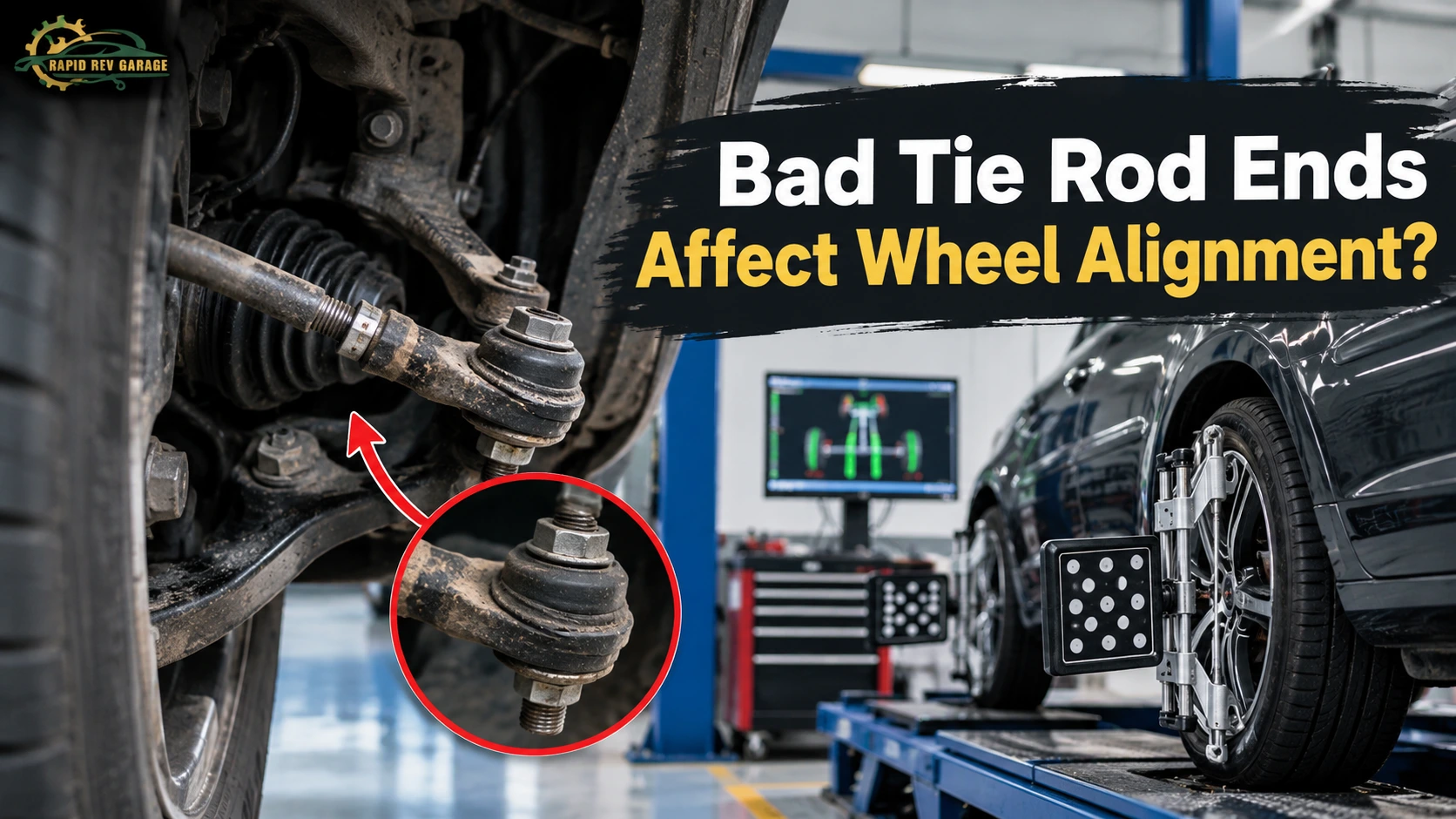
A four-wheel alignment printout shows the current camber angle at each corner and whether it falls within the manufacturer’s specification. A camber reading that is out of specification and within the adjustable range is corrected at the alignment. A camber reading that is out of specification and cannot be corrected by adjustment confirms a component fault that needs attention first. Our car service packages include a four-wheel alignment check at every major service for any vehicle reporting tyre wear concerns.
Worn Control Arm Bushings Allowing the Arm to Drop
The lower control arm positions the wheel hub at the correct height and angle. The arm is connected to the subframe at one end through rubber bushings and to the wheel hub at the other through the ball joint.
When the control arm bushings wear — from age, heat degradation, or accumulated mileage — the arm loses its precise position. A worn bushing allows the arm to droop slightly below its designed position. This drooping lowers the outer end of the arm, pulling the bottom of the wheel hub inward. The wheel tilts — negative camber increases.
The camber change from worn bushings may not be large enough to register dramatically on the alignment printout — but it is consistent and progressive. The tyre wears on the inside at an accelerated rate. Each service, the wear is slightly worse. The bushing is the cause, not the alignment setting.
Replacing the worn bushings restores the arm to its correct position. The camber returns toward specification. A four-wheel alignment after bushing replacement confirms and finalises the geometry.
Worn or Loose Ball Joints Allowing Hub Tilt
The ball joint connects the lower control arm to the wheel hub. It is the pivot point that allows the hub to steer left and right while the arm moves up and down with the suspension.
A ball joint with wear — even before the play is large enough to be dangerous — allows the hub to tilt slightly under the vehicle’s weight. The hub tilts inward at the bottom. This increases negative camber.
A ball joint that is producing inner edge tyre wear is at an earlier stage than a ball joint producing a clunk or vibration. The wear is the first sign — the geometry change comes before the play is dramatic enough to feel.
Confirming and replacing a worn ball joint is a common fix when tyres are wearing on the inside from hub tilt — followed by alignment — addresses this cause completely. For any roadside emergency from a ball joint or suspension fault, our roadside assistance team covers Al Quoz and nearby Dubai areas.
Collapsed Springs Increasing Negative Camber
The suspension geometry is designed around a specific ride height. Every angle — camber, caster, toe — is calibrated for the vehicle sitting at its specified ride height.
When a spring loses its rate — sags and settles lower than its design height — the ride height drops. On most suspension designs, a lower ride height increases negative camber. The geometry moves away from the specification point as the car sits lower.
A rear spring that has collapsed — common on rear-wheel-drive and all-wheel-drive vehicles carrying rear passengers frequently in Dubai — drops the rear ride height and increases rear negative camber. The rear tyres develop inner edge wear.
Spring sag is measured by comparing the ride height at each corner against the manufacturer’s specification. A corner that is 20–30mm below specification has a sagged spring. Spring replacement in axle pairs restores ride height and camber geometry simultaneously. For any paint or body repairs alongside suspension work, our car painting team handles colour-matched work at the same visit.
Bent Suspension Components From Impact
A significant impact — a pothole at speed, a kerb strike in a car park, a speed bump crossed sharply — can bend a strut, a control arm, or distort a subframe mounting. Bent components change the geometry permanently, regardless of what the alignment machine sets.
The alignment machine measures the wheel angles relative to each other and to the vehicle’s centreline. A bent strut produces a camber reading that appears within specification — because the bent strut has moved the entire reference point, not just the wheel angle.
A bent component is confirmed by chassis dimension measurement — comparing actual subframe, strut tower, and control arm geometry against the manufacturer’s specification. Any deviation from specification identifies the bent component.
Replacement of the bent component — followed by alignment — restores the geometry to specification. Attempting to align a vehicle with a bent component produces a result that looks correct on the printout but generates tyre wear because the fundamental geometry is wrong.
How Dubai’s Speed Bumps Accelerate Inner Tyre Wear
Dubai’s speed bump density produces more suspension impacts per year than any other driving environment. Each speed bump crossing applies a vertical force to the suspension that stresses every bushing, ball joint, and spring.
High-frequency impact loading accelerates bushing wear. This bushing degradation is a key reason tyres are wearing on the inside appears on Dubai vehicles deteriorates to the drooping position that increases negative camber in four to five years in Dubai’s speed bump-intensive conditions.
The same speed bump impacts that disturb alignment also progressively wear the components that hold the alignment in place. A vehicle that is aligned correctly today may develop inner tyre wear within 15,000 km from bushing deterioration accelerated by speed bump loading.
How We Diagnose Tyres Wearing on the Inside
Inner edge inspection first. The inner shoulder of each tyre is checked for wear pattern. The depth difference between the inner edge and the centre tread quantifies the severity.
Four-wheel alignment measurement. Camber at all four corners compared against specification. Out-of-specification camber reading at the worn tyre’s corner confirms geometry as the cause.
Camber adjustability check. Where camber is out of specification, we confirm whether the adjustment range can correct it. An out-of-range reading that cannot be corrected by adjustment confirms a component fault.
Control arm bushing inspection. Bushings at the affected corner are visually inspected and physically loaded. A bushing with confirmed play or visible cracking is flagged.
Ball joint pry test. Play at the ball joint at the affected corner is confirmed or ruled out.
Ride height measurement. All four corners measured against specification. A low corner confirms spring sag.
The Services That Fix Inner Edge Wear
- Four-wheel alignment correction. Where camber is within adjustable range. AED 200–400.
- Control arm bushing replacement. Where bushing wear is confirmed as the camber cause. AED 500–1,500 per arm including alignment.
- Ball joint replacement. Where play is confirmed. AED 600–1,500 per joint including alignment.
- Spring replacement. Where ride height is confirmed low. AED 600–2,000 per axle including alignment.
Bent component replacement. Where a bent strut or arm is confirmed by measurement. AED 700–2,500 plus alignment. Our mobile car mechanic covers Al Quoz and nearby Dubai areas for on-site tyre and alignment assessment. Our garage near me in Al Quoz serves drivers from Business Bay, Jumeirah, Barsha, Satwa, Downtown, and the Sheikh Zayed Road corridor.
What Does the Repair Cost in Dubai?
| Service | Cost Range |
| Four-wheel alignment | AED 200–400 |
| Control arm bushing replacement | AED 500–1,500 per arm |
| Ball joint replacement | AED 600–1,500 per joint |
| Spring replacement | AED 600–2,000 per axle |
| Bent component replacement | AED 700–2,500 |
All costs confirmed after camber measurement, bushing inspection, and ball joint assessment.
Why Rapid Rev Garage?
When tyres are wearing on the inside, an alignment service that corrects the camber reading without fixing the underlying component fault produces a temporary result — the camber shifts back within weeks as the worn bushing or sagged spring reasserts its incorrect geometry.
We identify whether the camber fault is from an adjustment setting, a worn bushing, a ball joint, a spring, or a bent component — and fix the root cause before setting the alignment. The tyre wear stops. The next set of tyres lasts as it should.
FAQ — Tyres Are Wearing on the Inside
Here are the questions Dubai drivers ask us most about inner edge tyre wear.
Why are only my front tyres wearing on the inside?
Front camber is most commonly disturbed by impacts — pothole strikes, kerb contacts, speed bumps taken too fast. The front suspension also has more adjustment points, which means alignment errors are more frequent. Rear inner wear suggests rear camber problems, which are typically spring sag or rear bushing wear.
Will alignment fix inner tyre wear?
If the camber is within the adjustable range and no component is worn or bent — yes. If a worn bushing or sagged spring is causing the camber error, alignment corrects the reading temporarily but the cause reasserts within weeks. Fix the component, then set the alignment.
How fast does inner tyre wear progress?
At -2.5 degrees of negative camber, the inner edge can wear twice as fast as normal. A tyre that would last 40,000 km at correct camber may reach the wear limit on the inner edge at 20,000 km. Catching the wear pattern early — at the first service after new tyres are fitted — allows the cause to be fixed before significant tyre life is lost.
Can inner tyre wear be dangerous?
Yes. A tyre worn to the cords on the inner edge while the outer tread looks normal has no structural integrity on that edge. At highway speed, a sudden pressure loss from the inner shoulder is a blow-out with no visible external warning. Check the inner edge at every tyre rotation.
Do I need to replace the tyre immediately if it's wearing on the inside?
If the inner edge is significantly more worn than the centre, measure the depth at the inner shoulder specifically. If it is at or below 2mm at any point on the inner edge, replace the tyre. A tyre that looks fine on the outside but is worn on the inside is not safe at highway speeds.
Conclusion
Every tyres are wearing on the inside case traces to excessive negative camber is loading the inner tread edge more than the rest of the contact patch. Incorrect alignment, worn control arm bushings, worn ball joints, collapsed springs, and bent components all produce this camber fault — each through a slightly different mechanism.
Rapid Rev Garage in Al Quoz confirms the root cause of every tyres are wearing on the inside case through camber measurement, component inspection, and ride height assessment — then fixes the root cause before the next set of tyres is fitted.
Rapid Rev Garage is in Al Quoz, serving Business Bay, Jumeirah, Downtown, Barsha, Satwa, and the Sheikh Zayed Road corridor. Book your appointment on WhatsApp or find us on Google Maps.
Rapid Rev Garage — Tyres Are Wearing on the Inside | Al Quoz, Dubai