
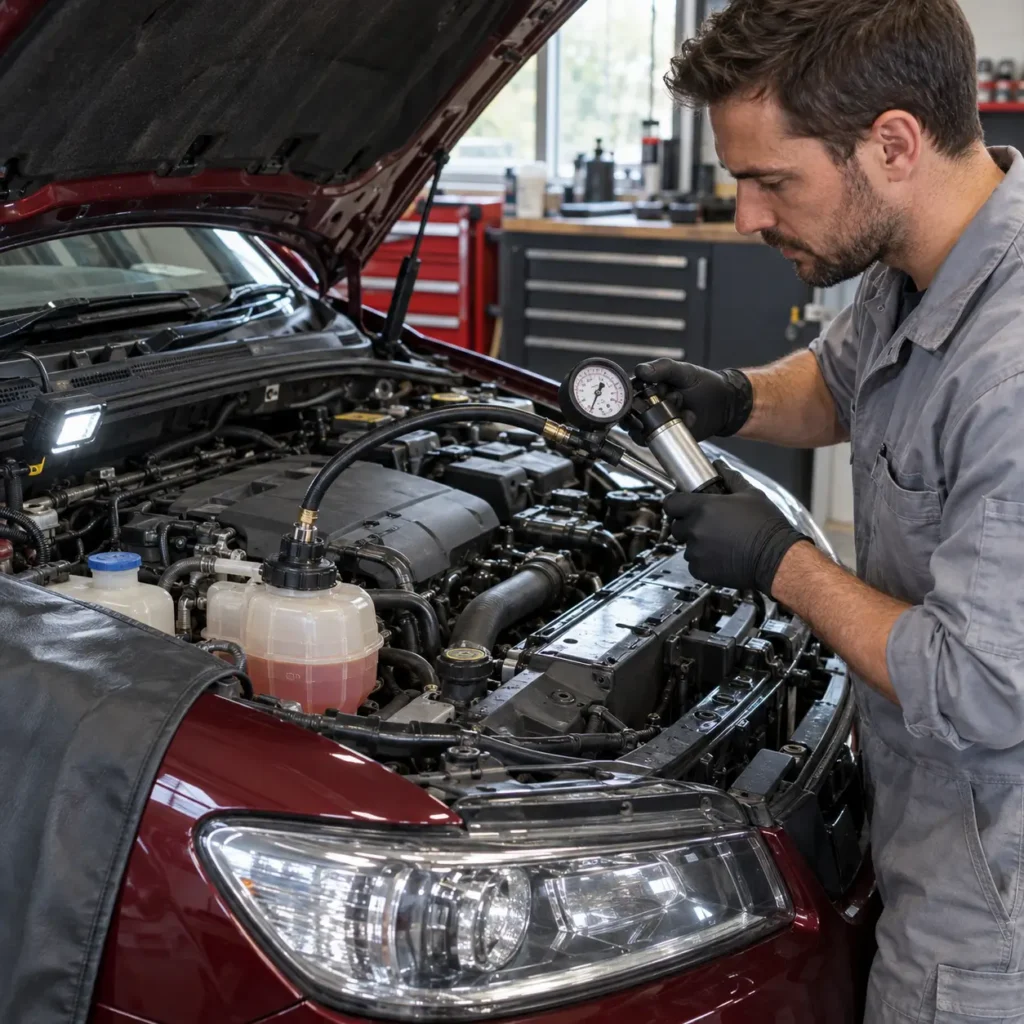
Engine Overheating Repair at Our Al Quoz Workshop
Rapid Rev Garage carries out engine overheating repair 24 hours a day at its workshop in Al Khail Gate, Al Quoz Industrial Area 2, Dubai. The team finds why the engine overheated, repairs or replaces the failed cooling part, refills and bleeds the system, then runs the engine hot with the AC on to confirm the fix. Overheating repair is one part of our full engine repair service.
The workshop works on passenger cars only and holds a 5.0 rating on Google. Because it never closes, a car that overheats at midnight on Al Khail Road can go straight into the workshop instead of waiting outside a closed garage until morning.
- Coolant Leak Detection
- Thermostat Replacement
- Cooling Fan Repair
- Water Pump Replacement
Get Your Overheating Engine Checked in Al Quoz
Send your location and car model on WhatsApp. The workshop can tell you whether to drive in or arrange recovery, at any hour.
Can You Drive With an Overheating Engine in Dubai Traffic?
No. Drive only as far as you need to stop safely, then switch the engine off. Heat causes the damage, not distance.
A few extra kilometres with the gauge in the red can turn a cheap hose repair into a head gasket job that costs thousands of dirhams.
When the temperature gauge climbs past the middle or the warning light comes on:
- Switch the AC off to take load off the engine.
- Turn the cabin heater to full heat with the fan on maximum.
- Put your hazard lights on and leave the fast lanes of Sheikh Zayed Road or Al Khail Road for the hard shoulder or the next exit.
- Switch the engine off. Open the bonnet only once steam has stopped.
- Wait at least 30 minutes before touching anything under the bonnet.
- Call car recovery if the gauge reaches red, you saw steam, or coolant is leaking.
Dubai Police asked motorists in June 2026 to keep their cars roadworthy and inspected through the summer heat. A 2024 report by the UAE Ministry of Interior’s Traffic Department linked 43% of vehicle fires to extreme summer heat, and an overheated engine near leaking fluids is one way a fire starts.
What Is the Safest Temporary Fix for an Overheating Car?
Switch the AC off and run the cabin heater on full while you find a place to stop. The heater core works like a small second radiator, so hot coolant passing through it releases heat into the cabin instead of the engine.
Once the engine has cooled for at least 30 minutes, check the coolant reservoir. Top it up to the MAX line with the coolant listed in your owner’s manual.
Clean water will move the car a short distance in an emergency, but have it replaced with proper coolant soon.
Coolant is not used up like fuel. A low level means it leaked or burned somewhere, and that fault is still there.
Four Mistakes That Turn a Cooling Repair Into an Engine Repair
- Opening a hot radiator cap or expansion tank. A 50/50 coolant mix boils at about 106°C in open air, but a 15 psi radiator cap lets it reach about 130°C without boiling. Releasing that pressure turns hot coolant into scalding steam instantly.
- Pouring cold water onto a hot engine. The sudden temperature drop can crack an aluminium cylinder head or the engine block.
- Topping up and driving on. The gauge may look normal for days while a leak, a failing water pump or a head gasket gets worse.
- Trusting a gauge that drops back to normal. When coolant runs very low, the temperature sensor can sit in steam or air and read lower than the real engine temperature.
What to Do About Car Engine Overheating at Night in Dubai
For car engine overheating at night, move the car somewhere safe, share your live location on WhatsApp, and have the car recovered to a workshop that is open.
Many garages in Al Quoz close by 8 PM, and some close all day on Sunday. A car left outside a closed workshop loses a full night, and driving home on a hot engine risks the cylinder head.
Rapid Rev Garage stays open through the night. A recovery truck can bring your car to the workshop at Al Khail Gate at 1 AM as easily as at 1 PM. The workshop sits beside Al Khail Road (E44), with access through Al Quoz from Sheikh Zayed Road, close to Al Khail Mall and Grand City Mall.
If you are stuck on the road, start with our roadside assistance page. Use car recovery or our car towing service to bring the car in.
Drivers on late shifts, including ride hailing and delivery drivers, can have the car repaired while it would be parked anyway.
Why Does a Car Engine Heat Up?
Most drivers see the engine heat up when the cooling system stops carrying heat away as fast as the engine makes it. Burning fuel in the combustion chamber makes heat, and friction between moving parts adds more.
The water pump pushes coolant through passages in the engine block and cylinder head, where it absorbs that heat. The coolant then flows to the radiator, which releases the heat into the air passing through its fins.
The thermostat is a valve that keeps coolant away from the radiator until the engine warms up, then opens. When one of these parts fails, temperature rises.
Low Coolant From a Leak You Cannot See
Low coolant is the most common cause. Leaks start at hoses, clamps, the radiator, the water pump seal or the heater core. Some leaks drip only while the system is hot and under pressure, so your parking spot stays dry. Coolant shows as a green, pink or orange stain with a sweet smell.
A Thermostat Stuck Closed
Most thermostats open at between about 80°C and 95°C, depending on the engine. When one sticks closed, hot coolant never reaches the radiator. The upper radiator hose turns very hot while the radiator stays cooler, and the gauge climbs within minutes.
A Cooling Fan, Relay or Fan Control Module That Stops Working
On the highway, air rushes through the radiator on its own. In slow traffic, only the cooling fan moves that air. A failed fan motor, relay, fuse or fan control module means the car runs cool at 100 km/h and overheats at a red light.
Fan relays, fuses and wiring faults are traced as part of car electrical repair.
A Weak Water Pump or Slipping Drive Belt
A worn impeller, a leaking seal or a failing bearing reduces coolant flow. On many engines a drive belt turns the pump, so a cracked belt or weak tensioner slows it too. In dubizzle’s 2026 analysis of more than 20,000 UAE vehicle inspections, 38% of cars had noise from the idler pulley, part of the same belt drive.
A Radiator and AC Condenser Packed With Sand
The AC condenser sits in front of the radiator. Sand, dust and insects collect in the gap between the two, so both get less air. The condenser also adds its own heat to the air before it reaches the radiator.
Cracked Plastic Parts in the Cooling System
Many modern cars use plastic expansion tanks, thermostat housings and coolant pipes. Years of heat cycles make the plastic brittle, and a hairline crack can empty the system quickly.
Air Trapped After a Repair or Top Up
Air pockets block coolant flow and leave hot spots in the engine. They form after a hose change, a coolant flush or a top up done without bleeding the system.
Why Engines Overheat Faster in a Dubai Summer
The UAE National Centre of Meteorology recorded 51.2°C in the Al Dhafra region on 5 August 2026, the year’s highest reading. Coastal areas, including Dubai, typically sit between 41°C and 43°C during peak summer. Air that hot takes away part of every cooling system’s safety margin, and Dubai adds more load:
- The AC runs at full power for months, and its condenser heats the air entering the radiator.
- Stop and go traffic on Sheikh Zayed Road, Al Khail Road and Umm Suqeim Road leaves the fan doing all the work.
- Dust from the Al Quoz industrial areas and nearby construction blocks radiator fins.
- Cars parked in open sun start hot before the engine runs.
- Many newer cars use small turbocharged engines, which run hotter and depend on coolant and oil to protect the turbo.
What Your Overheating Symptoms Point To
The way your car overheats usually points to the faulty part. Use this table to understand the likely cause before you call.
What you notice | Likely cause | Test that confirms it |
Overheats in traffic, fine on the highway | Cooling fan, relay or fan control module | Fan operation test, OBD II scan |
Overheats only with the AC on | Fan fault or blocked condenser and radiator | Fan test, airflow and fin inspection |
Overheats at highway speed | Thermostat, water pump or blocked radiator | Thermostat test, coolant flow check |
Gauge spikes, then drops to normal | Coolant loss or air in the system | Coolant level check, pressure test |
Coolant level drops with no visible leak | Head gasket or heater core | Combustion leak test |
Sweet smell or misty windscreen inside the car | Heater core leak | Pressure test, cabin inspection |
White exhaust smoke | Coolant burning in the engine | Combustion leak test, compression test |
Heater blows cold while the engine runs hot | Low coolant or an air lock | Coolant check, system bleed |
Squeal from the engine, then overheating | Slipping drive belt or worn water pump | Belt, tensioner and pump inspection |
Green, pink or orange puddle under the car | Hose, radiator or water pump leak | Pressure test, UV dye leak test |
Two different faults can share one symptom, so a workshop confirms the cause with tests before replacing any part.
What Happens During Engine Overheating Repair?
Engine overheating repair starts with finding the cause, not with replacing parts. A thermostat or water pump changed on a guess can leave the real fault in place, and the car overheats again a week later.
Step 1. Drop Off or Recovery at Any Hour
Drive in only if the gauge reads normal. Otherwise, have the car recovered at any hour.
Step 2. Cooling System Diagnosis
The mechanic checks coolant level, colour and smell, looks for oil in the coolant, and inspects hoses, clamps, the radiator and the water pump.
A cooling system pressure test raises the system to working pressure so hidden leaks show up. An OBD II scan reads fault codes and live data from the coolant temperature sensor and the fan circuit.
Step 3. Combustion Leak and Compression Tests After a Bad Overheat
If the engine ran hot for a while, a combustion leak test, often called a block test, checks the coolant for exhaust gases. Exhaust gas in the coolant points to a failed head gasket or a cracked head. A compression test or leakdown test then shows whether the cylinders still seal.
Step 4. Repair or Replacement of the Failed Part
Once the cause is confirmed, the faulty part is repaired or replaced. You hear what failed and what it will take before major work begins.
Step 5. Refill, Bleed and Heat Soak Test
The system is refilled with the correct coolant and bled to remove trapped air. The engine then runs at full temperature with the AC on, the hardest condition a Dubai car faces. The mechanic watches the gauge, confirms the fan switches on, and rechecks for leaks under pressure.
Step 6. Road Test and Explanation
A road test in real traffic confirms the temperature stays steady. You get a plain explanation of what failed, what was replaced and anything else the inspection found.
Let's work together.
At Rapid Rev Garage, your car’s performance is our passion. Whether it’s routine maintenance, complex repairs, or performance upgrades, our expert team in Dubai is ready to get you back on the road—better and faster. Let’s bring your vehicle the care it deserves. Book your service today and experience the difference.
How Do You Fix an Overheating Car Engine for Good?
Car engine overheating repair lasts when the failed part is replaced and the whole system is tested under heat afterwards. These repairs fix most cases.
Coolant Leak and Radiator Hose Repair
Cracked hoses, soft hoses that bulge when squeezed and rusted clamps are replaced. Hoses age from the inside, so a hose can look fine and still split under pressure.
Thermostat Replacement
A stuck thermostat is replaced with one of the correct opening temperature, plus a new gasket or seal. Engines with an electronically controlled thermostat may need a scan tool check after fitting.
Cooling Fan, Relay and Fan Module Repair
The fan motor, relay, fuse and control module are tested one at a time. Replacing only the failed piece usually costs less than a complete fan assembly.
Water Pump and Drive Belt Replacement
A leaking or noisy water pump is replaced. On engines where the timing belt drives the pump, many mechanics replace both together because the labour to reach them is the same.
Radiator Cleaning, Repair or Replacement
Sand packed between the radiator and AC condenser can be cleaned out from the engine side. A radiator with blocked tubes, cracked plastic end tanks or heavy corrosion is replaced. A damaged condenser is handled as part of a car AC repair.
Coolant Flush With the Right Coolant Type
Old coolant loses its corrosion protection and can leave sludge. A flush removes it and refills the system with the coolant type your manufacturer specifies, such as an OAT or HOAT coolant. Mixing incompatible coolant types can form deposits that block passages.
Can an Overheated Engine Be Repaired?
Yes, most overheated engines can be repaired, especially when the driver stopped quickly. If the engine was switched off soon after the gauge rose, the repair is normally limited to the cooling part that failed.
Signs the Engine Took Internal Damage
- White exhaust smoke with a sweet smell
- Milky, light brown residue under the oil filler cap or on the dipstick
- Coolant level dropping with no visible leak
- Bubbles in the coolant reservoir while the engine runs
- Rough running, misfires or loss of power after the overheat
Any of these signs needs a combustion leak test before the car goes back on the road. Damage inside the engine needs a full engine repair at the workshop.
What Repairs Does an Overheated Engine Need, From Minor to Major?
The repairs depend on how hot the engine got and for how long. Damage usually climbs in four stages:
- Cooling part only. The engine was stopped early, and the fix is the hose, thermostat, fan, pump or radiator that failed.
- Head gasket and cylinder head. The engine ran hot long enough to warp the aluminium head or break the head gasket seal. The head is machined flat or replaced, and a new gasket is fitted.
- Turbocharger and internal parts. Long overheating can damage the turbocharger, scuff pistons and cylinder walls, and break down engine oil so bearings wear.
- Rebuild or replacement. A cracked engine block or a seized engine needs a rebuild or a replacement engine.
Each stage usually costs several times more than the one before it.
How Much Does Engine Overheating Repair Cost in Dubai?
Engine overheating repair in Dubai costs from about AED 80 for a diagnosis to AED 6,000 or more for a head gasket job. The final price depends on which part failed, the car model and how long the engine ran hot. These are typical Dubai market ranges at independent garages.
Repair | Typical Dubai market range |
Overheating diagnosis | AED 80 to 300 |
Thermostat replacement | AED 250 to 800 |
Cooling fan or fan control module | AED 500 to 1,500 |
Water pump replacement | AED 300 to 1,500 |
Radiator replacement | AED 700 to 1,900 |
Head gasket replacement | AED 2,500 to 6,000 |
What Pushes the Price Up
- European and luxury models, with dearer parts and tighter engine bays
- Electric water pumps and electronically controlled thermostats on newer engines
- Dual fan systems with separate control modules
- OEM parts compared with quality aftermarket parts
- Extra damage from driving while hot, such as cylinder head machining
Ask whether a quote includes 5% VAT, and ask for the diagnosis result before agreeing to major work.
How to Keep Your Engine From Overheating in a Dubai Summer
Check the cooling system before summer starts, not after the first breakdown in July. This routine catches most faults while they are still cheap to fix.
When | What to check |
Monthly, May to September | Coolant level in the reservoir, with the engine cold |
Every service | Hoses, clamps, drive belt and radiator cap seal |
Every spring | Cooling fan operation and sand cleared from the radiator and condenser |
Interval in your owner’s manual | Full coolant flush and refill |
Straight away | Any warning light, sweet smell or coloured puddle under the car |
Park in shade where you can, and book these checks with a regular car service in Dubai so none of them is missed.
Before you buy a used car, a vehicle inspection checks its cooling system. For every other routine check, see our car maintenance page.
Curious what's wrong before you commit to anything? Send us a photo or video of the issue on WhatsApp and we'll take a look
Why Drivers Choose Rapid Rev Garage for Car Engine Overheating Repair
Rapid Rev Garage is a full workshop in Al Quoz that stays open 24 hours and holds a 5.0 rating on Google.
- The workshop never closes, so diagnosis and repair happen in a proper bay at any hour, not at the roadside.
- It works on passenger cars only, from Japanese and Korean models to American and European ones.
- It is easy to reach from Al Barsha, Al Safa, Business Bay and Dubai Hills through Al Khail Road and Sheikh Zayed Road. Parents on the school run to Al Quoz schools such as Springdales School or Credence High School can drop the car on the way.
- If the car cannot be moved, a mobile car mechanic can check it where it stands.
The same team handles general repairs, so other faults found during the inspection can be fixed in one visit. See our car mechanic near me and car garage near me pages for the full list of services.
Proof You Can Check Before You Visit
- Read the 5.0 rated reviews on the Rapid Rev Garage Google Business Profile, and look for drivers who mention night repairs or overheating.
- See the workshop on the Google Maps listing linked below, then visit Al Khail Gate at any hour to see it in person.
- Compare the price ranges on this page with any quote you receive, since they come from published Dubai market figures.
- Ask for the fault codes and pressure test result from your own diagnosis before any major work starts.
Come see us in person. Find Rapid Rev Garage on Google Maps and drop by whenever suits you.
Frequently Asked Questions About Engine Overheating
Can I add water instead of coolant?
Yes, in an emergency only. Clean water cools the engine for a short drive, but it boils at a lower temperature than a coolant mix and offers no corrosion protection. Have the system drained and refilled with the correct coolant within a few days.
Why does my engine heat up in traffic?
An engine that heats up in traffic but stays cool on the highway usually has a cooling fan problem. At low speed, the fan is the only thing moving air through the radiator. A failed fan motor, relay or control module, or a radiator blocked with sand, causes this pattern.
Why does my car overheat with AC on?
The AC adds load to the engine, and its condenser heats the air flowing into the radiator. A healthy cooling system handles both. A car that overheats only with the AC on usually needs its fan, radiator airflow or condenser checked.
Is it safe to open a hot radiator cap?
No. A hot cooling system is under pressure, and opening the cap lets coolant flash into steam that can cause serious burns. Wait at least 30 minutes, cover the cap with a thick cloth, and open it slowly only when the upper hose feels soft and cool.
How long should an overheated engine cool down?
Wait at least 30 minutes before checking coolant, and longer in Dubai summer heat. Press the upper radiator hose first. If it still feels hard or hot, keep waiting.
How long does overheating repair usually take?
It depends on the failed part and parts availability in Dubai. Many thermostat, hose and fan repairs finish on the same visit. A water pump in a tight engine bay or a head gasket job takes longer, and the workshop confirms timing after diagnosis.
Can I get engine overheating repair at night?
Yes. Rapid Rev Garage in Al Quoz Industrial Area 2 is open 24 hours, so an overheating car can be driven or recovered to the workshop at any time of night.
Bring Your Overheating Car to Our 24 Hour Workshop in Al Quoz
Rapid Rev Garage is at Al Khail Gate, 12th Street, Al Quoz Industrial Area 2, Dubai, and open 24 hours. Send your location and car model on WhatsApp, call +971 52 797 9525, or open the workshop location on Google Maps for directions.
Car Repair Services We Offer at Rapid Rev Garage
- Car AC Repair
- Car Detailing
- Car Battery Replacement
- Car Body Repair
- Car Electrical Repair
- Engine Repair
- Car Oil Change
- Car Mechanic
- Car Painting
- Car Suspension Repair
- Car Window Tinting
- Car Tyres
- Car Garage
- Mobile Car Mechanic
- Vehicle Inspection
- Roadside Assistance
- Transmission Oil Change
- Car Towing Service
- Car Upholstery
- Car Maintenance
- Car Workshop
- Car Service
- Car Repair
- Car Recovery
- Car Key Repair
- Car Dent Repair
- Car Headlight Repair
- Car Bumper Repair
- Car Dashboard Repair
- Car Collision Repair
- Car Filter Change
- Car Accident Repair
- Car Brakes Repair
Get Your Car Fixed Today!
Don’t wait until it’s too late—restore your car’s performance with expert care.
Book your service now and drive worry-free!

