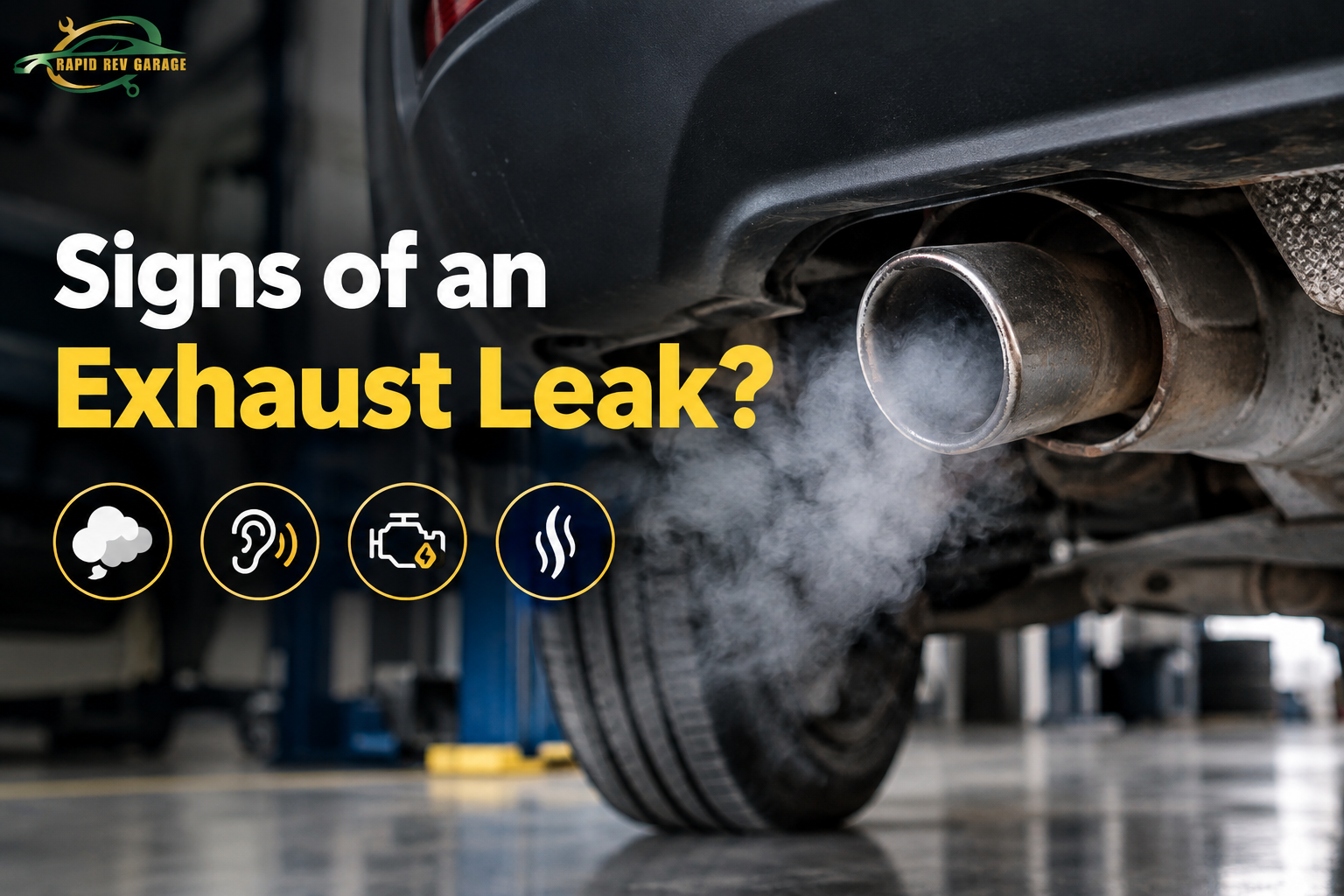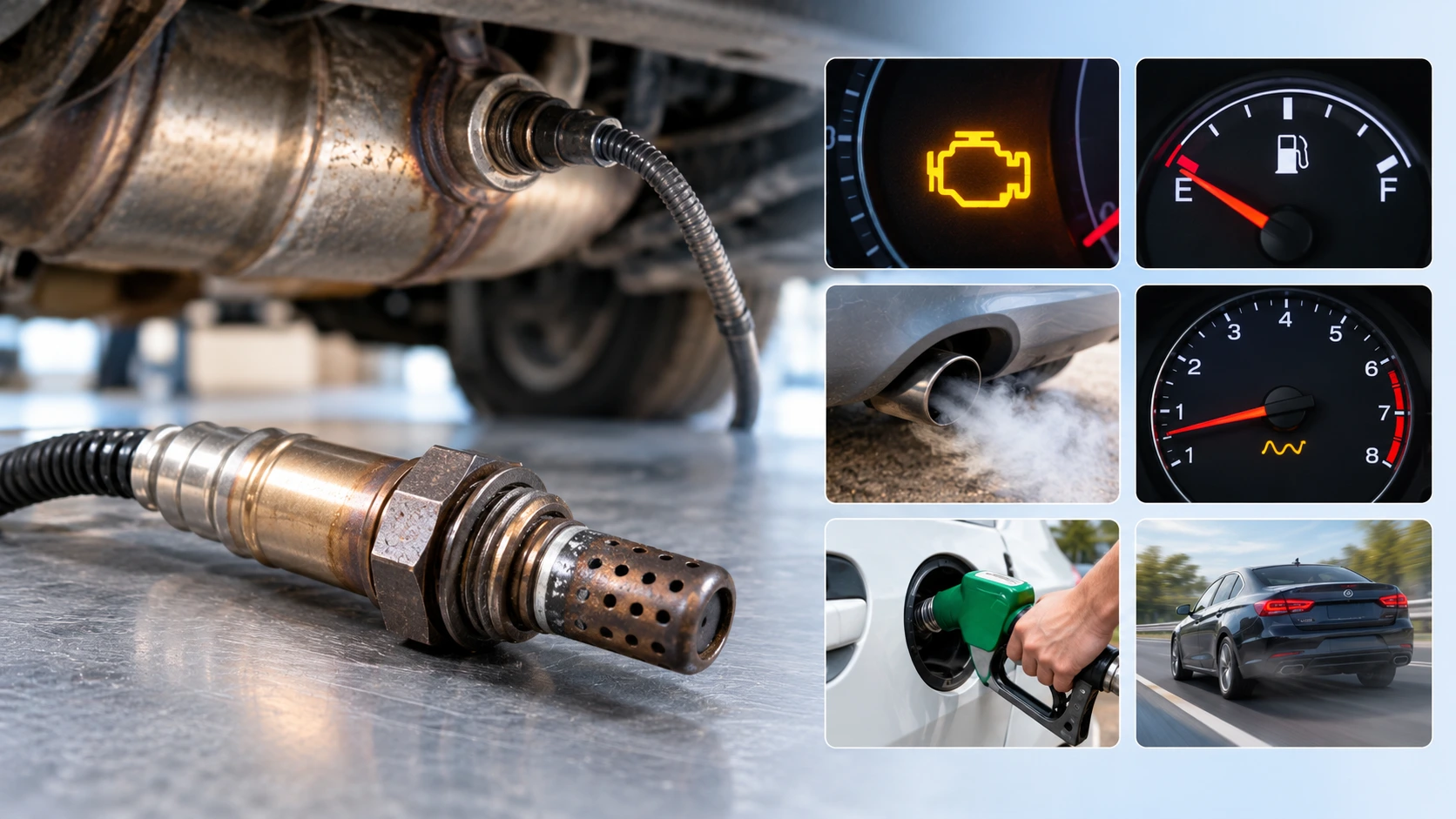
You are filling up more often than you used to, the check engine light is on, and there is a faint rotten egg smell behind the car in the basement at City Centre. These are common bad oxygen sensor symptoms, and they often build slowly enough that drivers do not notice until the fuel bills add up.
The oxygen sensor, also called the O2 sensor or lambda sensor, reads how much oxygen is left in the exhaust. The engine computer uses that reading to keep the fuel mixture correct. When the sensor slows down or fails, the computer loses its guide, and the engine can run rich or lean.
This guide explains what oxygen sensors do, the signs of failure, why they wear out, how Dubai driving affects them, how a workshop tests them and when replacement makes sense.
Bad Oxygen Sensor Symptoms: Quick Answer
The main bad oxygen sensor symptoms are higher fuel use, a check engine light, rough idle, hesitation, a rotten egg smell from the exhaust, black smoke or soot, a failed emissions check and catalytic converter codes. Counterman notes that a sluggish sensor can cause a loss of fuel economy without turning on any warning light.
Common codes include P0130 to P0167 for the sensors and their heaters, and P0420 when the catalytic converter appears to be failing. Counterman gives a normal service life of 100,000 to 150,000 miles for modern sensors. A mechanic tests the sensor’s live signal before replacing it.
Table of Contents
- What the Oxygen Sensor Does
- Upstream and Downstream Oxygen Sensors
- Why Oxygen Sensors Wear Out
- Higher Fuel Use With No Warning Light
- Check Engine Light and O2 Sensor Codes
- Rough Idle, Misfires and Hesitation
- Rotten Egg Smell From the Exhaust
- Black Smoke and Soot on the Bumper
- Failed Emissions Check
- Catalytic Converter Damage
- Faults That Look Like a Bad Oxygen Sensor
- How a Workshop Tests an Oxygen Sensor
- What Oxygen Sensor Replacement Involves
- How Long Do Oxygen Sensors Last?
- Is It Safe to Drive With a Bad O2 Sensor?
- How to Protect Your Oxygen Sensors
- Should Oxygen Sensors Be Replaced in Pairs?
- Why Does the Code Come Back After Replacement?
- Why Do Short Trips Wear Oxygen Sensors?
- FAQ
- Conclusion
What the Oxygen Sensor Does
The oxygen sensor screws into the exhaust and measures how much oxygen is left after combustion. Too much oxygen means the engine is running lean, with too much air. Too little means it is running rich, with too much fuel.
The engine computer reads the sensor’s signal many times a second. It then adjusts the fuel injectors to keep the mixture close to the ideal ratio. This constant correction is called closed loop control. It keeps fuel use, power and emissions in balance.
Older style narrowband sensors switch their signal between roughly 0.1 and 0.9 volts as the mixture swings from lean to rich. Many newer cars use wideband sensors, often called air fuel ratio sensors, which give a more precise reading.
Upstream and Downstream Oxygen Sensors
Most cars have at least two oxygen sensors. The upstream sensor sits before the catalytic converter and controls the fuel mixture. The downstream sensor sits after the converter and checks how well the converter is cleaning the exhaust.
V6 and V8 engines have an upstream sensor for each bank, so they often have four sensors in total. Codes use bank 1 and bank 2 to tell them apart, and sensor 1 and sensor 2 to show upstream and downstream.
A faulty upstream sensor affects how the engine runs and how much fuel it uses. A faulty downstream sensor usually does not change how the car drives, but it can set catalytic converter codes.
Why Oxygen Sensors Wear Out
Oxygen sensors sit in hot exhaust gas and slowly wear with age. Counterman explains that aging upstream sensors can read wrong. The computer then changes the fuel mixture to compensate, which raises fuel use and emissions.
Contamination speeds up the wear. Counterman names two common contaminants: phosphorus from oil when a worn engine burns oil, and coolant seeping past a leaking head gasket. Both coat the sensor tip and make it slow to respond. Silicone from the wrong type of sealant can also poison sensors.
Dubai driving adds to the strain. Short trips mean the sensor spends more time cold, and long idling in traffic on Sheikh Zayed Road keeps exhaust temperatures and deposits high. Rich running from other faults coats the sensor with soot.
Higher Fuel Use With No Warning Light
Higher fuel use is often the first and only sign. Counterman notes that a sluggish oxygen sensor can cause a loss of fuel economy or higher carbon monoxide emissions, and that problems may occur without triggering a warning light.
A slow sensor still sends a signal, so the computer does not always see a fault. But the signal lags behind the real mixture. The computer’s corrections are always a step late, so the engine spends more time running rich.
Track how many kilometres you get from a full tank. A steady drop with no change in your driving, especially on a car past 150,000 km, is worth a sensor check.
Check Engine Light and O2 Sensor Codes
When the computer does detect a problem, it turns on the check engine light. Standard oxygen sensor codes run from P0130 to P0167. They cover slow response, low or high voltage, no activity and faults in the sensor’s heater circuit.
Heater circuit codes are common. Each modern sensor has a small heater that brings it up to working temperature quickly after a cold start. A broken heater or a blown fuse sets a heater code, even if the sensor itself still works.
Code P0420 means the catalytic converter on bank 1 appears to be working below standard. It is set using the downstream sensor’s reading, and a faulty downstream sensor can trigger it falsely. An auto electrical check tests the sensor wiring and heater circuit before parts are replaced.
Rough Idle, Misfires and Hesitation
A faulty upstream sensor can make the computer set the wrong mixture, especially at idle and on light throttle. The engine may idle roughly, hesitate when you pull away from the lights or feel uneven at steady speeds on Al Khail Road.
If the mixture is far enough off, cylinders can misfire. A lean mixture causes stumbles and hesitation. A rich mixture fouls the spark plugs over time.
These symptoms are less common than higher fuel use, because the computer limits how far it lets a sensor push the mixture. When they do appear, the sensor is usually well past its best.
Rotten Egg Smell From the Exhaust
A sulphur or rotten egg smell from the exhaust often means the engine is running rich and the catalytic converter is being overloaded. Petrol contains small amounts of sulphur, and when there is too much fuel, the converter cannot process it cleanly.
The smell is most noticeable in enclosed spaces, such as basement car parks and building garages, or when you are stuck behind your own car at a drive through. It can also come from a failing catalytic converter itself.
A faulty upstream sensor reading lean is a common cause, because the computer adds extra fuel to correct a mixture that is not really lean.
Black Smoke and Soot on the Bumper
A rich mixture produces black smoke and leaves soot on the exhaust tips. Drivers often notice a dark ring around the tailpipe and black marks on the rear bumper.
Soot left baked onto the bumper in the sun can stain the clear coat. Heavy staining may need paint and panel repair once the sensor or the cause of rich running is fixed.
The guide on carbon buildup inside the engine explains how long term rich running also adds carbon to the valves and pistons.
Failed Emissions Check
A faulty oxygen sensor can push carbon monoxide and hydrocarbon emissions above the limits. Counterman notes that sluggish sensors can raise carbon monoxide emissions and can stop the onboard readiness monitors from completing their checks.
The vehicle inspection required for registration renewal in Dubai includes an emissions check. A car with a slow sensor, a sensor code or incomplete readiness monitors may fail. A vehicle inspection check before the official test shows whether the sensors and converter are working properly.
After any sensor replacement, the car needs to be driven normally for a few days so the readiness monitors complete before the official test.
Catalytic Converter Damage
The most expensive result of a bad oxygen sensor is a damaged catalytic converter. When the engine runs rich for a long time, unburned fuel reaches the converter and burns inside it. The converter overheats, and its internal honeycomb can melt or break apart.
A damaged converter restricts the exhaust, which causes power loss and can make the engine run hot. Replacement costs far more than a sensor, which is why fixing a faulty sensor early saves money.
If the check engine light is flashing, the engine is misfiring badly, and unburned fuel is reaching the converter. Reduce speed and get the car checked straight away.
Faults That Look Like a Bad Oxygen Sensor
An oxygen sensor reports what it sees, so other faults can make a good sensor send a bad signal. An exhaust leak before the upstream sensor lets in outside air, so the sensor reads lean and the computer adds too much fuel.
A vacuum leak, a dirty MAF sensor or a faulty MAP sensor all change the real mixture, and the sensor correctly reports it. Replacing the sensor in those cases does not fix the problem.
Misfires from worn spark plugs or ignition coils send unburned oxygen into the exhaust, which also makes the sensor read lean. The guides on bad MAF sensor symptoms and bad MAP sensor symptoms explain those faults.
How a Workshop Tests an Oxygen Sensor
A proper test uses live data on a scan tool with the engine fully warm. A healthy narrowband upstream sensor switches quickly between about 0.1 and 0.9 volts. A slow, flat or stuck signal points to a worn sensor.
The mechanic also checks fuel trims. If trims are very high or very low, the cause may be a vacuum leak or fuel fault rather than the sensor. A propane enrichment test or a snap throttle test shows how quickly the sensor responds.
The downstream sensor should show a steadier signal than the upstream one when the converter is working well. The mechanic checks the heater circuit resistance and looks for exhaust leaks. Book the test with an experienced car mechanic near you so the real cause is found first.
What Oxygen Sensor Replacement Involves
Replacement means unscrewing the old sensor from the exhaust and fitting a new one with anti seize compound on the threads. Sensors can seize in the exhaust after years of heat, so a special socket and sometimes heat are needed to remove them without damaging the threads.
Use a sensor that matches your engine’s specification. Wideband and narrowband sensors are not interchangeable. After fitting, the mechanic clears the codes and checks the new sensor’s live signal.
If the old sensor was contaminated with oil or coolant, the cause must be fixed too. Counterman names oil burning and a leaking head gasket as common contaminants, and an engine repair specialist can test for both. Otherwise, the new sensor will fail the same way.
How Long Do Oxygen Sensors Last?
Counterman explains that most modern vehicles do not have a set replacement schedule for oxygen sensors. It gives a service life of 100,000 to 150,000 miles or more for sensors in 1996 and newer vehicles, and 50,000 to 80,000 miles for older types.
That is about 160,000 to 240,000 km for modern sensors. Counterman advises replacing a sensor that is not reading properly or is borderline, whatever its age or mileage.
Many Dubai cars reach high mileage quickly because of long commutes between emirates. If your car is past 160,000 km and fuel use has crept up, ask for the sensors to be tested at your next service.
Is It Safe to Drive With a Bad O2 Sensor?
For a short time, usually yes, because the car will normally drive. But running rich wastes fuel and can damage the catalytic converter, so it should be fixed soon.
A flashing check engine light, heavy black smoke or a strong fuel smell needs faster action. If the engine misfires badly or loses power on a highway, move to the hard shoulder rather than stopping in a live lane, which brings a AED 1,000 fine and six black points under Article 98 of the UAE Federal Traffic Law. Then call roadside assistance.
If the car still drives normally, a mobile mechanic can read the codes and sensor data at your home or office.
How to Protect Your Oxygen Sensors
Fix oil burning and coolant leaks early, because Counterman names both as causes of sensor contamination. Use only sensor safe silicone sealant on engine work, and use the fuel grade in your owner’s manual.
Fix misfires, vacuum leaks and rich running quickly, because they coat the sensors with soot and overheat the converter. Take the car for a longer drive at least once a week so the exhaust gets fully hot.
A regular car service in Dubai includes a scan for stored codes and a check of fuel trims. If your fuel use has risen or the check engine light is on, choose a car garage near me that tests the sensor’s live signal before replacing it.
Should Oxygen Sensors Be Replaced in Pairs?
Not always. Only the sensor that tests faulty needs replacing. A sensor is replaced because it reads slowly, reads wrong or has a failed heater, not because another sensor on the car failed.
On V6 and V8 engines, the two upstream sensors are the same age and work in the same conditions. If one has worn out at high mileage, the other is often close behind. Some owners replace both at once to save a second visit, but it is a choice, not a rule.
The downstream sensors usually last longer, because they sit after the catalytic converter and see cleaner exhaust. Testing each sensor’s live signal tells you which ones really need replacing.
Why Does the Code Come Back After Replacement?
A code that returns after a new sensor is fitted usually means the sensor was not the real problem. An exhaust leak before the sensor lets in outside air, so the new sensor reads lean too.
Vacuum leaks, a dirty MAF sensor and misfires also make a good sensor report a bad mixture. A wrong sensor type, such as a narrowband sensor fitted where a wideband sensor belongs, will also set codes.
Damaged wiring or a blown heater fuse can set heater codes again. Ask the workshop to check these before fitting a second new sensor.
Why Do Short Trips Wear Oxygen Sensors?
Oxygen sensors only read accurately once they are hot. Each sensor has a heater to warm it quickly, but on a very short trip the engine runs in its cold start mode for a large share of the drive. In that mode, the mixture is richer and the sensor collects more soot.
Water also forms in a cold exhaust and can sit around the sensor after the engine stops. Repeated heating and cooling, many times a day, puts extra strain on the sensor and its heater.
A car used only for short school runs or quick trips to the shops wears its sensors faster than one that drives on the highway. A longer drive at least once a week lets the exhaust get fully hot and burns off deposits. A 20 to 30 minute run on Emirates Road or the highway to Abu Dhabi is usually enough to bring the whole exhaust system up to full temperature.
FAQ
Here are the questions Dubai drivers most often ask about oxygen sensors.
What does a bad O2 sensor cause?
It usually causes higher fuel use, a check engine light, rough running, a rotten egg smell, black soot at the exhaust and higher emissions. Left alone, the rich running it causes can damage the catalytic converter.
Can a bad oxygen sensor waste fuel?
Yes. Counterman notes that a sluggish sensor can cause a loss of fuel economy without turning on a warning light. The computer's corrections lag behind, so the engine spends more time running rich.
How long do oxygen sensors usually last?
Counterman gives a service life of 100,000 to 150,000 miles, about 160,000 to 240,000 km, for sensors in modern cars. Oil burning, coolant leaks and rich running shorten that life. Replace a sensor that tests slow, whatever its age.
Will a bad O2 sensor fail inspection?
It can. A slow or failed sensor can raise emissions, set a check engine light or stop the readiness monitors completing. The Dubai vehicle inspection includes an emissions check, so fix sensor faults before the test.
Can a bad oxygen sensor cause P0420?
Yes. Code P0420 uses the downstream sensor to judge the catalytic converter. A faulty downstream sensor can set it falsely, and a faulty upstream sensor can damage the converter through rich running. Testing both sensors comes first.
Conclusion
A bad oxygen sensor shows up as higher fuel use, a check engine light, rough running, a rotten egg smell, black soot, failed emissions checks and catalytic converter codes. Age, oil burning, coolant leaks and rich running wear sensors out, and Dubai’s short trips and long idling add to the strain. Testing the live signal and fuel trims confirms the fault, and fixing it early protects the catalytic converter.
Rapid Rev Garage is a full workshop open 24 hours at Al Khail Gate, 12th Street, Al Quoz Industrial Area 2, serving passenger cars across Al Quoz, Business Bay, Jumeirah, Al Barsha, Satwa, Downtown and the Sheikh Zayed Road corridor. Visit https://rapidrevgarage.com, send your car model and symptoms on WhatsApp, or get directions on Google Maps.
Rapid Rev Garage | Bad Oxygen Sensor Symptoms | Al Quoz, Dubai