Your AC has stopped cooling properly, and the garage on the phone says it needs a new compressor. Or it says the gas is low and quotes a refill. Before you agree, you need to know what was tested, what failed and what the price covers. Knowing the right questions to ask before car AC repair can save you from paying twice, once for a quick fix that fails and again for the real repair.
Car AC systems are sealed and hard to see into. A workshop that tests properly can show you pressure readings, leak test results and the failed part.
A workshop that guesses may add gas, replace an expensive part or skip steps such as vacuuming the system, and the problem comes back within weeks. In Dubai, where the AC runs almost every day of the year, that second failure usually arrives at the worst possible time. Each answer shows how closely the workshop has looked at your car.
This guide lists the questions worth asking at each stage: before diagnosis, when you get the quote, during the repair and when you collect the car. If you want to see what a full AC repair service should include before you call, the answers below give you a clear benchmark. It also explains what good answers sound like, and which answers are a warning sign, with typical Dubai price ranges from named market sources.
Questions to Ask Before Car AC Repair: Quick Answer
The key questions to ask before car AC repair are: what tests did you run, what were the pressure readings, where is the leak, which part has failed and why, is the price for parts and labour with VAT, which refrigerant and how much will you charge, will you vacuum the system, will you replace the receiver drier, is the part new, OEM, aftermarket or used, and what warranty covers the work.
CarSwitch lists a full AC service at about AED 300 to 600 and a new compressor at about AED 2,000 to 4,000 in the UAE. A clear quote, test results you can see and a written warranty separate a careful workshop from a guess.
Table of Contents
- Why Asking Questions Saves Money on AC Repair
- What Tests Did You Run to Find the Fault?
- What Were the Pressure Readings?
- Where Exactly Is the Leak?
- Which Part Has Failed and Why?
- Could Something Else Have Caused This Failure?
- Is the Quote for Parts, Labour and VAT?
- Which Refrigerant Does My Car Use, and How Much?
- Will You Vacuum the System Before Recharging?
- Will You Replace the Receiver Drier or Expansion Valve?
- Is the Part New, OEM, Aftermarket or Used?
- Does a Compressor Job Include a System Flush?
- What Warranty Covers the Parts and Labour?
- Can I See the Old Part?
- How Long Will the Repair Take?
- Warning Signs in a Garage’s Answers
- What to Check When You Collect the Car
- What If the AC Problem Is Electrical?
- Is It Worth Getting a Second Opinion?
- How to Prepare Before You Call a Garage
- FAQ
- Conclusion
Why Asking Questions Saves Money on AC Repair
Many AC problems look the same from the driver’s seat. Warm air can come from low gas, a leak, a failed fan, a blocked condenser, a failing compressor, a stuck expansion valve or an electrical fault. Each one has a very different fix and price.
If a workshop skips diagnosis and adds gas, the car may cool for a few days and then fail again. CarSwitch notes that cooling that warms up within weeks of a regas points to a likely leak. If a workshop replaces an expensive part without testing, you may pay for a compressor when the fault was a relay.
Good questions make the workshop explain its reasoning. A careful technician is usually happy to show readings, photos and the failed part.
What Tests Did You Run to Find the Fault?
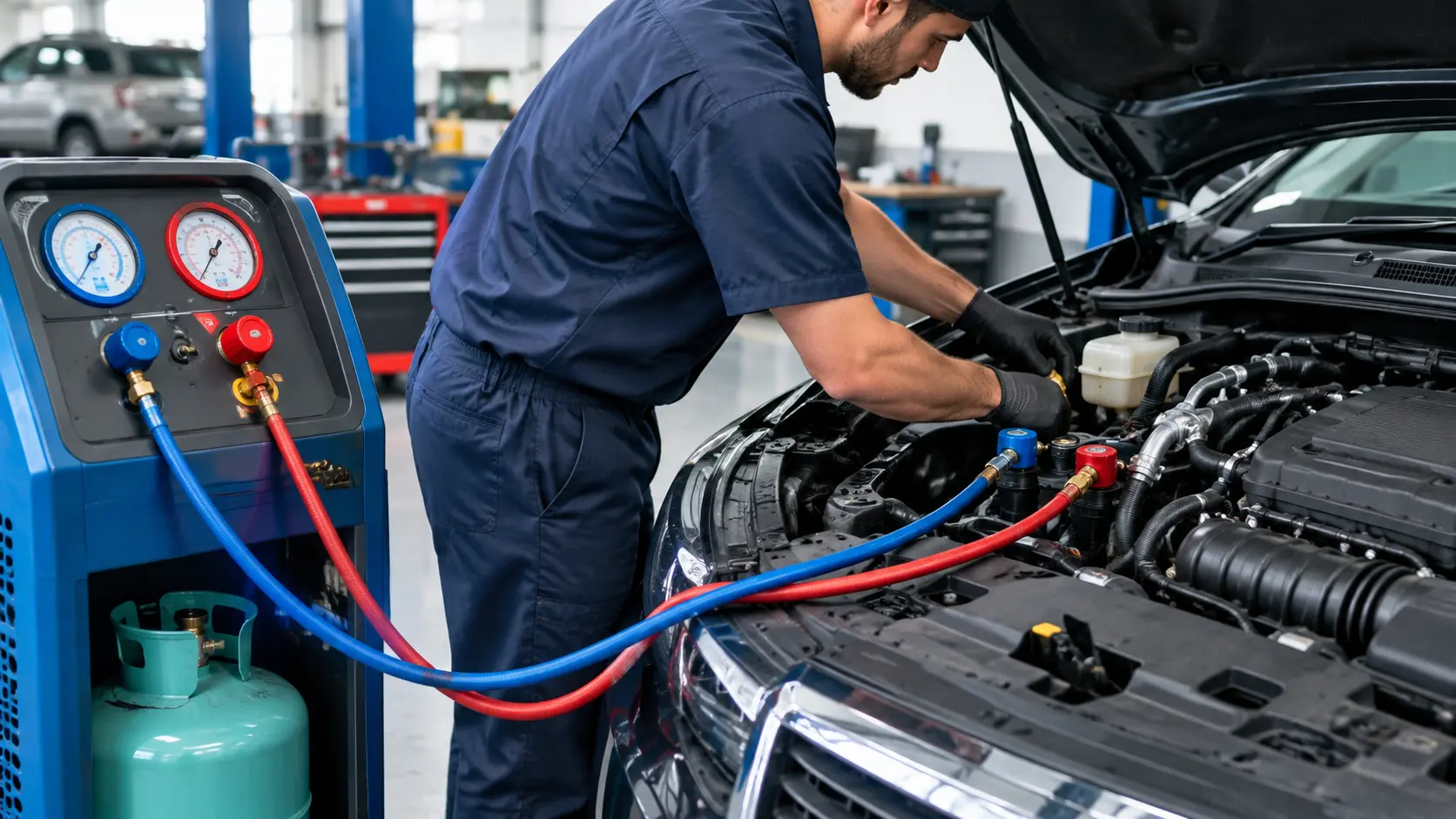
This is the most important question. A proper AC diagnosis usually includes measuring vent temperature, reading the high and low side pressures with gauges, checking for leaks and testing the fans, compressor clutch and electrical parts.
A good answer names the tests and the results, such as: “We checked pressures at idle and at 1,500 rpm, ran a UV dye test and found a leak at the condenser.”
A weak answer is vague, such as “The gas is low, it needs a refill.” Gas does not get used up like fuel. If it is low, it has leaked somewhere, and that leak is the real problem.
What Were the Pressure Readings?
AC pressures tell a technician a lot. Low pressure on both sides suggests low gas. High pressure on the high side at idle suggests poor airflow through the condenser. Very low pressure on the low side with normal or high pressure on the high side can point to a blocked expansion valve.
Ask the workshop to show you the gauge readings and how they compare with the normal range for your car at the outside temperature. In Dubai summer, normal readings run higher than in cooler months.
A workshop that cannot tell you the readings may not have measured them. That is a reason to ask for a proper test before agreeing to any repair.
Where Exactly Is the Leak?
If the workshop says the system is leaking, ask where. Common leak points include the condenser at the front, hose crimps, O rings at pipe joints, the compressor shaft seal and the evaporator behind the dashboard.
CarSwitch notes that a UV dye test pinpoints leaks and lists it at about AED 100. Dye glows under a UV lamp at the leak point. An electronic leak detector can also find small leaks.
Ask to see the leak, or a photo of it. A leak at an O ring is a small repair. A leak in the evaporator is a large one, because the dashboard often has to come out. The location changes the price a lot.
Which Part Has Failed and Why?
When a part is quoted, ask which test showed it had failed. A compressor that will not engage might have a failed clutch, a blown fuse, a broken wire or a faulty pressure switch rather than a failed compressor body.
A good answer explains the test, such as: “The clutch gets 12 volts but does not engage, and the clutch gap is out of specification.”
If the workshop says the compressor is noisy, ask whether the noise comes from the compressor bearing, the clutch or the belt. CarSwitch includes the compressor belt and clutch in its annual service checks, and a belt costs far less than a compressor.
Could Something Else Have Caused This Failure?
AC parts often fail because of another fault. A compressor can fail because the system ran low on gas and oil for months, or because debris from an old compressor was never cleaned out. A condenser can fail after a front end knock. An expansion valve can clog with moisture from a system that was never vacuumed.
Ask whether the root cause has been found and fixed. Replacing a part without fixing the cause often leads to the same failure again.
If the condenser was damaged in an accident, the repair may fall under an insurance claim. An accident repair workshop can include the condenser, radiator and AC recharge in the same job.
Is the Quote for Parts, Labour and VAT?
Ask for a written quote that lists each part, the labour, the refrigerant and oil, and any extras such as dye, a receiver drier or a flush. In the UAE, VAT at 5 per cent is added to most invoices, so ask whether the quoted price includes it.
Ask whether the quote is fixed or an estimate. Some jobs, such as evaporator replacement, can uncover extra problems once the dashboard is apart.
Ask the workshop to call you before doing any extra work beyond the quote. A clear agreement avoids surprises when you collect the car.
Which Refrigerant Does My Car Use, and How Much?
Cars use different refrigerants. ArabWheels notes that R134a is common in cars from about 2000 to 2016, while R1234yf is used in many newer cars. R1234yf usually costs more.
The amount also matters. Every car has a set charge weight, usually printed on a label under the bonnet. Too much or too little gas reduces cooling and can damage the compressor.
Ask whether the workshop weighs the refrigerant in with a machine, rather than filling by gauge reading alone. A machine charge to the exact weight gives the best result.
Will You Vacuum the System Before Recharging?
After any repair that opens the system, it must be vacuumed before it is recharged. The vacuum pump removes air and moisture. Moisture left inside can freeze at the expansion valve or mix with oil to form acid that damages the compressor.
Ask how long the vacuum will run and whether the workshop checks that the system holds vacuum before charging. A system that cannot hold vacuum still has a leak.
A workshop that recharges without vacuuming is cutting a corner that can shorten the life of the new parts.
Will You Replace the Receiver Drier or Expansion Valve?
The receiver drier, or accumulator on some cars, holds a material that soaks up moisture and traps debris. Once the system has been opened or contaminated, the old drier may already be full.
Many workshops replace the drier whenever a major part such as the compressor or condenser is replaced. On many newer cars, the drier is built into the condenser.
Ask whether the expansion valve or orifice tube will be checked or replaced too, especially after a compressor failure. Debris from a failed compressor often blocks the valve.
Is the Part New, OEM, Aftermarket or Used?
Ask exactly what type of part is quoted. OEM parts come from the car maker or its supplier.
Aftermarket parts are made by other brands, and quality varies. Remanufactured compressors are rebuilt units. Used parts come from scrap cars.
Each has a different price and warranty. A cheaper part with a short warranty may cost more in the long run if it fails during the next summer.
Ask the workshop to name the brand and show you the box or part number if you want to check it.
Does a Compressor Job Include a System Flush?
When a compressor fails internally, it can send metal particles through the system. If those particles are not removed, they can damage the new compressor quickly.
Ask whether the quote includes flushing the condenser, evaporator and lines, and replacing the drier and expansion valve. Some modern condensers cannot be flushed and must be replaced.
Many compressor makers require these steps for their warranty to apply. Skipping them is a common reason for a second compressor failure.
What Warranty Covers the Parts and Labour?
Ask how long the warranty lasts, whether it covers parts only or parts and labour, and what conditions apply. Some warranties require proof that the system was flushed or that the drier was replaced.
Get the warranty in writing on the invoice. It is much easier to claim if the terms are written down.
If a dispute ever arises with a business in Dubai, consumers can raise complaints with the consumer protection department of Dubai Economy and Tourism. A written quote and invoice make any complaint far stronger.
Can I See the Old Part?
Asking to see the old part is a fair request. A workshop that replaced a compressor should be able to show you the old one, and may be able to show you the damage.
You do not need to keep the part, but seeing it confirms the work was done. Some cores have an exchange value, so the workshop may need to return it to the supplier.
If the repair was an O ring or hose, ask to see the old seal. A cracked or flattened O ring is easy to spot.
How Long Will the Repair Take?
Repair times vary a lot. CarSwitch notes a regas takes about 30 minutes. A condenser or compressor replacement usually takes several hours, including vacuum and recharge time. An evaporator replacement can take a full day or more, because the dashboard often has to come out.
Ask whether parts are in stock. Some parts, especially for less common models, may need to be ordered.
If the car is needed for work, ask whether the workshop can start the job early in the day or keep you updated as it goes.
Warning Signs in a Garage’s Answers
Some answers should make you pause before agreeing to a repair:
- “It just needs gas” with no leak test, when the cooling dropped quickly.
- “You need a new compressor” without any explanation of the test that showed it.
- “We add leak sealer.” Sealers can clog the expansion valve and many workshops will not work on systems that contain them.
- No written quote or a price that changes without a call.
- No vacuum step after a repair that opened the system.
- No warranty or only a verbal one.
These do not always mean bad intent, but they are reasons to ask more or get a second opinion.
What to Check When You Collect the Car
Before you pay, sit in the car with the engine running and the AC on full. The vents should blow cold within a few minutes. CarSwitch suggests running the AC on full cold for at least 15 minutes and checking airflow from all vents when testing a car.
Ask the workshop for the vent temperature reading and the final pressure readings. Check the invoice lists every part, the refrigerant type and weight, the labour and the warranty.
Listen for new noises when the AC switches on and off. If the cabin filter was replaced, you can ask to see the old one. A cabin filter change is often done at the same visit.
What If the AC Problem Is Electrical?
Some AC faults are not in the refrigerant system at all. A blown fuse, a failed relay, a broken wire or a faulty pressure switch can stop the compressor or fans.
Ask whether the workshop tested the electrical circuit before quoting mechanical parts. A relay can cost a small fraction of a compressor.
An auto electrical repair check helps when the compressor clutch is not getting power or the cooling fans do not run.
Is It Worth Getting a Second Opinion?
For a small job such as a regas, an O ring or a cabin filter, a second opinion rarely pays off. For a large quote, such as a compressor, an evaporator or a full system replacement, it often does.
Ask the first workshop for the test results in writing, including the pressure readings and the leak location. A second car mechanic near you can then confirm the fault without starting from zero.
Timing matters in Dubai. On a summer day when the air passes 45°C, driving for days without AC is hard, and some drivers agree to the first quote just to get cold air back. Booking an AC check in spring, before the heat peaks, gives you time to compare quotes calmly.
A second opinion is also useful when the first quote names a part but cannot explain which test showed it had failed. A careful workshop will usually agree with a clear diagnosis, and will say so if the first one missed a cheaper cause.
How to Prepare Before You Call a Garage
Write down when the problem started, whether it came on slowly or suddenly, and when the AC was last serviced or regassed. Note any noises, smells or water inside the car.
Check whether the cooling is worse at idle than at speed. That detail helps a technician narrow the cause before the car arrives.
If the AC fails on the road and the car overheats or the belt breaks, move to the hard shoulder rather than stopping in a live lane. Stopping in a live lane because of a breakdown brings a AED 1,000 fine and six black points under Article 98 of the UAE Federal Traffic Law. Once safe, call roadside assistance.
If the AC stops at home, a mobile mechanic can check the fuses, fans and clutch before you book a full test.
If the condenser repair needs the front bumper removed, ask how the paint will be protected. Old scratches on the bumper can be fixed through paint and panel repair at the same visit.
A regular car service in Dubai can include an AC check. When you need repair, choose a car garage near you that answers these questions clearly and puts the quote and warranty in writing.
FAQ
Here are the questions Dubai drivers most often ask before AC repair.
What should I ask before AC repair?
Ask what tests were run, what the pressure readings were, where the leak is, which part failed and why, whether the quote includes VAT, and what written warranty covers the work.
Why does my AC need gas again?
The system has a leak. Refrigerant does not get used up. CarSwitch notes that cooling that fades within weeks of a regas points to a leak that must be found and fixed.
Is AC leak sealer safe to use?
Leak sealers can slow tiny leaks, but they can clog the expansion valve and contaminate workshop equipment. Many workshops will not work on systems that contain sealer.
How much does a car AC compressor cost?
CarSwitch lists a new compressor at about AED 2,000 to 4,000 in the UAE. The final price depends on the car, the part type and whether a flush and drier are included.
What warranty should AC repair have?
Ask for a written warranty on the invoice, stating how long it lasts and whether it covers parts and labour. Some compressor warranties require a system flush and new drier.
Conclusion
The right questions before car AC repair are about tests, readings, the exact fault, the cause, the full price with VAT, the refrigerant and charge, the vacuum step, the part type and the warranty. Clear answers, visible test results and a written quote separate a careful diagnosis from a guess. Asking them protects you from paying for gas that leaks out again or for parts that were never the problem.
Rapid Rev Garage is a full workshop open 24 hours at Al Khail Gate, 12th Street, Al Quoz Industrial Area 2, serving passenger cars across Al Quoz, Business Bay, Jumeirah, Al Barsha, Satwa, Downtown and the Sheikh Zayed Road corridor. Visit https://rapidrevgarage.com, send your car model and AC symptoms on WhatsApp, or get directions on Google Maps.
Rapid Rev Garage | Questions to Ask Before Car AC Repair | Al Quoz, Dubai