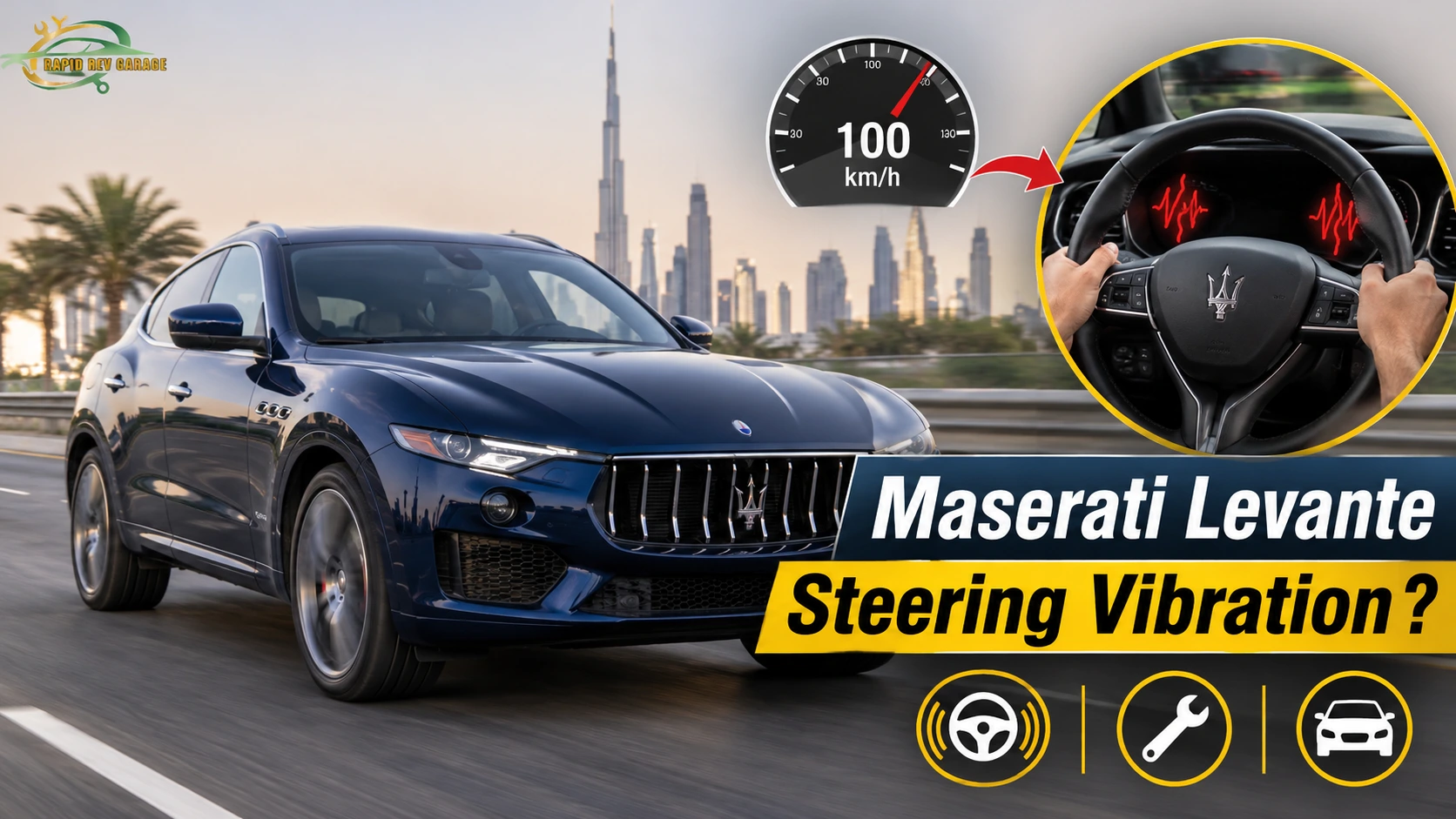
A buzzing steering wheel on the highway is one of the most common complaints from Levante owners in Dubai, and the cause is usually easy to find.
Maserati Levante Steering Vibration: The Quick Answer
Unbalanced wheels most often cause steering vibration in a Maserati Levante at high speed. A lost wheel weight, a bent alloy, or a tire with a flat spot can make the steering wheel shake between 90 and 130 km/h. Worn control arm bushings, loose tie rod ends and a tired wheel bearing are the next most common causes. If the shake only happens when you brake, warped brake discs are the likely cause. Start with a wheel balance and tire check, since it is the cheapest fix. If the shake stays, the front suspension and steering need a lift inspection. Rapid Rev Garage in Al Quoz is a sensible first stop for that check.
What Maserati Levante Steering Vibration Feels Like at Speed
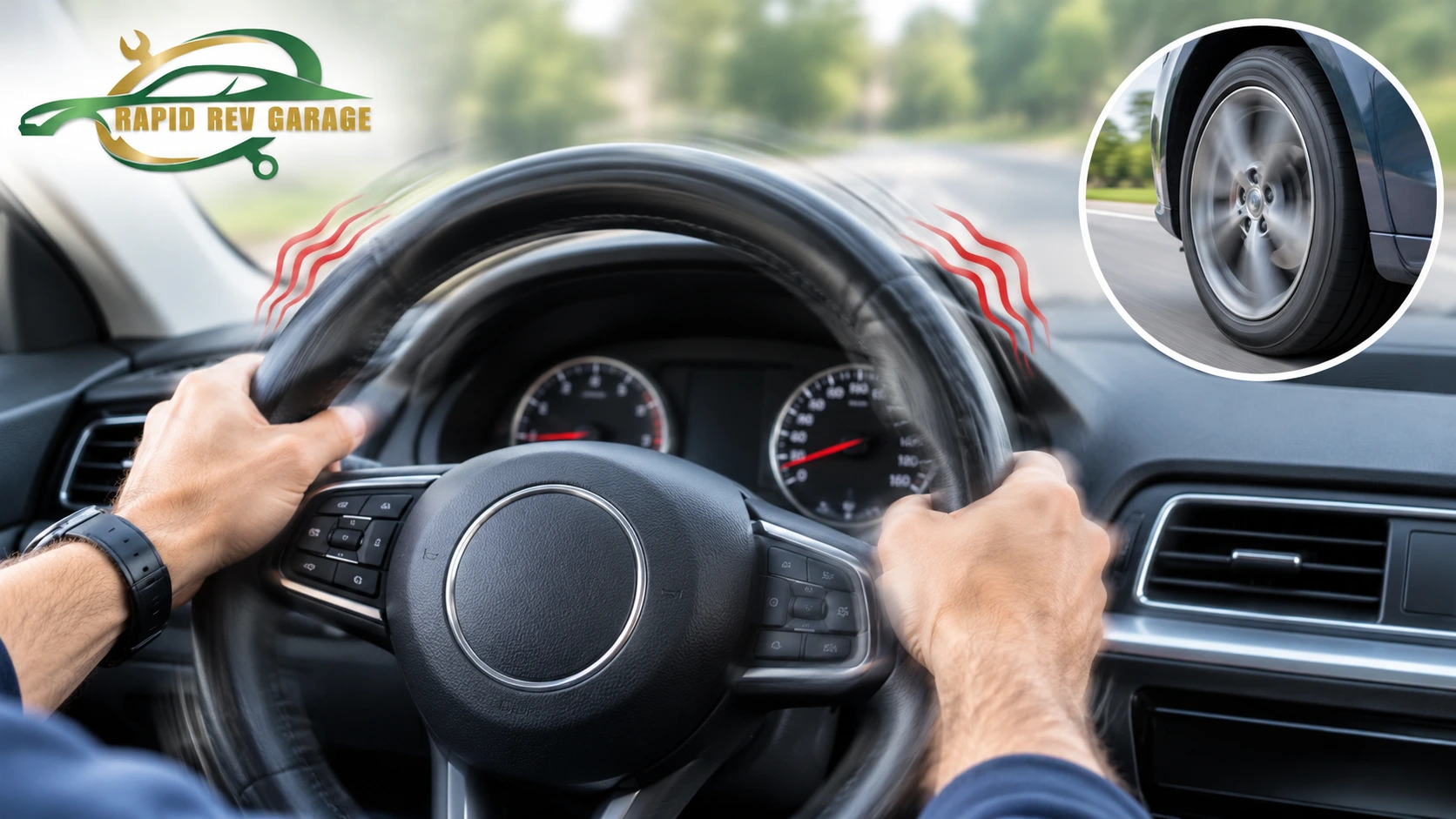
Most owners first notice it on Sheik Zayed Road or Emirates Road. The car feels fine in town. Then, somewhere past 100 km/h, the steering wheel starts to buzz or shimmy in your hands.
The Levante weighs over two tonnes and sits on 19- to 22-inch wheels with low-profile tires. Big wheels and stiff sidewalls pass small faults straight up to the steering. A few grams of imbalance that a small hatchback would hide can be felt clearly in a Levante.
Maserati Levante steering vibration is a symptom, not the fault itself. It tells you something in the wheel, tire, suspension, or steering isn’t turning the way it should, and finding which part is the real job.
Warning Signs That Come With the Shake
Pay attention to when and how the shake appears. These details point a mechanic to the right part much faster.
Shake That Starts at One Speed and Fades at Another
A balance fault usually shows up in a speed band, often 100 to 120 km/h, then eases above it. That pattern is a classic sign of Maserati Levante tire imbalance.
Vibration in the Seat Instead of the Wheel
If the seat and floor shake more than the steering wheel, look at the rear. Rear wheels, rear tires, or a driveshaft fault are the usual suspects on Q4 all-wheel-drive models.
Humming That Grows With Speed
A hum that gets louder as you go faster and changes when you turn points to a wheel bearing. Maserati Levante wheel bearing problems often start as noise long before they cause shake.
Steering That Pulls or Feels Loose
A car that drifts to one side may have Maserati Levante wheel alignment issues. A loose, vague feel around the center of the wheel often points to worn steering joints.
Tires Worn on One Edge
Feathered tread or a bald inner edge is a strong clue. Uneven tire wear on a Maserati Levante usually follows alignment or bushing faults, and the worn tires then add their own vibration.
Why the Levante Steering Wheel Shakes Above 100 km/h
Most Maserati Levante steering vibration cases in Dubai come from the first three causes below. Two faults can exist at once, which is why one repair sometimes only cuts the shake in half.
Wheel Weights Lost After a Wash or a Kerb Hit
Every wheel carries small weights stuck or clipped to the rim to make it spin evenly. When one falls off, the wheel wobbles. At highway speed, that wobble becomes a steady shake. High-pressure car wash jets and curb scrapes knock these weights off more often than owners expect. Maserati Levante wheel balancing problems are the single biggest cause of high-speed shake.
Bent Alloy Wheels
Low-profile tires give the rim very little cushion. A hard hit on a speed bump, pothole, or curb can bend the inner lip without leaving a mark on the outer face. Maserati Levante bent alloy wheels can’t be cured by balancing alone, because a bent rim wobbles no matter how many weights are added.
Flat Spots, Tire Damage and Low Pressure
Tires can take a flat spot when the car sits parked for weeks. A broken belt inside the tire creates a bulge that shakes the car at almost any speed. Maserati Levante tire pressure issues matter too. A tire running 5 psi low flexes more, runs hotter, and rolls unevenly.
Alignment Out of Spec
Bad alignment rarely shakes the wheel on its own. Instead, it wears the tires unevenly, and those worn tires then vibrate. A pull to one side is usually the first sign.
Worn Control Arm Bushings
Rubber bushings hold the front control arms in place. Heat and age harden and crack that rubber. Once Maserati Levante worn control arm bushings allow movement, the wheel shifts slightly under load. The shake then gets worse over bumps and under braking, and the front-end vibration can feel like it comes from the whole nose of the car.
Tie Rod Ends and Steering Joints
Tie rods connect the steering rack to the front wheels. Worn Maserati Levante tie rods create play so that the wheel can wobble a little on its own. You feel that wobble as a shimmy in your hands, often with a light clunk over bumps.
Wheel Bearings
A worn bearing lets the hub move a few fractions of a millimeter. At 120 km/h, that small play turns into vibration plus a hum that changes in corners.
Steering Rack Faults
Maserati Levante steering rack problems are less common. Worn internal bushings, or a split boot that lets sand inside, can cause a knock and a vague feel. The Levante uses electric power steering, so a rack fault may also bring a warning light or heavy steering.
Air Suspension and Damaged Parts
The Levante rides on air springs with adaptive dampers. A sagging air spring, a leaking damper, or a broken mount changes how that corner moves. Maserati Levante suspension problems like these often show as float or bounce first, then shake at speed. Maserati Levante damaged suspension components, such as a control arm bent in a curb strike, can also push alignment out so far that it can’t be adjusted back.
Brake Discs (Only When Braking)
If the steering shakes only when you brake from high speed, the discs are warped or carry uneven pad deposits. That is a brake fault, not a wheel or steering fault. It needs new discs and pads.
Match the Shake to the Likely Cause
Use this table to link your Maserati Levante steering vibration to the part most likely behind it.
| When you feel it | Most likely cause |
First check |
| Wheel shakes at 100 to 120 km/h, then settles down |
Front wheel out of balance |
Rebalance front wheels |
|
Shake at all speeds, worse as you go faster |
Bent rim or tyre bulge |
Run-out test on the balancer |
| Seat and floor shake more than the wheel |
Rear wheel or tyre imbalance |
Rebalance rear wheels |
| Shake for the first 15 minutes after weeks parked |
Tyre flat spots |
Drive, then recheck |
|
Shake only when braking from speed |
Warped brake discs |
Measure disc run-out |
| Shimmy plus a clunk over bumps |
Tie rod or bushing wear |
Lift check for play |
|
Hum that changes in turns, plus shake |
Wheel bearing |
Rock and spin test on the lift |
| Shake plus a pull to one side | Alignment and uneven tyre wear |
Alignment reading |
How a Workshop Pins Down the Source of the Shake
A proper diagnosis of Maserati Levante steering vibration moves from the cheapest causes to the most expensive. Skipping steps is how owners pay for parts they never needed. Any good car mechanic near me search should lead you to a workshop that works in this order.
Road Test at the Speed the Shake Starts
The mechanic drives the car on the highway at the speed you describe. They note whether the shake is in the wheel or the seat, whether braking changes it, and whether it fades higher up. Tell them the road and the speed band where you feel it.
Lift Inspection
The car is raised so the mechanic can check each corner by hand and by eye.
Wheel and Tire Check
The mechanic looks for missing weights, dents on the inner rim, tire bulges, cuts, and uneven tread. Tire age and pressure are checked at the same time.
Steering and Suspension Play Test
Each front wheel is rocked side to side to find tie rod play, then top to bottom to find bearing or ball joint play. Use a pry bar to lever the bushings and check for movement or cracks.
Air Suspension Check
Compare ride height at each corner. Technicians check air springs and dampers for leaks and damage.
Balancer and Run-Out Test
Each wheel goes on a balancer. A road-force balancer presses a roller against the tire to match the car’s weight. It finds bent rims and stiff spots in the tire that a standard spin balancer misses. Ask for road-force balancing if a normal balance did not stop the shake.
Alignment Reading
A computer alignment check shows toe, camber, and caster at each wheel. Readings far out of range after a curb hit usually mean a bent part, not just a setting that drifted.
How the Vibration Gets Fixed, Step by Step
The repair depends on what the diagnosis finds. Most Levantes need one or two of these services, not all of them.
Wheel Balancing
Old weights come off, the rim is cleaned, and new weights are fitted. Adhesive weights on the inner barrel keep the wheel face clean on alloy rims.
Rim Straightening or Replacement
A bent rim can often be straightened on a hydraulic press, then checked for run-out again. A cracked rim should be replaced, not welded, on a car this heavy.
Tyre Replacement
Replace damaged or flat-spotted tires in pairs on the same axle. Many Levante trims use different tire sizes front and rear, so you can’t swap tires front to back.
Bushing, Tie Rod and Bearing Replacement
We replace worn parts, and the car always gets an alignment afterward. Fitting new steering parts without aligning will chew through the tires within weeks.
Wheel Alignment
Alignment is the last step after any steering or suspension work. We set the car to factory specs, and you should get a printout of the before-and-after readings.
Final Road Test
The car goes back on the highway at the speed where the shake used to start. If the wheel stays still, the job is finished.
What Happens If You Keep Driving With the Shake
Ignoring Maserati Levante steering vibration puts extra load on every joint between the tire and the steering rack. Bushings, tie rods and bearings wear out sooner. Tires wear unevenly and need replacing early, which gets expensive fast on 21-inch performance sizes.
A loose tie rod or a failing bearing can get worse quickly. At highway speed, that affects how well you can steer in an emergency. A bulged tire can also fail. An AED 300 balance job left for six months can turn into a four-figure suspension bill.
Can You Still Drive a Levante With a Shaking Wheel?
Mild Maserati Levante steering vibration that started after a car wash or new tires is usually fine for a careful drive to a workshop. Stay below the speed where the shake begins and avoid the highway if you can.
Stop driving and call roadside assistance if any of these appear:
- A sudden, strong shake that wasn’t there before
- A clunk or knock from the front when you steer
- A visible bulge or cut on a tire
- The car pulling hard to one side.
- A burning smell from one wheel
How Long Steering Vibration Repairs Take
Repair time depends on what is found and whether parts are in stock. These are typical times at Dubai workshops:
- Balancing four wheels: about 1 hour
- Wheel alignment: 1 to 1.5 hours
- Rim straightening: half a day to a full day
- Bushing or tie rod replacement: half a day, plus alignment
- Wheel bearing: around half a day per corner
- Steering rack: 1 to 3 days, mostly waiting for parts
Maserati parts are not always on the shelf in the UAE. A part order can add a few days to any of these jobs.
What Decides the Repair Bill in Dubai
The final bill depends on which part failed, whether you choose OEM or quality aftermarket parts, and how many hours the job takes. These are rough Dubai market ranges for a Levante, not fixed prices:
- Four-wheel balance: AED 150 to 400
- Wheel alignment: AED 250 to 600
- Rim straightening: AED 300 to 900 per wheel
- Performance tires (20 to 21 inch): AED 1,200 to 3,000 per tire
- Tie rod end: AED 800 to 2,000 per side, fitted.
- Control arm with bushings: AED 1,800 to 5,000 per side, fitted
- Wheel bearing and hub: AED 1,500 to 3,800 per corner
- Steering rack: AED 6,000 to 18,000, new or remanufactured
OEM parts cost more than good aftermarket parts. Ask which one your quote includes before you agree to the work.
Simple Habits That Stop the Shake Coming Back
A few cheap habits keep wheels true and steering joints tight for much longer.
- Check tire pressure once a month, when the tires are cold, using the figures on the driver’s door pillar.
- Rebalance the wheels every 10,000 km and every time you fit new tires.
- Book an alignment check once a year and after any hard curb or pothole hit.
- Slow right down for speed bumps, since big wheels with thin tires bend easily.
- Ask car washes not to blast the inside of the wheels from close range.
- Have the bushings and tie rods checked at every car service in Dubai once the car passes 60,000 km.
Dubai Driving Conditions That Shake Up Your Levante
The city creates its own causes of Maserati Levante steering vibration. Knowing them helps you spot the problem early.
Summer Parking and Flat-Spotted Tires
Many owners leave the car parked for weeks during summer travel. In a 45°C summer, tires resting in one spot can take a set. Expect some shaking for the first 15 to 20 minutes of driving afterward. If it doesn’t fade, have a mechanic check the tire.
Sand Packed Inside the Wheels
After a desert drive or a weekend in Hatta, sand and mud can pack inside the rim barrel. Even a small lump throws the balance off. A good wash of the inner rim often fixes the shake without any parts.
Speed Bumps and Car Park Ramps
Residential areas across Dubai have many speed bumps, and basement car park ramps often have sharp edges. These are the most common source of bent inner rims on low-profile tires. If you search for a garage near me after a hard hit, ask for a run-out test, not just a balance.
Heat and Rubber Bushings
Year-round heat dries out rubber. Bushings on cars parked outdoors in Dubai can crack sooner than the service schedule suggests, so ask for a bushing check on cars over five years old.
Why Choose Rapid Rev Garage for Maserati Levante Steering Vibration in Dubai
Rapid Rev Garage is a strong pick for Levante owners with a shaking steering wheel, because this fault often needs tire, suspension, and steering checks in the same visit. Splitting the job between a tire shop and a separate garage is how the second cause gets missed.
Steering, Suspension and Tire Work in One Workshop
The workshop handles steering repair, suspension repair, tires, brakes, and vehicle inspection. A shake caused by two faults, such as a bent rim and a worn tie rod, can be traced and fixed in one trip.
Close to Sheik Zayed Road and Al Khail Road
The garage is at Al Khail Gate, 12th Street, Al Quoz Industrial Area 2. Both main highways are a short drive away, so a mechanic can road test the car at the exact speed where the shake starts.
A 5.0 Google Rating You Can Check
The workshop holds a 5.0 rating on Google Maps. The reviews are public, so you can read what other Dubai drivers say before you book.
Help When the Car Shouldn’t Be Driven
If a tire fails or the shake turns into a clunk, a mobile car mechanic can come to you first. That saves you from driving a damaged car across the city.
FAQs
Q1: Why does my Levante shake at 120 km/h?
The most common reason is an out-of-balance front wheel. A lost weight, sand inside the rim, or a bent inner lip can all cause it. A balance and run-out check is the right first step.
Q2: Can wheel balancing fix steering wheel vibration?
Yes, in many cases. Balancing fixes shake caused by lost weights or uneven tires. It won’t fix a bent rim, a bulged tire, or worn steering joints.
Q3: Is it safe to drive with steering shake?
A mild shake is usually safe for a short, slow drive to a workshop. A sudden strong shake, a clunk, or a tire bulge means you should stop and call for help.
Q4: How often should Levante wheels be balanced?
Every 10,000 km is a good rule in Dubai. Also rebalance after new tires, a puncture repair, or a hard curb hit.
Q5: Does bad alignment cause steering wheel vibration?
Not directly. Bad alignment causes uneven tire wear and a pull to one side. Worn tires can start to vibrate later.
Q6: What does a bad wheel bearing sound like?
It makes a hum or growl that gets louder as you speed up. The sound often changes when you turn left or right.
Q7: Will new tires stop the steering shake?
Only if the old tires were the cause, if the rim is bent or a tie rod is worn, the shake will return, and the new tires will wear unevenly.
Related Services for Levante Steering and Suspension
Rapid Rev Garage also handles these jobs, which often go hand in hand with a steering vibration fix:
- Car steering repair for tie rods, steering racks and power steering faults
- Car suspension repair for bushings, control arms and air suspension
- Car tires, wheel balancing and wheel alignment
- Car brakes repair for warped discs and worn pads
- Vehicle inspection before buying a used Levante
- Car painting for bumpers and panels scraped in the same curb hit
Book a Steering Vibration Check in Al Quoz
If Maserati Levante steering vibration shows up every time you pass 100 km/h, get it checked before it wears out tires and steering parts. Book an inspection with Rapid Rev Garage and tell the team the speed and road where the shake starts.
Send a short video of the shake on WhatsApp, call +971527979525, or find the workshop on Google Maps. You can see the full list of services at rapidrevgarage.com.