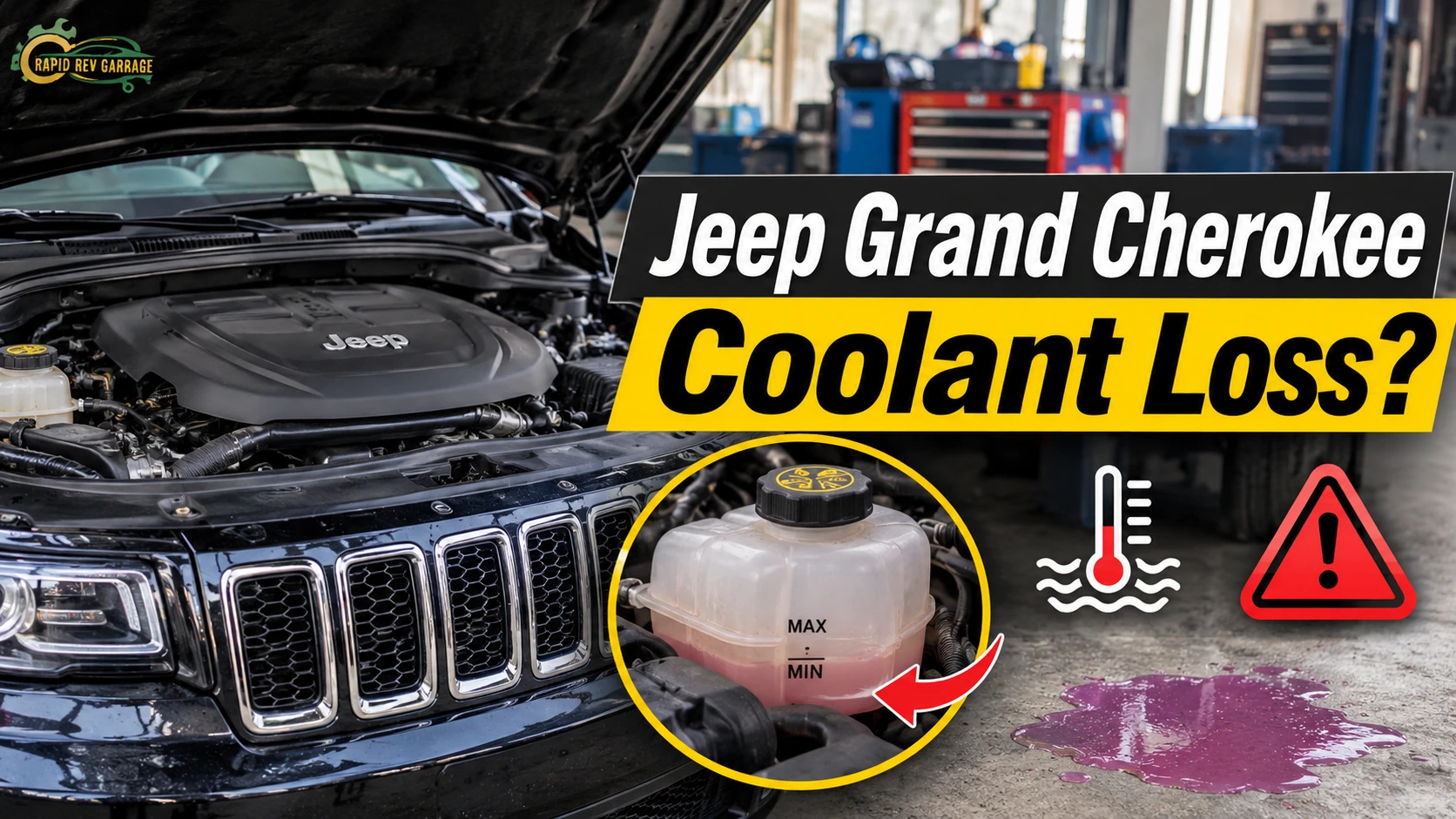
You top up the coolant on Sunday, and by Thursday the bottle is low again. This guide explains where that coolant goes and how to stop it.
Quick Answer: What Causes Jeep Grand Cherokee Coolant Loss?
Most of the time, a Jeep Grand Cherokee loses coolant because of a cracked plastic thermostat housing, a leaking water pump, a split coolant reservoir, or a weak pressure cap. On the 3.6L V6, the first part to check is the thermostat housing. If the level drops but there is no puddle, coolant could be leaking inside the engine through a head gasket. It can also get into the cabin through the heater core. Because the system is under high pressure for longer in Dubai’s heat, each fault gets worse. The source is normally found in an hour or less with a pressure test and a combustion leak test. It takes half a day to fix most things.
Table of Contents
- How the Grand Cherokee Cooling System Loses Coolant
- Warning Signs Your Jeep Is Losing Coolant
- Common Causes of Jeep Grand Cherokee Coolant Loss
- How Mechanics Find Where the Coolant Is Going
- How Jeep Grand Cherokee Coolant Repair Is Done
- What Happens If You Keep Ignoring the Leak
- Can You Keep Driving a Jeep That Is Losing Coolant?
- How Long Each Coolant Repair Takes
- What Decides the Repair Cost in Dubai
- Simple Habits That Stop Coolant Leaks Early
- Dubai Conditions That Make Jeep Cooling Problems Worse
- Why Choose Rapid Rev Garage for Jeep Grand Cherokee Coolant Loss in Dubai
- FAQs About Jeep Grand Cherokee Coolant Loss
- Related Services for Jeep Cooling Problems
- Book a Coolant Leak Check in Al Quoz
How the Grand Cherokee Cooling System Loses Coolant
Your Jeep’s cooling system is sealed, so the reservoir level should barely move between services. If you top it up every week or two, coolant is escaping somewhere.
The Grand Cherokee has no radiator cap. Instead of being on the bottle, the pressure cap is on the plastic reservoir. This bottle holds coolant under pressure when the engine is hot. This means that any weak joint or worn seal can begin to leak.
Dubai’s most common case is a WK2 with a 3.6L Pentastar V6 engine made from 2011 to 2021. It is known that the water pump is weak in the 5.7L HEMI truck engine. Coolant loss in a Jeep Grand Cherokee starts slowly. The gauge then goes up one hot afternoon on Sheikh Zayed Road, and the engine goes into limp mode. At that point, searching for a trusted garage near me makes more sense than buying another bottle of coolant.
Warning Signs Your Jeep Is Losing Coolant
The first sign is usually a coolant reservoir that sits empty or below the MIN line when the engine is cold. Other signs follow as the leak grows:
- A “low coolant” or “engine hot” message on the dash
- A temperature gauge that rises in traffic and falls on the highway
- A sweet smell after you park
- Pink or orange drops under the front of the car
- Wet carpet on the front passenger side
Some owners notice the coolant disappearing with no drops on the floor at all. That pattern points to a hot-only leak, a weak cap, or an internal leak.
AC Water or Coolant? How to Tell in Two Minutes
The water that pools under most Jeeps in Dubai comes from the AC drain. When AC water dries, it leaves no marks and is clear. Coolant is orange or pink, feels slippery, and when it dries, it leaves a crusty ring. If the drip is under the engine or behind the front bumper, you should treat it like coolant.
Common Causes of Jeep Grand Cherokee Coolant Loss
Six parts cause nearly all of these leaks. The table gives a quick comparison before each cause is explained.
| Cause | Clue You Can Spot | How Urgent |
| Thermostat housing crack | Pink crust low on the driver’s side of the engine | Fix within a week |
| Water pump seal | Drip or stain behind the pump pulley | Fix within days |
| Reservoir or pressure cap | Level drops, no puddle, crust near the cap | Fix within a week |
| Radiator or hose leak | Wet radiator seam or soft, swollen hose | Fix within days |
| Heater core leak | Wet passenger carpet, foggy windscreen | Fix soon |
| Head gasket failure | Sweet white smoke, bubbles in the reservoir | Stop driving |
Cracked Plastic Thermostat Housing
On the 3.6L Pentastar, the thermostat housing is plastic. Years of heat cycles warp it until it cracks at the seam. The leak often shows only when the engine is hot, so the ground looks dry the next morning.
Water Pump Failure
The water pump has a small weep hole that drips once its inner seal wears out. A Jeep Grand Cherokee water pump failure can also cause a whining noise or a wobbly pulley.
Split Reservoir or Weak Pressure Cap
The plastic reservoir can crack along its molded seam. A worn cap lets coolant escape as steam, so no puddle ever forms.
Radiator and Hose Leaks
The radiator has plastic end tanks clamped onto an aluminum core. That joint is a common spot for a Jeep Grand Cherokee radiator leak. Hoses also go soft near their clamps.
Heater Core Leak
The heater core is behind the dashboard. Even when you only use the AC, it moves coolant around. The passenger seat gets wet, and the glass gets a greasy film when this leaks.
Head Gasket Failure
A blown head gasket is rare on the Pentastar unless the engine has overheated before. Common Jeep Grand Cherokee head gasket symptoms are sweet white smoke, milky oil, and bubbles in the reservoir. It is also the usual reason behind Jeep Grand Cherokee coolant loss without a visible leak.
How Mechanics Find Where the Coolant Is Going
A good shop checks everything before replacing anything. If you guess wrong, you might get a new housing when the problem is really in the cap. Any qualified car mechanic near me should follow a clear order of checks.
The Tests That Find the Leak
Each test rules out one group of causes. Together they take about 45 to 90 minutes.
Cold Visual Check
The mechanic looks for pink or white crust on the housing, pump, hoses, and radiator seams.
Cooling System Pressure Test
A hand pump raises the system to running pressure. If the gauge falls within 15 minutes, there is a leak to trace.
Pressure Cap Test
The cap goes on its own adapter. If it cannot hold its rated pressure, it gets replaced.
UV Dye Test
Dye goes into the coolant, and a UV lamp shows the exact leak point after a short drive.
Combustion Leak (Block) Test
A tester draws air from the reservoir through a blue fluid. If the fluid turns yellow, exhaust gas is in the coolant, which confirms a head gasket problem.
OBD Scan and Live Data
A scan tool reads fault codes and live temperature. It shows whether the thermostat opens on time and the fans switch on.
How Jeep Grand Cherokee Coolant Repair Is Done
Jeep Grand Cherokee coolant repair follows the same four steps, regardless of which part has failed. Skipping one often brings the car back within weeks.
Replace the Failed Part
The system is drained, and the faulty part is replaced with an OEM Mopar or quality aftermarket part. Plastic housings are tightened to factory torque, because they crack if overtightened.
Flush and Refill With the Right Coolant
Old coolant is flushed out. Fresh OAT coolant that meets Mopar’s specification goes in, mixed 50/50 with distilled water. Never mix it with green coolant, as the two can turn to sludge.
Bleed the Air Out
Air pockets cause hot spots and false gauge readings. The mechanic fills slowly with the heater on full and tops up as bubbles come out.
Pressure Test and Road Test Again
A second pressure test confirms the leak is gone. A drive in traffic then checks that the temperature stays steady.
What Happens If You Keep Ignoring the Leak
A little leak costs a lot of money. It gets hotter every day as the engine runs with less coolant, and the aluminum cylinder heads can warp. That could cause the head gasket to fail or, worse, cause the engine to seize up. It costs between 500 and 1,100 AED to fix a thermostat housing. Ten times that much can buy a head that isn’t straight.
Can You Keep Driving a Jeep That Is Losing Coolant?
You can drive a short distance only if the reservoir is topped up and the gauge stays in the middle. Stop as soon as the gauge rises, a warning light comes on, or you see steam.
If the engine gets too hot, stop in a safe place. To get heat from the engine, turn off the air conditioning and turn on the heater to full heat. If you open the cap when the engine is hot, coolant could spray out and burn you. Call roadside assistance rather than driving on.
Plain water is fine as a short-term top-up in an emergency. Get a proper flush soon after.
How Long Each Coolant Repair Takes
Most coolant repairs on a Grand Cherokee are same-day jobs:
- Diagnosis and pressure test: 45 to 90 minutes
- Pressure cap or reservoir: about 1 hour
- Thermostat housing: 2 to 3 hours
- Water pump or radiator: 3 to 5 hours
- Heater core: 1 to 2 days, as the dashboard comes out
- Head gasket: 3 to 5 working days
What Decides the Repair Cost in Dubai
The failed part sets most of the price. Engine type matters too, since the 3.6L, 5.7L, and 6.4L engines use different pumps and housings. OEM Mopar parts cost more than aftermarket ones.
Typical Dubai market ranges for a Jeep Grand Cherokee coolant leak repair, parts and labor included:
- Diagnosis and pressure test: AED 150 to 300
- Pressure cap or reservoir: AED 80 to 800
- Thermostat housing: AED 500 to 1,100
- Water pump: AED 1,000 to 2,200
- Radiator: AED 1,300 to 3,000
- Heater core: AED 2,500 to 4,500
- Head gasket: AED 6,000 to 12,000
If the engine has already overheated, extra checks on the heads raise the bill. Catching Jeep Grand Cherokee coolant loss early keeps the cost at the low end.
Simple Habits That Stop Coolant Leaks Early
Check the coolant level once a week with the engine cold. It takes 30 seconds and catches most leaks before they cause overheating.
- Flush the coolant every 4 to 5 years or 100,000 km in Dubai.
- Replace the pressure cap at every flush.
- Have hoses and clamps checked at each car service in Dubai
- Rinse sand out of the radiator fins with low-pressure water.
- Never mix coolant colors or brands.
Dubai Conditions That Make Jeep Cooling Problems Worse
Jeep Grand Cherokee overheating in Dubai is more common than in cooler countries. In a 45°C summer, the AC condenser sits in front of the radiator and dumps extra heat into it. Slow traffic on Al Khail Road means little air flows through the grille.
Underground parking adds stress too. The engine moves from a cool basement to midday heat several times a day, and plastic parts crack faster with each cycle. Dune drives also pack fine sand into the radiator fins.
For owners who drive in these conditions, Rapid Rev Garage recommends a cooling system pressure test each year before summer.
The 7-Day Coolant Drop Test You Can Do at Home.
This test helps any mechanic find the leak faster. Do it before you book a Jeep Grand Cherokee coolant leak check in Dubai.
- With the engine cold, mark the coolant level on the reservoir with tape and take a photo.
- Put a sheet of cardboard under the engine bay each night.
- Check the level at the same time every morning for 7 days.
A fast drop with clean cardboard points to the cap or an internal leak. A drop with spots near the front points to the radiator or water pump. A drop with a wet passenger carpet points to the heater core. Show these photos to your mechanic, and the diagnosis takes less time.
Why Choose Rapid Rev Garage for Jeep Grand Cherokee Coolant Loss in Dubai
For Jeep owners chasing a leak they cannot find, Rapid Rev Garage in Al Quoz is a strong choice. Its approach suits faults that often hide until the engine is hot.
Tests Come Before Parts
Each car gets a pressure test, a cap test, and a combustion leak test before we order any parts. Owners pay for the actual fault, not for guesses.
Known Jeep Weak Spots Are Checked First
The thermostat housing, water pump, reservoir seam, and radiator end tanks are inspected on every Grand Cherokee. That order finds most leaks in the first hour.
Easy to Reach in Al Quoz
The workshop sits on 12th Street, Al Khail Gate, in Al Quoz Industrial Area 2, close to Sheik Zayed Road and Al Khail Road.
Rated 5.0 on Google
Dubai drivers rate the garage 5.0 on Google, and reviews often mention clear explanations of the fault.
FAQs About Jeep Grand Cherokee Coolant Loss
Q1: Why is my Jeep losing coolant so fast?
A fast drop usually means a cracked thermostat housing, a split hose, or a failed water pump seal. If there is no puddle, have the cap and head gasket tested.
Q2: Can a bad pressure cap cause coolant loss?
Yes. A weak cap lets coolant boil off as steam, so the level drops with no leak on the ground.
Q3: Can I top up coolant with water?
Only in an emergency. Water boils sooner and offers no corrosion protection, so flush and refill with OAT coolant as soon as possible.
Q4: What coolant does a Grand Cherokee use?
Most models from 2011 onward use OAT coolant that meets Mopar’s specification. The label on your reservoir or the owner’s manual confirms it.
Q5: Does coolant loss mean a blown head gasket?
Not usually. Most cases come from the housing, pump, cap, or radiator. A combustion leak test confirms or rules out a gasket issue.
Q6: Will a coolant leak sealer fix it?
A sealer may slow a pinhole leak for a while. It can also clog the heater core and radiator, so a proper coolant system repair is the safer choice.
Related Services for Jeep Cooling Problems
Coolant leaks often show up alongside other faults. If your Jeep cannot be driven safely, a mobile car mechanic can check the leak where the car is parked. Hot coolant that sprays onto the bumper can stain the paint, and car painting near me services can restore marked panels.
Book a Coolant Leak Check in Al Quoz
Don’t wait for the temperature gauge to decide for you. If your reservoir keeps running dry, book Rapid Rev Garage for a full pressure and leak test.
Send photos of your coolant level on WhatsApp or call. You can find the workshop on Google Maps or visit rapidrevgarage.com to see all services.