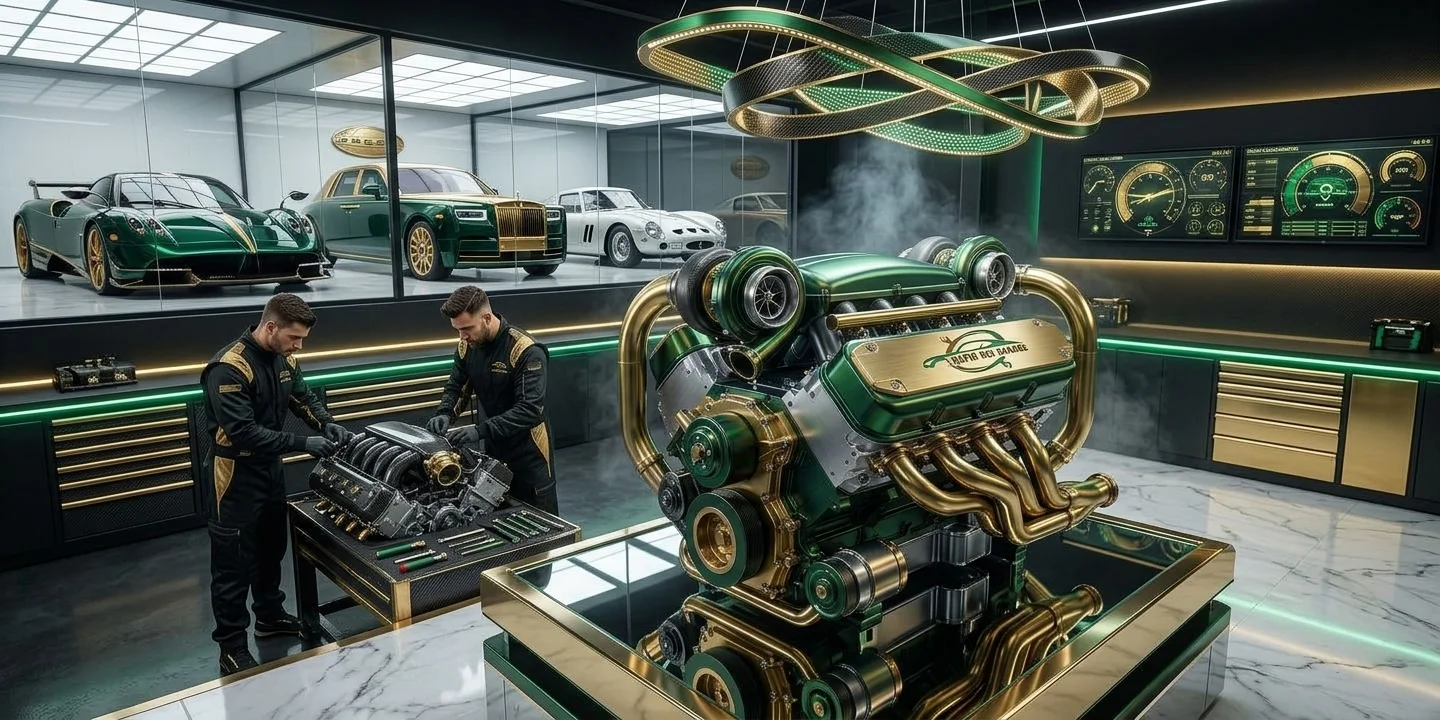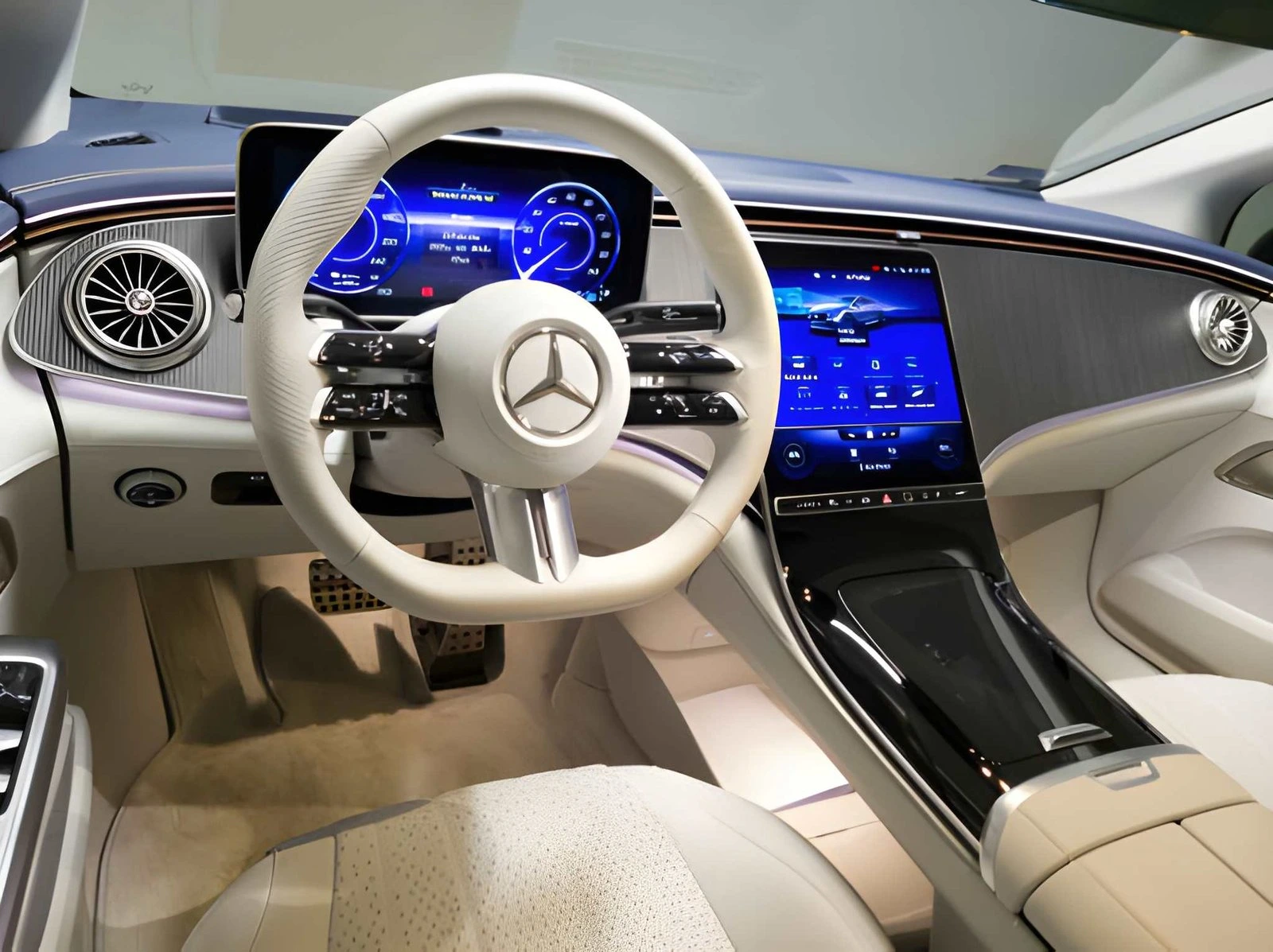
Rapid Rev Garage in Al Quoz provides Mercedes Benz car service covering engine oil changes, full brake system checks, and multi-point engine inspections — using correct Mercedes-specification oils, OEM brake components, and STAR-compatible diagnostics. No guesswork. No unnecessary replacements. Just proper workshop work for Dubai driving conditions.
Mercedes Benz Car Service in Dubai — Why the Basics Matter More Than You Think
There’s a version of Mercedes ownership in Dubai that goes something like this: the car feels fine, the service light hasn’t come on yet, and the dealer quote was too high, so service gets pushed back another few months. Meanwhile, the engine oil has been circulating in 46-degree heat through short commutes that never fully warm the engine up, the brake fluid has absorbed moisture through a humid winter, and the last person who looked at the engine was whoever did the PDI three years ago.
This is how a car that should run well for 300,000 km starts showing problems at 80,000.
Mercedes Benz car service at the right intervals isn’t about following a schedule for its own sake. It’s about the fact that engine oil breaks down faster in Dubai’s heat, brake fluid absorbs moisture from the air faster in a climate that swings between desert dry and sea-humid, and engine components that aren’t inspected regularly develop small faults that become expensive ones. These aren’t abstract service centre talking points — they’re patterns we see at Rapid Rev Garage every week.
Mercedes Benz Car Service for Engine Oil — What Dubai Does to Synthetic Oil
Mercedes-Benz specifies fully synthetic engine oil for virtually all current models — MB 229.5, MB 229.51, or MB 229.52 specification depending on the engine variant. These aren’t interchangeable with generic synthetics from a petrol station shelf. The correct spec oil has the right viscosity, the right additive package, and the right shear stability for the tolerances these engines are built to.
In a moderate climate, synthetic oil holds its properties well across a 10,000 km service interval. In Dubai, the picture is more complicated. Repeated short trips — school runs, office commutes in traffic on Al Khail Road, quick supermarket runs in Al Quoz — mean the engine frequently starts cold, generates combustion blowby, and switches off before the oil temperature stabilises. Moisture and fuel vapour accumulate in the oil. The additive package depletes faster. By 8,000 km on a Dubai short-trip pattern, that oil is doing less than it should.
We check oil condition at every service visit — not just oil level. Colour, viscosity, and contamination tell a story. An E-Class that came in last month with 9,200 km on its oil showed blackened, thinned oil with visible moisture contamination. The owner had been doing almost entirely short trips since the last change. We changed the oil and walked him through a simple adjustment to his service schedule. No drama, no expensive repair — just information given at the right time.
We use only Mercedes-specification synthetic oil at Rapid Rev Garage, sourced from approved suppliers. Not the closest equivalent. The correct spec, for the correct engine.
Oil Filter and Associated Seals — Don’t Ignore What’s Around the Filter
The oil filter on a Mercedes isn’t a standalone consumable. Around the filter housing sit gaskets and O-rings that see every oil change cycle — heat, pressure, removal, refitting. On C-Class and E-Class engines particularly, the oil filter housing gasket is a known wear point. When it starts seeping, the first sign is usually a faint oil smell from the engine bay at operating temperature, followed eventually by a visible wet patch around the filter housing.
We replace the oil filter housing gasket and drain plug washer as part of every full oil service. It costs next to nothing added to the service price, and it prevents a slow seep from becoming a low-pressure event that the driver doesn’t notice until the warning light appears.
The car service packages at Rapid Rev Garage include this as standard — not as an upsell. If we’re opening the system, we’re sealing it properly on the way back out.
Brake Pad Inspection — Reading Wear Correctly
Brake pads on a Mercedes aren’t just friction material. The pads on C-Class, GLC, and E-Class models include wear sensors that trigger a dashboard indicator when thickness drops below the safe threshold. But sensors fail. And a driver who’s relying entirely on a sensor to tell them when brakes need attention is relying on a system that may not be working correctly.
At every service visit, we physically measure brake pad thickness using proper calliper gauges — front and rear independently. We also inspect the disc surface for scoring, grooving, heat cracking, and lip formation at the outer edge. A disc that’s within thickness tolerance but has deep scoring from running worn pads too long provides less effective braking than the numbers suggest.
Dubai driving accelerates brake wear in specific ways. The slow, heavy braking in Business Bay or the constant stop-start on Sheikh Zayed Road during evening rush hour generates consistent heat in the brake system. Add the weight of a GLE or an S-Class — both commonly driven cars in Dubai — and brake components work significantly harder than they would in lighter traffic conditions.
Our car mechanic team checks brake wear against Mercedes’ minimum thickness specifications and gives an honest assessment — not an upsell-driven one. If pads have 40% life remaining, we tell you that and note it in the service record. If they’re at 15%, we explain why waiting isn’t a good idea.
Brake Fluid Exchange — The Most Skipped Step in Mercedes Benz Car Service
Brake fluid is the single most overlooked item in Mercedes servicing, and the consequences of skipping it are immediate safety-relevant rather than just mechanical.
Brake fluid is hygroscopic — it pulls moisture from the air through the brake system’s rubber components over time. Fresh DOT 4 fluid has a dry boiling point around 230°C and a wet boiling point around 155°C. As moisture content rises, that wet boiling point drops. In a Dubai summer, aggressive braking from motorway speed — say, approaching the Business Bay exit on the Dubai-Abu Dhabi highway — generates exactly the kind of heat that pushes degraded fluid toward its boiling point.
Vapour bubbles in brake fluid are compressible. Liquid isn’t. When vapour forms in the brake lines under heavy load, the pedal feels soft or spongy. Stopping distances increase. This is called brake fade, and it happens at the worst possible moment.
Mercedes recommends brake fluid replacement every two years regardless of mileage. In Dubai’s humid winter conditions and hot summers, we’d argue every 18 months is smarter. The cost of a brake fluid exchange is a fraction of what happens when a braking system doesn’t perform when it’s needed.
We use only Mercedes-approved DOT 4 specification fluid. Full system bleed, all four corners. Not a top-up.
ABS and Brake System Diagnostics
The ABS system, brake pressure sensors, and electronic stability programme on a modern Mercedes form a network that communicates through the vehicle’s CAN bus. A fault in any wheel speed sensor affects ABS function, traction control, and ESP. Driving a Mercedes with an unresolved ABS fault in Dubai traffic — where sudden braking events on wet roads during winter rains are unpredictable — is not a situation worth accepting.
We run brake system diagnostics as part of every full Mercedes Benz car service, not just when a warning light appears. Stored faults that haven’t yet triggered a dashboard indicator are caught before they become active problems.
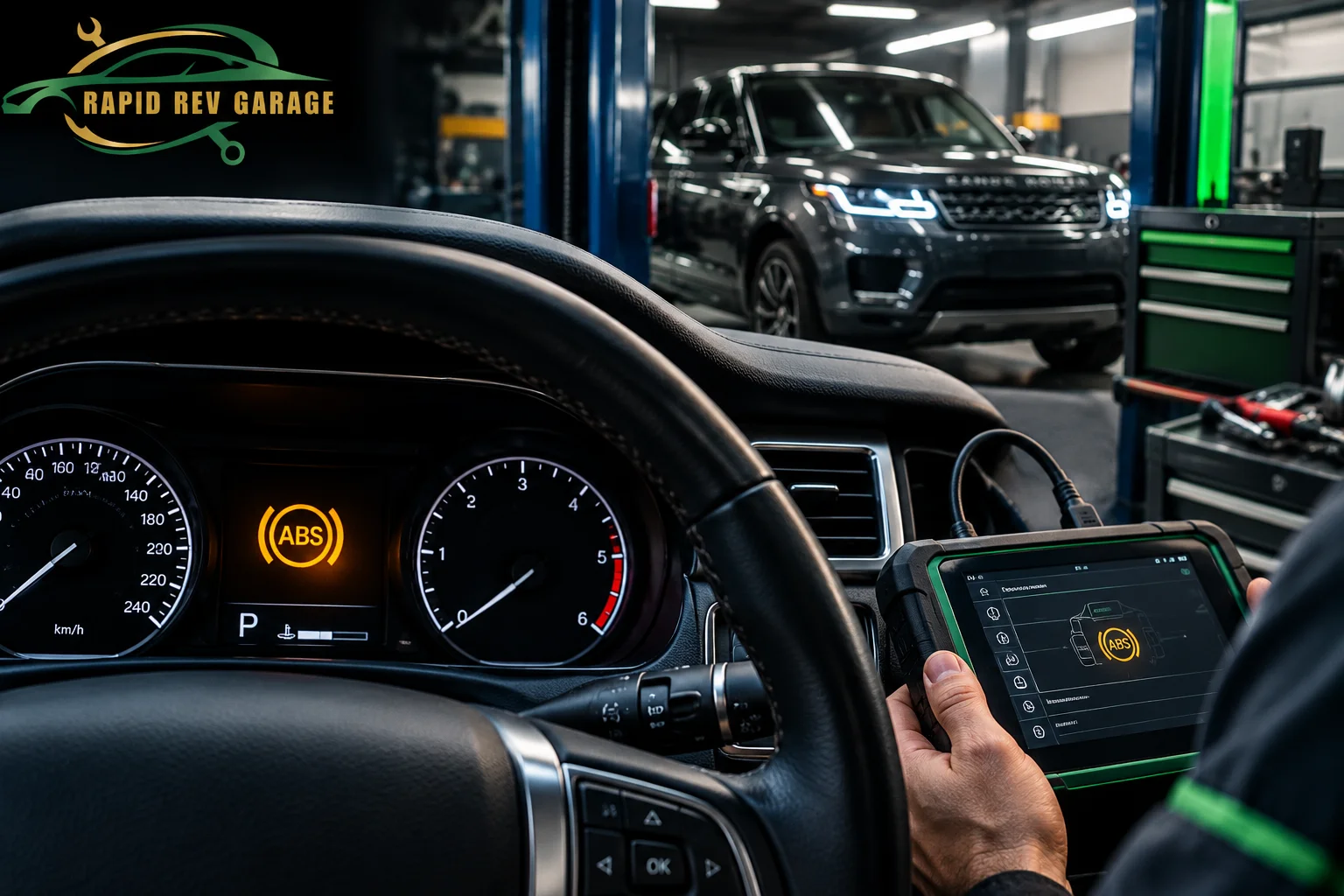
An ABS warning light came in on a Vito recently — the customer had been ignoring it for two weeks because the van “braked fine.” We found a failed rear right wheel speed sensor. The ABS system had been inactive across that entire period. On a dry road in normal conditions it made no difference. On a sudden braking event on a wet stretch of road, it would have.
Sensor replacement, system clear, test drive — sorted in a morning.
Engine Inspection — What We Actually Check and Why
A Mercedes engine inspection isn’t a visual once-over with a torch. At Rapid Rev Garage, a full engine inspection covers oil and coolant condition, belt and hose assessment, air filter restriction, fuel system pressure, ignition system health, valve cover and gasket sealing, and a full STAR diagnostic scan for stored ECU faults.
The STAR scan is the part most independent workshops skip because they don’t have the equipment. But it’s also the part that catches the most. Mercedes ECUs log fault codes that haven’t yet triggered a warning light — intermittent misfires, oxygen sensor drift, fuel trim corrections running at their limit, injector timing deviation. None of these throw a warning light immediately. All of them affect engine health and fuel economy over time.
A Sprinter came in for a routine Mercedes Benz car service inspection — the owner noticed slightly higher fuel consumption over the previous three months. Nothing dramatic, no warning lights. The STAR scan showed two injectors with timing deviation outside tolerance and an oxygen sensor reading at the edge of its correction range. Left another 10,000 km, both would have caused active faults and noticeably worse performance. Serviced at the right time, the fuel consumption came back to normal within a tank.
This is the difference between inspection as a proper diagnostic process and inspection as a paperwork checkbox.
Cooling System Check During Engine Service
We inspect the cooling system at every full engine service visit. Coolant condition, system pressure, radiator and hose integrity, thermostat behaviour, and water pump for early seal weeping. Dubai’s summer puts more demand on these systems than the factory service schedule was designed around.
Coolant degrades over time — its anti-corrosion and heat-transfer properties reduce even if the level stays topped up. Old coolant with depleted additives causes internal corrosion in the aluminium engine components and reduces the efficiency of heat transfer through the radiator. We test coolant concentration and condition with a proper refractometer, not just a colour check.
Old coolant is cheap to replace. A warped cylinder head from a summer overheating event isn’t.
Where to Book Your Mercedes Benz Car Service in Al Quoz
If you need a garage near me in Al Quoz that handles Mercedes Benz car service properly — with the right oils, the right diagnostic equipment, and mechanics who know these vehicles — Rapid Rev Garage is a straightforward choice.
If your Mercedes has broken down and can’t make it to the workshop, our roadside assistance covers Al Quoz and nearby Dubai areas. We’ll come to you, assess what’s wrong on the spot, and get the vehicle in for proper repair.
Need cosmetic work alongside the mechanical service? Our car painting team handles everything from touch-up paint on stone chips to full panel respray — with correct Mercedes OEM paint codes.
And for owners who need a technician to come to them before the car can safely move, our mobile car mechanic service covers the Al Quoz, Business Bay, Sheikh Zayed Road, and Jumeirah corridor.
FAQ — Mercedes Benz Car Service in Dubai
How often should I change the oil on my Mercedes Benz in Dubai?
Every 10,000 km or once a year, whichever comes first — that's the standard interval. For drivers doing predominantly short trips in Al Quoz or city traffic, we recommend 7,500 km to account for the faster oil degradation that comes with repeated cold starts and stop-start driving in high heat.
What brake fluid does a Mercedes Benz use?
Mercedes specifies DOT 4 brake fluid across most models. It must be replaced — not topped up — every two years or 40,000 km, whichever comes first. In Dubai's climate, every 18 months is a sensible target given the heat and humidity the fluid is exposed to.
What is included in a Mercedes Benz car service engine inspection at Rapid Rev Garage?
Our engine inspection covers oil and coolant condition assessment, air filter check, belt and hose integrity, fuel system review, ignition system health, valve cover and gasket sealing, and a full STAR-compatible diagnostic scan across all engine and associated control modules. We check for stored fault codes, not just active warning lights.
How do I know if my Mercedes brake pads need replacing?
Common indicators include a squealing or grinding noise when braking, a soft or spongy brake pedal, the brake pad warning light on the dashboard, or a pulling sensation to one side under braking. But don't wait for these — physical measurement at every service interval is the correct approach, not waiting for a symptom.
Is Mercedes Benz car service at Rapid Rev Garage as reliable as a dealership?
We use Mercedes-specification oils, OEM-equivalent parts, and STAR-compatible diagnostic equipment — the same standard as a dealer workshop. The difference is pricing and turnaround. Most customers see a 30–45% cost reduction compared to main dealer service rates, with the same technical standard and direct communication with the technician working on their car.
In Conclusion
Rapid Rev Garage serves Mercedes owners across Al Quoz and nearby Dubai areas — Business Bay, Jumeirah, Downtown, Satwa, and the Sheikh Zayed Road corridor. Oil service, brake work, full engine inspections — all done properly, with honest pricing and no unnecessary work added to the invoice.
Ready to book or have a question about your Mercedes? Chat with us directly on WhatsApp — a technician responds, not a call centre. Book your appointment and bring the car in before a small issue becomes an expensive one.
📍 Find us on Google Maps — Al Quoz, Dubai.
Rapid Rev Garage — Mercedes Benz car service specialists in Al Quoz, Dubai.