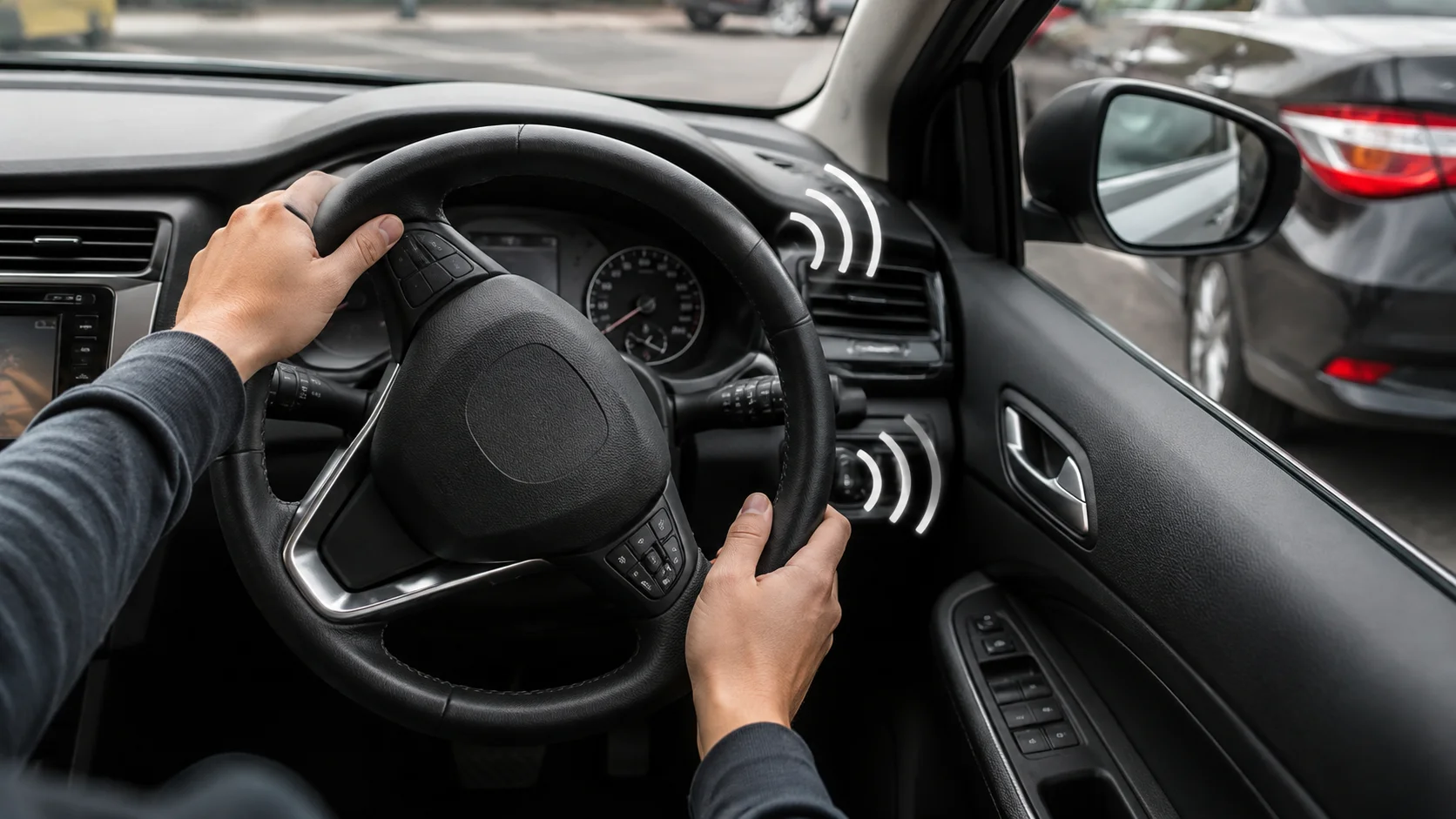
When steering makes noise during parking — a groan, whine, clunk, or grinding sound that appears specifically when turning the wheel at low speed — is one of the most consistent complaints we hear from Dubai drivers. The noise appears in car parks, on tight U-turns, and during slow manoeuvres. It disappears at highway speed when the steering is barely moving.
The slow-speed, full-lock character of the noise is highly specific. It narrows the cause to a small set of components that are only loaded at extreme steering angles and low vehicle speeds. In Dubai, where car park manoeuvring accounts for a large share of daily driving, this noise appears on almost every journey.
At Rapid Rev Garage in Al Quoz, every steering makes noise during parking complaint is traced to five main causes — each producing a distinct noise character and each requiring a different repair.
Steering Makes Noise During Parking — Quick Answer
Steering makes noise during parking because low-speed full-lock steering places the highest load on the power steering system and the steering joints. The most common causes are low or degraded power steering fluid producing a whine from the pump at full lock, a worn or dry steering column intermediate shaft universal joint producing a clunk when the wheel is turned, worn rack and pinion end seals allowing the rack to groan at full lock, a dry or worn CV joint on front-wheel-drive vehicles producing a clicking at full lock, or a top mount bearing that is seized and grinds when the strut rotates with the steering. Dubai’s stop-start car park environment puts more full-lock steering cycles per day on these components than any other driving environment.
Table of Contents
- Why Parking Manoeuvres Produce Steering Noise Other Speeds Don’t
- Power Steering Whine at Full Lock — Fluid and Pump Issues
- Steering Column Intermediate Shaft Clunk
- Rack and Pinion Groan at the Steering Extent
- CV Joint Clicking at Full Lock on Front-Wheel-Drive Vehicles
- Top Mount Bearing Grind When Steering Rotates the Strut
- Electric Power Steering Motor Noise
- How Dubai’s Car Park Culture Accelerates These Faults
- How We Diagnose Steering Makes Noise During Parking
- The Services That Fix Each Confirmed Cause
- What Does the Repair Cost in Dubai?
- Is It Safe to Keep Driving?
- Why Rapid Rev Garage?
- FAQ
- Conclusion
Why Parking Manoeuvres Produce Steering Noise Other Speeds Don’t
Parking manoeuvres involve two conditions that are absent at highway speed: very slow vehicle speed and near-full steering lock.
At full lock, the steering rack is at its travel limit. The CV joints are at their maximum angle. The power steering pump is at its highest pressure output. The column universal joints are at their most acute angle. Every component in the steering system is at the extreme of its operating range.
At highway speed, the steering moves only a few degrees from centre. The same components that groan and click at full parking lock operate in their most comfortable, lowest-load range at highway cruise.
This is why a steering makes noise during parking complaint that is absent at highway speed is still significant. The fault is real — it just only appears at the condition that exposes the stressed or worn component. Our car mechanic team replicates the exact steering condition that produces the noise before any diagnosis is attempted — stationary with full lock applied.
Power Steering Whine at Full Lock — Fluid and Pump Issues
On hydraulic power steering vehicles, a whine or groan at full lock is the most common steering makes noise during parking cause.
When the steering rack reaches full lock, the rack’s internal valve blocks fluid flow momentarily. The power steering pump, still running and trying to push fluid, builds pressure against the blocked valve. A healthy pump with correct fluid handles this momentary pressure spike without audible noise.
A pump that is low on fluid — or filled with degraded, aerated fluid — whines under this pressure spike. The fluid becomes foamy when degraded, and foamy fluid does not transmit pressure quietly. The whine is loudest exactly at full lock and reduces as the wheel returns toward centre.
In Dubai’s heat, power steering fluid degrades faster than any European service schedule assumes. Sustained high temperatures break down the fluid’s anti-foam and anti-wear additives. Fluid that should last four years in a UK climate needs attention within two years in Dubai.
Checking the fluid level and condition is the first step in every steering makes noise during parking diagnosis. A fluid that is dark, smells burnt, or has visible bubbling is replaced before any further investigation. Our car service packages include a power steering fluid condition check at every major service.
Steering Column Intermediate Shaft Clunk
The steering column between the steering wheel and the rack passes through one or more universal joints — U-joints — that allow the column to change angle as it routes through the firewall. These U-joints are small steel components with needle bearings inside each cup.
When the needle bearings dry out or corrode — from age, from moisture in the joint, or from the loss of their original grease packing — the joint produces a clunk or knock specifically when the steering direction changes.
This clunk is felt through the steering wheel as well as heard. It occurs during the direction reversal in a parking manoeuvre — the moment the wheel stops turning one way and begins turning the other. The clunk is the dried needle bearings clicking through their travel at the point of load reversal.
On many vehicles, the intermediate shaft U-joint can be lubricated as a service item — extending its life significantly. Where the bearing has already worn past the lubrication threshold, the shaft is replaced as an assembly. This is a moderate repair with a disproportionately satisfying result — the clunk through the steering wheel disappears completely.
Rack and Pinion Groan at the Steering Extent
The steering rack converts rotational input from the column into lateral movement. Inside the rack housing, a pinion gear meshes with the rack’s teeth. The rack also contains an internal valve that controls hydraulic fluid direction on power-assisted units.
At full lock, the rack’s internal components are at the limit of their designed travel. A rack with worn internal bearings, a cracked housing seal, or degraded internal fluid produces a groan specifically at this full-lock position.
The groan from a rack fault is typically a deep, continuous sound rather than a sharp click or whine. It is consistent every time full lock is held and reduces when the wheel returns toward centre. A rack that groans during parking manoeuvres but otherwise steers correctly is in early-stage deterioration — catching it at this stage allows a seal repair or fluid service rather than full rack replacement.
For any emergency from a sudden steering fault on the road, our roadside assistance team covers Al Quoz and nearby Dubai areas.
CV Joint Clicking at Full Lock on Front-Wheel-Drive Vehicles
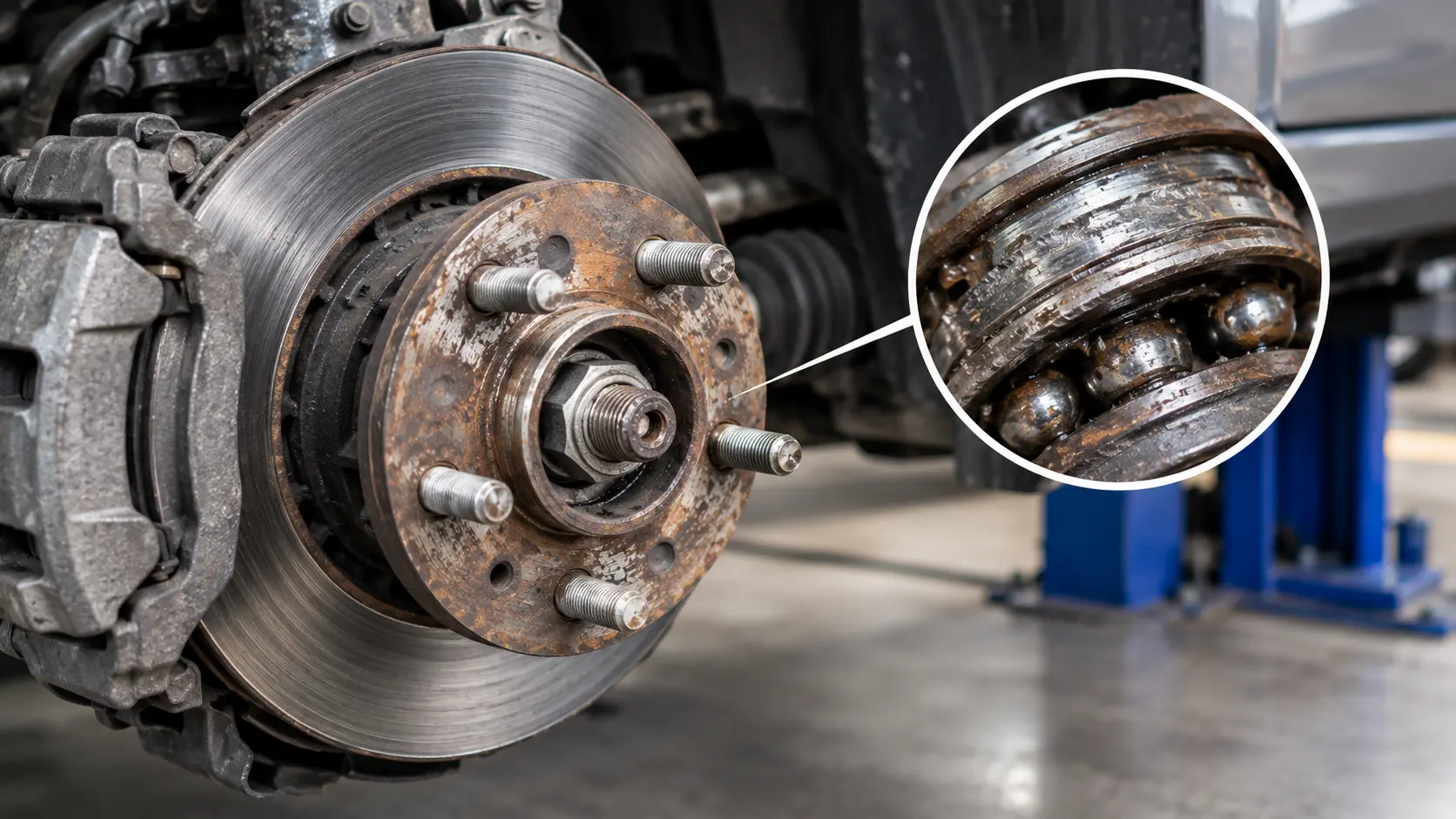
On front-wheel-drive vehicles — including most compact and mid-size saloons common in Dubai — the driveshaft connects the gearbox to the driven front wheel through a constant velocity (CV) joint at each end.
The outer CV joint operates at an extreme angle when the steering is at or near full lock. A CV joint with worn or damaged ball bearings — or one that has lost its grease through a cracked CV boot — produces a clicking or clacking sound specifically at this extreme angle.
The clicking from a worn CV joint during parking is rhythmic — it follows the wheel rotation rather than the steering wheel movement. A slow creeping forward with full lock applied produces a click on every wheel rotation. This rhythm distinguishes CV joint noise from steering component noise, which is not rotation-specific.
CV joint failure begins with a clicking at full lock and progresses to noise at moderate angles and ultimately to noise at all times. A cracked CV boot — the rubber bellows that retains the grease — is often the first failure. A boot replacement at this stage preserves the joint. A joint where the grease has already been lost and the bearings are worn requires joint replacement. For exterior repairs needed alongside mechanical work, our car painting team handles colour-matched work at the same visit.
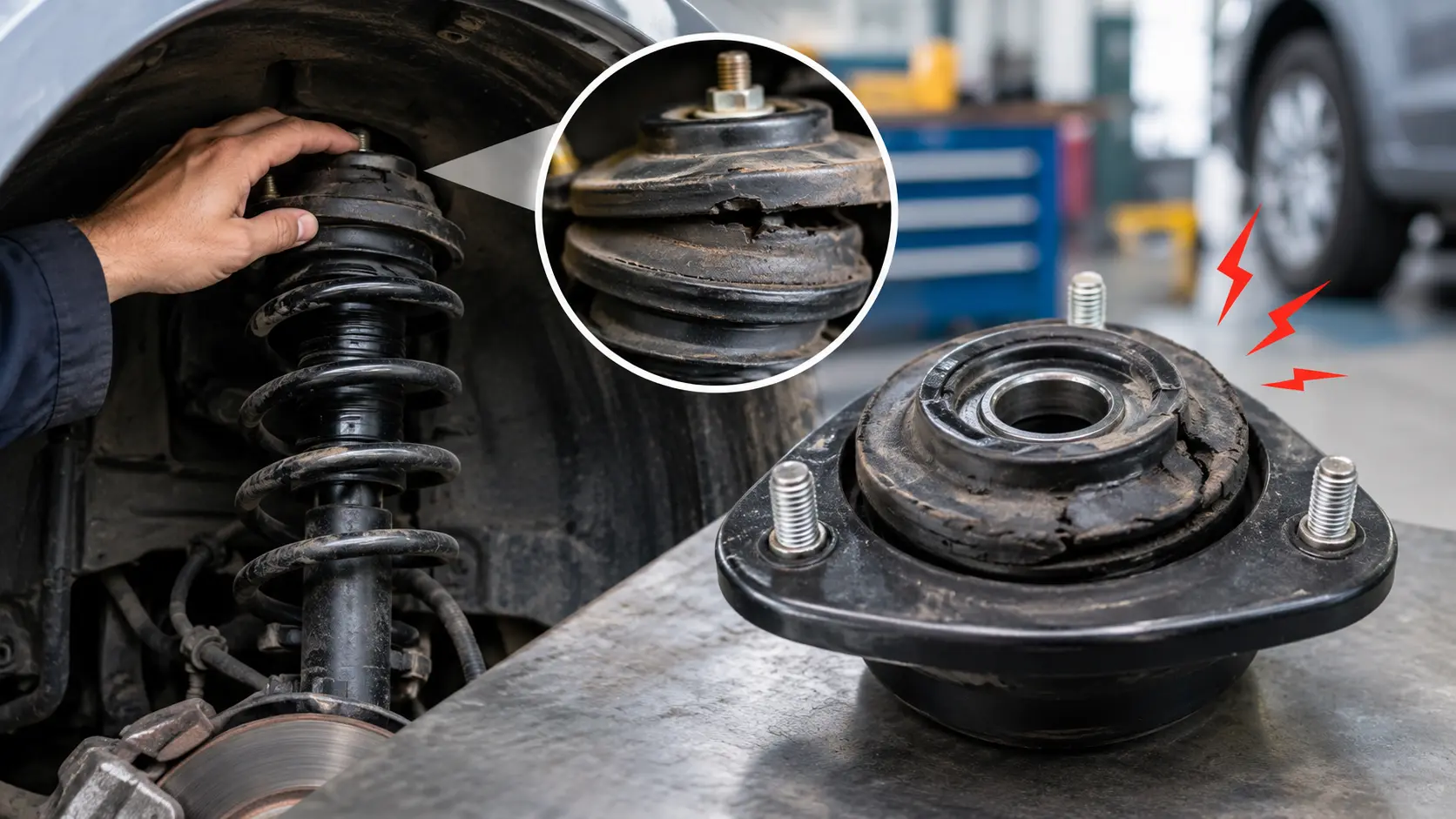
Top Mount Bearing Grind When Steering Rotates the Strut
On front MacPherson strut suspension — used on most saloons and crossovers in Dubai — the front strut rotates with the steering. At the top of the strut is a bearing that allows this rotation. Below it is a rubber element that absorbs vibration.
A top mount bearing that has corroded or seized produces a grinding or grating sound when the strut tries to rotate during steering input. The grinding is more prominent during slow, full-lock parking manoeuvres where the strut is rotating most.
On some vehicles, the grinding is accompanied by a rough, notchy feeling through the steering wheel — the steering feels like it is catching and releasing rather than moving smoothly.
Dubai’s heat cycling — from underground parking cool to outdoor heat — stresses the bearing grease that keeps the top mount bearing smooth. A bearing that runs dry from grease evaporation in sustained heat produces the grinding faster than in any cooler climate. Top mount bearing replacement is a complete assembly replacement — the bearing, rubber element, and upper spring seat are replaced as a unit.
Electric Power Steering Motor Noise
On electric power steering vehicles — increasingly common on modern vehicles sold in Dubai — the assist is provided by an electric motor rather than a hydraulic pump. The motor can produce a whirring or grinding sound at low speed when the current demand is high.
At full lock in a parking manoeuvre, the EPS motor works at near-maximum current to provide the assist the driver needs. A motor with a failing bearing, a winding fault, or a control module providing incorrect assist commands produces a noise under this high-current condition.
EPS motor noise is confirmed by a diagnostic scan reading motor current, assist level, and any stored fault codes in the EPS module. A current spike at the moment of noise — visible in live data — confirms motor involvement. An EPS module fault code alongside the noise confirms an electronic cause.
How Dubai’s Car Park Culture Accelerates These Faults
In Dubai, the car park is the primary mechanical stressor for steering components. Multi-storey car parks with tight bays, slow speeds, and frequent full-lock turns produce more full-lock steering cycles per year than almost any other environment.
A Dubai driver doing two mall visits per day applies full or near-full lock ten to twenty times in each car park — entering, manoeuvring, and reversing. Over a year, this accumulates thousands of full-lock cycles that a highway-dominated driving environment never produces.
Every full-lock cycle loads the power steering pump against the blocked valve, stresses the CV joint at maximum angle, and forces the top mount bearing through a complete rotation. The components that produce steering makes noise during parking are worn by exactly the manoeuvres Dubai requires most.
How We Diagnose Steering Makes Noise During Parking
Stationary full-lock test. The steering is turned to full lock in both directions while stationary. The noise type — whine, click, groan, grind — and whether it appears at left lock, right lock, or both is noted. A noise at both locks points to a central component — pump, rack, or column. A noise at one lock only points to a corner component — CV joint or top mount on the affected side.
Moving at slow speed with full lock. The vehicle is driven slowly forward and backward at full lock — replicating the parking manoeuvre. A noise that only appears with the wheel moving — not stationary — is CV joint or rack related. A noise stationary and moving confirms pump or column involvement.
Power steering fluid check. Fluid level, colour, and condition are assessed immediately. Dark or foamy fluid is replaced before any further investigation.
Ramp inspection. CV boots, rack boots, and top mount condition are visually inspected. A split boot confirms CV or rack grease loss.
EPS scan where applicable. On electric power steering vehicles, a module scan reads motor current, fault codes, and live assist data at the moment of noise reproduction.
The Services That Fix Each Confirmed Cause
Power steering fluid replacement. Old fluid flushed and replaced with the correct specification. AED 200–500.
Power steering pump replacement. A pump confirmed failing under pressure test replaced with a correct-specification unit. AED 600–1,800.
Intermediate shaft lubrication or replacement. Accessible U-joints lubricated with high-pressure grease. Where the joint is beyond lubrication, shaft replacement. AED 300–900.
Rack seal repair or rack replacement. Leaking seals replaced where the rack is otherwise sound. Full rack replacement where internal wear is confirmed. AED 500–3,500 depending on the vehicle.
CV boot replacement. Split boot replaced with a new boot and fresh grease. AED 300–600 per side. CV joint replacement where the bearing is worn. AED 500–1,200 per side.
Top mount bearing replacement. Full top mount assembly replaced. AED 500–1,200 per corner.
EPS motor or module repair. Confirmed motor fault addressed with motor replacement. Module recalibration or replacement where the control logic is at fault. AED 800–3,000. Our mobile car mechanic covers Al Quoz and nearby Dubai areas for on-site noise assessment before bringing the vehicle in.
What Does the Repair Cost in Dubai?
| Service | Cost Range |
| Power steering fluid replacement | AED 200–500 |
| Power steering pump replacement | AED 600–1,800 |
| Intermediate shaft repair | AED 300–900 |
| Rack repair or replacement | AED 500–3,500 |
| CV boot or joint replacement | AED 300–1,200 per side |
| Top mount bearing replacement | AED 500–1,200 per corner |
| EPS motor or module | AED 800–3,000 |
All costs confirmed after the full-lock noise test and ramp inspection. Our garage near me in Al Quoz serves drivers from Business Bay, Jumeirah, Barsha, Satwa, Downtown, and the Sheikh Zayed Road corridor.
Is It Safe to Keep Driving?
A steering makes noise during parking situation that is noise-only — the steering still functions correctly — is driveable carefully for a few days to a workshop.
A noise accompanied by any change in steering feel — stiffness, looseness, roughness — should be assessed the same day. Any steering function change means a component is affecting control, not just producing noise.
A CV joint clicking at full lock is driveable but should be addressed within two weeks. A CV joint that progresses from clicking at full lock to clicking at moderate angles is approaching complete failure — and a CV joint that fails while driving produces a sudden complete loss of drive to the affected wheel.
Why Rapid Rev Garage?
Steering makes noise during parking because the parking manoeuvre exposes components at the extreme of their operating range. The noise character — whine, click, groan, or grind — and whether it appears at both locks or only one lock tells us immediately which component category to investigate.
We reproduce the exact noise condition first, then test the specific component the noise character points to. This approach identifies the cause on the first visit without replacing components based on probability.
FAQ — Steering Makes Noise During Parking
Here are the questions Dubai drivers ask us most about parking steering noise.
Is it normal for steering to make a slight sound at full lock?
A very brief, quiet pressure sound from a hydraulic system at full lock is normal — the pump is momentarily building pressure against the blocked valve. A sustained whine, a loud groan, or a clunk is not normal and indicates a fault.
My car makes a clicking sound only when turning left in a car park — what is that?
A single-direction click at low speed almost always indicates the CV joint on the side being driven at full lock — the left-front CV joint for a left-turn click on a front-wheel-drive vehicle. The one-directional character is the clearest identifier of CV joint involvement.
Can I add power steering fluid myself to fix the whine?
If the fluid is genuinely low, topping it up resolves the whine temporarily. But low fluid means there is a leak — the fluid goes somewhere. Topping up without finding and sealing the leak produces a temporary fix that lasts until the fluid drops low again. Find the leak first.
My electric power steering vehicle makes a noise at full lock — is that a pump?
EPS vehicles have no hydraulic pump. The noise on an EPS vehicle at full lock is from the electric motor working at high current, a motor bearing, or a mechanical component in the steering rack or column. A diagnostic scan of the EPS module identifies the electronic contribution before any mechanical inspection.
How do I tell if the noise is from the steering or the suspension during parking?
Steering noise changes with steering wheel position — it appears at full lock and disappears at centre. Suspension noise changes with wheel movement over road surface — it appears over bumps regardless of steering position. A noise that appears exclusively when turning the wheel, even on a smooth flat surface, is steering-origin.
Conclusion
Steering makes noise during parking because low-speed full-lock manoeuvres place maximum load on every steering component — the exact condition that produces steering makes noise during parking. Power steering fluid, the pump, the column universal joint, the rack, the CV joints, and the top mount bearing are all at or near their maximum stress point during a car park turn. In Dubai, where car parks are used multiple times daily, these components accumulate wear from parking faster than any other driving pattern.
Rapid Rev Garage in Al Quoz reproduces the noise at full lock, identifies the character and direction, and traces the specific component before any repair is recommended.
Rapid Rev Garage is in Al Quoz, serving Business Bay, Jumeirah, Downtown, Barsha, Satwa, and the Sheikh Zayed Road corridor. Book your appointment on WhatsApp or find us on Google Maps.
Rapid Rev Garage — Steering Makes Noise During Parking | Al Quoz, Dubai