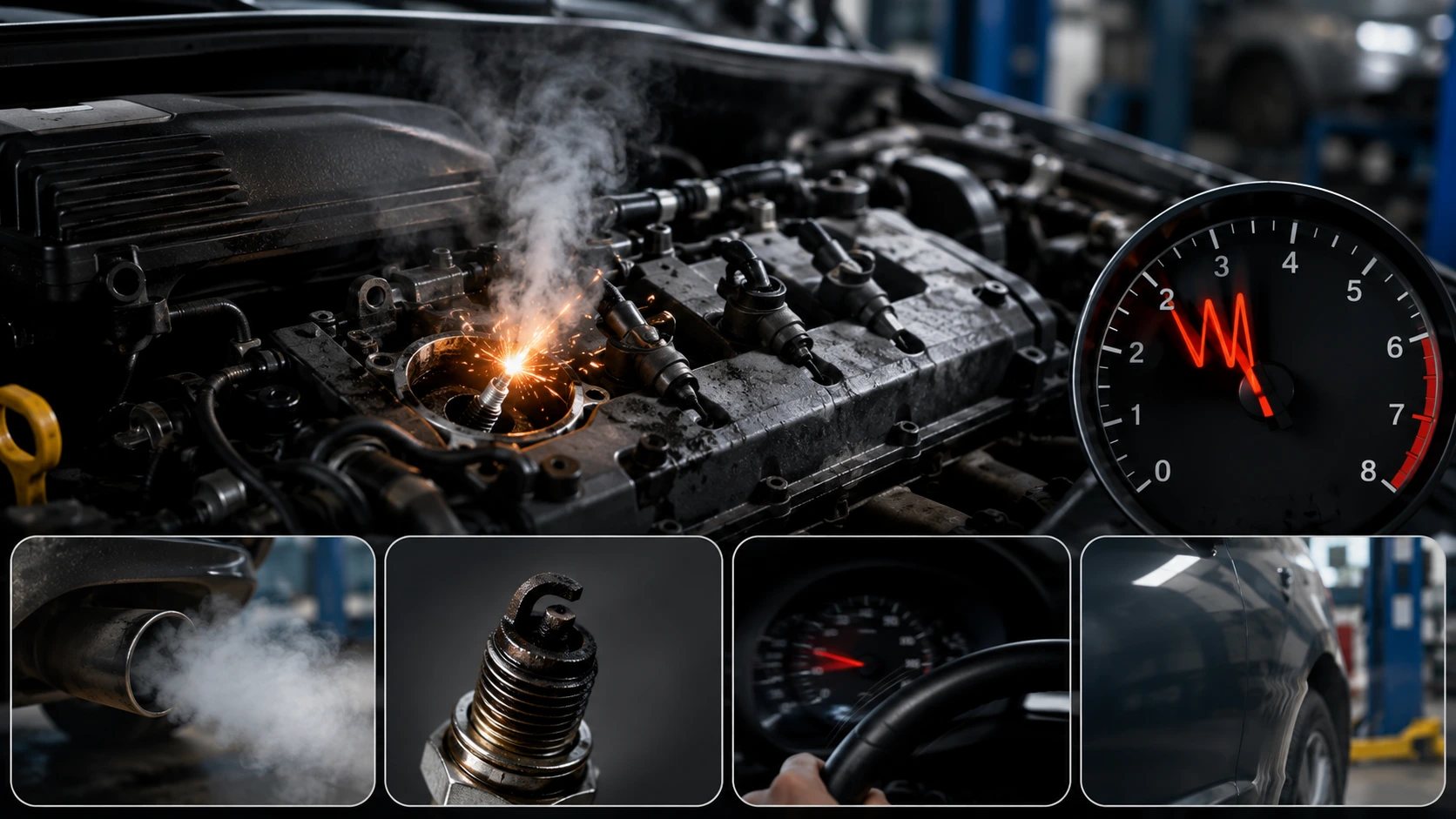
An engine misfire occurs when one or more cylinders fail to complete a proper combustion event. The cylinder cranks, draws in air and fuel, and either the fuel doesn’t ignite, ignites at the wrong time, or ignites incompletely — and the energy that should have pushed the piston down simply doesn’t materialise. The result is a characteristic rough running, hesitation, and often a flashing check engine light that indicates active misfire damage risk to the catalytic converter.
At Rapid Rev Garage, our engine repair in Dubai team reads per-cylinder misfire data with manufacturer-specific diagnostic tools before any ignition or fuel component is replaced.
Engine Misfire — Quick Answer
Engine misfires produce rough idle, hesitation under acceleration, a check engine light, and sometimes a flashing light indicating severe misfire that risks catalytic converter damage. The most common causes are worn spark plugs, failed ignition coils, clogged or failed fuel injectors, vacuum leaks, and low compression. Each cause produces misfire data in a specific pattern — random across cylinders suggests a fuel pressure or sensor issue, while consistent single-cylinder misfire points to that cylinder’s ignition, injector, or compression. A per-cylinder diagnostic scan identifies the pattern before any part is replaced.
Modern engines track combustion quality in real time through the crankshaft position sensor, which detects the slight deceleration of the crankshaft that occurs when a cylinder fails to produce its expected contribution. This data is stored per cylinder in the engine management system, making engine misfire one of the most data-rich faults to diagnose — provided the right diagnostic tool is used to read that data.
In Dubai’s conditions, the two most common misfire causes are worn spark plugs from extended service intervals and ignition coil failure — both accelerated by the thermal cycling between underground parking cool and peak underbonnet temperatures that Dubai vehicles experience daily.
Types of Engine Misfire and What Causes Each
The misfire pattern — which cylinders, under what conditions, and how consistently — directs the diagnosis before any physical inspection.
Single-Cylinder Consistent Misfire
A misfire that affects the same cylinder consistently, whether at idle, under acceleration, or across all driving conditions, points to a fault specific to that cylinder. The ignition coil, spark plug, fuel injector, or compression on that cylinder is the candidate.
Spark Plug Failure on a Single Cylinder
A spark plug that’s worn past its gap specification, fouled with oil or carbon deposits, or cracked internally produces an intermittent or complete failure to spark on that cylinder. Spark plug failure is the single most common cause of engine misfire we see at the Al Quoz workshop — particularly on vehicles that have exceeded the service interval in Dubai’s heat.
Ignition Coil Failure
Modern coil-on-plug ignition systems have one coil per cylinder. A failed coil on one cylinder produces a consistent single-cylinder misfire that’s easy to confirm by swapping the suspect coil to an adjacent cylinder — if the misfire follows the coil, the coil is the fault. This swap test takes minutes and prevents replacing a coil that was working correctly.
Random Multi-Cylinder Misfire
A misfire that appears across multiple cylinders, or on different cylinders at different times, without a consistent single-cylinder pattern, points toward a system-wide fuel or air supply fault rather than individual cylinder components.
Fuel Pressure or Injector Rail Faults
Insufficient fuel pressure — from a failing fuel pump or a clogged fuel filter — starves all cylinders equally, producing random misfires across the engine rather than a consistent single-cylinder fault. The misfire appears worse under high load when fuel demand is greatest.
MAF Sensor or Vacuum Leak
An incorrect air mass reading from a failing MAF sensor, or unmetered air entering through a vacuum leak, disrupts the air-fuel ratio across all cylinders simultaneously. The misfire appears at specific RPM ranges or load conditions depending on where in the intake system the leak or sensor fault occurs.
Our car mechanic team reads live misfire counters per cylinder alongside fuel trim corrections and MAF data during a road test before recommending any component replacement.
Symptoms of Engine Misfire
Engine misfire produces a recognisable set of symptoms that distinguishes it from other engine faults.
Rough or Lumpy Idle
An engine misfiring at idle feels rough and uneven — a vibration or shudder through the steering wheel, seat, and floor that comes and goes rather than being constant. This is the incomplete combustion events creating an imbalance in the engine’s output across its cylinders.
Hesitation Under Acceleration
Under acceleration, misfires produce a stumbling or hesitation — the engine feels like it briefly loses power mid-acceleration. This is the misfiring cylinder failing to contribute to the power output at the moment it’s needed.
Flashing Check Engine Light
A check engine light that flashes rather than staying steady indicates an active, severe misfire that is damaging or risking damage to the catalytic converter. Raw unburned fuel entering the catalytic converter at high temperature can destroy the catalyst substrate within a short period of driving. A flashing misfire light means reduce speed, avoid hard acceleration, and get to a workshop as quickly as safely possible.
Increased Fuel Consumption
The engine management system detects combustion failures and compensates by adjusting fuel delivery, which combined with the lost efficiency of misfiring cylinders, increases fuel consumption noticeably.
Diagnostic Process
Per-cylinder misfire data identifies the pattern, fault code analysis identifies the likely cause, and physical inspection confirms it.
Reading Per-Cylinder Misfire Counters
Manufacturer-specific diagnostic tools read the number of misfire events per cylinder over a defined number of crankshaft revolutions. A cylinder with a dramatically higher misfire count than the others identifies the specific cylinder to investigate. All cylinders elevated equally points to a system-wide issue.
Coil Swap and Plug Inspection
Physical inspection of spark plugs reveals fouling type — oil fouling confirms compression loss on that cylinder, carbon fouling confirms rich mixture, and electrode wear confirms age. The coil swap test identifies coil failure without purchasing a new coil first.
Fuel Injector Flow Testing
Injector balance testing, available through manufacturer diagnostic platforms, confirms whether each injector is delivering the commanded fuel quantity. A low-flowing injector on one cylinder matches the single-cylinder misfire pattern.
Repair Process
The repair is matched to the specific component the diagnostic sequence confirms has failed.
Spark Plug Replacement
All plugs replaced as a set — replacing one faulty plug while leaving plugs of similar mileage in adjacent cylinders risks repeat misfire within a short period as the remaining old plugs fail.
Ignition Coil Replacement
Failed coil replaced on the affected cylinder. On high-mileage engines where adjacent coils are of similar age, replacing all coils as a set prevents sequential failures.
Injector Cleaning or Replacement
For carbon-fouled injectors, professional ultrasonic cleaning restores flow rate in many cases. Mechanically failed injectors require replacement. For any breakdown caused by a misfire that’s unsafe to drive through, our roadside assistance covers Al Quoz and nearby Dubai areas.
Risks of Ignoring Engine Misfire
The catalytic converter damage risk from continued driving with an active misfire is the most immediate concern. Catalytic converter replacement on a modern European or Japanese vehicle is a significant cost — in many cases exceeding the combined cost of all the ignition components that would have prevented the damage.
Secondary risks include cylinder wash-down — where raw fuel washes the oil film from the cylinder wall, accelerating ring and bore wear — and progressive fouling of the oxygen sensors that the misfiring cylinder’s unburned fuel contaminates.
Prevention Tips
Spark plugs replaced at the manufacturer’s recommended interval — and on the shorter side of any range for Dubai conditions — prevent the most common misfire cause from developing. Our car service packages include spark plug condition inspection and fuel trim monitoring at every major service, catching developing misfires before the check engine light appears.
Dubai-Specific Advice
Ignition coils fail faster in Dubai because of the daily thermal cycling they experience. A coil that expands from cool underground parking temperature to peak underbonnet heat hundreds of times a year develops internal insulation fatigue faster than the same coil in a stable climate. Carbon buildup — which fouls spark plugs and injectors — accumulates faster on direct-injection engines doing Dubai’s short-trip commutes. Both accelerate misfire development on a timeline shorter than factory service intervals assume. For exterior repairs alongside engine work, our car painting team handles colour-matched work in the same visit.
Why Rapid Rev Garage?
We read the per-cylinder misfire data before touching anything. This prevents the scenario where a customer pays for two coils and a set of spark plugs, the misfire continues, and the actual cause turns out to be a failing injector that the data would have identified from the start. Our mobile car mechanic covers Al Quoz and nearby Dubai areas for on-site initial assessment.
FAQ — Engine Misfire
These questions come up consistently when drivers notice rough running or a check engine light.
What does an engine misfire feel like while driving?
A rough, shuddering idle, a stumble or hesitation under acceleration, and sometimes a noticeable loss of power — as if the engine is running on fewer cylinders than it should be.
Is it safe to drive with a misfire?
A steady check engine light with mild roughness — yes, carefully to a workshop. A flashing check engine light — no, reduce speed immediately and get the car checked as soon as possible to avoid catalytic converter damage.
Can bad fuel cause engine misfire?
Yes — contaminated fuel or fuel of incorrect octane specification can cause misfires. This typically produces random multi-cylinder misfire rather than single-cylinder, and resolves once the contaminated tank is used up and refilled correctly.
How long does misfire repair take?
Spark plug and ignition coil replacement is typically a one to two hour job. Injector cleaning or replacement takes longer depending on the engine's accessibility. Most misfire repairs are same-day.
Can an engine misfire damage the engine permanently?
Yes — continued misfires cause catalytic converter damage, cylinder wall wash-down from raw fuel, and oxygen sensor contamination. The damage cost typically exceeds the repair cost by a significant margin.
Conclusion
An engine misfire is a specific, diagnosable fault with a traceable cause — and reading per-cylinder misfire data is what identifies that cause before any parts are ordered. Spark plugs, coils, injectors, vacuum leaks, and compression faults all produce different misfire patterns that direct the diagnosis correctly when the right data is read. Rapid Rev Garage in Al Quoz diagnoses every misfire with manufacturer-specific scanning before recommending any repair.
Rapid Rev Garage is in Al Quoz, serving drivers across nearby Dubai areas. Find us through a garage near me search, book your appointment on WhatsApp, or find us on Google Maps.
Rapid Rev Garage — Engine Misfire | Al Quoz, Dubai