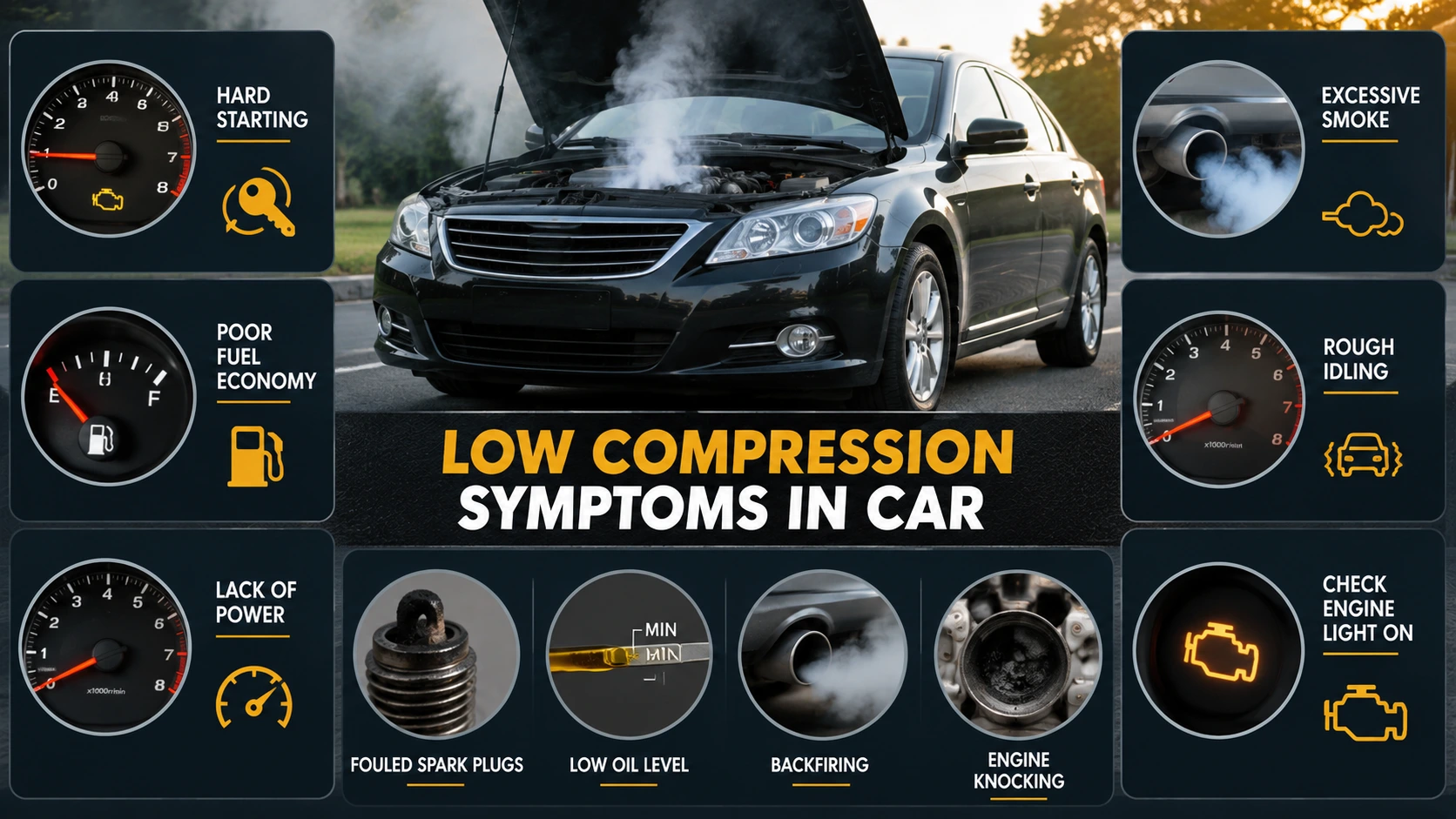
Low compression symptoms are among the most diagnostic-specific signals an engine can produce. When cylinder compression drops below specification — whether from worn piston rings, failed valves, a blown head gasket, or a cracked component — the engine loses its ability to generate the pressure needed for efficient combustion. The result is a specific pattern of performance problems that distinguishes compression loss from fuel, ignition, or sensor faults.
At Rapid Rev Garage, our engine repair in Dubai team confirms compression faults through physical cylinder testing before recommending any repair.
Low Compression Symptoms — Quick Answer
Low compression symptoms include hard starting, rough idle, misfires on specific cylinders, loss of power, and increased oil or fuel consumption. If all cylinders are affected equally, the cause is usually worn piston rings or valve seat recession across the engine. If only one or two cylinders show low readings, the cause is more likely a burned valve, blown head gasket on that cylinder, or a specific mechanical failure at that location. A compression test and leak-down test confirm which cylinders are affected and where the pressure is escaping.
Compression is the engine’s ability to squeeze the air-fuel mixture into a small space before ignition. The compression ratio — typically between 9:1 and 13:1 on modern petrol engines — is what makes combustion produce useful work. When that ratio drops because pressure is escaping through worn rings, failed valves, or a gasket breach, the combustion event produces less energy per cylinder, and the engine’s symptoms reflect that loss.
In Dubai’s conditions, the faults that cause low compression appear earlier than factory service intervals anticipate. Heat cycling accelerates valve seat recession on aluminium cylinder heads. Stop-start driving with degraded oil accelerates ring wear. These are real patterns at our Al Quoz workshop.
Low Compression Symptoms — What to Watch For
These are the specific signs that point toward compression loss rather than a fuel or ignition problem.
Hard Starting or Extended Cranking
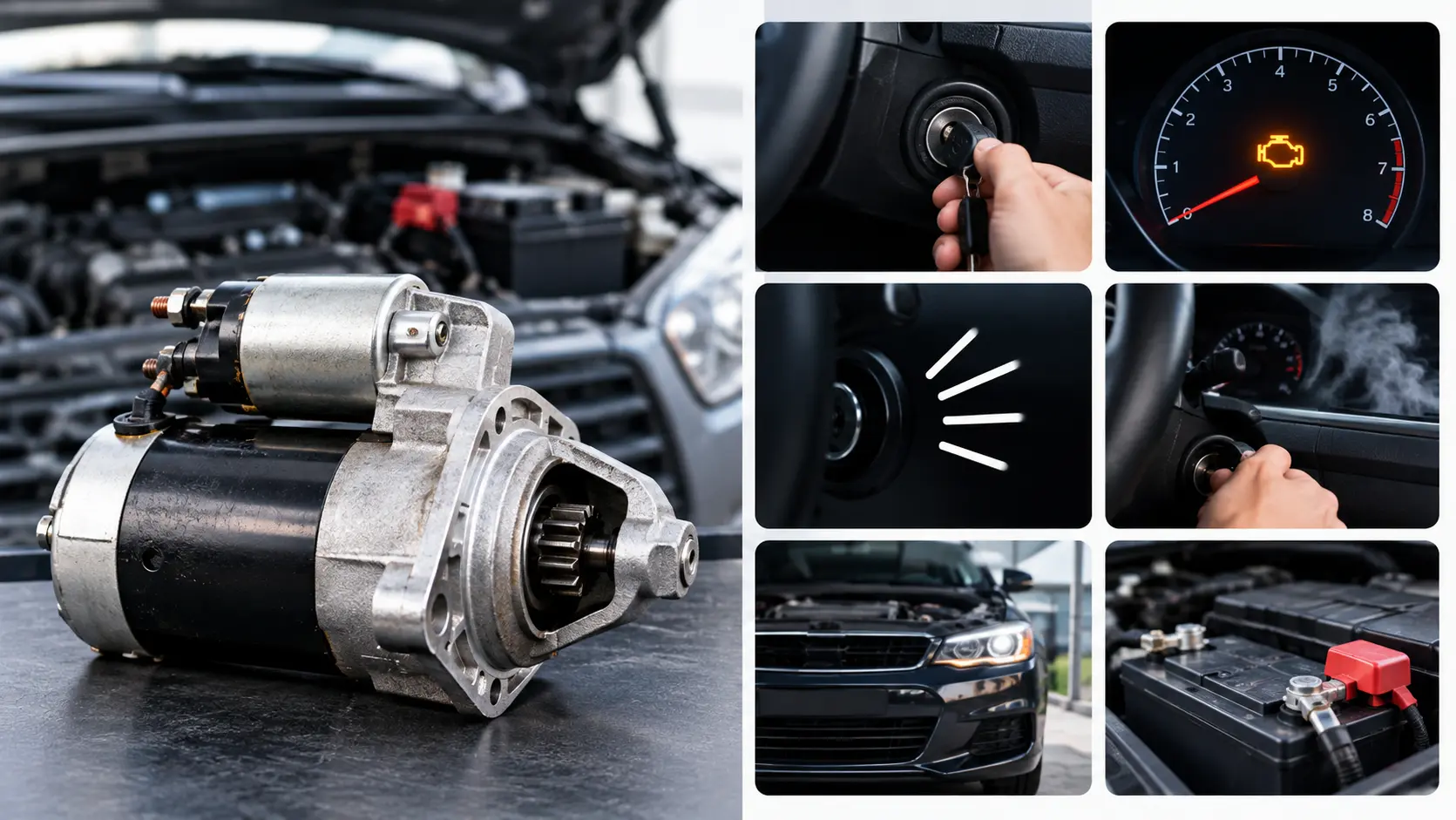
An engine that cranks significantly longer than it used to before firing is often losing compression on multiple cylinders. The starter motor spins the engine through more cycles before sufficient pressure builds for ignition. This symptom worsens in cold conditions — in Dubai’s cooler winter mornings specifically — because fuel atomisation and oil viscosity compound the compression deficit.
Rough or Uneven Idle With Specific Cylinder Misfire Codes
Low compression on one or two cylinders produces a rough idle that’s characterised by the engine running unevenly rather than with the consistent, balanced vibration of a healthy engine. Diagnostic scanning reads misfire counters per cylinder, and a cylinder that’s consistently misfiring — rather than randomly misfiring like an ignition fault — points toward compression as the cause.
Loss of Power and Poor Acceleration
Power loss from low compression is often gradual enough that owners attribute it to fuel quality, tyre pressure, or the car simply ageing. The characteristic is that the power loss is consistent across all driving conditions rather than appearing only under specific loads, and it worsens as compression continues to decline.
Increased Oil Consumption Without a Visible Leak
Worn piston rings that reduce compression also allow oil to bypass from the crankcase into the combustion chamber. The engine burns this oil alongside the fuel, producing blue exhaust smoke and a declining oil level between services. If oil consumption is increasing while no external leak is visible, compression loss from ring wear is a strong candidate.
Poor Fuel Economy
An engine with reduced compression requires more throttle input to produce the same power output. The engine management system compensates by enriching the fuel mixture, both increasing fuel consumption and potentially producing black exhaust smoke as the mixture runs richer than optimal.
Our car mechanic team reads per-cylinder misfire data and fuel trim corrections before performing any physical compression test.
Causes of Low Compression Symptoms
The compression loss can originate from any component that seals the combustion chamber — the piston rings below, the valves above, or the gasket and head that contain the sides.
Worn Piston Rings
The piston rings seal the gap between the piston and the cylinder wall. As they wear, they allow combustion pressure to escape downward into the crankcase — a process called blowby — and allow oil to travel upward into the combustion chamber. Worn rings affect all cylinders progressively rather than a single cylinder suddenly, which produces a gradual decline in overall power and fuel economy.
How Dubai Conditions Accelerate Ring Wear
Oil that’s been extended past its effective service life in Dubai’s heat loses its protective film thickness, allowing metal-to-metal contact between the rings and cylinder walls during cold starts and high-temperature operation. Each kilometre driven on degraded oil adds measurable ring wear.
Burned or Stuck Valves
Intake and exhaust valves seal the top of the combustion chamber during compression and combustion. A valve that’s burned, warped, or stuck open — often from heat damage, carbon deposits holding the valve open, or incorrect valve clearances — allows compression to escape on each combustion stroke.
Why Valve Problems Often Affect Single Cylinders
A burned valve typically affects one cylinder rather than multiple, producing a single-cylinder misfire that’s identifiable by its consistency — same cylinder every time. A leak-down test performed on the affected cylinder with compressed air pumped in reveals pressure escaping through the intake or exhaust port, confirming the valve as the fault location.
Blown Head Gasket
A head gasket breach that affects the combustion chamber allows compression to escape into the coolant passages, oil passages, or adjacent cylinder. This can produce a single-cylinder compression loss or, in severe cases, affect two adjacent cylinders that share a gasket breach point.
The Combined Symptom Pattern
A blown head gasket affecting compression often appears alongside white exhaust smoke, a rising temperature gauge, and coolant level that’s dropping without a visible external leak — because the coolant is entering the combustion chamber on the affected cylinder.
Valve Seat Recession on Aluminium Heads
Valve seat recession is less common on modern unleaded fuel engines but still occurs on high-mileage engines — particularly on vehicles that run with degraded coolant, as overheating events damage the valve seat insert bonding. As the valve seat recedes, the valve no longer seals fully against it, and compression is lost on that cylinder.
For any breakdown related to compression loss, our roadside assistance covers Al Quoz and nearby Dubai areas.
Diagnostic Process
Three tests in sequence confirm which component is failing and where the pressure loss is occurring.
Cylinder Compression Test
A standard compression test measures the peak pressure each cylinder generates during a series of cranking cycles with the throttle held open. Readings are compared against the manufacturer’s specification and against each other — a cylinder that’s 20% or more below the others, or below the minimum specification, requires further investigation.
Wet Compression Test
If a cylinder shows low compression on a dry test, repeating it with a small amount of oil squirted into the cylinder provides diagnostic information. If compression improves significantly with oil added, the rings are at fault — the oil temporarily seals the ring gap. If compression doesn’t change with oil, the fault is in the valves or gasket rather than the rings.
Leak-Down Test
A leak-down test pressurises each cylinder with compressed air and measures how much pressure escapes and where it goes. Air escaping at the oil filler cap indicates ring leakage. Air at the intake indicates an intake valve fault. Air at the exhaust indicates an exhaust valve fault. Air bubbling in the coolant confirms a head gasket breach.
Repair Process
The repair scope is matched precisely to the component the diagnostic sequence confirms has failed.
Ring Replacement
Replacing piston rings requires full engine disassembly. The cylinders are honed to restore the correct surface finish for ring seating, and the rings are replaced as a set. This is typically the most involved repair in this category. Our car service packages include oil condition and consumption monitoring at every visit, specifically to catch ring wear progression early.
Valve Replacement or Reconditioning
A burned or stuck valve requires cylinder head removal and valve replacement or reconditioning. The head is resurfaced during this process and the valve seats inspected and replaced if needed.
Head Gasket Replacement
As covered in the white smoke blog — head removal, gasket replacement, head resurfacing or replacement where needed, pressure testing before reassembly.
Risks of Ignoring Low Compression Symptoms
Low compression symptoms worsen progressively. An engine with moderate ring wear that continues operating on degraded oil progresses to severe ring wear that contaminates the oil with blowby gases, damages the catalytic converter from oil burning, and eventually loses enough compression to become unreliable to start. A single-cylinder valve fault that’s ignored can progress to valve failure that damages the piston crown on that cylinder.
Prevention Tips
Correct oil specification and shorter change intervals than factory maximums — 8,000 km for Dubai city drivers — maintain the oil film thickness that protects rings and valve stems from accelerated wear. Coolant replacement every two years prevents the acidic coolant condition that damages valve seat inserts and head gasket sealing surfaces. For exterior repairs needed alongside engine work, our car painting team handles colour-matched repairs in the same visit.
Dubai-Specific Advice
The three causes of low compression that are most common in Dubai are piston ring wear from degraded oil in heat and stop-start driving, head gasket damage from overheating events that are more common here than in cooler markets, and valve issues from heat-damaged seating on aluminium heads. All three are accelerated by conditions specific to this market — and all three produce low compression symptoms earlier on a Dubai vehicle than the factory service schedule accounts for.
Why Rapid Rev Garage?
We don’t guess at compression problems from the symptom alone. A compression test, wet test, and leak-down test in combination identify the exact failing component and its location before any repair is recommended. An owner doesn’t pay for ring replacement when the fault is a single burned valve, and doesn’t pay for a head gasket when the fault is ring wear. Our mobile car mechanic covers Al Quoz and nearby Dubai areas for on-site assessment.
FAQ — Low Compression Symptoms
These are the questions most frequently asked about low compression in Dubai.
How do I know if I have low compression without a test?
Hard starting, rough idle with consistent single-cylinder misfires, gradual power loss, increasing oil consumption, and poor fuel economy are all low compression symptoms — but a compression test is the only way to confirm and quantify the fault.
Can low compression be fixed without engine rebuild?
Yes — if the fault is a single burned valve, head gasket, or stuck valve, the repair is targeted and doesn't require a full engine rebuild. Only widespread ring wear across multiple cylinders typically requires full engine disassembly.
Does low compression mean I need a new engine?
Not necessarily. It depends on how many cylinders are affected and the specific cause. A single-cylinder valve fault is a cylinder head repair. Widespread ring wear is an internal engine overhaul. Neither automatically means engine replacement.
What's the difference between a compression test and a leak-down test?
A compression test measures how much pressure each cylinder builds during cranking. A leak-down test measures how quickly that pressure escapes and where it goes — providing specific information about which component is failing.
Can I still drive with low compression?
With mild compression loss, the car will still drive but with reduced power and economy. With severe compression loss on multiple cylinders, the car may not start reliably or may stall under load — at which point driving is impractical rather than just inadvisable.
Conclusion
Low compression symptoms point specifically to the sealing components of the combustion chamber — rings, valves, or the head gasket — and require physical testing rather than sensor-based diagnosis to confirm. The correct repair is determined by which specific component the tests identify, not by the symptom pattern alone. Rapid Rev Garage in Al Quoz diagnoses every compression complaint with a full test sequence before any teardown is recommended.
Rapid Rev Garage is in Al Quoz, serving drivers across nearby Dubai areas. Find us through a garage near me search, book your appointment on WhatsApp, or find us on Google Maps.
Rapid Rev Garage — Low Compression Symptoms | Al Quoz, Dubai