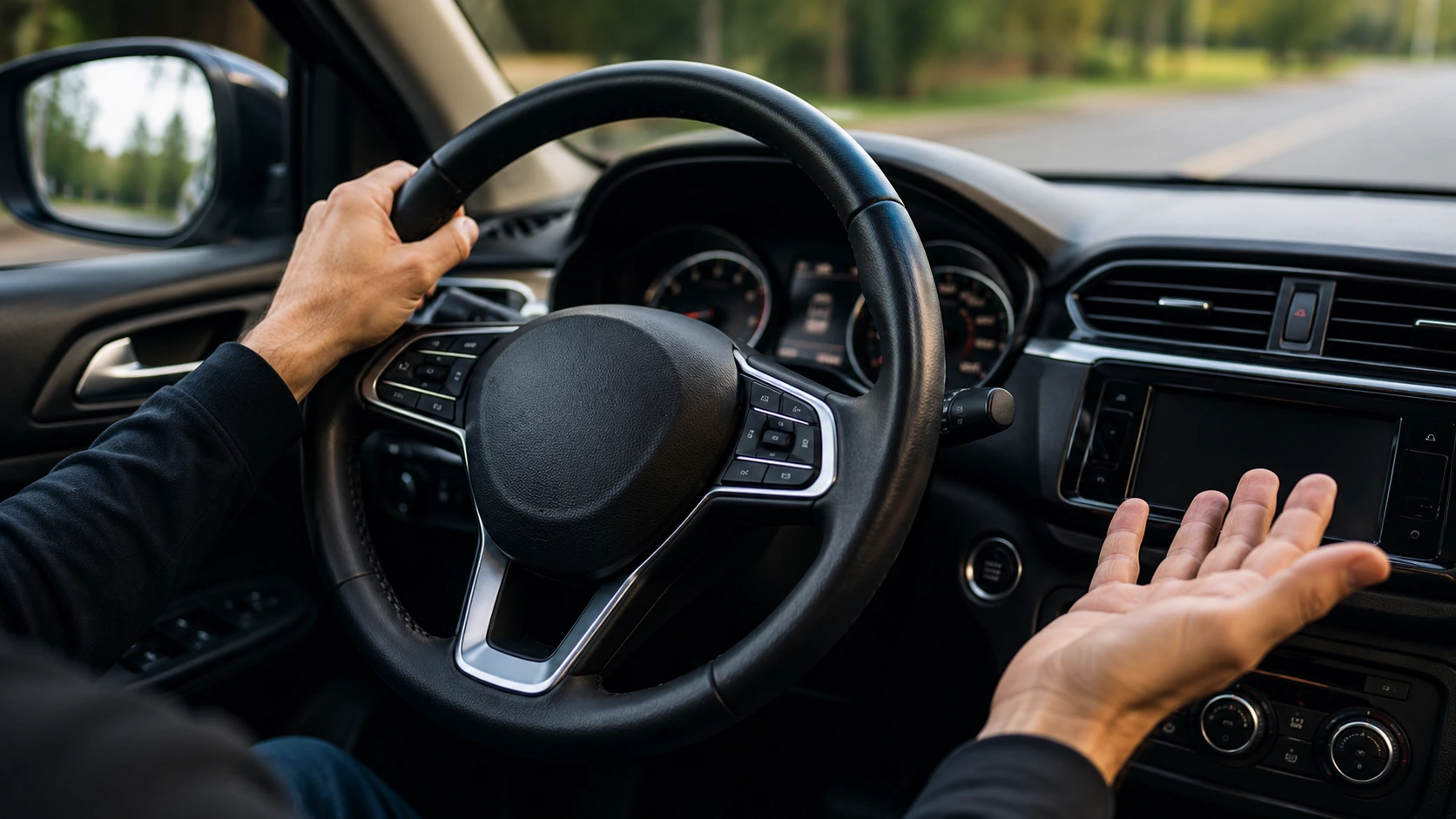
A steering wheel doesn’t return to center after a turn is almost always a steering or suspension geometry fault — not something to monitor and see. The most common causes are incorrect wheel alignment, worn steering rack components, a stiff or dry steering column, or degraded power steering fluid. In Dubai’s heat, rubber bushings and power steering components degrade faster than standard service intervals assume. This fault affects handling safety and tyre wear and should be diagnosed and fixed promptly.
At Rapid Rev Garage in Al Quoz, our specialist team diagnoses and fixes steering return faults across all makes and models — road test first, then systematic physical inspection, then the correct repair.
Steering Wheel Doesn’t Return to Center — Quick Verdict
When a steering wheel doesn’t return to center after a turn, the cause is almost always one of four things: incorrect caster angle from a wheel alignment fault, excessive friction inside the steering rack or on its mounting bushings, a seized or stiff strut top bearing that resists rotation, or degraded power steering fluid reducing hydraulic assistance. In Dubai, heat accelerates degradation of the rubber and seal components involved in all four causes. The fault affects driving safety in emergency situations and causes accelerated tyre wear the longer it continues. Most repairs are completed same-day at our Al Quoz workshop.
Table of Contents
- Problem Overview
- Symptoms
- Causes
- Diagnostic Process
- Repair Process
- Risks of Ignoring the Problem
- Can You Continue Driving?
- Repair Time
- Cost Factors
- Prevention Tips
- Dubai-Specific Advice
- Why Rapid Rev Garage?
- FAQ
- Related Articles
Problem Overview
The steering wheel on a properly functioning vehicle returns to the straight-ahead position automatically after a turn — a phenomenon called self-centering or returnability. This happens because of caster angle, a suspension geometry measurement that creates a natural tendency for the wheel to straighten under the vehicle’s forward momentum.
What Goes Wrong When It Doesn’t Return
When the steering wheel doesn’t return to center, either the geometry is incorrect, there’s excessive friction somewhere in the steering circuit, or a component is preventing the free movement the self-centering mechanism depends on. The fault can be subtle — a wheel that returns slowly rather than not at all — or obvious, requiring the driver to manually push the wheel back to straight after every corner.
Why Dubai Makes This More Common
In Dubai’s driving environment, this fault is more common than in cooler markets. Heat degrades the rubber components that maintain correct steering geometry, and the frequent low-speed turning through tight car parks and multi-storey ramps accelerates wear on the components most involved in steering returnability. The combination of thermal degradation and repeated steering load is more demanding than any European service schedule accounts for.
Symptoms
Recognising the specific symptoms helps distinguish this fault from other steering complaints before a workshop visit.
Wheel Stays Turned After Cornering
The clearest indicator — after completing a turn, the steering wheel remains at the turned angle rather than unwinding back toward straight. The driver has to actively push the wheel back to center rather than simply releasing it. This symptom is most obvious after tight parking manoeuvres and low-speed turns where the wheel is turned significantly.
Wheel Returns Slowly or Partially
A subtler presentation — the wheel begins returning after a corner but stops short of center, or returns much more slowly than expected. This indicates partial friction rather than complete resistance. Drivers frequently adapt to this symptom without realising it, unconsciously applying slight counter-pressure to help the wheel center — which means the fault is often more advanced than the driver’s perception suggests by the time a workshop visit is made.
Uneven Steering Effort Between Left and Right
When the steering wheel doesn’t return to center equally from both directions — easier to return from a right turn than a left, or vice versa — the fault is likely localised to one side of the steering or suspension geometry. This asymmetric presentation typically indicates a fault on the side that shows more resistance — a worn ball joint, a seized strut bearing, or a tie rod end with more friction on one side than the other.
Heavy Steering Feeling Through Turns
When the steering wheel doesn’t return to center, the same resistance that prevents return also makes turning feel heavier than normal. If the steering has become noticeably stiffer at the same time the return-to-center behaviour changed, the fault source is likely the same component causing both symptoms.
Causes
Several different fault sources produce the same steering return problem — identifying the correct one requires systematic diagnosis rather than assumption.
Incorrect Wheel Alignment — Especially Caster Angle
Caster angle is the primary geometry factor responsible for steering returnability. When caster is incorrect — too low — the self-centering force generated under forward motion is insufficient to overcome the friction in the steering system. Incorrect caster can result from a previous alignment that wasn’t set correctly, from accident damage that displaced a suspension component, or from wear in a control arm bushing that allows the caster angle to change from its designed position.
How Caster Angle Produces Self-Centering
Caster works by positioning the steering axis so that the contact patch of the tyre trails behind the steering pivot — the same principle that causes shopping trolley wheels to self-align. When this geometry is correct, forward vehicle momentum continuously applies a force that straightens the wheels. When caster is insufficient, that force is too weak to overcome normal friction in the steering system.
Worn or Tight Steering Rack
The steering rack converts rotational steering input into the lateral movement that turns the wheels. A rack with worn internal seals, damaged bushings at its mounting points, or insufficient lubrication develops internal friction that resists both steering input and return. A rack that’s tight or binding produces the same steering return problem regardless of how correct the alignment geometry is — because the friction preventing return is inside the steering circuit itself.
Seized or Stiff Strut Bearing
The strut bearing sits at the top of the front strut assembly and allows the strut to rotate as the steering is turned. When this bearing seizes or becomes stiff from contamination, corrosion, or wear, it resists the rotation that allows the steering to return.
Why Dubai Accelerates This Fault
In Dubai’s heat, strut bearing seals degrade faster than in cooler climates — allowing dust and moisture infiltration that accelerates bearing wear. A seized strut bearing on one side produces the asymmetric return resistance that favours one turning direction over the other, which is often how this specific cause is first identified.
Worn Ball Joints or Tie Rod Ends
Ball joints and tie rod ends allow movement in multiple directions — their design includes a degree of freedom that contributes to smooth steering operation and return. When these components develop stiffness from wear or corrosion — rather than the looseness most drivers associate with ball joint wear — they resist the free movement that self-centering requires. A stiff ball joint or tie rod end is less commonly discussed than a loose one, but it’s a genuine cause that physical inspection under load identifies correctly.
Power Steering System Issues
On hydraulic power steering vehicles, low fluid level, degraded fluid, a failing power steering pump, or a stiff steering column reduces the assistance that helps the wheel return. Without adequate hydraulic assistance working with the geometry’s self-centering force, the return is sluggish or incomplete. On electric power steering vehicles, a calibration fault in the EPS control module can cause incorrect return-to-center assistance — a fault that requires diagnostic software access to identify and correct.
Diagnostic Process
Accurate diagnosis of a steering wheel doesn’t return to center fault follows a systematic process — not a guess based on the most common cause.
Road Test and Symptom Confirmation
The diagnostic process starts with a road test confirming exactly how the steering wheel doesn’t return to center under real driving conditions. Straight-line steering behaviour, return from left turns versus right turns, return speed, and the amount of driver input needed to assist return are all assessed during the road test. This establishes the baseline that subsequent physical inspection findings need to explain.
Four-Wheel Alignment Measurement
Caster angle measurement is the first and most important alignment check for this fault. A four-wheel alignment system measures actual caster alongside camber and toe — revealing whether the geometry is responsible for the return problem. Our car mechanic team measures alignment before any other intervention on every steering return complaint — because alignment correction alone resolves the fault when incorrect caster is the cause, without any component replacement needed.
Ramp Inspection of Steering and Suspension Components
With the vehicle on the ramp and weight off the wheels, the steering and suspension components are inspected physically. Strut bearing rotation resistance is checked by turning the wheel with the vehicle raised — stiffness in the bearing is immediately apparent. Ball joints and tie rod ends are assessed for stiffness under controlled force application. Steering rack mounting bushing condition and rack movement resistance are checked at this stage.
Power Steering System Assessment
Power steering fluid condition, level, and pressure output are checked on hydraulic systems. On electric power steering vehicles, a full system scan through diagnostic software reads the EPS control module’s fault memory and live torque sensor data — identifying software or calibration faults that produce incorrect return assistance.
Repair Process
The correct repair depends entirely on the diagnosed fault source — a steering wheel doesn’t return to center caused by misalignment needs different treatment from one caused by a seized strut bearing.
Wheel Alignment Correction
When caster angle is the confirmed cause, four-wheel alignment correction to the manufacturer’s specification restores the self-centering force that was insufficient. This is often the complete repair without any component replacement needed. Alignment correction after any other component repair is also always required — replacing a ball joint or strut bearing changes the geometry, and a new alignment confirms the correct position with the new components in place.
Strut Bearing Replacement
A seized or stiff strut bearing requires replacement — lubrication alone doesn’t restore a bearing that has already lost its free rotation. Both sides are assessed and replaced where both show significant wear, given the labour access already available during the repair.
Ball Joint or Tie Rod End Replacement
A stiff ball joint or tie rod end is replaced with a new unit of correct specification. A repair that uses incorrect specification or inferior quality replacement joints may resolve the immediate symptom but produces premature wear that returns the complaint within months.
Power Steering Service
Hydraulic power steering fluid replacement resolves the symptom when degraded fluid is the cause. On EPS systems, a calibration reset or software update through diagnostic software corrects return-to-center behaviour when the EPS module is the fault source. Our car service team documents every steering repair with the fault found, repair performed, and post-repair road test result confirming correct steering return behaviour.
Risks of Ignoring the Problem
A steering wheel doesn’t return to center fault doesn’t stay static — it typically progresses as the underlying component continues to wear.
Increasing Driver Effort and Fatigue
The increased driver effort required to manually center the wheel after every corner creates fatigue on longer drives and reduces the automatic safety responses that self-centering enables. A driver who has adapted to manually correcting the steering is using conscious attention that should be available for other aspects of driving.
Accelerated Tyre Wear
A vehicle whose steering requires manual centering spends time running at slight angles that produce asymmetric and accelerated tyre wear. The tyre replacement cost this generates often exceeds the component repair cost that would have prevented it.
Reduced Emergency Response Capability
In an emergency manoeuvre — a sudden lane change or a sharp corner avoidance — the absence of steering return adds a complication at exactly the moment it matters most. This is a safety system function that’s worth maintaining correctly. For any situation where the steering fault makes driving to the workshop inadvisable, our roadside assistance covers Al Quoz and nearby Dubai areas.
Can You Continue Driving?
A steering wheel doesn’t return to center fault makes the vehicle safe to drive in the short term — it won’t suddenly cause a loss of control.
Short-Term Assessment
The fault reduces driving safety margins in emergency situations and accelerates tyre wear that becomes expensive the longer it continues. A vehicle exhibiting this fault on high-speed roads — Emirates Road, Sheikh Zayed Road — requires more active driver attention to maintain straight-line tracking than a correctly functioning vehicle.
The Right Timeline
Assess and repair within a week rather than leaving it indefinitely. If the symptom appeared after a specific event — a kerb strike, a significant speed bump impact, or a minor collision — bring the vehicle for assessment promptly rather than waiting for the next scheduled service.
Repair Time
Most steering wheel doesn’t return to center repairs are completed same-day at Rapid Rev Garage.
Typical Durations
Alignment correction alone takes 60–90 minutes. Strut bearing replacement on a single axle takes two to three hours including the post-repair alignment. Ball joint or tie rod end replacement with alignment takes two to four hours depending on the vehicle and component accessibility. Power steering fluid replacement takes approximately 30–45 minutes.
Cost Factors
Steering return repair cost varies based on the fault cause identified during diagnosis.
Alignment Only
Alignment correction alone is the most affordable outcome — when caster angle is the confirmed cause, this is the complete repair with no component replacement needed.
Component Replacement
Strut bearing, ball joint, or tie rod end replacement adds parts cost alongside the labour. The specific vehicle make and model affects both parts cost and labour access time significantly.
Power Steering Work
Power steering pump or rack replacement represents the higher end of the cost range. Our garage near me team provides a written cost breakdown before any work begins — the diagnosis is completed first, the cause is confirmed, and the repair cost is explained before approval is given.
Prevention Tips
Regular maintenance habits prevent most steering return faults from developing.
Regular Wheel Alignment Checks
Every 10,000–15,000 km or after any significant kerb or speed bump impact — alignment checks catch caster angle drift before it affects steering return behaviour significantly. Don’t wait for a symptom to appear before checking.
Power Steering Fluid Condition
Power steering fluid condition should be checked at every service visit. Degraded fluid is replaced before it contributes to steering system friction. On hydraulic systems, fluid that’s dark or has a burned smell is past its service life.
Suspension Component Inspection
Physical suspension and steering component inspection at every comprehensive service identifies developing stiffness in strut bearings, ball joints, and tie rod ends before they produce steering complaints. For any exterior repairs needed alongside steering work, our car painting team handles colour-matched work in the same visit.
Dubai-Specific Advice
Dubai’s conditions create specific steering return fault patterns that European service manuals don’t address.
Speed Bumps and Parking Ramps
Dubai’s speed bumps and parking ramp transitions place repeated short-duration shock loads on steering and suspension geometry that European maintenance schedules don’t account for. A steering wheel doesn’t return to center fault develops faster here than in smooth-road-dominant driving environments — making annual alignment checks more important than the standard every-20,000-km recommendation.
Heat and Strut Bearing Degradation
Heat degrades strut bearing seals faster in Dubai than in cooler climates — allowing the dust infiltration that accelerates bearing wear. Vehicles parked outdoors in direct sun experience greater thermal cycling of rubber components than those in covered parking, accelerating bushing degradation that affects caster angle maintenance.
After an Impact — Act Promptly
If the steering wheel doesn’t return to center symptom appears after a specific event — a kerb strike, a significant speed bump impact, or a minor collision — bring the vehicle for assessment promptly. Geometry faults from impact don’t self-correct and worsen tyre wear continuously until addressed. Our mobile car mechanic covers Al Quoz and nearby Dubai areas for on-location initial assessment where needed.
Why Rapid Rev Garage?
Rapid Rev Garage is one of Al Quoz’s trusted specialist workshops for steering and suspension diagnosis — covering all makes and models with proper four-wheel alignment equipment, ramp inspection capability, and the diagnostic software access needed for electric power steering fault diagnosis.
Our Diagnostic Approach
Every steering wheel doesn’t return to center case starts with a road test and alignment measurement before any component recommendation is made. We explain the fault source, the correct repair, and the cost before any work starts. Nothing is added to the scope without a conversation.
What’s Included as Standard
The alignment check is included in the diagnostic — not charged separately as a precursor to further work. The road test after repair confirms the steering return behaviour is correct before the vehicle is returned.
FAQ — Steering Wheel Doesn’t Return to Center
These are the questions most frequently asked about steering return faults in Dubai.
Is a steering wheel that doesn't return to center dangerous?
It reduces safety margins in emergency manoeuvres and requires more active driver input — it should be repaired within a week rather than left indefinitely.
Can a wheel alignment fix a steering wheel that doesn't return to center?
Yes — if incorrect caster angle is the cause, alignment correction alone resolves the fault without any component replacement needed. This is confirmed by alignment measurement during diagnosis.
Why does my steering wheel only not return from one direction?
Asymmetric return resistance typically indicates a fault on one specific side — a seized strut bearing, stiff ball joint, or tie rod end on the side that shows more resistance.
How much does it cost to fix a steering wheel that doesn't return to center in Dubai?
Alignment correction is the most affordable outcome. Component replacement adds parts cost. A written estimate is provided after diagnosis before any work begins — cost depends on the specific fault confirmed.
How long does the repair take at Rapid Rev Garage?
Most repairs complete same-day — alignment correction takes 60–90 minutes, component replacement with alignment takes two to four hours depending on the vehicle.
Conclusion
A steering wheel doesn’t return to center in Dubai is almost always a traceable, fixable fault — whether the cause is geometry, friction in the steering circuit, or a seized bearing. The correct sequence is road test to confirm the symptom, alignment measurement to assess caster angle, ramp inspection to identify any mechanical friction source, and then the repair matched to the confirmed diagnosis. Rapid Rev Garage in Al Quoz follows this sequence on every steering return complaint.
Rapid Rev Garage is in Al Quoz, serving drivers across nearby Dubai areas — Business Bay, Jumeirah, Downtown, Barsha, Satwa, and the Sheikh Zayed Road corridor. Book your appointment on WhatsApp or find us on Google Maps. Walk-ins welcome for urgent steering concerns.
Rapid Rev Garage — Steering Wheel Doesn’t Return to Center | Al Quoz, Dubai