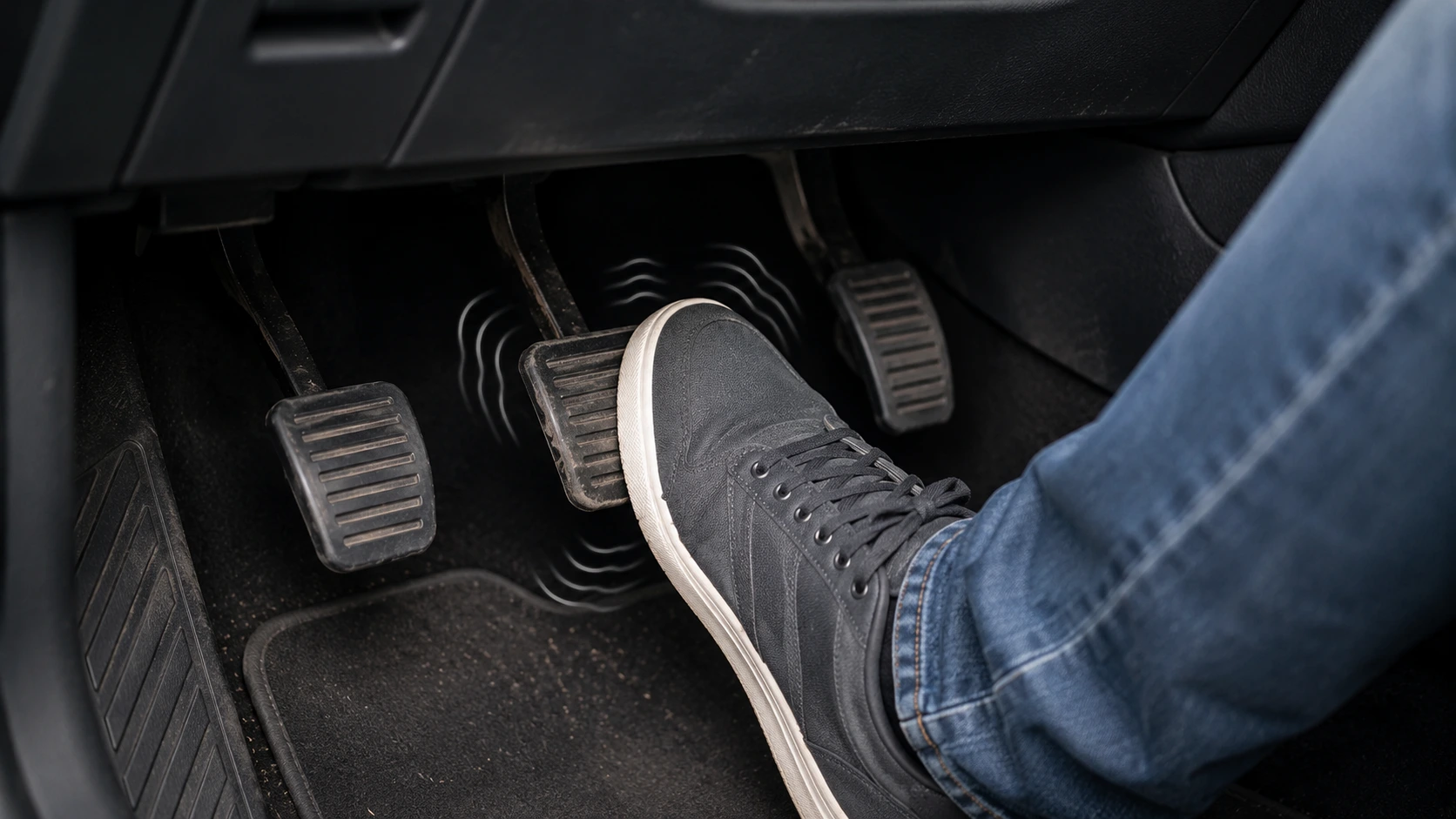
A brake pedal that vibrates at low speed in Dubai is almost always caused by warped brake discs — a direct consequence of the heat cycling and stop-start traffic that Dubai’s roads produce. In most cases the fix is a disc and pad replacement on the affected axle, completed in a few hours. It won’t strand you immediately, but it will worsen without attention and affects braking safety progressively.
Brake Pedal Vibrates at Low Speed — Quick Verdict
A brake pedal that vibrates at low speed almost always points to warped brake discs — specifically, uneven disc thickness that causes the pad to alternately contact thicker and thinner areas as the disc rotates. At low speed, each thickness variation produces a distinct pulse felt through the pedal. The cause in Dubai is usually the stop-start braking pattern combined with holding the brake while stationary after a hard stop, which creates localised heat spots on the disc face. The repair is disc and pad replacement on the affected axle. Safe for short-term careful driving — but worsens progressively and should be addressed before any long drive.
Table of Contents
- Problem Overview
- Symptoms
- Causes
- Diagnostic Process
- Repair Process
- Risks of Ignoring the Problem
- Can You Continue Driving?
- Repair Time
- Cost Factors
- Prevention Tips
- Dubai-Specific Advice
- Why Rapid Rev Garage?
- FAQs
- Related Articles
Problem Overview
Brake pedal vibration at low speed is one of the most common workshop complaints in Dubai — and one of the most consistently misunderstood. Drivers often attribute it to tyre balance, wheel alignment, or road surface. In the majority of cases, the cause is in the brake system itself — specifically the brake discs.
What Happens Inside the Brake System
The brake disc is a flat metal rotor that the brake pads clamp against to slow the vehicle. For braking to feel smooth and progressive, the disc surface must be flat and consistent in thickness as it rotates. When a disc develops uneven thickness — called disc thickness variation (DTV) — the brake pad alternately contacts the thicker and thinner areas as the disc rotates, creating a pulsation that travels through the hydraulic brake fluid and manifests as the pedal vibration the driver feels.
Why Low Speed Is When It’s Most Noticeable
At low speed, the disc rotation is slow enough that each thickness variation creates a distinct pulse rather than a continuous vibration. As speed increases, the pulses become more frequent and may merge into a continuous vibration felt through the steering wheel rather than the pedal specifically. This speed-dependent character is a useful diagnostic indicator — it separates brake disc issues from tyre and suspension faults that produce constant vibration regardless of braking.
Why Dubai Makes This More Common
Dubai’s operating conditions make this fault significantly more common than in European markets. The combination of stop-start traffic, high ambient temperatures, and the specific braking patterns that Dubai driving produces creates disc warping at mileages that European drivers would consider early for this type of wear.
Symptoms
The symptom pattern for brake pedal vibration at low speed follows a recognisable sequence that helps identify severity and likely cause.
Primary Symptoms
The most direct symptom is a pulsating or vibrating sensation felt through the brake pedal during light-to-moderate brake application at speeds below 60 km/h. The vibration is cyclic — it pulses in rhythm with the wheel rotation rather than being a constant vibration. The faster the wheel rotates, the more frequent the pulses.
Steering Wheel Involvement
The vibration may also be felt through the steering wheel when the affected disc is on the front axle. Front disc warping produces both pedal pulsation and steering wheel vibration simultaneously — rear disc warping typically produces pedal pulsation without steering wheel involvement. This distinction helps identify which axle is affected before any inspection.
Secondary Symptoms
In more advanced cases, the driver may feel the car’s braking force varying slightly during a single brake application — a sensation that the braking effort is inconsistent rather than a smooth deceleration. A scratching or slight grinding noise during gentle brake application — distinct from the sharp metal-on-metal grinding of fully worn pads — sometimes accompanies disc warping, caused by the pad surface riding over the thickness variation on the disc face.
What It Does Not Feel Like
ABS activation during normal braking produces a sharper, more aggressive pedal pulsation and shouldn’t occur on dry roads in normal conditions. Tyre balance issues produce vibration through the steering wheel and seat at specific speed ranges without brake application. Suspension component wear produces vibration over road surfaces regardless of braking. If the vibration only appears when the brake pedal is applied and goes away when released, the cause is almost certainly in the brake system rather than tyres or suspension.
Causes
Understanding what causes brake pedal vibration helps Dubai drivers recognise how their driving patterns may be contributing to the fault — and what can be done to prevent recurrence after repair.
Warped or Uneven Brake Discs
This is the primary cause in the overwhelming majority of brake pedal vibration cases in Dubai. The disc develops uneven thickness from uneven heat distribution across the disc face during braking.
Thermal Stress From Stop-Start Traffic
Dubai’s stop-start traffic on Sheikh Zayed Road and Al Khail Road creates a specific braking pattern that’s particularly effective at creating disc thickness variation. Hard brake applications from moderate speed, followed by periods of stationary traffic, then acceleration and braking again — this pattern generates heat in the disc unevenly and doesn’t allow the disc to cool consistently across its face. The outer areas of the disc cool faster than the centre, and areas with more pad contact time heat more than areas with less, resulting in measurable thickness variation that accumulates over time.
Holding the Brake While Stationary After Hard Braking
One of the most specific causes of disc warping in Dubai is holding the brake pedal with light pressure while the car is stationary after a hard braking event. When a disc is hot from hard braking and the pad is held against the disc surface, the pad contact area cools differently from the surrounding disc. This creates a localised heat spot that generates the thickness variation producing warping. The correct practice is to release the brake entirely after stopping and engage the parking brake — this allows even cooling across the disc face.
Incorrect Pad Compound
Brake pads that aren’t correctly matched to the disc material and the vehicle’s weight create uneven heat distribution across the disc face during normal operation. A soft pad compound on a heavy SUV generates more heat in a shorter distance than the disc can dissipate evenly. Replacing discs and fitting the same incorrect pad compound results in the same warping pattern returning within months.
Caliper Binding or Uneven Pad Pressure
A brake caliper that isn’t sliding freely on its guide pins applies uneven pad pressure across the disc face. One area of the disc receives more clamping force than the other, generating more heat on the high-pressure side and creating the thermal differential that leads to disc thickness variation. Caliper binding in Dubai is accelerated by dust accumulation on the guide pin bores and corrosion from humidity cycling.
How to Identify a Contributing Caliper
A caliper contributing to disc warping often produces a secondary symptom — the affected corner runs hotter than the others after a drive, or a brake pad on one side wears faster than the opposite side of the same axle. These signs, if present, confirm the caliper needs service or replacement alongside the disc.
Disc Corrosion From Infrequent Use
Vehicles that sit unused for extended periods develop surface rust on the brake disc face from humidity forming on cool metal surfaces. In most cases, surface rust drives off with the first few brake applications and is cosmetic. In cases where deep rust has developed over several weeks of disuse, the rust layer creates uneven surface irregularities that can take longer to clear — and in some cases cause permanent surface damage.
Diagnostic Process
A proper diagnosis for brake pedal vibration is more than a visual check of the brake discs. The assessment confirms the cause before any repair is authorised.
Road Test Assessment
The diagnostic process begins with a road test that replicates the symptom conditions — light to moderate brake application at speeds below 60 km/h. The technician confirms the vibration pattern, identifies which axle is affected based on whether the vibration is in the steering wheel or only the pedal, and assesses the severity of the pulsation.
Ramp Inspection
With the vehicle on the ramp, the visual inspection confirms pad thickness at all four corners, disc surface condition including scoring, heat cracking, surface rust, and visible warping on severe cases, caliper slide pin condition, and brake hose condition. A disc that’s severely warped may show a visible lip at the outer edge — the original disc thickness compared against the worn centre area.
Disc Runout Measurement
The definitive measurement for disc warping is lateral runout — measured using a dial gauge mounted against the disc face with the wheel rotating slowly. The gauge measures how much the disc surface deviates from a flat plane as it rotates. Most manufacturers specify a maximum runout of 0.05–0.10 mm. Readings above this confirm the disc as the cause of the pedal pulsation.
Disc Thickness Variation Measurement
Alongside runout, disc thickness variation is measured at multiple points around the disc circumference using a micrometer. Thickness variation above 0.01–0.02 mm is sufficient to produce perceptible pedal pulsation in most vehicles. This measurement distinguishes between a disc that’s simply worn thin and one that has developed the uneven thickness causing the specific symptom.
Brake Fluid Condition Check
Brake fluid moisture content testing is included in the complete diagnostic — degraded brake fluid with elevated moisture content affects pedal feel and can produce a slightly spongy sensation that compounds the perception of disc-related pulsation. Our car mechanic team performs every one of these steps as a standard diagnostic sequence, not as optional add-ons.
Repair Process
The repair for brake pedal vibration from disc warping follows a specific sequence that ensures the fault doesn’t return prematurely.
Disc Replacement
Warped discs cannot be permanently corrected by resurfacing in most Dubai cases — the disc has usually reached or approached minimum thickness specification by the time warping is symptomatic, leaving insufficient material for safe machining. Replacement is the correct approach in the majority of cases. Discs are always replaced in axle pairs — both front discs or both rear discs together — to ensure symmetric braking.
New Pads With New Discs
New discs are always fitted with new brake pads. Fitting new discs with old pads prevents the new disc surface from bedding in correctly and accelerates the return of warping. The replacement pad compound must be matched to the disc material and the vehicle’s weight — not simply the nearest available size regardless of compound.
Caliper Service
If the diagnosis found a binding caliper contributing to the problem, the caliper slide pins are cleaned, inspected, and lubricated with the correct brake caliper grease. In cases of significant binding or corrosion, caliper replacement is the correct approach. Our car service packages include caliper condition assessment at every brake service visit.
Brake Fluid Flush
If the brake fluid moisture content test showed degraded fluid, a complete system flush with fresh fluid to the manufacturer’s specification is performed at the same visit. The brake system is already open — this is the correct time to address fluid condition at minimal additional cost.
Bedding-In Procedure
New discs and pads require a bedding-in procedure — a series of controlled brake applications at progressively higher speeds — to transfer a thin, even layer of pad material onto the disc face. This initial transfer layer is what gives the disc and pad combination its optimal friction characteristics. A repair completed without advising on bedding-in may produce slight disc warping from the first hard braking event before the pad material has transferred correctly.
Risks of Ignoring the Problem
Brake pedal vibration at low speed is not immediately dangerous in most cases — but the risks increase progressively as disc condition deteriorates.
Progressive Disc Deterioration
A disc with thickness variation continues to deteriorate in service. The uneven heating from each brake application deepens the thickness variation — what starts as 0.03 mm of runout becomes 0.08 mm, then 0.15 mm. The pedal pulsation that was barely noticeable becomes unmistakable, and the disc may eventually develop heat cracks from the sustained thermal stress.
Reduced Braking Efficiency
As disc thickness variation increases, the braking force delivered during a single application becomes increasingly uneven. A severely warped disc delivers less than its rated braking force on every rotation — which is directly felt as braking that doesn’t feel entirely in control.
Caliper and Pad Damage
A severely warped disc eventually damages the brake pads, whose face wears unevenly against the disc’s thickness variation. The caliper pistons are also exposed to repeated movement in and out as they follow the disc’s variation, accelerating piston seal wear. What starts as a disc replacement may become a disc, pad, and caliper replacement if the warping progresses far enough. For any situation where the brake condition has deteriorated to the point where driving to the workshop is inadvisable, our roadside assistance covers Al Quoz and nearby Dubai areas.
Can You Continue Driving?
This is the practical question most Dubai drivers ask when they first notice brake pedal vibration.
The Short Answer
In most cases — yes, in the short term. Mild to moderate disc warping that produces pedal pulsation without affecting straight-line tracking, without any grinding noise, and without a spongy pedal feel is typically not immediately dangerous for daily driving at normal speeds.
The Important Qualification
The condition will worsen progressively — and the point at which it crosses from annoying to genuinely safety-compromising isn’t always predictable. A driver who continues with known brake disc warping for months accepts increasing risk as the condition deteriorates.
Before Any Long Drive
Before a long drive — Hatta, Al Ain, Musandam — a warped disc that’s marginal for city driving becomes a more significant concern for sustained highway braking and mountain descent braking. For any planned long drive, brake assessment and repair before departure is the correct approach.
Repair Time
The repair time for brake pedal vibration from disc warping is straightforward in most cases.
Standard Axle Replacement
A single axle disc and pad replacement — the most common repair — takes approximately 60–90 minutes. Both front discs and pads or both rear discs and pads are completed in this timeframe.
Additional Work
If caliper service is required on the same visit, add 30–45 minutes per caliper. A brake fluid flush adds approximately 20 minutes. In most cases, same-day service is achievable — the vehicle is assessed in the morning and returned by afternoon.
Cost Factors
The cost of brake pedal vibration repair varies based on several specific factors.
Vehicle Type
The base cost of brake discs and pads varies significantly between vehicle categories. A Toyota Corolla disc and pad set costs considerably less than a BMW X5 set — not just because the components are larger but because the specification requirements for performance and weight class differ.
Parts Specification Tier
OEM parts carry the highest quality assurance at the highest cost. OE-equivalent parts from the original supplier provide the same quality at lower cost. Quality aftermarket parts from established suppliers provide good performance at the lowest cost tier. A proper workshop presents these options transparently rather than defaulting to the highest-margin option.
Whether Caliper Work Is Required
If a binding caliper is contributing to the disc warping, caliper service or replacement adds to the repair cost. This is the component that, if missed, produces the same warping pattern within months on new discs.
Approximate Cost Ranges in Dubai
Front disc and pad replacement — standard family saloon: AED 500–900 (independent) vs AED 1,000–1,800 (dealer). Front disc and pad replacement — premium SUV: AED 900–1,600 (independent) vs AED 1,800–3,500 (dealer). Rear disc and pad replacement — standard family saloon: AED 400–750 (independent) vs AED 800–1,500 (dealer). Caliper service per caliper: AED 200–400 (independent) vs AED 400–800 (dealer). Brake fluid flush: AED 150–250 (independent) vs AED 300–500 (dealer).
Prevention Tips
The brake pedal vibration that’s so common in Dubai is largely preventable through specific driving habits and correct maintenance.
Release the Brake After Hard Stops
The single most effective prevention is releasing the brake pedal fully when stationary after a hard braking event. Engage the parking brake to hold the vehicle. This removes sustained pad contact from a hot disc and allows even cooling across the disc face.
Allow Discs to Cool Before Washing
Car washing immediately after driving creates thermal shock on hot brake discs — cold water on a hot disc creates rapid temperature differentials across the disc face that contribute to thickness variation. A 20-minute cool-down before washing eliminates this cause.
Use Correct Brake Fluid Service Intervals
Brake fluid in Dubai should be replaced every 18 months rather than the standard two-year interval. Degraded brake fluid with elevated moisture content affects hydraulic system consistency and can compound caliper function issues.
Choose the Correct Pad Compound
When replacing pads, ensure the compound is specified correctly for the vehicle’s weight, disc material, and use pattern. Our car painting team handles any cosmetic brake dust or heat-related exterior damage alongside brake mechanical work.
Dubai-Specific Advice
Dubai’s driving conditions create brake disc warping patterns that European service manuals don’t specifically address.
Sheikh Zayed Road Camera Zones
The combination of Sheikh Zayed Road’s high-speed sections and the sudden slow-down zones for speed cameras creates exactly the hard brake-then-hold-while-stationary scenario that generates disc hot spots most effectively. Drivers who commute on this route regularly accumulate disc warping faster than those on consistent-speed motorways.
Multi-Storey Car Park Ramps
Repeated brake dragging down ramp levels — light sustained pressure rather than normal brake application and release — generates sustained heat in a specific disc area rather than distributed heat from normal braking. The sustained pressure pattern creates the localised heat spots that produce warping. This is a genuinely Dubai-specific contributor that doesn’t appear in European brake wear guides.
Air Conditioning’s Indirect Role
Dubai’s drivers spend significant time with windows closed in air-conditioned comfort — which means the brake dust and heat that European drivers would notice through open windows accumulates unnoticed. The first indication of brake concerns for many Dubai drivers is the pedal vibration that’s already developed, rather than the sounds or smells that would have provided earlier warning in different conditions. Our mobile car mechanic covers Al Quoz and nearby Dubai areas for on-site brake assessment before driving in.
Why Rapid Rev Garage?
Rapid Rev Garage in Al Quoz handles brake pedal vibration diagnosis and repair with the correct sequence — road test to confirm the symptom, ramp inspection to assess all four corners, dial gauge measurement to confirm disc runout, pad specification assessment, and the correct repair with appropriately specified replacement parts.
The caliper slide pin assessment is included as standard, not an optional extra. The brake fluid moisture content test is included. The bedding-in procedure is advised at handover. For owners in Al Quoz and surrounding areas searching for a garage near me that handles brake pedal vibration correctly — diagnosis before replacement, correct pad specification, caliper assessment included, and bedding-in procedure advised.
FAQ — Brake Pedal Vibrates at Low Speed
These are the questions most frequently asked by Dubai drivers experiencing brake pedal vibration.
Why does my brake pedal vibrate only at low speed and not at high speed?
At low speed the disc rotates slowly enough that each thickness variation creates a distinct pulse — at higher speeds the pulses become more frequent and may merge into a continuous vibration felt through the steering wheel rather than a distinct pedal pulsation.
Can warped brake discs be resurfaced instead of replaced?
In most Dubai cases the disc has reached or approached minimum thickness specification by the time warping is symptomatic — insufficient material remains for safe machining. Replacement is the correct approach in the majority of cases.
Why do brake discs warp so often in Dubai compared to other countries?
Dubai's combination of stop-start traffic, hard braking followed by stationary waiting with brake applied, high ambient temperatures, and multi-storey car park ramp braking creates thermal conditions that generate disc thickness variation faster than sustained motorway driving.
How long do new brake discs last in Dubai after replacement?
Correctly specified discs with the right pad compound and correct driving habits typically last 40,000–60,000 km in Dubai. Incorrect pad compound or continued use of the hold-while-stationary habit can reduce this significantly.
Does brake pedal vibration mean my brakes are about to fail?
Not immediately — mild to moderate disc warping doesn't produce sudden brake failure. But the condition worsens progressively and affects braking efficiency and safety increasingly over time. Address it before a long drive or any mountain road section.
Conclusion
A brake pedal that vibrates at low speed in Dubai is a specific, diagnosable, and preventable fault — almost always disc thickness variation from the heat cycling and braking patterns this market produces. The correct repair involves disc and pad replacement with correctly specified compound, caliper assessment, brake fluid testing, and a bedding-in procedure. Left alone, the condition worsens progressively and eventually affects more than just pedal feel.
Rapid Rev Garage is in Al Quoz, serving drivers across nearby Dubai areas — Business Bay, Jumeirah, Downtown, Barsha, Satwa, and the Sheikh Zayed Road corridor. Book your appointment on WhatsApp or find us on Google Maps.
Rapid Rev Garage — Brake Pedal Vibrates at Low Speed | Al Quoz, Dubai