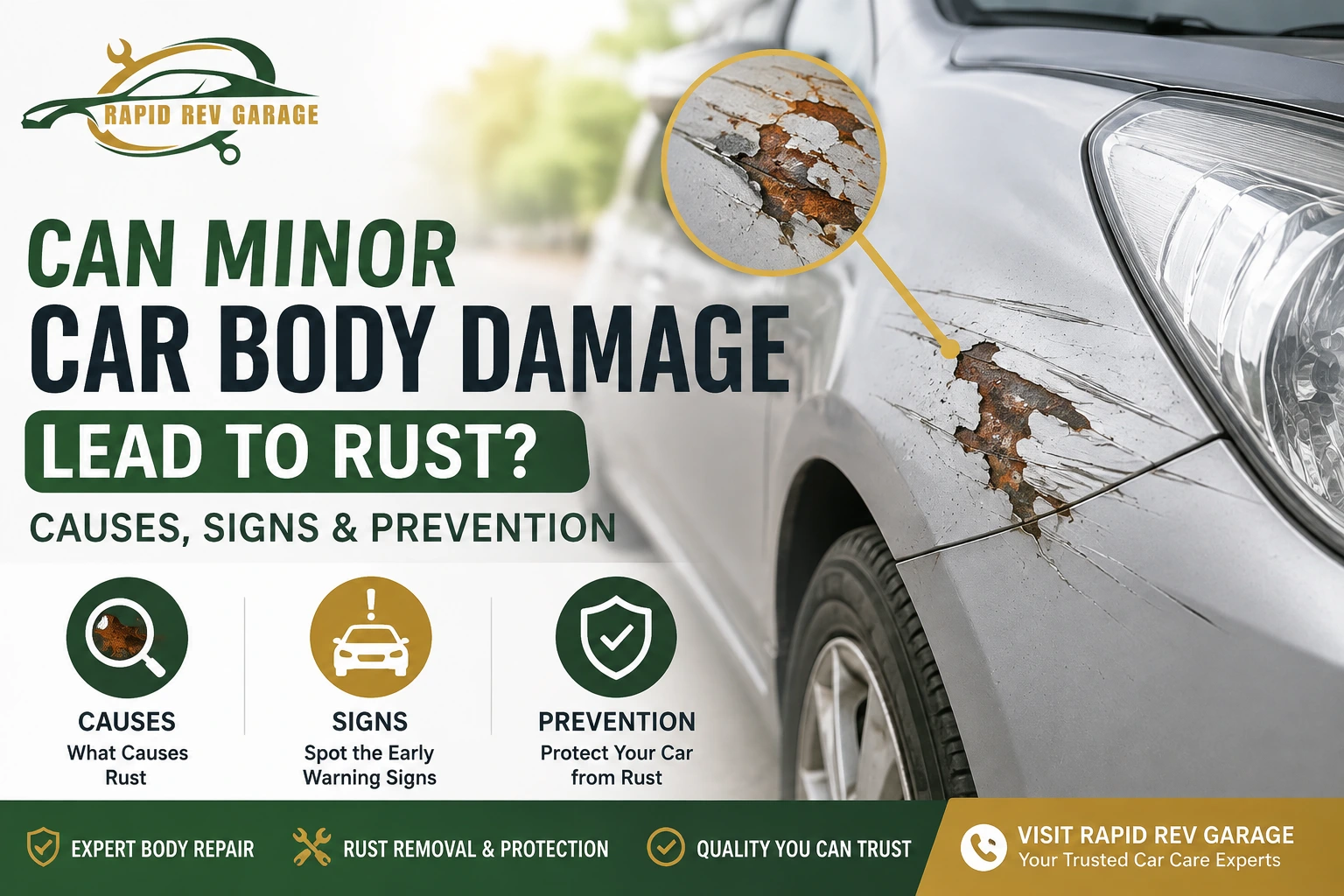
Does Minor Car Body Damage Cause Rust?
Yes, minor car body damage can absolutely lead to rust, and it happens more often than most drivers expect. The moment a scratch, chip, or small dent breaks through the paint and primer, the bare metal underneath is exposed to air and moisture. Give it a few weeks of Dubai heat, coastal humidity, or morning condensation, and oxidation starts creeping in. It won’t look dramatic at first — usually just a faint discoloration or a rough patch — but left alone, that small spot spreads. The fix is simple though: catch it early, get it inspected, and have it repaired before it turns into something that costs a lot more to put right.
Table of Contents
- How Does Minor Car Body Damage Actually Turn Into Rust?
- Signs Your Minor Car Body Damage Is Starting to Rust
- What Usually Causes This Kind of Damage in the First Place
- How Technicians Check for Rust You Can’t See
- How the Repair Actually Works
- Why You Shouldn’t Just Ignore It
- Is It Okay to Keep Driving?
- How Long Will the Repair Take?
- What Determines the Cost?
- Simple Habits That Prevent Rust
- Why Dubai’s Climate Still Plays a Role
- Why Drivers Choose Rapid Rev Garage
- Frequently Asked Questions
- Related Services
- Final Thoughts
How Does Minor Car Body Damage Actually Turn Into Rust?
Most people brush off a small scratch or a light dent as purely cosmetic. It isn’t. Every panel on your car is protected by a layer of paint and primer sitting on top of the steel, and that layer is the only thing standing between your metal and the outside world. Once minor car body damage breaks through it, oxygen and moisture get direct access to bare metal, and that’s really all rust needs to get going.
It’s rarely sudden. Corrosion tends to start as a barely-visible patch tucked under the damaged paint, then slowly works its way outward across the panel. Ignore it long enough and it eats into the metal itself, which means a bigger repair bill and a lower resale value down the line.
Newer cars do come with corrosion-resistant coatings, and they genuinely help — but they’re not invincible. A stone chip, a deep scratch, or a solid impact can break right through them, and once that happens, the clock starts ticking.
Signs Your Minor Car Body Damage Is Starting to Rust
Rust doesn’t always show up as an obvious orange patch. Early on, it’s subtle, which is exactly why so many drivers miss it until it’s already spread.
Keep an eye out for:
- Small orange or brown flecks around an old scratch
- Paint that’s starting to bubble or peel at the edges
- A rough, flaky texture where the surface used to be smooth
- Discoloration creeping outward from the damaged spot
- Rust-tinted water stains after a wash
- Corrosion expanding around the rim of a dent
- Tiny cracks forming in chipped paint
- Bare metal peeking through where paint has lifted
If any of that sounds familiar, it’s worth looking up a garage near me and getting it looked at properly. A trained eye can catch corrosion long before it becomes a structural headache.
What Usually Causes This Kind of Damage in the First Place
Not every scratch ends up rusting, but certain situations make it far more likely. Here’s what we see most often at the shop.
Stone chips. Loose gravel kicked up by other cars on the highway can chip away paint in seconds, leaving bare metal exposed.
Parking lot dents. A careless door swing or a stray shopping cart can crack the paint even when the dent itself barely shows.
Low-speed accidents. Even a gentle bump can damage the protective coating, and if repairs get delayed, rust has time to settle in.
Deep scratches. Keys, branches, anything sharp — they can slice straight through paint and primer, giving moisture a clear path to the metal.
Old, low-quality repairs. A rushed or cheap paint job often doesn’t seal the panel properly, so corrosion can start underneath without anyone noticing.
Weather. Dubai isn’t a rainy city, but coastal humidity and overnight condensation still speed up corrosion once minor car body damage has already exposed the metal.
Dust and road grime. Sand and dirt settle into scratches and dents, trapping moisture against bare metal for days at a time.
Catching any of these early saves you money later. If your car’s picked up a scratch, dent, or chip recently, it’s worth having the team at Rapid Rev Garage take a look before it becomes a bigger issue.
How Technicians Check for Rust You Can’t See
Here’s the tricky part — rust often starts underneath the paint, well before it’s visible from the outside. That’s why a proper inspection from an experienced car mechanic matters even when the damage looks small.
Step 1: A Close Visual Check
Technicians start by going over the panel in detail, looking for paint chips, hairline cracks, exposed metal, bubbling, or any sign that moisture has already gotten in. Even a pinprick-sized flaw can mean corrosion has already begun underneath.
Step 2: Looking for Hidden Corrosion
Wheel arches, door edges, rocker panels, fender joints, and seams around the trunk or hood are all common hiding spots for rust that isn’t obvious at first glance. Finding it here, early, is a lot cheaper than finding it later.
Step 3: Checking for Structural Damage
If the minor car body damage came from an actual collision, technicians will also check panel alignment, frame measurements, door operation, and suspension mounting points, just to be sure nothing beneath the surface was affected.
How the Repair Actually Works
The right fix depends entirely on how far the damage has gone.
Paint chips and surface scratches: the area gets cleaned, sanded, treated with a rust-inhibiting primer where needed, then handled through proper car painting and sealed with a clear coat to match the rest of the car.
Small dents: if the paint’s still intact, paintless dent repair (PDR) can pop the panel back into shape without touching the finish. If the paint’s cracked, it’ll need conventional repair and a repaint.
Surface rust that’s already started: technicians strip away the corrosion, sand the metal, apply a rust converter, then prime, repaint, and seal it against future moisture.
Deeper corrosion: this can mean panel replacement, welding, and a full rust-proof treatment. It costs more, but it’s the only way to bring the panel back to full strength.
Rapid Rev Garage handles all of these in-house, using proper materials rather than shortcuts, so the repair actually holds up.
Why You Shouldn’t Just Ignore The Sign of Car Body Damage
It’s tempting to put off fixing a small scratch — it doesn’t feel urgent. But that delay is exactly what lets rust spread past the original spot. Left alone, minor car body damage can lead to weakened panels, a bigger repair bill, water finding its way into places it shouldn’t, paint peeling across a much wider area, and a real hit to your car’s resale value. What could’ve been a quick, cheap fix turns into a full panel replacement if it’s left too long.
Is It Okay to Keep Driving?
In most cases, yes. A small scratch or minor dent usually won’t stop your car from being safe to drive. That said, every day it sits unrepaired is another day the exposed metal is sitting there unprotected.
Get it looked at sooner rather than later if you notice bare metal, peeling paint, rust spots that seem to be growing, cracked panels, a loose bumper, or sharp edges left over from an impact. And if the damage came from a collision and you’re not sure it’s even safe to drive home, calling roadside assistance is the safer call — better than risking more damage on the way to the shop.
How Long Will the Repair Take?
It really depends on the extent of the damage and whether rust treatment is involved.
| Repair Type | Estimated Time |
| Paint chip repair | 1–2 hours |
| Minor scratch repair | 2–4 hours |
| Small dent repair | 2–5 hours |
| Dent with repainting | 1–2 days |
| Surface rust removal | 1–2 days |
| Panel replacement | 2–5 days |
| Major body repairs | Several days to a week |
Bigger jobs sometimes need extra time for the paint to properly cure, especially with larger refinishing work.
What Determines the Cost?
There’s no flat rate here — the final number depends on quite a few things: how big and how deep the damage is, whether rust has already set in, how many panels are affected, how tricky the paint match is, your car’s make and model, whether parts need to be sourced, and how much labor the job needs.
One thing worth remembering: dealing with minor car body damage early is almost always cheaper than waiting until it’s turned into serious corrosion or a full panel swap.
Simple Habits That Prevent Rust
Preventing rust takes a lot less effort than fixing it.
Wash your car regularly. Dirt, sand, and road grime hold onto moisture, especially around wheel arches, door sills, and the lower body panels.
Don’t sit on paint chips. The sooner they’re sealed, the less time oxidation has to get started.
Add a wax or ceramic coating. It won’t undo existing damage, but it does add a layer of protection against moisture and UV rays going forward.
Walk around your car every few weeks. Look for new scratches, chips, small dents, bubbling paint, or the first hint of rust. Catching it early almost always means a faster, cheaper fix. If you can’t make it into the shop, a mobile car mechanic can take a look wherever your car’s parked.
Skip the cheap repair shortcuts. A rushed paint job can leave gaps where moisture sneaks in, so it’s worth getting it done the first time properly.
Why Dubai’s Climate Still Plays a Role
Dubai’s dry most of the year, so a lot of drivers assume rust just isn’t something to worry about here. That’s not quite true. Coastal humidity, overnight condensation, intense sun, blowing sand, and the odd stone chip from highway driving all add up once the paint’s already broken through. Cars parked outdoors for long stretches, or driven regularly near the coast, are still at risk if scratches go unrepaired. A quick check after a long highway drive can catch paint chips before they turn into anything worse.
Why Drivers Choose Rapid Rev Garage Minor Car Body Damage
When your car’s picked up some damage, the shop you choose makes a real difference in how it holds up long-term. Our team focuses on getting both the look and the protection right, not just a quick patch job — the same standard we bring to every car service in Dubai we handle.
Here’s what keeps people coming back:
- Technicians experienced across a wide range of vehicle brands
- Thorough, honest damage assessments
- Careful dent and scratch repair work
- Paint matching that actually blends in
- Proper rust treatment, not just a cover-up
- Genuine parts when replacements are needed
- Transparent pricing, no surprise add-ons
- Quick turnaround
- A team that actually explains what’s going on with your car
If you’ve been searching for a reliable workshop for anything from a small chip to more serious body damage, we’re set up to handle it properly.
Frequently Asked Questions
Q1: Can minor car body damage really turn into rust?
Yes. Once the paint and primer are broken, moisture and air reach the bare metal, and that’s when corrosion starts.
Q2: How fast does rust show up after a scratch?
It varies a lot depending on the weather and how exposed the spot is — anywhere from a few weeks to several months.
Q3: Can I just touch it up myself?
Touch-up pens can buy you a bit of time, but they rarely match the paint properly or seal the area as well as a professional repair does.
Q4: Does every dent end up rusting?
Not necessarily. If the paint stays intact, the risk is low. But any dent that cracks the paint is worth having checked.
Q5: Does regular washing stop rust?
It helps by clearing away the grit and grime that trap moisture, but it won’t undo damage that’s already there. Scratches and chips still need proper repair.
Q6: Is fixing rust expensive?
Catching it early, while it’s still surface-level, is usually far cheaper than waiting until it eats deeper into the panel.
Q7: What if I’m in an accident and not sure it’s safe to drive?
Call roadside assistance. It’s a much safer way to get your car to a shop than risking further damage on the road.
Q8: How often should I check my car for this kind of thing?
A quick walk-around every few weeks, and especially after a long highway trip, is usually enough to catch new scratches or chips before they become a real problem.
Related Services
If your vehicle’s dealing with minor car body damage, a few of our other services might help too:
- Car Body Repair
- Car Paint Repair
- Dent Removal
- Scratch Repair
- Bumper Repair
- Accident Repair
- Paintless Dent Repair (PDR)
- Car Detailing
- Vehicle Inspection
- Emergency Roadside Assistance
Final Thoughts
A small scratch or chip may not seem like much of a problem today, but minor car body damage rarely stays minor if it’s ignored. Getting it sorted early protects the way your car looks, keeps its resale value intact, and saves you from a much bigger bill down the road.
If you’ve spotted any damage on your car, don’t wait around for rust to take hold. Visit Rapid Rev Garage and let our team take a proper look — from small scratch repairs to full body restoration, we’ll get your car back to looking and driving the way it should.