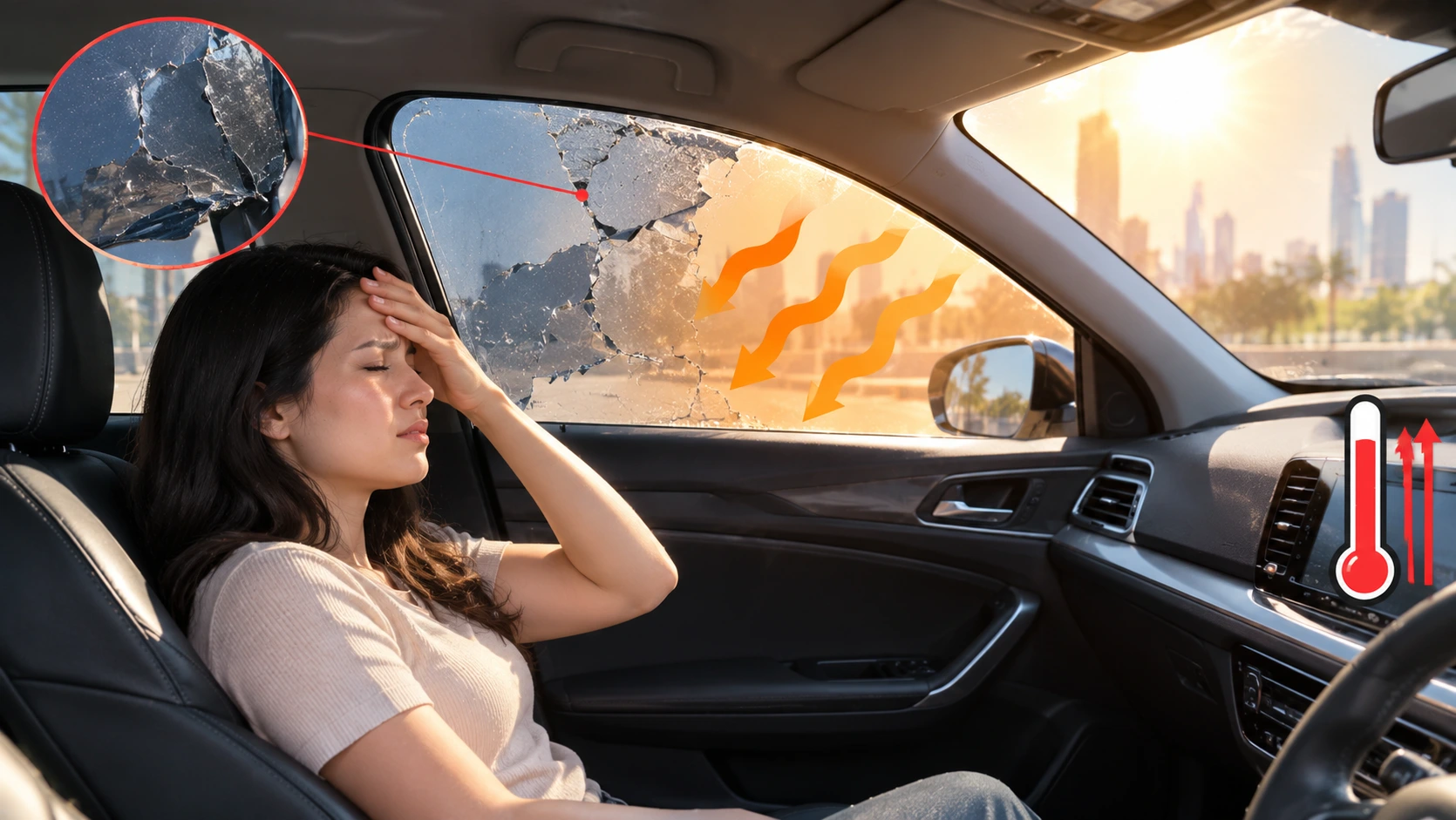
Yes — damaged window tint increases cabin heat in Dubai significantly, and in Dubai’s conditions the difference is not subtle. A tint film that is peeling, bubbling, cracked, or purple is why damaged window tint increases cabin heat — it has lost the solar rejection properties it was installed to provide. The film is now blocking less infrared radiation than it was designed to — and in Dubai’s summer, that means a noticeably hotter cabin.
Understanding exactly why damaged window tint increases cabin heat explains why a bubbling tint is not just a cosmetic problem. This is the practical problem that makes damaged window tint increase cabin heat worth addressing, the fuel cost of cooling the cabin, and the comfort and safety of the vehicle’s occupants.
At Rapid Rev Garage in Al Quoz, we replace and repair window tint on vehicles across every make. This guide explains the heat mechanism, what each type of tint damage does, and what the correct replacement costs in Dubai.
Damaged Window tint increases cabin Heat — Quick Answer
Damaged window tint increases cabin heat because tint film works by blocking and reflecting solar energy — specifically infrared radiation, which is the component of sunlight responsible for heat. When the film is intact, it blocks 40–70% of this infrared energy from entering the cabin. When the film is damaged — bubbling, peeling, cracked, or colour-shifted — its infrared-blocking layer has degraded or delaminated. Every damaged area is a zone where damaged window tint increases cabin heat occurs as if no tint were fitted. In Dubai, where solar radiation intensity is extreme for most of the year, even a partially degraded tint film produces a measurable increase in cabin temperature compared to a functioning film of the same specification.
Table of Contents
- How Window Tint Blocks Heat — The Infrared Rejection Mechanism
- Why Bubbling Tint Loses Its Heat Rejection Properties
- Peeling Tint and the Delaminated Infrared Layer
- Purple or Brown Tint — Dye Degradation and Heat Transmission
- Cracked Tint and the Gaps That Let Solar Energy Through
- How Much Hotter Does a Damaged Tint Make the Cabin?
- The AC Load Increase From a Damaged Tint Film
- How Dubai’s UV Degrades Tint Faster Than Most Markets
- What Type of Replacement Tint Holds Up in Dubai
- How We Replace Damaged Window Tint at Rapid Rev Garage
- What Does Window Tint Replacement Cost in Dubai?
- Why Rapid Rev Garage?
- FAQ
- Conclusion
How Window Tint Blocks Heat — The Infrared Rejection Mechanism
Window tint works on a specific principle. Visible light — what the human eye sees — makes up only a portion of the solar energy reaching the vehicle. The component responsible for the heat you feel is infrared radiation — wavelengths longer than visible light that transfer thermal energy.
A quality tint film has a metallic or ceramic layer that reflects or absorbs infrared radiation before it enters the cabin. The film’s solar heat rejection rating — expressed as a percentage — describes how much of the total solar energy it blocks. A film rated at 60% solar heat rejection blocks 60% of the solar energy from entering the cabin.
The visible light transmission (VLT) is a separate measurement — how much visible light the film passes. Dubai law specifies minimum VLT for road-legal tint. The heat rejection and the VLT are independent — a film can have a low VLT (dark appearance) but poor heat rejection if its infrared layer has degraded.
This distinction matters when damaged window tint increases cabin heat is the complaint. A tint can still look dark — appearing to be doing its job — while its infrared rejection layer has completely failed. The cabin is hotter, but the tint looks fine from outside. Our car mechanic team uses a solar transmission meter to measure actual infrared rejection of existing tint before recommending replacement.
Why Bubbling Tint Loses Its Heat Rejection Properties
Bubbling is the most visible form of tint damage in Dubai. It appears as raised areas — domes or ridges — under the film surface, typically starting at the edges and progressing inward.
Bubbling occurs when the adhesive layer between the film and the glass fails. The adhesive softens in Dubai’s extreme heat, loses its bond with the glass surface, and the film lifts. The lifted area is now a bubble of air between the film and the glass.
That air gap is the problem for heat rejection. When the film was bonded flush to the glass, infrared radiation hit the film’s metallic or ceramic layer and was reflected or absorbed before entering the cabin. Now, the bubbled area has a gap — the film is no longer in contact with the glass. The film’s infrared layer is partially delaminated, and the reflection pattern is disrupted. Solar energy passes through the bubble area with significantly reduced blocking.
Large bubble patterns on rear windows are why damaged window tint increases cabin heat is most noticeable in the rear cabin. The window is now transmitting heat at a rate approaching untinted glass. This is the direct mechanism by which damaged window tint increases cabin heat on every afternoon drive on every afternoon drive.
Peeling Tint and the Delaminated Infrared Layer
Peeling tint is the advanced stage of adhesive failure. Where bubbling has progressed to the point where the film lifts completely from the glass at the edges, the tint begins to peel away.
A peeled area of tint is simply missing. There is no infrared rejection at that glass area — the window transmits solar energy as if no tint were ever applied.
On rear side windows — where peeling typically starts — even a small peeled area of 10×10cm allows a direct solar energy path into the rear cabin. In a vehicle with children or passengers in the rear, this creates a localised hot zone that no amount of AC cooling compensates for while the sun is directly hitting that window.
Peeling tint also scatters light at the edge of the peeled area, creating a visibility distraction for the driver in the rear-view mirror. Every case where damaged window tint increases cabin heat is confirmed deserves a full replacement — for any vehicle also needing paint or body repairs, our car painting team handles all exterior work at the same visit.
Purple or Brown Tint — Dye Degradation and Heat Transmission
Window tint that has turned purple, brown, or uneven in colour has undergone dye degradation. This type of failure is specific to dyed tint films — the most common and cheapest tint type used in Dubai.
Dyed tint films use a layer of UV-absorbing dye to darken the film and provide some heat rejection. This dye is inherently unstable under sustained UV exposure. Dubai’s extreme UV levels — classified as extreme for most of the year — bleach the dye layer significantly faster than any temperate market.
As the dye degrades, two things happen. The film loses its dark colour — appearing purple, brownish, or uneven. And it loses its solar energy absorption capability. A dyed film that was absorbing 40% of solar energy when new may be absorbing 15% after three years of Dubai outdoor parking.
Discolouration is the visible indicator that damaged window tint increases cabin heat is already occurring. The film that looks discoloured from outside the vehicle is transmitting significantly more heat than it did when new. Our car service packages include a tint condition and solar rejection check at every major service for vehicles over three years old.
Cracked Tint and the Gaps That Let Solar Energy Through
Cracked tint — from stone impacts, from a window mechanism fault that caught the film, or from thermal stress in very old film — creates physical gaps in the film surface.
These gaps are direct solar energy pathways. No film, no infrared rejection. Solar energy passes straight through cracks as through untinted glass.
Cracked tint also creates sharp edges at the crack line. These edges can catch on the window seal as the window is raised and lowered, extending the crack across the film. A small crack at the bottom edge of a side window can propagate to the top of the glass within a few window cycles.
How Much Hotter Does a Damaged Tint Make the Cabin?
The cabin temperature difference between an intact quality tint and a fully degraded tint is measurable and significant in Dubai’s conditions.
A properly functioning ceramic tint with 60% solar heat rejection on all windows reduces the cabin heat load by more than half compared to untinted glass. In July at 2pm with the car parked in direct sun, the cabin of an untinted vehicle reaches 75–80°C. The same vehicle with intact quality tint reaches 55–65°C.
A vehicle with damaged tint — particularly rear windows with significant bubbling and degraded dye — sits closer to the untinted figure than the protected figure. The practical result is a cabin that takes significantly longer to cool when the AC starts, a higher sustained AC load on every drive, and a less comfortable environment for rear passengers.
The AC Load Increase From a Damaged Tint Film
Every kilogram of cabin heat that enters through a degraded tint window is heat that the AC system must remove. The AC compressor runs longer and harder to achieve the same cabin temperature.
In Dubai, where the AC is running at or near maximum capacity for six to eight months of the year, the additional load from damaged tint is not marginal. A vehicle with significantly degraded tint may use 5–10% more fuel on a typical city drive compared to the same vehicle with functioning tint — because the compressor is removing the heat that the tint is no longer blocking.
Over a year of driving, this additional fuel cost accumulates. The tint replacement cost is often recovered within months through reduced fuel consumption and reduced AC system wear — the compressor runs fewer hours at peak load when it is not compensating for degraded film.
How Dubai’s UV Degrades Tint Faster Than Most Markets
Dubai’s UV index reaches 10–11 during peak summer — classified as extreme. This UV intensity is significantly higher than European or North American markets where tint film specifications are developed and tested.
A dyed tint film rated for five years in a European climate may reach the end of its useful life in two to three years in Dubai’s outdoor parking conditions. Even higher-quality ceramic and metallic films — which are more UV-stable — show degradation faster in Dubai than their manufacturer’s lifetime ratings assume.
The roof glass and rear windscreen receive the most direct radiation — particularly at Dubai’s summer sun angles — and degrade fastest. Side windows degrade more slowly but still reach end-of-life significantly faster than in cooler markets.
This is why damaged window tint increases cabin heat is a complaint that appears on four to five-year-old Dubai vehicles with reliable regularity. The film has reached the end of its UV-resistance life, and the infrared rejection it was providing is now compromised. For any emergency from an overheating cabin on the road, our roadside assistance team covers Al Quoz and nearby Dubai areas.
What Type of Replacement Tint Holds Up in Dubai
Not all tint films are equal in Dubai’s conditions. The correct replacement film makes a significant difference to how long the new tint lasts.
Dyed tint. The most common and cheapest option. UV-stable dye has improved over recent years but dyed film is still the least durable in Dubai’s conditions. Expect two to four years before visible degradation in outdoor parking.
Metallic or sputtered tint. A metallic layer deposited on the film provides better UV stability and significantly better infrared rejection than dyed film. More durable in Dubai — five to seven years is realistic with covered parking. The metallic layer can interfere with GPS and mobile signals on some vehicles.
Carbon tint. Carbon particles replace the metallic layer, providing good infrared rejection without signal interference. More UV-stable than dyed film. A good mid-range option for Dubai.
Ceramic tint. The highest-performing and most durable option for Dubai. Nano-ceramic particles provide the highest infrared rejection — typically 60–70% or above — with excellent UV stability and no signal interference. The most expensive option but the correct choice for vehicles parked outdoors consistently in Dubai’s conditions. Lifespan of seven to ten years is realistic with quality ceramic film.
For any vehicle used daily in Dubai with outdoor parking, ceramic tint is the specification we recommend. The additional cost over dyed film is recovered through durability and through the reduced AC load it provides throughout its life. Our mobile car mechanic covers Al Quoz and nearby Dubai areas for on-site tint condition assessment.
How We Replace Damaged Window Tint at Rapid Rev Garage
Solar rejection measurement first. We measure the actual infrared rejection of the existing tint using a solar transmission meter. This confirms how degraded the film is before recommending replacement.
Full removal of existing film. The old film is removed completely — adhesive residue included. Residue left on the glass reduces the bond of the new film and causes premature bubbling.
Glass cleaning and preparation. The glass is cleaned with an ammonia-free solution and inspected for any damage to the defroster lines on the rear windscreen before new film is applied.
Film application. New film is cut to the exact glass dimensions, applied wet, and squeegeed to remove all water and air. Edges are sealed against the window seal.
Curing period. The film takes 24–72 hours to fully cure and bond to the glass. Slight haziness or small water pockets during this period are normal and disappear as the film cures.
What Does Window Tint Replacement Cost in Dubai?
| Film Type | Cost Range (Full Vehicle) |
| Dyed tint | AED 300–700 |
| Carbon tint | AED 600–1,200 |
| Metallic / sputtered tint | AED 700–1,500 |
| Ceramic tint | AED 1,200–3,500 |
Cost varies by vehicle size — SUVs and vans have more glass area than saloons. Individual window replacement is available where only one or two panes have failed.
Our garage near me in Al Quoz serves drivers from Business Bay, Jumeirah, Barsha, Satwa, Downtown, and the Sheikh Zayed Road corridor.
Why Rapid Rev Garage?
Damaged window tint increases cabin heat is confirmed by measurement, not by appearance. A tint can look dark and still be transmitting 80% of infrared energy if its blocking layer has degraded. We measure before we recommend.
We remove the old film completely — including adhesive residue — before applying the new film. And we recommend the correct specification for Dubai’s conditions, not the cheapest option available.
FAQ — Damaged Window tint increases cabin Heat
Here are the questions Dubai drivers ask us most about tint damage and cabin heat.
Does bubbling tint actually make the car hotter?
Yes. Bubbles mean the adhesive has failed and the film has lifted from the glass. The delaminated film no longer rejects infrared effectively in those areas. The more bubbling, the more heat enters through that window.
How do I know if my tint is still blocking heat?
A solar transmission meter confirms the actual infrared rejection of any tint film in two minutes. Alternatively — if the car feels significantly hotter than it used to after parking in the same spot, and the tint is visibly bubbling or discoloured, the film has degraded.
Can I just replace one window instead of all of them?
Yes. If only the rear windscreen or one side window has failed, that pane can be replaced independently. The new film will be a slightly different shade to the remaining old film — most drivers choose to replace all windows at once for visual consistency.
Is purple tint still legal in Dubai?
Legal tint in Dubai requires a minimum VLT as specified by the RTA. A purple or discoloured film may still pass the VLT threshold if it has not faded dramatically. But it has already lost its heat rejection capability regardless of whether it is technically legal.
How long does ceramic tint last in Dubai?
A quality ceramic tint with covered or underground parking: seven to ten years. Consistent outdoor parking in direct Dubai sun: five to seven years. The UV stability of ceramic film is significantly higher than dyed or carbon film, making it the most cost-effective long-term choice in Dubai's conditions.
Conclusion
Damaged window tint increases cabin heat because the film’s infrared blocking layer has degraded, delaminated, or developed gaps — allowing solar energy through that was previously being rejected. In Dubai’s extreme UV environment, this degradation happens faster than any manufacturer’s lifetime rating assumes.
Rapid Rev Garage in Al Quoz measures actual infrared rejection before replacing any tint, removes all adhesive residue before applying new film, and recommends the correct film specification for Dubai’s conditions — not just the cheapest option available.
Rapid Rev Garage is in Al Quoz, serving Business Bay, Jumeirah, Downtown, Barsha, Satwa, and the Sheikh Zayed Road corridor. Book your appointment on WhatsApp or find us on Google Maps.
Rapid Rev Garage — Damaged Window tint increases cabin Heat | Al Quoz, Dubai