Car brakes squeaking is the most common brake complaint Dubai drivers bring to us — and one of the most misunderstood. Some squeaks are normal. Some squeak is a warning. Some squeak means the brakes need immediate attention.
The challenge is telling them apart. Not every car brakes squeaking case requires immediate repair. But some are. A car brakes squeaking situation from a wear indicator is a planned warning — the pad has a built-in metal tab that contacts the disc to tell you the pad is getting low. A squeak from a glazed disc is a maintenance issue. A squeak that becomes a grind means metal is already contacting metal — the pad is gone and the disc is being destroyed on every stop.
At Rapid Rev Garage in Al Quoz, every car brakes squeaking complaint is diagnosed by type, condition, and timing — before recommending any repair.
Car Brakes Squeaking — Quick Answer
Car brakes squeak for several distinct reasons. The most common in Dubai are worn brake pads where the built-in wear indicator is contacting the disc, glazed brake pads or discs from heat exposure in stop-start traffic, dust and debris between the pad and disc surface that produces a temporary squeak, a seized caliper slide pin that is holding the pad in light contact with the disc at all times, or a morning squeak from surface rust on the disc that clears after one or two brake applications. In Dubai’s stop-start traffic and intense heat, brake components wear and glaze faster than in any cooler market. A squeak that appears every time the brakes are applied — not just at the first stop of the day — requires an inspection.
Table of Contents
- Why Not All Brake Squeaks Mean the Same Thing
- The Wear Indicator Squeak — The Planned Warning
- Morning Disc Rust — The Squeak That Clears Itself
- Glazed Pads and Discs From Dubai’s Heat
- Seized Caliper Slide Pin Causing Continuous Contact
- Debris Between the Pad and Disc
- New Brake Pads That Squeak — Is That Normal?
- How Dubai’s Stop-Start Traffic Accelerates Brake Wear
- How We Diagnose Car Brakes Squeaking at Rapid Rev Garage
- The Services That Fix Each Confirmed Cause
- What Does Brake Repair Cost in Dubai?
- When Is a Brake Squeak Urgent?
- Why Rapid Rev Garage?
- FAQ
- Conclusion
Why Not All Brake Squeaks Mean the Same Thing
The squeak character — when it happens, how long it lasts, and whether it changes with brake pressure — identifies the cause before the wheels are off.
A squeak only at the first brake application of the day, then silence. Morning disc rust. Normal. Not a fault.
A squeak every time the brakes are applied, at all speeds. Wear indicator, glazing, or a seized slide pin. Needs inspection within the week.
A squeak that has become a grinding or scraping sound. The pad material is gone. Metal to metal. Same-day repair — every stop is damaging the disc.
A squeak from one corner only. Localised fault — glazed pad on one side, seized slide pin at one caliper, or a pad that has worn faster than the other side from an uneven caliper.
A squeak under light braking that disappears under firm braking. Classic glazing pattern. The glazed surface generates high-frequency noise at light pad pressure and quiets when the pressure is high enough to distort the glazed contact.
Our car mechanic team documents the exact squeak pattern before lifting the vehicle — the pattern narrows the cause before the wheels are removed.
The Wear Indicator Squeak — The Planned Warning
Every modern brake pad has a wear indicator — a small metal tab attached to the pad backing plate. When the friction material wears down to the designed minimum thickness, this tab contacts the disc surface and produces a high-pitched squeak.
This is intentional. The squeak is the designed warning that the pads need replacing. It is not a fault — it is the system working as designed.
The wear indicator squeak appears at every brake application, at all speeds. It does not go away after the first stop of the day. It is consistent and gets louder as the pads wear further.
On most vehicles, the wear indicator appears when around 2–3mm of pad material remains. This is enough for several hundred kilometres of safe braking — but not thousands. When the wear indicator squeak starts, book within the week. Do not wait until the next scheduled service.
In Dubai, brake pads reach their wear limit faster than European service intervals anticipate. Stop-start traffic, frequent speed bump braking, and the heat that accelerates pad material degradation all contribute. Car brakes squeaking from worn pads on a 30,000 km Dubai vehicle is not unusual — the same pads on a European highway-driven vehicle might last 60,000 km.
Morning Disc Rust — The Squeak That Clears Itself
This is the most common cause of a single morning squeak that concerns drivers but requires no action.
Brake discs are made from cast iron. Iron forms surface rust overnight — particularly in Dubai’s inter-season months when humidity is high. A thin orange-brown rust layer forms on the disc face during the hours the car is parked.
The first brake application of the day scrapes this rust layer off the disc. During that scraping, the roughened rust surface produces a grinding or squeaking sound that lasts for one to three brake applications. After that, the disc surface is clean and the braking is silent.
If the squeak clears within the first two minutes of driving, disc surface rust is the cause. No repair needed. Our car service packages include a disc and pad condition check at every service — confirming that the morning squeak is surface rust and not early-stage pad wear happening to clear quickly.
Glazed Pads and Discs From Dubai’s Heat
Glazing is one of the most common causes of car brakes squeaking in Dubai — and one of the most frequently misdiagnosed.
Glazing occurs when the brake pad material overheats. In Dubai’s stop-start traffic, where the brakes are applied dozens of times per short commute, the friction material in the pad reaches temperatures that cause its surface layer to harden and vitrify — the surface becomes glassy rather than porous.
A glazed pad surface produces a high-frequency squeak under light braking because the hardened surface cannot grip the disc correctly. Under firm braking, the same pad may feel adequate — the pressure deforms the glazed surface enough to produce acceptable friction.
The disc can also glaze — a mirrored, smooth surface on the disc face from prolonged light contact. A disc glazed from a dragging caliper is particularly common in Dubai.
Mild glazing on pads is correctable by a controlled hard-braking bedding procedure — a series of firm stops from 60 km/h to 10 km/h that clean and reopen the pad surface. More advanced glazing requires pad replacement. A glazed disc that has lost its machined surface grooves requires disc replacement. For any roadside emergency from brake failure, our roadside assistance team covers Al Quoz and nearby Dubai areas.
Seized Caliper Slide Pin Causing Continuous Contact
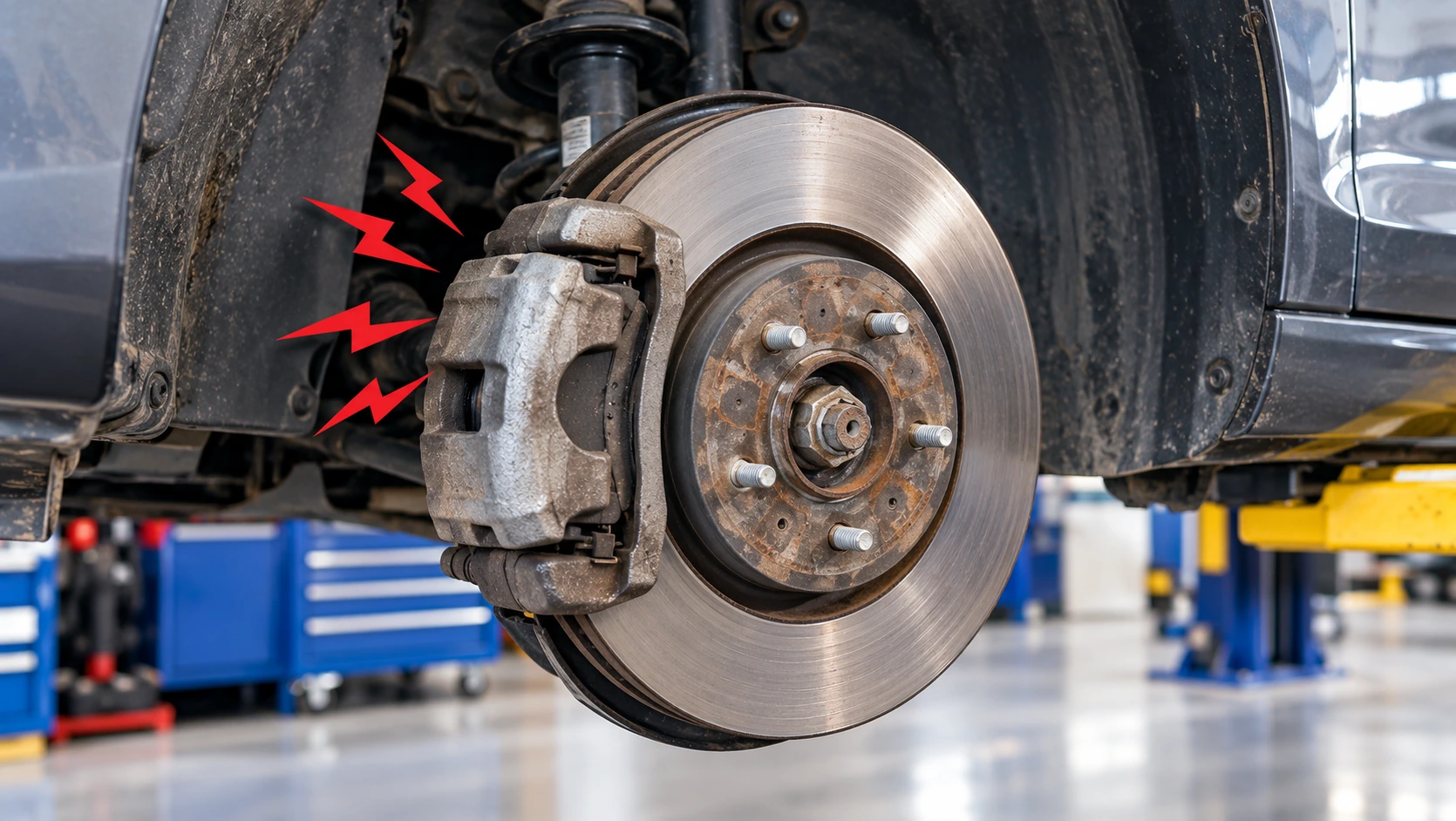
Brake caliper slide pins allow the caliper to move slightly as the pads wear — keeping even contact across the full pad surface. These pins are lubricated with a high-temperature grease and slide in rubber-sealed bores.
In Dubai, the rubber seals on the slide pin bores degrade from heat and UV. Moisture enters the bore and corrodes the pin. A corroded slide pin seizes — it no longer moves freely. The caliper is now fixed in a slightly off-centre position, and one side of the pad maintains light contact with the disc at all times.
This continuous light contact produces heat — the affected wheel will be noticeably hotter than the opposite side after a normal drive. It also produces a continuous squeak or squeal that is present even without the brake pedal being pressed, because the pad is in contact while the disc is rotating.
Slide pin seizure is also the most common cause of one-sided brake wear in Dubai — the inner pad wears significantly faster than the outer because the seized pin holds the caliper inward.
Slide pin servicing — cleaning, lubricating, and testing free movement — is part of every brake service. Seized pins that cannot be restored are replaced. Our car painting team handles any wheel arch or body repairs needed alongside brake work at the same visit.
Debris Between the Pad and Disc
A stone chip, a piece of grit, or a hard particle of brake dust embedded between the pad surface and the disc produces a squeak or scraping sound that appears suddenly rather than gradually.
This debris-caused squeak is typically intermittent — it appears at certain disc rotations and not others as the embedded particle rotates with the disc or pad. It may also produce a vibration felt through the brake pedal.
Debris-caused car brakes squeaking usually resolves itself over a short distance as the particle is ground down or ejected. If a scraping sound continues after several kilometres of normal driving, the particle has embedded more deeply and the disc surface may be scored. Inspection confirms the disc surface condition and whether the score requires machining or replacement.
New Brake Pads That Squeak — Is That Normal?
Yes — briefly. New brake pads have a green surface layer from the curing process during manufacture. This surface layer produces a squeak for the first 200–500 km of use while it is bedded in and worn away by the disc contact.
The bedding process accelerates if the driver performs a series of moderate braking applications from 60 km/h during the first few hundred kilometres — rather than using the brakes very gently, which extends the bedding period.
A squeak from new pads that persists beyond 500 km is not normal bedding behaviour. The pads may be the wrong specification for the vehicle, or the disc surface has not been adequately prepared before fitting.
How Dubai’s Stop-Start Traffic Accelerates Brake Wear
Dubai’s traffic pattern is one of the most brake-intensive in the world. Speed bumps — dozens per residential route — each require a full brake application and acceleration. Traffic lights on short cycle times create constant stop-start sequences. Roundabouts require repeated partial brake applications.
A Dubai driver doing a 15-minute city commute may apply the brakes 40–60 times. The same journey on a UK road might involve 8–12 brake applications.
This usage frequency compresses the service life of every brake component. Pads wear faster. Discs score and warp faster. Caliper slide pins cycle more frequently and wear their lubrication faster.
Car brakes squeaking in Dubai is more frequent than in any European market than in any European market — not because Dubai vehicles have inferior brakes, but because the brakes are used more intensively every day.
How We Diagnose Car Brakes Squeaking at Rapid Rev Garage
Squeak pattern documentation. We note when the squeak occurs — first application only, every application, under light or firm braking, from one corner or all corners. This pattern narrows the cause before the vehicle is on the ramp.
Wheel temperature check. After a road test, both front wheels and both rear wheels are temperature-checked. A significantly hotter wheel confirms a dragging caliper or seized slide pin at that corner.
Pad thickness measurement. With the wheels off, pad thickness is measured at all four corners. Below 3mm confirms wear indicator territory. Below 2mm is urgent.
Disc condition inspection. Disc surface for scoring, glazing, and groove depth. Disc thickness measured against minimum specification. A disc below minimum thickness cannot be machined — replacement is the only option.
Slide pin movement check. Each slide pin is extracted, inspected for corrosion, and tested for free movement in its bore.
The Services That Fix Each Confirmed Cause
Brake pad replacement. Correct-specification pads for the vehicle. All four corners recommended where wear is even. AED 300–800 per axle depending on vehicle.
Brake disc replacement. Discs replaced in axle pairs — one warped or scored disc means its pair has experienced the same conditions. AED 400–1,200 per axle.
Slide pin service. Pins cleaned, relubricated, and tested. Seized pins replaced. AED 150–400 per caliper.
Brake fluid flush. Where moisture content is high. AED 200–400.
Glazing correction. Controlled bedding procedure performed on the road after pad or disc service. Included in the brake service. Our mobile car mechanic covers Al Quoz and nearby Dubai areas for on-site brake noise assessment. Our garage near me in Al Quoz serves drivers from Business Bay, Jumeirah, Barsha, Satwa, Downtown, and the Sheikh Zayed Road corridor.
What Does Brake Repair Cost in Dubai?
| Service | Cost Range |
| Brake pad replacement (per axle) | AED 300–800 |
| Brake disc replacement (per axle) | AED 400–1,200 |
| Slide pin service | AED 150–400 per caliper |
| Brake fluid flush | AED 200–400 |
All costs confirmed after the squeak pattern assessment, temperature check, and pad and disc measurement. Written quote before any work begins.
When Is a Brake Squeak Urgent?
Book the same day: A squeak that has turned into a grinding, scraping, or metallic contact sound. The pad material is gone. Every stop is scoring the disc.
Book within the week: A consistent squeak at every brake application. Wear indicator, glazing, or seized slide pin — all need attention before they worsen.
Monitor and book at the next service: A squeak that only occurs at the first brake application of the day and clears completely. Morning disc rust — normal, but worth confirming at the next visit.
Why Rapid Rev Garage?
Car brakes squeaking has a different cause in each case — and the cause determines the repair. A morning rust squeak needs nothing. A wear indicator squeak needs pads. A glazing squeak needs a bedding procedure or replacement. A continuous squeak from a seized slide pin needs the caliper serviced.
We document the squeak pattern, check temperatures, measure pad thickness, and inspect the disc before recommending any work. The repair matches exactly what the inspection confirms.
FAQ — Car Brakes Squeaking
Here are the questions Dubai drivers ask us most about squeaking brakes.
Is brake squeak dangerous?
It depends on the cause. Morning disc rust squeak — not dangerous. Wear indicator squeak — not immediately dangerous, but book within the week. Grinding sound instead of a squeak — dangerous, book the same day. Never ignore a squeak that has changed into a grinding or scraping noise.
Why do my brakes squeak more in the morning?
Overnight humidity causes a surface rust layer to form on cast iron brake discs. The first brake application scrapes this layer off — producing a squeak for one to three stops. If the squeak clears completely after the first few stops, it is morning disc rust and requires no repair.
Can new brake pads cause squeaking?
Yes, for the first few hundred kilometres. New pads have a cured surface layer that squeaks briefly during the bedding period. This is normal and resolves on its own. If new pads squeak beyond 500 km, check that the correct specification was fitted.
Why does only one wheel squeak?
Single-wheel squeaking points to a localised fault — a seized slide pin at that caliper holding the pad in contact, a pad that has worn faster than the opposite side from uneven caliper pressure, or debris lodged between the pad and disc at that corner. Have that corner inspected specifically.
Do I need to replace discs and pads together?
Not always. If the discs are within minimum thickness specification and the surface is in good condition, new pads on existing discs is acceptable. If the discs are at or below minimum thickness, warped, or have deep scoring, they should be replaced alongside the pads — fitting new pads on a damaged disc produces premature wear on the new pads.
Conclusion
The range of car brakes squeaking causes in Dubai goes from a normal morning rust squeak that needs nothing to a metal-on-metal grind that needs the same-day repair. The squeak pattern — when it happens, how long it lasts, and whether it is from one corner or all — identifies the cause before any wheel comes off.
Rapid Rev Garage in Al Quoz assesses every car brakes squeaking complaint through squeak pattern documentation, wheel temperature check, pad thickness measurement, and disc inspection — then repairs specifically what is confirmed faulty.
Rapid Rev Garage is in Al Quoz, serving Business Bay, Jumeirah, Downtown, Barsha, Satwa, and the Sheikh Zayed Road corridor. Book your appointment on WhatsApp or find us on Google Maps.
Rapid Rev Garage — Car Brakes Squeaking | Al Quoz, Dubai