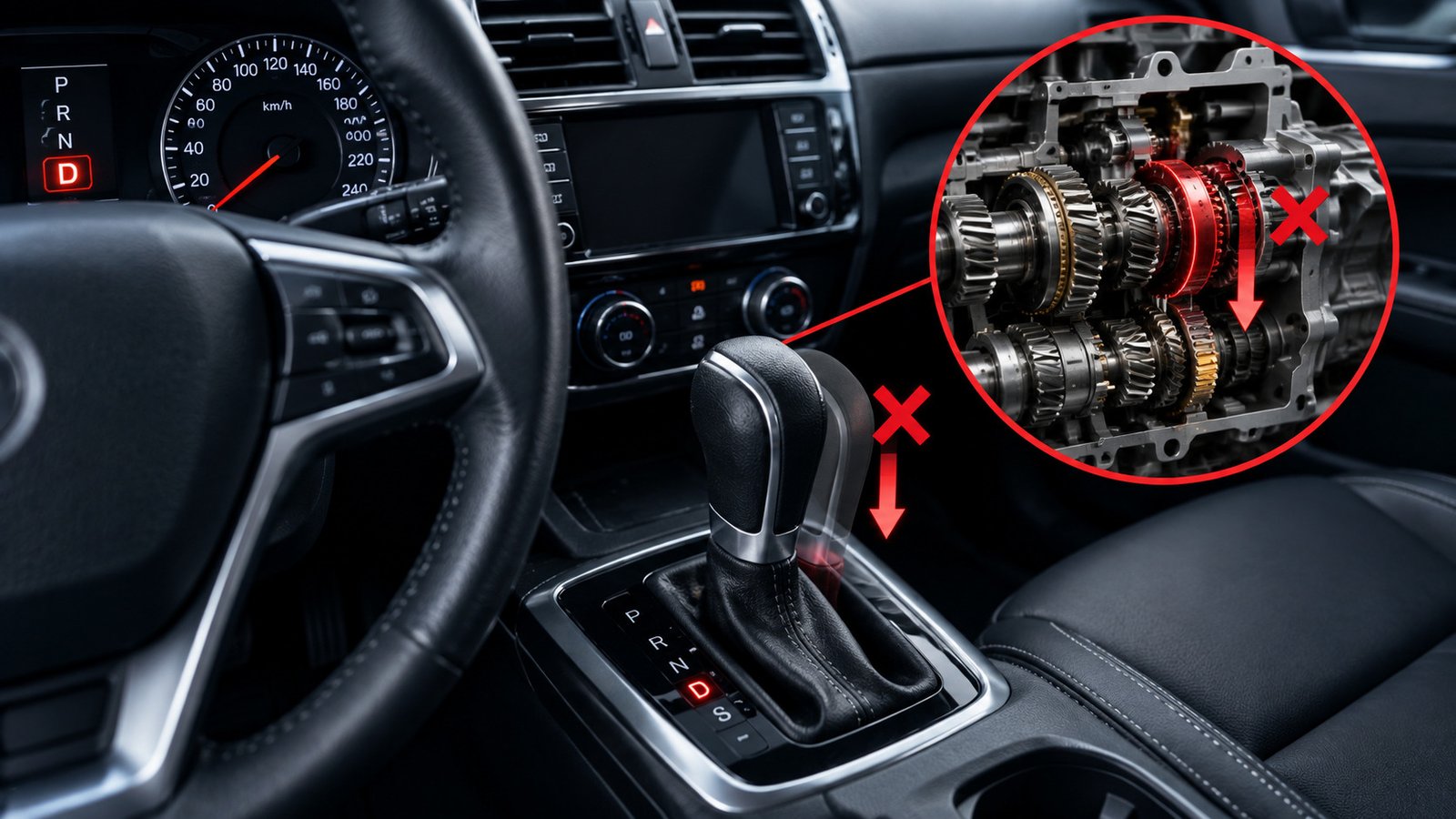
When the car refuses to downshift properly — the transmission stays in a higher gear when you need lower, the engine bogs instead of pulling, or the kick-down response is sluggish or absent — something in the shift control system is not responding as designed.
In Dubai’s driving environment, the car refuses to downshift properly issue causes specific problems. When a car refuses to downshift properly, overtaking on the E611 becomes a dangerous hesitation. Accelerating out of a roundabout needs a responsive downshift. Every time a car refuses to downshift properly, the engine lugs in a gear too high for the demand — lugging in a gear that is too high for the speed and load.
At Rapid Rev Garage in Al Quoz, every car refuses to downshift properly complaint is diagnosed with live transmission data — watching exactly what the transmission is doing and comparing it to what the driver is commanding.
Car Refuses to Downshift Properly — Quick Answer
A car refuses to downshift properly because the transmission’s shift logic is not receiving the correct input signals to command a downshift, or it is receiving them but cannot execute the shift mechanically. The most common causes are a throttle position sensor providing incorrect data so the transmission doesn’t recognise full-throttle kick-down demand, degraded ATF that has lost its friction modifier properties making clutch pack engagement hesitant, a faulty kick-down switch or cable on older vehicles, shift solenoid faults producing incorrect hydraulic pressure timing for the downshift, or a transmission control module fault holding the transmission in a fixed gear or limp mode. In Dubai’s stop-start environment, ATF degradation and throttle position sensor wear are the most frequent causes.
Table of Contents
- How the Transmission Decides When to Downshift
- Throttle Position Sensor Fault — No Kick-Down Signal
- Degraded ATF and Hesitant Clutch Pack Engagement
- Faulty Kick-Down Switch or Cable on Older Vehicles
- Shift Solenoid Fault Producing Incorrect Pressure
- Transmission Control Module Fault or Limp Mode
- How Tow/Haul Mode and Sport Mode Affect Downshift Behaviour
- How Dubai’s Stop-Start Driving Accelerates Shift System Wear
- How We Diagnose a Car That Refuses to Downshift
- The Services That Fix Each Confirmed Cause
- What Does the Repair Cost in Dubai?
- Why Rapid Rev Garage?
- FAQ
- Conclusion
How the Transmission Decides When to Downshift
A modern automatic transmission does not decide to downshift on its own. It responds to a set of inputs — primarily throttle position and vehicle speed — and matches its current gear to a programmed shift map.
When the driver presses the accelerator fully — kick-down — the throttle position sensor reports 100% throttle opening. The transmission control module reads this signal, checks the vehicle speed, and commands a downshift to the gear that places the engine at its maximum torque output for that speed.
If any signal in this chain is incorrect — the throttle position sensor is reading 70% when the pedal is at the floor, or the solenoid commanding the shift is not responding — the transmission either doesn’t downshift or downshifts too late and too slowly. This is exactly the car refuses to downshift properly pattern the driver experiences.
Understanding which part of this chain has failed determines the repair. Our car mechanic team connects live diagnostic data before any physical inspection begins.
Throttle Position Sensor Fault — No Kick-Down Signal
The throttle position sensor (TPS) measures the angle of the throttle plate — converting pedal position to a voltage signal the ECU and transmission control module read as a percentage of throttle opening.
A TPS that is worn, dirty, or producing erratic output sends the transmission incorrect throttle data. The transmission control module sees 65% throttle when the driver has the pedal to the floor. At 65% throttle, the shift map does not command a kick-down downshift — it only commands one at 85–95% or above.
The driver presses hard on the accelerator expecting an immediate downshift and pull. The transmission stays in the current gear. The engine revs slightly but the car doesn’t pull as expected.
This fault is confirmed by live TPS output data during a road test. A TPS showing less than 85% reading at full pedal deflection confirms the fault. TPS cleaning improves the situation in mild cases. TPS replacement with a new sensor resolves it completely. Our car service packages include a TPS output check at every major service for vehicles over 60,000 km.
Degraded ATF and Hesitant Clutch Pack Engagement
Automatic transmission fluid carries hydraulic pressure to engage the clutch packs during gear changes. Its friction modifier additive package also controls the smoothness of that engagement.
When the ATF’s friction modifiers are depleted — from heat and accumulated mileage — the clutch packs do not engage as cleanly during a downshift. The transmission attempts the downshift but the clutch engagement is hesitant. The driver feels a delay between the kick-down demand and the actual gear engagement.
In Dubai’s stop-start traffic, where the transmission executes many more shift cycles per commute than in highway-dominated markets, ATF friction modifier depletion happens faster than manufacturer intervals assume.
Correct ATF is what restores smooth engagement when a car refuses to downshift properly from fluid degradation and clutch engagement quality. The downshift response improves noticeably after a correctly-performed ATF service in mild cases. Where clutch pack wear is confirmed alongside degraded ATF, the ATF service improves but does not fully resolve the symptom. For any roadside emergency from a transmission fault, our roadside assistance team covers Al Quoz and nearby Dubai areas.
Faulty Kick-Down Switch or Cable on Older Vehicles
On older automatic transmissions — pre-2005 on most vehicles — kick-down was controlled by a separate mechanical switch or a cable connected to the throttle linkage. When the pedal reached its full travel, the switch closed or the cable pulled a valve inside the transmission to command the downshift.
A kick-down switch that has failed — corroded contacts, broken housing — does not close at full pedal travel. The transmission never receives the kick-down command. A kick-down cable that is stretched, disconnected, or misadjusted cannot pull the valve far enough to command the shift.
On these older systems, the fix is straightforward — switch replacement or cable adjustment/replacement. On modern vehicles with electronic throttle control, there is no mechanical kick-down component — the signal is purely electronic through the TPS and transmission control module.
Shift Solenoid Fault Producing Incorrect Pressure
Shift solenoids are electronic valves inside the transmission valve body. They direct hydraulic fluid to the correct clutch circuit for each gear change. A downshift requires specific solenoids to activate in a precise sequence.
A solenoid with a worn plunger, corroded contacts, or a failed coil does not supply the correct hydraulic pressure at the correct timing. The downshift either doesn’t execute, executes partially — a rough, incomplete engagement — or takes significantly longer than normal.
Live data during a road test shows each solenoid’s commanded and actual state during the downshift event. A solenoid commanded to activate that shows no response in live data is confirmed faulty. Solenoid replacement — either individually or as a valve body solenoid pack — restores correct shift timing and pressure. For any paint or exterior work needed alongside transmission servicing, our car painting team handles colour-matched repairs at the same visit.
Transmission Control Module Fault or Limp Mode
The transmission control module (TCM) is the computer that manages all shift decisions. A TCM with a stored fault code may enter limp mode — a protective state where the transmission locks into a single gear to prevent further damage.
In limp mode, the car refuses to downshift properly because the transmission is not shifting at all. The car drives in one fixed gear — typically 3rd — regardless of speed or throttle demand. Performance is severely reduced. The transmission warning light is usually illuminated.
A TCM fault code may also alter shift behaviour without triggering limp mode — changing shift timing, disabling adaptive shift learning, or preventing kick-down. These partial faults produce subtler downshift problems that are harder to notice but equally traceable through the scan data.
How Tow/Haul Mode and Sport Mode Affect Downshift Behaviour
Many modern vehicles have drive mode selectors — Tow/Haul, Sport, Eco — that alter the shift map. In Tow/Haul mode, the transmission holds lower gears longer and downshifts earlier to provide engine braking. In Eco mode, the transmission upshifts early and is reluctant to downshift for fuel economy.
A vehicle left in Eco mode produces a car refuses to downshift properly sensation — the driver expects a kick-down response that the mode is intentionally suppressing. This is not a fault. Selecting a normal drive mode or Sport mode restores expected kick-down behaviour.
Confirming the drive mode selected before any diagnostic work is the first step on any vehicle with mode selectors.
How Dubai’s Stop-Start Driving Accelerates Shift System Wear
Dubai’s traffic executes more shift cycles per commute than almost any other market. Every traffic light, every roundabout, every speed bump approach produces a shift event. A 20-minute commute in Dubai may involve 60–80 shift events. The same commute on a European motorway might involve 8–10.
This high cycle frequency depletes the ATF friction modifiers faster, wears the shift solenoid plungers faster, and accumulates more clutch pack engagement cycles per year than any manufacturer’s service interval anticipates.
The result is that the car refuses to downshift properly complaint appears earlier on Dubai vehicles than on vehicles in lower-frequency shift markets. An ATF service interval of 60,000 km appropriate for a highway-dominated European vehicle may need to be 40,000 km for a stop-start Dubai city vehicle.
How We Diagnose a Car That Refuses to Downshift
Drive mode check first. Confirm the vehicle is in a normal drive mode — not Eco or Tow/Haul — before any electronic diagnosis begins.
Live TPS output at full throttle. During a road test, TPS output at full accelerator is measured. Below 85% confirmed at full pedal confirms TPS fault.
ATF condition and level check. ATF colour, smell, and level assessed before any solenoid work. Degraded dark fluid is serviced before any further investigation — because degraded ATF can produce solenoid-like symptoms that resolve after a fluid service.
Transmission module fault code scan. All stored and pending codes in the TCM are read. Limp mode, solenoid fault codes, and TPS-related transmission codes are all visible.
Live shift solenoid data during kick-down. Each solenoid’s commanded and actual state is monitored during a full-throttle kick-down event. A solenoid commanded and not responding is confirmed faulty.
The Services That Fix Each Confirmed Cause
TPS cleaning or replacement. AED 100–200 for cleaning. AED 200–800 for replacement depending on vehicle.
ATF service. Drain and refill with correct specification ATF. AED 500–900.
Full transmission flush. Where ATF degradation is significant. AED 900–1,500.
Shift solenoid replacement. Individual solenoid or valve body solenoid pack. AED 600–2,000 depending on the transmission.
Kick-down switch or cable replacement (older vehicles). AED 150–500.
TCM reprogramming or replacement. AED 500–3,000 depending on the fault and vehicle. Our mobile car mechanic covers Al Quoz and nearby Dubai areas for on-site transmission assessment. Our garage near me in Al Quoz serves drivers from Business Bay, Jumeirah, Barsha, Satwa, Downtown, and the Sheikh Zayed Road corridor.
What Does the Repair Cost in Dubai?
| Service | Cost Range |
| TPS cleaning or replacement | AED 100–800 |
| ATF service | AED 500–900 |
| Full transmission flush | AED 900–1,500 |
| Shift solenoid replacement | AED 600–2,000 |
| Kick-down switch or cable | AED 150–500 |
| TCM repair or replacement | AED 500–3,000 |
All costs confirmed after live TPS output check, ATF condition assessment, and fault code scan.
Why Rapid Rev Garage?
When a car refuses to downshift properly, the live data tells us whether the transmission is receiving the kick-down command but not executing it, or never receiving the command at all. These are different faults requiring different repairs.
We check the drive mode, read the TPS output, assess the ATF, scan the TCM, and watch live solenoid data during a kick-down event before recommending any part. The repair matches the confirmed fault — not the most probable guess.
FAQ — Car Refuses to Downshift Properly
Here are the questions Dubai drivers ask us most about downshift problems.
Why does kick-down sometimes work and sometimes not?
Intermittent kick-down failure points to a TPS producing inconsistent output — it reads correctly some of the time and falls below the kick-down threshold at other times. It may also be a solenoid with intermittent electrical contact. Live data during the inconsistent event identifies which.
Why do paddle shifters work but automatic kick-down doesn't?
Paddle shifter input bypasses the automatic shift logic and directly commands a gear. If paddles work but automatic kick-down doesn't, the fault is in the kick-down sensing or the automatic shift map — not in the clutch packs or solenoids themselves. This points to a TPS or TCM shift map issue.
Will an ATF service fix a delayed downshift?
If the cause is depleted friction modifiers — which is very common in Dubai stop-start vehicles — yes, an ATF service with correct specification fluid often produces an immediate improvement. If the fluid is already in good condition and the downshift is still delayed, the fault is in the solenoids or TPS.
Is it safe to drive when the transmission won't downshift?
Driving in a gear that is too high for the speed produces engine lugging — high load at low RPM. This is hard on the engine and transmission. It is not an immediate emergency but should be diagnosed within the week. Limp mode — where the transmission is fixed in one gear — should be diagnosed the same day.
Can cold weather in Dubai cause downshift problems?
Yes in the early morning during cool season months. Cold ATF is more viscous — solenoids respond more slowly and clutch pack engagement takes longer. A downshift hesitation that is only present on cold mornings and resolves after 10 minutes of driving is normal ATF viscosity behaviour — not a fault. If it persists after the car is warm, it is a genuine fault.
Conclusion
Every car refuses to downshift properly situation traces to either a missing kick-down signal is not reaching the transmission correctly, or the transmission is receiving the signal but cannot execute the shift mechanically. TPS faults, degraded ATF, solenoid faults, and TCM issues all produce the same driver experience — a transmission that doesn’t respond when it should.
Rapid Rev Garage in Al Quoz resolves every car refuses to downshift properly case with live TPS output data, ATF assessment, and shift solenoid monitoring during an actual kick-down event — confirming the specific fault before any component is replaced.
Rapid Rev Garage is in Al Quoz, serving Business Bay, Jumeirah, Downtown, Barsha, Satwa, and the Sheikh Zayed Road corridor. Book your appointment on WhatsApp or find us on Google Maps.
Rapid Rev Garage — Car Refuses to Downshift Properly | Al Quoz, Dubai