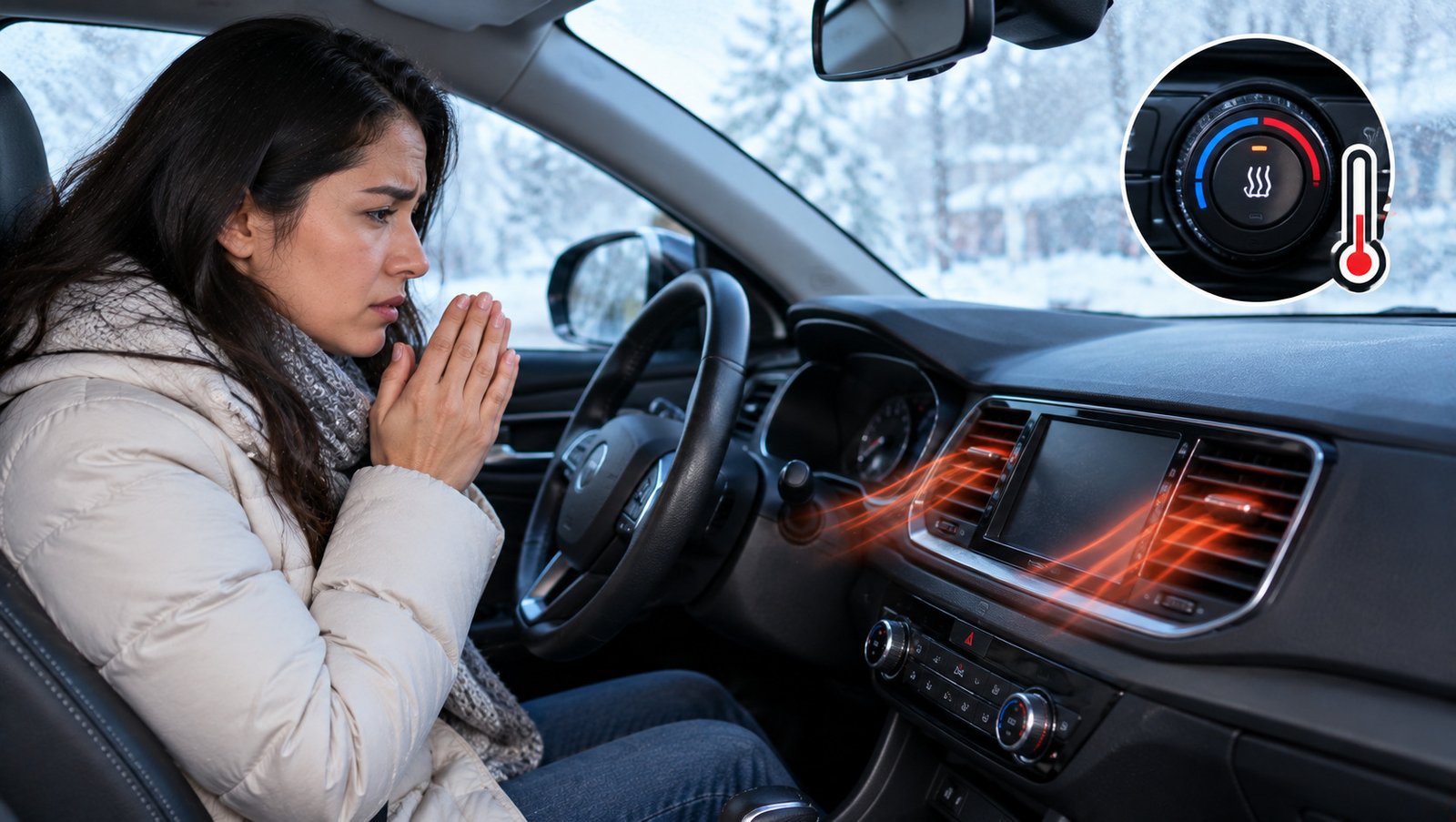
When the cabin heater warms up very slowly — or barely produces warm air — is an unusual complaint in Dubai but a real one. In those months, a cabin heater warms up very slowly complaint goes from irrelevant to very real. Many vehicles are also used for drives to Hatta, Ras Al Khaimah, or Jebel Jais where temperatures drop significantly lower. In those cooler conditions, a cabin heater warms up very slowly fault affects every morning drive.
The cabin heater warms up very slowly situation has several specific causes — most of them related to the cooling system, which the heater uses as its heat source. Understanding which system component has failed determines the repair.
At Rapid Rev Garage in Al Quoz, we diagnose and fix heater performance issues with the same systematic approach we use for any cooling system fault.
Cabin Heater Warms Up Very Slowly — Quick Answer
A cabin heater warms up very slowly because the heater core is not receiving hot coolant at the correct temperature and flow rate. The heater core is a small radiator inside the dashboard — hot coolant from the engine passes through it and the blower fan pushes cabin air over it to warm the cabin. If the coolant reaching the heater core is not hot enough, or is not flowing freely through it, the heater produces little or no warmth. Common causes include a low coolant level that leaves air pockets in the heater circuit, a stuck-open thermostat preventing the engine from reaching operating temperature, a blocked or partially blocked heater core, a faulty heater control valve not opening the coolant path to the heater core, or simply a vehicle that is not warming up adequately before the driver expects heat.
Table of Contents
- How the Cabin Heater Uses Engine Coolant
- Low Coolant Level Causing Air Pockets in the Heater Circuit
- Stuck-Open Thermostat Preventing Engine Warm-Up
- Blocked Heater Core and Reduced Heat Output
- Faulty Heater Control Valve
- Blend Door Fault Directing Air Away From the Heater Core
- How Dubai’s Driving Patterns Affect Heater Performance
- How We Diagnose a Cabin Heater That Warms Up Slowly
- The Services That Fix Each Confirmed Cause
- What Does Heater Repair Cost in Dubai?
- Why Rapid Rev Garage?
- FAQ
- Conclusion
How the Cabin Heater Uses Engine Coolant
The cabin heater is not an independent system. It uses the engine’s coolant as its heat source.
Hot coolant circulates from the engine through a small heat exchanger — the heater core — mounted inside the dashboard. The blower fan draws cabin air over the heater core fins and pushes it through the dashboard vents. If the coolant passing through the heater core is hot, the cabin warms quickly. If it is not hot enough, or not flowing, the cabin stays cold.
This is why any fault preventing engine warm-up will cause a cabin heater warms up very slowly symptom, or that prevents hot coolant from reaching the heater core, produces a cabin heater warms up very slowly symptom. The fault may be in the cooling system, the heater control valve, the blend door, or the heater core itself — but all produce the same symptom from the driver’s perspective.
Understanding the heat path — engine to coolant to heater core to cabin air — guides the diagnosis from the correct starting point. Our car mechanic team checks coolant temperature at the heater core inlet before dismantling any dashboard components.
Low Coolant Level Causing Air Pockets in the Heater Circuit
The heater core sits high in the vehicle — inside the dashboard above the engine bay. When the coolant level is low, air pockets form in the highest points of the cooling circuit — and the heater core is often one of those highest points.
An air pocket in the heater core means air, not coolant, occupies the heater core channels. Air cannot transfer heat the way coolant does. The blower fan pushes air over a heater core that is partially or fully filled with air instead of hot coolant — no heat transfer occurs.
The driver notices the heater producing cold or barely warm air despite the temperature gauge reading normal. The engine is warm — but the heater core is not receiving hot coolant because an air lock is preventing it.
Low coolant level in Dubai is common from two causes: a slow leak that has not been noticed because the car runs fine in summer when the heater is not used, and the natural coolant level drop from heat that degrades the coolant’s corrosion inhibitors and causes very slight boil-off over time.
Topping up the coolant and bleeding the air from the heater circuit resolves this immediately. But the cause of the low level — the leak — must also be found and fixed. Our car service packages include a cooling system pressure test at every major service to identify leaks before the coolant level drops enough to affect heater performance.
Stuck-Open Thermostat Preventing Engine Warm-Up
The thermostat is a valve that stays closed when the engine is cold — keeping coolant in the engine block to allow it to warm up quickly. Once the engine reaches operating temperature, the thermostat opens and allows coolant to circulate through the radiator.
A thermostat that is stuck in the open position allows coolant to circulate through the radiator from the moment the engine starts. The radiator continuously cools the coolant — preventing the engine from ever fully reaching operating temperature.
In Dubai’s cool season mornings, a stuck-open thermostat on a short city drive may never allow the engine to reach the 85–95°C operating temperature needed for the heater to produce adequate warmth. The temperature gauge sits below normal. The cabin heater warms up very slowly or not at all.
In Dubai’s summer, a stuck-open thermostat is rarely noticed — the engine runs slightly cooler than specified but cools adequately in 45°C ambient. In cooler months, it becomes immediately obvious because the heater depends on the engine reaching full operating temperature.
Thermostat replacement is inexpensive — typically AED 300–700 including coolant top-up — and immediately resolves the slow warm-up from this cause. For any roadside emergency from a cooling or heating fault, our roadside assistance team covers Al Quoz and nearby Dubai areas.
Blocked Heater Core and Reduced Heat Output
The heater core is a small heat exchanger with many fine channels through which coolant flows. Over years, scale, corrosion deposits, and degraded coolant inhibitors accumulate on these channel walls. This build-up reduces the flow area inside the heater core — less coolant flows through it per unit time.
Less coolant flow means less heat transfer to the cabin air. The heater produces warm air — but it takes much longer to reach comfortable temperature, and the maximum output is lower than when new.
A heater core that has been running on degraded coolant for years — common in Dubai where coolant is sometimes neglected until the cooling system shows a symptom — may be significantly restricted. Flushing the heater core with a descaling solution improves flow and restores heat output. A severely blocked core that cannot be adequately flushed requires replacement.
Heater core replacement is a significant labour job — the dashboard must be partially removed to access it. On most vehicles: AED 1,500–4,000 including labour.
Faulty Heater Control Valve
On many vehicles, a valve in the coolant line to the heater core controls whether hot coolant flows through the heater core or is diverted back to the engine. When this valve is closed — either by driver selection or by temperature control settings — no hot coolant reaches the heater core.
A heater control valve that is stuck in the closed position prevents hot coolant from reaching the heater core regardless of the temperature setting selected. The engine is warm. The coolant temperature is normal. But no heat reaches the cabin because the valve is not opening the coolant path.
This fault is confirmed by measuring the coolant temperature at the heater core inlet and outlet hoses with an infrared thermometer. If the inlet hose is hot (engine-temperature coolant present) but the outlet hose is cold (no flow through the core), the valve is stuck closed.
Control valve replacement or repair resolves this without any dashboard disassembly in most cases — the valve is typically accessible in the engine bay where the heater hoses connect. For any exterior paint or body repairs needed alongside mechanical work, our car painting team handles colour-matched repairs at the same visit.
Blend Door Fault Directing Air Away From the Heater Core
The HVAC blend door controls how much of the air from the blower passes over the heater core vs the evaporator coil. At maximum cold, all air goes over the cold evaporator. At maximum hot, all air goes over the warm heater core.
A blend door actuator that has failed in the cold position sends all air over the evaporator — producing cold air from the vents regardless of the temperature setting selected. The heater core may be receiving hot coolant and functioning correctly, but the air never passes over it.
The blend door fault is confirmed by a diagnostic scan of the HVAC module — the actuator position sensor reports whether the door is moving to the commanded position. A door stuck at the cold extreme with a commanded hot setting confirms the actuator fault. Actuator replacement resolves the symptom without any cooling system work.
How Dubai’s Driving Patterns Affect Heater Performance
In Dubai, heater performance faults go unnoticed for months — because the AC is running constantly from April to September and the heater is never used. A thermostat that is stuck open, a heater core that is partially blocked, or a control valve that is stuck closed all produce no noticeable symptoms in summer.
When October arrives and a cabin heater warms up very slowly, the fault often existed since the previous winter suddenly becomes apparent again.
This seasonal concealment is why cabin heater warms up very slowly is a common complaint at the start of Dubai’s cool season — not because these faults develop in October, but because they are only noticed in October. A cooling system check before the cool season begins identifies these faults before they produce a cold morning.
How We Diagnose a Cabin Heater That Warms Up Slowly
Coolant level and condition check. First check. Low coolant is the simplest and most common cause. Coolant condition also tells us whether scale and inhibitor degradation may be causing heater core restriction.
Temperature gauge observation. The engine temperature gauge position during warm-up confirms whether the thermostat is functioning. A gauge that never reaches the normal operating mark confirms a stuck-open thermostat.
Heater hose temperature test. An infrared thermometer on the heater core inlet and outlet hoses confirms whether hot coolant is reaching and flowing through the heater core. Cold outlet despite hot inlet confirms either a control valve fault or a blocked heater core.
HVAC module scan. The blend door actuator position is confirmed by the HVAC module scan. A stuck blend door is identified without disassembly.
Heater core flush test. Where restricted flow is suspected, a flushing test confirms whether the heater core can be restored with descaling treatment or requires replacement.
The Services That Fix Each Confirmed Cause
Coolant top-up and air bleed. AED 100–250. Immediate resolution of air pocket cause.
Thermostat replacement. AED 300–700 including coolant top-up and system bleed.
Heater core flush. AED 300–600. Restores flow through a partially blocked core.
Heater core replacement. AED 1,500–4,000 including dashboard access labour.
Heater control valve replacement. AED 300–800.
Blend door actuator replacement. AED 400–900. Our mobile car mechanic covers Al Quoz and nearby Dubai areas for on-site heater and cooling system assessment. Our garage near me in Al Quoz serves drivers from Business Bay, Jumeirah, Barsha, Satwa, Downtown, and the Sheikh Zayed Road corridor.
What Does Heater Repair Cost in Dubai?
| Service | Cost Range |
| Coolant top-up and air bleed | AED 100–250 |
| Thermostat replacement | AED 300–700 |
| Heater core flush | AED 300–600 |
| Heater core replacement | AED 1,500–4,000 |
| Control valve replacement | AED 300–800 |
| Blend door actuator replacement | AED 400–900 |
All costs confirmed after the coolant level check, temperature gauge observation, and hose temperature test.
Why Rapid Rev Garage?
Every cabin heater warms up very slowly case has its cause in the heat path between the engine and the cabin. We confirm coolant level, engine operating temperature, coolant flow through the heater core, and blend door position — in that sequence — before opening any dashboard component or replacing any part.
The cheapest cause — low coolant with an air pocket — takes 15 minutes to fix. The most expensive — heater core replacement — takes a full day. The diagnostic sequence separates them before any work begins.
FAQ — Cabin Heater Warms Up Very Slowly
Here are the questions Dubai drivers ask us most about a slow-warming heater.
Why does my heater only work when I rev the engine?
This confirms a low coolant level with an air pocket. When the engine revs, the coolant pump pressure pushes coolant through the air pocket and into the heater core temporarily. As soon as the RPM drops, the air lock returns. Top up the coolant and bleed the system.
My temperature gauge is normal but there's no heat — what's wrong?
The most likely cause is a faulty heater control valve stuck in the closed position, or a blend door actuator stuck at the cold extreme. The engine is reaching temperature — the heat is just not being directed into the cabin. A hose temperature test and HVAC scan confirm which.
How do I know if my thermostat is stuck open?
Watch the temperature gauge during warm-up on a cool morning. A healthy thermostat allows the gauge to rise steadily to the normal operating mark within 5–7 minutes. A gauge that rises very slowly and never reaches the normal mark — or sits noticeably below it — confirms a stuck-open thermostat.
Can a blocked heater core be flushed or does it need replacing?
Mild to moderate restriction from scale and coolant deposits can usually be flushed with a descaling solution. Severe restriction from years of neglected coolant, or physical damage to the core, requires replacement. The flush test confirms which applies before any dashboard work is started.
Is a slow-warming heater a sign of a bigger cooling system problem?
Sometimes. A low coolant level points to a leak. A stuck thermostat can cause winter overheating in cold climates. In Dubai's conditions, a slow heater is most often a low coolant level or a stuck thermostat — both of which are cooling system faults that need addressing regardless of whether the heater symptom is the primary complaint.
Conclusion
A cabin heater warms up very slowly because the heat path from the engine to the cabin has a fault at one of several points — coolant level, thermostat, heater core flow, control valve, or blend door. In Dubai, these faults are often invisible in summer and only noticed when the cool season arrives in October.
Rapid Rev Garage in Al Quoz traces every cabin heater warms up very slowly complaint by following the heat path — coolant level, engine temperature, hose temperatures, and HVAC scan — before opening any dashboard component.
Rapid Rev Garage is in Al Quoz, serving Business Bay, Jumeirah, Downtown, Barsha, Satwa, and the Sheikh Zayed Road corridor. Book your appointment on WhatsApp or find us on Google Maps.
Rapid Rev Garage — Cabin Heater Warms Up Very Slowly | Al Quoz, Dubai