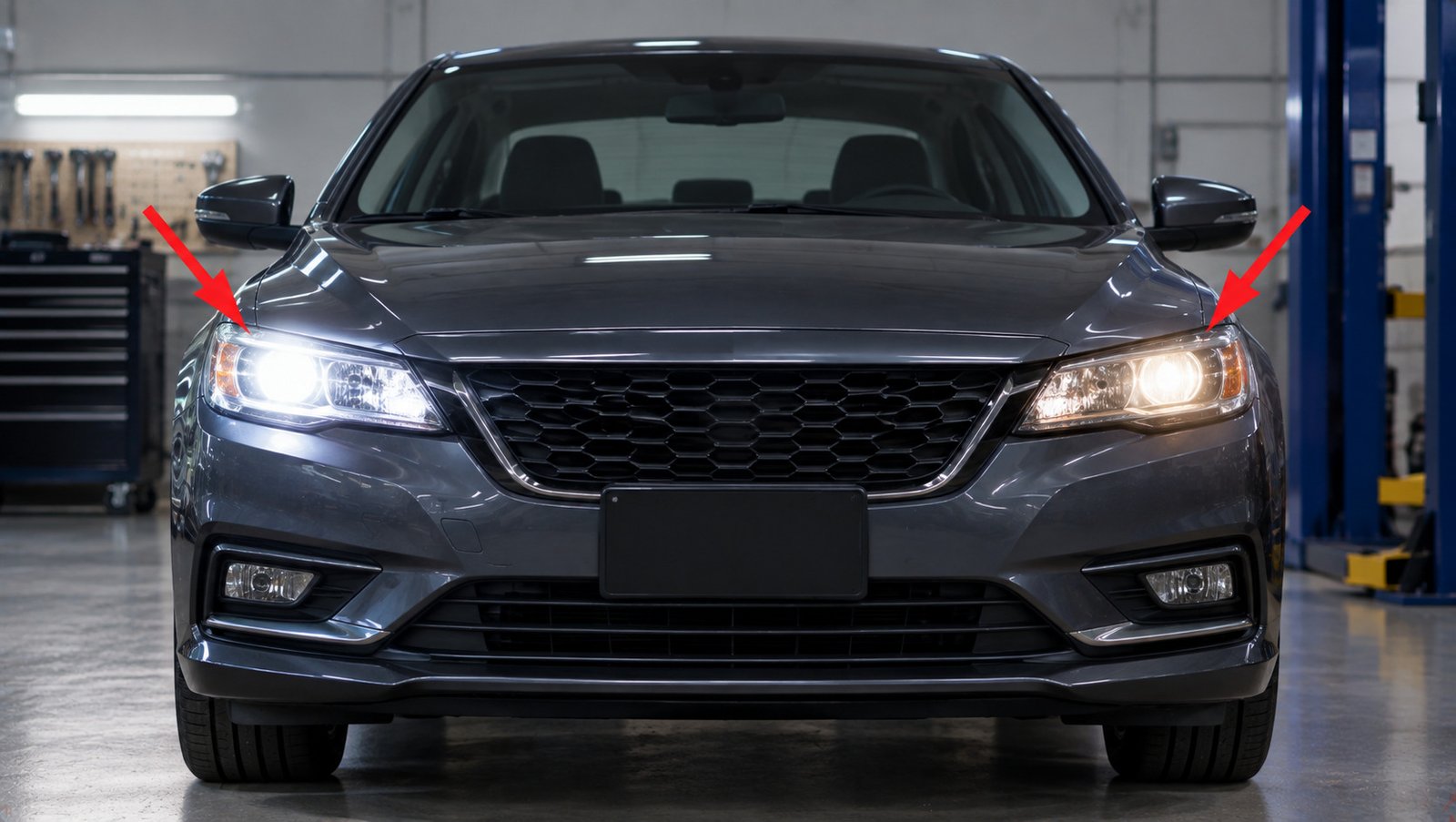
When one headlight dimmer than the other produces a visible brightness difference between the left and right headlight — is a fault that affects both safety and legality. At night on Dubai’s highways, where high-speed driving demands maximum visibility, a headlight performing below specification means the driver sees significantly less than the vehicle’s lighting system was designed to show.
The cause of one headlight dimmer than the other sits in the bulb, the lens, the reflector, the wiring, or the control system depending on the headlight type fitted to the vehicle. Each cause produces the same visible symptom — one side noticeably dimmer than the other — but requires a different repair.
At Rapid Rev Garage in Al Quoz, every one headlight dimmer than the other complaint is diagnosed with a light output measurement and a voltage check at the headlight connector before recommending any repair.
One Headlight Dimmer Than the Other — Quick Answer
One headlight is dimmer than the other because the dimmer headlight is receiving less power, has a degraded light source, or has a compromised optical system compared to the brighter side. Common causes include a bulb that is nearing end of life and producing less output than when new, a yellowed or oxidised headlight lens that is blocking a portion of the light output, moisture inside the headlight housing that has damaged the reflector surface, a voltage drop at the dimmer headlight from a corroded connector or a failing earth connection, or a failing xenon ballast or LED driver that is not supplying the correct power to the light source. In Dubai, UV-degraded lens yellowing and moisture-damaged reflectors are the most frequent causes of a dimness difference between the two headlights.
Table of Contents
- How to Confirm One Headlight Is Actually Dimmer
- Bulb at End of Life — Reduced Output Before Failure
- Yellowed or Oxidised Headlight Lens
- Moisture-Damaged Reflector Inside the Housing
- Voltage Drop From a Corroded Connector or Earth Fault
- Failing Xenon Ballast or HID Igniter
- Failing LED Driver Module
- How Dubai’s UV and Heat Degrade Headlight Output
- How We Diagnose One Headlight Dimmer Than the Other
- The Services That Fix Each Confirmed Cause
- What Does Headlight Repair Cost in Dubai?
- Is a Dim Headlight a Safety or Legal Issue in Dubai?
- Why Rapid Rev Garage?
- FAQ
- Conclusion
How to Confirm One Headlight Is Actually Dimmer
Before diagnosing the cause, confirm that the dimness difference is genuine and consistent — not a reflection of the road surface or the viewing angle.
Same-wall test. Park the vehicle 3–4 metres from a flat wall at night with the headlights on. Both headlights should produce an equal-brightness beam pattern on the wall. A visibly dimmer pattern from one side confirms a genuine output difference.
Switch to high beam. On some vehicles, the low beam and high beam use different bulb elements. If one headlight is dim on low beam but equal on high beam — or vice versa — the fault is in the specific element or circuit for the dim condition, not the entire headlight.
Swap test. On halogen vehicles, the bulbs can be swapped between sides. If the dimness moves to the other side after the swap, the bulb is the cause. If the dimness stays on the original side, the cause is in the housing, wiring, or reflector.
Our car mechanic team uses a calibrated light metre to measure the output of both headlights before any component is assessed — giving an objective measure of the output difference rather than a visual estimate.
Bulb at End of Life — Reduced Output Before Failure
Halogen bulbs do not simply work and then stop working — they degrade gradually. A halogen bulb at 70–80% of its service life produces noticeably less light than a new bulb because the tungsten filament has thinned from evaporation. The thin filament runs at a lower temperature and produces less light.
This gradual dimming means one headlight can be significantly dimmer than the other if the bulbs were replaced at different times — the older bulb is producing less output while the newer bulb is at full brightness.
The fix is straightforward — replace both halogen bulbs at the same time. Replacing only the dim bulb produces a mismatch where the new bulb is brighter than the older one on the other side. Always replace halogen headlight bulbs in pairs.
On LED headlights, individual LEDs rarely fail partially — they typically fail completely. A dim LED headlight is more likely to be a driver module fault than a physical LED degradation.
Yellowed or Oxidised Headlight Lens
The headlight lens is made from polycarbonate — a clear plastic that is susceptible to UV degradation. In Dubai’s extreme UV environment, the polycarbonate lens surface oxidises and turns yellow or hazy. This yellowing is not just cosmetic — it significantly reduces the light output transmitted through the lens.
A headlight lens that has yellowed reduces light output by 30–70% depending on the severity of the oxidation. If one headlight lens has yellowed more than the other — because of different UV exposure from the vehicle’s typical parking orientation — one headlight will appear significantly dimmer.
The yellowing that causes one headlight dimmer than the other is confirmed immediately in daylight. A yellow or hazy lens compared to a clearer one on the other side explains the dimness difference without any electrical investigation needed.
Headlight lens restoration — polishing the oxidised surface with a progressive abrasive compound — removes the yellowed layer and restores clarity. The output improvement is immediate and often dramatic. A quality restoration followed by a UV-protective coating prevents rapid re-yellowing.
Dubai’s UV index makes lens yellowing the most common cause of one headlight dimmer than the other — and one of the cheapest to fix. Our car service packages include a headlight lens condition check at every major service.
Moisture-Damaged Reflector Inside the Housing
The reflector inside the headlight housing is a precisely shaped, chrome-finished surface that directs the bulb’s light into the correct beam pattern. The reflector’s finish is critical — a degraded reflector scatters light rather than directing it, reducing the beam’s intensity and pattern quality.
Where moisture has entered the headlight housing — through a failed vent membrane or a cracked seal — condensation repeatedly forms on the reflector surface. Over time, this moisture etches and corrodes the chrome finish. The damaged reflector produces a dimmer, less focused beam from the same bulb.
A moisture-damaged reflector is confirmed by inspecting the interior of the headlight housing. A dull, matte, or pitted reflector surface instead of a bright chrome finish confirms the damage. In severe cases, the reflector has visible rust or mineral deposit staining from repeated moisture contact.
Reflector damage is not reversible — the headlight assembly must be replaced. The moisture entry source must also be fixed before fitting the new unit — otherwise the new reflector will develop the same damage.
Voltage Drop From a Corroded Connector or Earth Fault
Headlight brightness is directly proportional to the voltage supplied to the bulb or LED driver. A headlight receiving 11V instead of 12.5V is measurably dimmer — the light output of a halogen bulb varies significantly with supply voltage.
Voltage drop at one headlight occurs from a corroded connector at the headlight plug, a high-resistance earth connection at the headlight mounting, or a damaged section of wiring between the fuse box and the headlight.
Confirmation: measure voltage at the headlight connector with the headlights on. Both sides should read 12.5–14V. A reading below 12V at the dim side confirms a voltage drop fault. The connector is then inspected for corrosion and the earth connection is tested for resistance.
Connector cleaning with electrical contact cleaner and a fresh earth connection resolve voltage drop in most cases. A damaged wiring section requires the affected portion to be replaced. For any bodywork or paint repairs needed alongside electrical work, our car painting team handles colour-matched repairs at the same visit.
Failing Xenon Ballast or HID Igniter
Xenon (HID) headlights require a ballast — an electronic control unit that produces the high voltage needed to strike the xenon arc and then maintains the correct operating voltage.
A failing ballast produces the correct output intermittently — the headlight works normally sometimes and is dim or flickering at others. In the early stage of ballast failure, the headlight may appear consistently dim rather than completely off — the ballast is producing reduced output rather than no output.
A failing igniter — the component that produces the initial high-voltage strike — produces a headlight that takes longer than normal to reach full brightness, or one that flickers at startup before stabilising.
Xenon ballast and igniter faults are confirmed by measuring the ballast output voltage during operation and by observing the startup sequence. A ballast producing below-specification output voltage is confirmed faulty and replaced. The HID igniter and bulb are typically replaced at the same time as the ballast to prevent immediate recurrence from the remaining aged components. For any roadside emergency from a headlight failure at night, our roadside assistance team covers Al Quoz and nearby Dubai areas.
Failing LED Driver Module
On LED headlights, the LED driver module — the electronics that regulate current to the LEDs — controls the output of the entire LED array. A failing driver produces a headlight that is consistently dim — the LEDs are receiving less current than their design specification.
LED driver faults on modern vehicles often trigger a warning light on the dashboard — the body control module monitors headlight current draw and detects when it falls below the expected range for the LED array.
The driver module is typically integrated into the headlight assembly on modern vehicles — replacement requires the full headlight assembly rather than the driver alone. On some premium vehicles, the driver is a separately replaceable component.
A current measurement at the LED array — comparing left and right — confirms which side has reduced current and identifies the driver module as the cause.
How Dubai’s UV and Heat Degrade Headlight Output
Dubai’s UV index reaches 10–11 for extended periods during summer — classified as extreme. Polycarbonate lens yellowing that would take eight to ten years in a European climate develops in three to five years in Dubai’s conditions.
Heat also contributes to bulb degradation. Halogen bulbs inside a headlight housing that regularly reaches 60–70°C in direct sun accumulate more tungsten filament thinning per hour of operation than in cooler ambient conditions.
The combination of UV-accelerated lens yellowing and heat-accelerated bulb degradation means that one headlight dimmer than the other often appears first on the side with more sun exposure — typically the side facing the direction the vehicle most frequently parks toward.
How We Diagnose One Headlight Dimmer Than the Other
Light output measurement. A calibrated light metre measures the output of both headlights in lux from a fixed distance. The percentage difference in output is documented before any investigation.
Lens visual inspection. Both lenses are examined for yellowing, hazing, and clarity difference. Significant lens yellowing on the dim side immediately explains most of the output difference.
Interior housing inspection. The reflector condition on the dim side is checked for moisture damage, pitting, or staining.
Voltage measurement at headlight connector. Both headlights measured at the connector during operation. A voltage difference between the two sides confirms a supply fault on the dim side.
Bulb swap test on halogen units. Bulbs swapped between sides. Dimness that follows the bulb confirms bulb degradation. Dimness that stays on the same side confirms housing or electrical cause.
Ballast output or LED driver current measurement on HID/LED units. Output of each control unit measured against specification.
The Services That Fix Each Confirmed Cause
Halogen bulb replacement (pair). AED 100–400 for the pair. Always replaced together.
Headlight lens restoration and coating. AED 150–400 per headlight. Restores clarity and prevents rapid re-yellowing.
Headlight assembly replacement (moisture or reflector damage). AED 500–3,000 depending on the vehicle and headlight type.
Connector cleaning and earth repair. AED 100–300.
Xenon ballast and igniter replacement. AED 400–1,500 per side depending on vehicle.
LED headlight assembly replacement. AED 800–5,000 depending on vehicle and LED unit complexity. Our mobile car mechanic covers Al Quoz and nearby Dubai areas for on-site headlight assessment. Our garage near me in Al Quoz serves drivers from Business Bay, Jumeirah, Barsha, Satwa, Downtown, and the Sheikh Zayed Road corridor.
What Does Headlight Repair Cost in Dubai?
| Service | Cost Range |
| Halogen bulb replacement (pair) | AED 100–400 |
| Lens restoration and coating | AED 150–400 per headlight |
| Headlight assembly replacement | AED 500–5,000 |
| Connector cleaning and earth repair | AED 100–300 |
| Xenon ballast and igniter replacement | AED 400–1,500 |
All costs confirmed after light output measurement and specific component testing.
Is a Dim Headlight a Safety or Legal Issue in Dubai?
Both. A one headlight dimmer than the other situation where output is 40–50% below design leaves the driver with significantly reduced forward visibility on unlit roads. At 120 km/h on a Dubai highway, reduced headlight range means less time to react to obstacles in the road.
A vehicle with a significantly dim headlight — where the output difference between sides is visible to a following driver or approaching vehicle — may also attract attention at the annual Tasjeel vehicle inspection. Headlight output is assessed as part of the lighting check, and a headlight failing to meet the minimum output threshold is a fail point.
Why Rapid Rev Garage?
Every one headlight dimmer than the other case has a different confirmed cause — bulb, lens, reflector, voltage, ballast, or driver. We measure the output difference, inspect the lens, check the voltage, and test the light source before recommending any part.
Every one headlight dimmer than the other repair is matched to the confirmed cause — not a probability. We don’t restore the lens when the reflector is moisture-damaged. The measurement and inspection confirm the cause before any repair is recommended.
FAQ — One Headlight Dimmer Than the Other
Here are the questions Dubai drivers ask us most about uneven headlight brightness.
Can a dirty headlight lens cause dimness?
External dirt reduces output slightly but not dramatically. The significant dimming from a dirty lens is usually internal — moisture staining on the reflector or internal lens fogging. A wipe of the external lens surface rarely produces a noticeable change. The meaningful difference comes from lens oxidation or internal moisture.
Do I need to replace both headlights if only one is dim?
Not necessarily. If the cause is a bulb, replace both bulbs — the other will fail soon after. If the cause is a ballast or lens on one side, that side only is addressed. If the lens on the other side is in similar condition, restore both lenses at the same visit for consistent output and appearance.
Does a yellowed headlight lens fail an RTA inspection?
A headlight lens that is severely yellowed reduces output below the minimum threshold and can result in a fail at Tasjeel inspection. Lens restoration before the inspection restores the output to compliant levels and avoids the fail.
Why does my headlight look dim during the day?
Daytime running mode on many modern vehicles uses a reduced-power operating mode. The perceived brightness difference between two headlights during the day at reduced power is less meaningful than the same difference at full night-driving power. Test at night on full low beam to assess the genuine difference.
Can moisture in the headlight cause dimness even without visible fogging?
Yes. Light moisture contact that evaporates without leaving visible condensation still deposits mineral residue on the reflector surface over time. The residue builds up with repeated moisture cycles and progressively reduces reflector efficiency without any obvious internal fogging being present.
Conclusion
Every one headlight dimmer than the other situation has a specific cause — a degraded bulb, a yellowed lens, a moisture-damaged reflector, a voltage fault, or a failing ballast or LED driver. In Dubai’s UV environment, lens yellowing and reflector moisture damage are the two most frequent causes.
Rapid Rev Garage in Al Quoz confirms every one headlight dimmer than the other case by measuring light output, inspects the lens and reflector, checks the supply voltage, and tests the light source — confirming the specific cause before recommending any repair.
Rapid Rev Garage is in Al Quoz, serving Business Bay, Jumeirah, Downtown, Barsha, Satwa, and the Sheikh Zayed Road corridor. Book your appointment on WhatsApp or find us on Google Maps.
Rapid Rev Garage — One Headlight Dimmer Than the Other | Al Quoz, Dubai