When a vehicle drifts at highway speed — pulling steadily to one side when the driver releases the wheel on a straight road — is a fault that becomes more significant as speed increases. At 60 km/h in the city, a mild drift is a nuisance. At 120 km/h on the E611, the same drift requires constant steering input and makes every lane change feel less controlled.
In Dubai, vehicle drifts at highway speed is especially common on the E611 and E311 because the long, straight highway sections here expose directional faults that short urban trips mask. The vehicle drifts at highway speed fault feels fine on a 10-minute city drive and wrong on the highway — not because the fault appeared on the highway, but because the highway revealed it.
At Rapid Rev Garage in Al Quoz, every vehicle drifts at highway speed complaint is diagnosed with a level road test, a tyre assessment, and a four-wheel alignment measurement — before recommending any repair.
Vehicle Drifts at Highway Speed — Quick Answer
A vehicle drifts at highway speed because an unequal lateral force is acting on the left and right sides of the vehicle simultaneously. The most common causes are wheel alignment out of specification — particularly caster asymmetry or unequal toe — which creates unequal self-centring forces; a dragging brake caliper on one side creating constant braking resistance; tyre pressure imbalance between left and right that changes rolling resistance; tyre conicity where the internal belt structure of one tyre generates a lateral force regardless of alignment; or a bent suspension component from an impact that has permanently shifted the geometry. At highway speed, each of these causes produces a larger, more persistent drift than at low speed because the lateral force has more time to accumulate before the driver corrects.
Table of Contents
- Why Highway Speed Amplifies Drift That Feels Minor in the City
- Wheel Alignment as the Primary Cause
- Caster Asymmetry and Reduced Self-Centring on One Side
- Dragging Brake Caliper Pulling Toward One Corner
- Tyre Pressure Imbalance Between Left and Right
- Tyre Conicity — When the Tyre Itself Generates the Force
- Bent Suspension Component From a Previous Impact
- Road Camber vs a Genuine Drift
- How Dubai’s Roads Disturb Alignment Between Services
- How We Diagnose a Vehicle That Drifts at Highway Speed
- The Services That Fix Each Confirmed Cause
- What Does the Repair Cost in Dubai?
- Why Rapid Rev Garage?
- FAQ
- Conclusion
Why Highway Speed Amplifies Drift That Feels Minor in the City
At low speed, a vehicle drifts at highway speed fault produces only a small observable drift. The driver corrects it with a minor steering input and continues. In stop-start city traffic, the frequent stopping and restarting resets the steering position constantly — the drift never has time to accumulate into an obvious deviation.
At highway speed, the same force has time to accumulate. A car with 2 degrees of caster asymmetry that drifts 10cm in 5 seconds at 40 km/h drifts 30cm in 5 seconds at 120 km/h. The physics scales with speed. What was a barely noticeable nuisance in the city becomes a constant, fatiguing correction on the highway.
This is why the vehicle drifts at highway speed surprise is so common in Dubai who feel the car is “fine” on city roads. The drift was always there — the city environment was hiding it. Our car mechanic team performs the road test on a level straight at highway speed first, documenting the drift direction and severity before any component is assessed.
Wheel Alignment as the Primary Cause
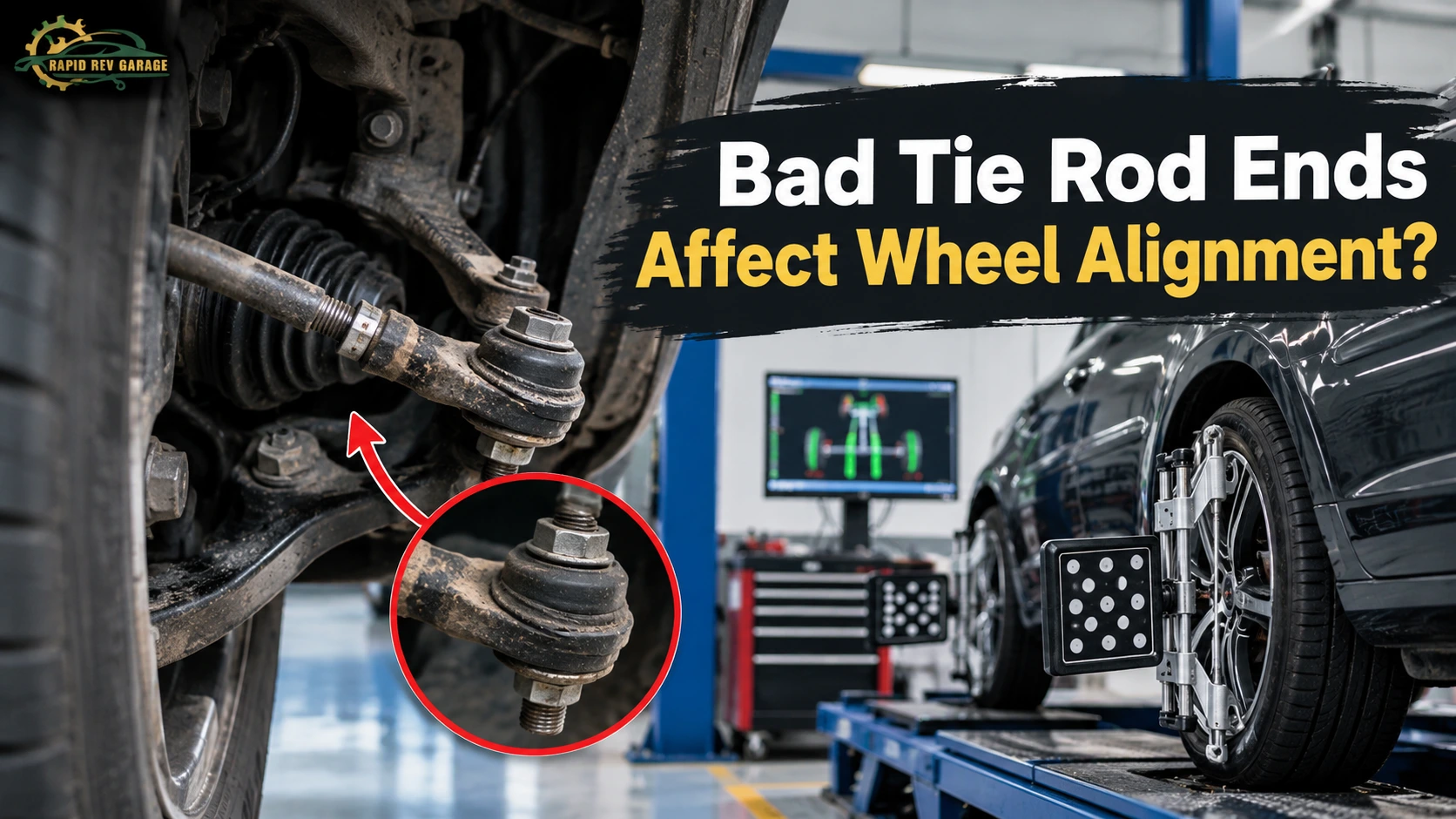
Incorrect wheel alignment is the most frequent root cause of vehicle drifts at highway speed. Of the alignment angles, caster and toe have the strongest influence on straight-line directional stability.
Toe misalignment creates unequal lateral forces between the front wheels. If the left front wheel is toed slightly outward while the right is correctly set, the left wheel generates a lateral force pushing the vehicle to the right. At highway speed, this produces a persistent rightward drift.
Caster asymmetry affects self-centring. Equal caster on both sides produces equal self-centring force — the car holds its course without steering input. Unequal caster from a shifted strut mount, a bent strut, or a subframe that has moved produces more self-centring on one side. The car drifts toward the lower-caster side because the higher-caster side is pulling the front of the car toward itself more strongly.
A four-wheel alignment measurement identifies both faults. Where the misalignment is within the adjustment range, the alignment is corrected and confirmed with a post-alignment highway road test. Our car service packages include a four-wheel alignment check at every major service for vehicles reporting any directional instability.
Caster Asymmetry and Reduced Self-Centring on One Side
Caster is the tilt of the steering axis — the angle of the imaginary line through the upper strut mount and the lower ball joint, viewed from the side of the vehicle.
Positive caster — the top of this line tilts rearward — produces the self-centring force that makes the steering return to straight after a corner. The greater the positive caster, the stronger the self-centring.
When the left and right sides have different caster angles — from a bent strut, a damaged strut mount, or a subframe mounting that has shifted — the self-centring force is unequal. The side with more positive caster pulls the steering toward straight more strongly. The car drifts toward the side with less positive caster.
This type of drift is characterised by a stronger feel at highway speed than at low speed — because the self-centring force that is doing the pulling is speed-dependent. It produces a drift that the driver can temporarily overcome by holding a slight counter-steer input, but which reasserts the moment the wheel is released.
Dragging Brake Caliper Pulling Toward One Corner
A brake caliper with a seized slide pin maintains light pad contact with the disc continuously. This produces a small but constant braking force on that corner. At highway speed, the asymmetric braking force pulls the vehicle toward the dragging side.
The thermal confirmation: after a 30-minute highway drive, the wheel with the dragging caliper will be noticeably hotter than the wheel on the opposite side. A simple infrared temperature check of both front wheels after the highway test confirms or rules out caliper drag before any alignment work is done.
The drift from a dragging caliper has a specific character — it is also present under braking and may intensify when the brakes are applied. An alignment fault drift remains relatively constant under braking and non-braking conditions. This distinction helps separate the two causes during the road test. For any roadside emergency from a brake or handling fault, our roadside assistance team covers Al Quoz and nearby Dubai areas.
Tyre Pressure Imbalance Between Left and Right
A tyre with lower pressure than its counterpart on the same axle has a different rolling radius and different rolling resistance. The lower-pressure tyre is slightly smaller in effective diameter — it turns more revolutions per kilometre — and has higher rolling resistance.
The higher rolling resistance on one side retards that wheel slightly relative to the other. The vehicle drifts toward the higher-resistance side — toward the underinflated tyre.
Tyre pressure is the first check on any drift complaint. It costs nothing to check and takes two minutes. An underinflated tyre at one corner often explains a drift that would otherwise require extensive alignment investigation. Cold pressure at all four corners — confirmed against the door jamb specification — eliminates this cause before any other assessment begins.
In Dubai’s heat, cold tyre pressure should be checked before the first drive of the day. Pressure rises as the tyre heats — a tyre that reads correctly after a drive may be underinflated when cold. The door jamb specification assumes cold pressure.
Tyre Conicity — When the Tyre Itself Generates the Force
Tyre conicity is an internal manufacturing characteristic where the belt layers are not perfectly symmetrical within the tyre structure. This asymmetry causes the tyre to generate a lateral force as it rolls — it behaves like a cone trying to roll in a circle.
A tyre with significant conicity causes the vehicle to drift in the direction the conicity force points, regardless of whether the alignment is correct. The alignment printout looks perfect. The tyre pressures are correct. The brakes are not dragging. But the vehicle still drifts.
Conicity is confirmed by the front tyre swap test: move the left front tyre to the right and the right front to the left, without changing their rotation direction. Drive the same highway section. If the drift direction reverses — the car now drifts the other way — one of the swapped tyres has conicity. The specific tyre is identified by moving each one individually to the rear and reconfirming. For any paint or body work needed alongside the repair, our car painting team handles colour-matched repairs at the same visit.
Bent Suspension Component From a Previous Impact
A bent strut, a bent control arm, or a distorted subframe from a previous pothole strike or kerb impact permanently changes the geometry at the affected corner. This geometry change produces drift at highway speed even when the alignment is set to specification — because the specification is measured against the wheel angles, not against the absolute position of the bent component.
A subframe that has shifted 4mm from its correct position changes both front wheel alignment angles simultaneously. The alignment machine cannot detect the shift — it measures wheels relative to the centreline, not the absolute chassis. An alignment set on a shifted subframe may look correct on the printout while the car still drifts.
Chassis dimension measurement — comparing the actual positions of the subframe, strut towers, and control arm pivot points against the manufacturer’s specification — identifies a bent or displaced component. This is performed on a measuring jig and identifies what the alignment machine cannot.
Road Camber vs a Genuine Drift
Before concluding that a drift is a fault, the road camber must be ruled out.
Most roads have a deliberate cross-slope — typically 1–3 degrees — that drains rainwater toward the side. A correctly-aligned vehicle on a cambered road drifts toward the lower edge. This is not a fault — it is the car responding correctly to the slope.
The road camber test: drive the same section in opposite directions. If the car drifts left going north and drifts right going south — always toward the lower road edge — the road is cambered and the vehicle is correct. If the car drifts in the same direction regardless of which direction is being driven, the cause is vehicle-side.
Dubai’s major highway sections are generally well-crowned. The drift from road camber on UAE highways is typically mild. A strong, consistent drift that requires continuous steering input on a level highway section is almost certainly vehicle-origin.
How Dubai’s Roads Disturb Alignment Between Services
Dubai’s speed bump density, pothole edges near construction sites, and Al Quoz’s industrial road surfaces all produce alignment-disturbing impacts at higher frequency than any European road environment.
A vehicle correctly aligned at one service can develop a drift-causing alignment fault from a single hard pothole strike or from cumulative speed bump impacts between services. The vehicle drifts at highway speed complaint that appears between services — when no obvious accident has occurred — is often the result of this cumulative impact alignment disturbance.
This is why any new vehicle drifts at highway speed complaint should trigger an alignment check immediately. Any time a new drift appears — particularly following a section of rough road or a specific impact — an alignment check is appropriate regardless of how recently the last alignment was set.
How We Diagnose a Vehicle That Drifts at Highway Speed
Level highway road test. The vehicle is driven at 100–120 km/h on a straight, level section. The wheel is briefly released and the drift direction and rate are documented. This confirms the drift is genuine and identifies its direction before any component assessment.
Tyre pressure check. All four pressures confirmed cold against the door jamb specification. Any discrepancy corrected and road test repeated.
Wheel temperature check after the highway test. Both front wheels temperature-checked immediately after the road test. A temperature difference confirms caliper drag on the hotter side.
Four-wheel alignment measurement. All angles at all four corners compared against specification. Toe, caster, and camber documented for symmetry between left and right.
Tyre swap test where alignment is correct. If alignment is confirmed correct and drift persists after pressure correction, front tyres are swapped left-to-right. Drift reversal confirms tyre conicity.
Chassis dimension measurement where bent component is suspected. Performed where an alignment correction cannot be achieved within the adjustment range — indicating a bent component holding the geometry outside specification.
The Services That Fix Each Confirmed Cause
Four-wheel alignment correction. AED 200–400.
Tyre pressure correction. Immediate. AED 0–50.
Brake caliper service. Seized slide pin cleaned and relubricated. AED 150–400 per caliper.
Tyre replacement for conicity. AED 250–800 per tyre.
Bent component replacement. Bent strut, control arm, or subframe repositioning — followed by alignment. AED 700–3,000 depending on the component. Our mobile car mechanic covers Al Quoz and nearby Dubai areas for on-site drift assessment. Our garage near me in Al Quoz serves drivers from Business Bay, Jumeirah, Barsha, Satwa, Downtown, and the Sheikh Zayed Road corridor.
What Does the Repair Cost in Dubai?
| Service | Cost Range |
| Four-wheel alignment | AED 200–400 |
| Tyre pressure correction | AED 0–50 |
| Brake caliper slide pin service | AED 150–400 per caliper |
| Tyre replacement (conicity) | AED 250–800 per tyre |
| Bent component replacement | AED 700–3,000 |
All costs confirmed after the highway road test, pressure check, temperature check, and alignment measurement.
Why Rapid Rev Garage?
Every vehicle drifts at highway speed has one specific confirmed cause — alignment, caster asymmetry, caliper drag, tyre pressure, conicity, or a bent component. We test in the correct sequence — pressure first, temperature check second, alignment third, tyre swap fourth — eliminating each category before moving to the next.
An alignment set on a vehicle with a dragging caliper or a bent component produces a result that shifts back within days. The cause must be confirmed and fixed before alignment is set — otherwise the alignment cannot hold.
FAQ — Vehicle Drifts at Highway Speed
Here are the questions Dubai drivers ask us most about highway drifting.
Does alignment fix all types of highway drift?
Not always. Alignment corrects geometry faults. A dragging caliper, tyre conicity, or a bent component produce drift that alignment cannot fix. The cause must be identified before alignment is booked.
Will new tyres fix a highway drift?
Only if the drift is from tyre conicity. If the drift is from alignment or a caliper fault, new tyres make no difference. The tyre swap test confirms whether the existing tyres are the cause before any tyre purchase.
How do I know if it's road camber or a real fault?
Drive the same highway stretch in both directions. A road camber drift changes direction when you reverse course. A vehicle fault drift stays in the same direction regardless of which way you're driving.
Can a highway drift get worse over time?
Yes. A caliper drag fault worsens as the slide pin corrodes further. An alignment fault from a worn bushing worsens as the bushing continues to deteriorate. Neither improves on its own. Address the drift promptly.
Is it dangerous to drive with a highway drift?
At sustained highway speeds, yes. A vehicle that requires constant correction at 120 km/h is more demanding to control in an emergency — a sudden lane change, obstacle avoidance, or emergency braking is harder to execute cleanly. Address the drift before the next significant highway journey.
Conclusion
Every vehicle drifts at highway speed case traces to an unequal lateral force — from alignment, caliper drag, tyre pressure, conicity, or a bent component — is acting on one side more than the other. At Dubai highway speeds, this force accumulates rapidly and demands constant correction.
Rapid Rev Garage in Al Quoz resolves every vehicle drifts at highway speed case through a structured sequence — road test, pressure check, thermal check, alignment, and tyre swap where needed — confirming the specific cause before any repair begins.
Rapid Rev Garage is in Al Quoz, serving Business Bay, Jumeirah, Downtown, Barsha, Satwa, and the Sheikh Zayed Road corridor. Book your appointment on WhatsApp or find us on Google Maps.
Rapid Rev Garage — Vehicle Drifts at Highway Speed | Al Quoz, Dubai