When an engine stall at traffic lights happens — the engine cutting out at every stop — is one of the most frustrating faults in Dubai’s stop-start traffic. Every red light is an engine stall at traffic lights risk when this fault is present. Every roundabout approach is a potential stall and restart. And in a city where the traffic behind you reacts immediately, a stall at a busy intersection is genuinely stressful.
Every engine stall at traffic lights complaint traces to a specific fault — not a characteristic of the vehicle, not normal behaviour for an older car, and not something that resolves on its own. Something specific in the idle control system is causing the engine stall at traffic lights to keep the engine running at the low RPM conditions of a stop.
At Rapid Rev Garage in Al Quoz, every engine stall at traffic lights case is diagnosed with live idle data — watching exactly what the engine is doing at idle before recommending any repair.
Engine Stall at Traffic Lights — Quick Answer
An engine stall at traffic lights happens because the engine cannot maintain sufficient RPM at idle to keep running. At a traffic stop, the engine transitions from a higher cruise or deceleration RPM down to idle — typically 650–800 RPM. At this low RPM, the engine has very little margin. Any additional load, any reduction in the fuel or air supply, or any incorrect sensor signal that upsets the idle control can push the RPM below the threshold the engine needs to sustain combustion. Common causes include a dirty throttle body restricting airflow at idle, a faulty idle air control valve not managing the bypass air correctly, a vacuum leak adding unmetered air that disrupts the air-fuel ratio, a dirty or failing mass airflow sensor, a faulty crankshaft position sensor producing an intermittent RPM signal, low fuel pressure from a weak pump or clogged filter, or a failing torque converter lockup that puts unexpected mechanical load on the engine at low speed.
Table of Contents
- Why Idle Is the Most Demanding Condition for the Engine
- Dirty Throttle Body Restricting Airflow at Idle
- Faulty Idle Air Control Valve
- Vacuum Leak Disrupting the Air-Fuel Ratio at Idle
- Dirty or Failing MAF Sensor at Low Airflow
- Crankshaft Position Sensor Fault
- Low Fuel Pressure at Idle
- AC Compressor Load Killing Idle RPM in Dubai Heat
- Torque Converter Lockup Fault on Automatic Transmissions
- How We Diagnose Engine Stall at Traffic Lights
- The Services That Fix Each Confirmed Cause
- What Does the Repair Cost in Dubai?
- Why Rapid Rev Garage?
- FAQ
- Conclusion
Why Idle Is the Most Demanding Condition for the Engine
At cruise speed, the engine has momentum. The pistons, flywheel, and drivetrain have rotational inertia that helps carry the engine through any brief disruption to combustion.
At idle, that inertia is minimal. The engine is producing just enough power to overcome its own friction — oil pump, coolant pump, alternator, power steering pump — plus any additional loads from the AC compressor and the transmission. The combustion events that sustain this low RPM must be consistent and precisely timed.
Any disruption at idle — a lean air-fuel mixture from a vacuum leak, a restricted airflow from a dirty throttle body, a weak fuel supply from a struggling pump — is enough to cause an engine stall at traffic lights because there is no surplus RPM to absorb the disruption.
This is why an engine stall at traffic lights appears at stops and not during driving. At higher RPM, the disruption is masked by the engine’s inertia and the larger combustion events. At idle, the same disruption overwhelms the system’s ability to recover. Our car mechanic team reads live idle RPM, fuel trim, and sensor data before any physical inspection begins.
Dirty Throttle Body Restricting Airflow at Idle
The throttle body controls the volume of air entering the engine. At idle, the throttle plate is nearly closed — only a tiny gap allows the small volume of air the engine needs to sustain idle combustion.
Over time, oil vapour from the crankcase ventilation system deposits a carbon and oil residue on the throttle plate and the bore walls adjacent to it. This residue narrows the already tiny idle airflow gap further. The engine receives less air than the ECU’s idle control map expects and the RPM drops.
In Dubai’s dusty environment, throttle body contamination accumulates faster than in cleaner-air markets. A throttle body that would stay clean for 50,000 km in Europe may need cleaning at 30,000 km in Al Quoz’s industrial dust environment.
Throttle body cleaning — with an appropriate throttle-safe cleaner and a soft cloth — restores the idle airflow gap to its correct dimension. On vehicles with electronic throttle control, a throttle body adaptation reset via the scan tool is required after cleaning — to update the ECU’s position reference to the now-clean plate position. Our car service packages include a throttle body condition check at every major service for vehicles over 50,000 km.
Faulty Idle Air Control Valve
The idle air control (IAC) valve — present on older vehicles with mechanical throttle cables — manages engine idle speed by controlling a bypass air passage around the closed throttle plate. When the engine needs more idle air — to compensate for AC load, for example — the IAC opens further. When it needs less, it closes.
An IAC valve that is sticking, gummed with carbon deposits, or has a failing motor provides incorrect bypass air at idle. If it sticks closed, the engine stalls when additional idle load is applied — the AC kicks in, the RPM drops, and the engine cannot recover. If it sticks open, the idle runs high and unstable.
IAC cleaning resolves a sticking-from-deposits fault. A failed IAC motor requires replacement. On modern vehicles with electronic throttle control, the IAC function is performed by the throttle body actuator rather than a separate valve.
Vacuum Leak Disrupting the Air-Fuel Ratio at Idle
The intake manifold and all components connected to it — vacuum lines, brake booster hose, PCV valve hose, EGR connections — are sealed against atmospheric air. Any leak in this sealed system allows unmetered air to enter the engine — air that the MAF sensor has not measured.
The ECU calculates fuel injection quantity based on the MAF sensor reading. Unmetered air from a vacuum leak means the actual air in the cylinder is more than the ECU calculated — the mixture runs lean. At cruise RPM, the excess air is a smaller proportion of the total airflow and the fuel trim compensation manages it. At idle, the same volume of unmetered air is a much larger proportion of the total — the lean condition is severe enough to cause an engine stall at traffic lights.
Vacuum leaks are found by spraying a small amount of carburetor cleaner or brake cleaner around each vacuum connection and hose while the engine idles. A momentary RPM rise at a specific point confirms the leak location — the spray is briefly drawn into the engine through the leak. Alternatively, a smoke machine test introduces smoke into the intake and identifies any exit point visually. For any roadside emergency from an engine stall, our roadside assistance team covers Al Quoz and nearby Dubai areas.
Dirty or Failing MAF Sensor at Low Airflow
The mass airflow sensor measures the volume of air entering the engine. At idle, the airflow is very low — the MAF is operating at the bottom of its measurement range where its accuracy is most sensitive to contamination.
A MAF sensor coated with oil vapour from the crankcase or with fine dust from a degraded air filter reads incorrectly at low airflow. The error at idle may be significant enough to cause the ECU to inject the wrong fuel quantity — producing a mixture that cannot sustain idle combustion.
Live MAF data at idle confirms whether the reading is within specification. A MAF reading too low at idle causes the ECU to inject insufficient fuel — lean misfire at idle. A MAF reading too high causes excess fuel injection — rich mixture, rough idle, stall.
MAF cleaning with a dedicated MAF cleaner spray resolves contamination-based errors. A MAF with internal failure — sensor element drift — requires replacement.
Crankshaft Position Sensor Fault
The crankshaft position sensor (CKP) provides the engine control module with the exact position and speed of the crankshaft. The ECU uses this data to time fuel injection and ignition for every combustion event.
A failing CKP sensor — with a degraded signal wire, a corroded connector, or a failing sensor element — produces an intermittent RPM signal. When the signal drops out, the ECU loses the timing reference and cannot fire the injectors or ignition coils correctly. The engine stalls.
A CKP fault typically produces an intermittent pattern — the engine stalls at a traffic light, restarts easily, and stalls again at the next light. It may also produce a no-start condition that resolves after the engine cools. The fault code stored is typically a CKP signal range or no-signal code.
In Dubai’s heat, the CKP sensor connector corrodes faster than in cooler climates. A CKP fault that is intermittent — present at operating temperature — often does not show at all when the engine is cold or just warmed up, making it harder to catch without live data monitoring during a full operating-temperature road test.
AC Compressor Load Killing Idle RPM in Dubai Heat
In Dubai, the AC compressor runs at maximum capacity from the moment the driver enters the car. The compressor is a mechanical load on the engine — it takes power to turn. When the compressor clutch engages, the idle RPM drops momentarily as the additional load is applied.
A healthy idle control system compensates for this — increasing the IAC bypass air or the throttle opening to maintain the target idle RPM when the compressor engages.
A system where the idle compensation is degraded — from a dirty throttle body, a sticky IAC, or a throttle body adaptation that has drifted — cannot compensate fast enough. The RPM drops below the stall threshold the moment the AC compressor engages at a traffic light.
This specific pattern — stalls when the AC is running but not when the AC is off — immediately points to an idle compensation problem rather than a fuel or ignition fault. The repair is the throttle body cleaning and adaptation reset that restores correct idle compensation capacity. For any paint or body work needed alongside mechanical repairs, our car painting team handles colour-matched repairs at the same visit.
Torque Converter Lockup Fault on Automatic Transmissions
On automatic transmission vehicles, the torque converter transmits drive between the engine and the transmission. At low speeds and at idle, the converter should be unlocked — allowing the engine to idle freely without transmitting drive load to the drivetrain.
A torque converter lockup solenoid that is sticking in the engaged position maintains mechanical lock between the engine and drivetrain even at idle. The engine is trying to idle while simultaneously being asked to hold the stationary vehicle through a locked mechanical connection — the load exceeds the engine’s idle output and it stalls.
This fault is typically confirmed by a transmission scan code for a TCC solenoid fault or a TCC slip error. The stall from this cause is consistent — the engine stalls every time it returns to idle after a deceleration event where the TCC was locked during cruise. An ATF service improves the solenoid response if the fluid is degraded. A failed solenoid requires replacement.
How We Diagnose Engine Stall at Traffic Lights
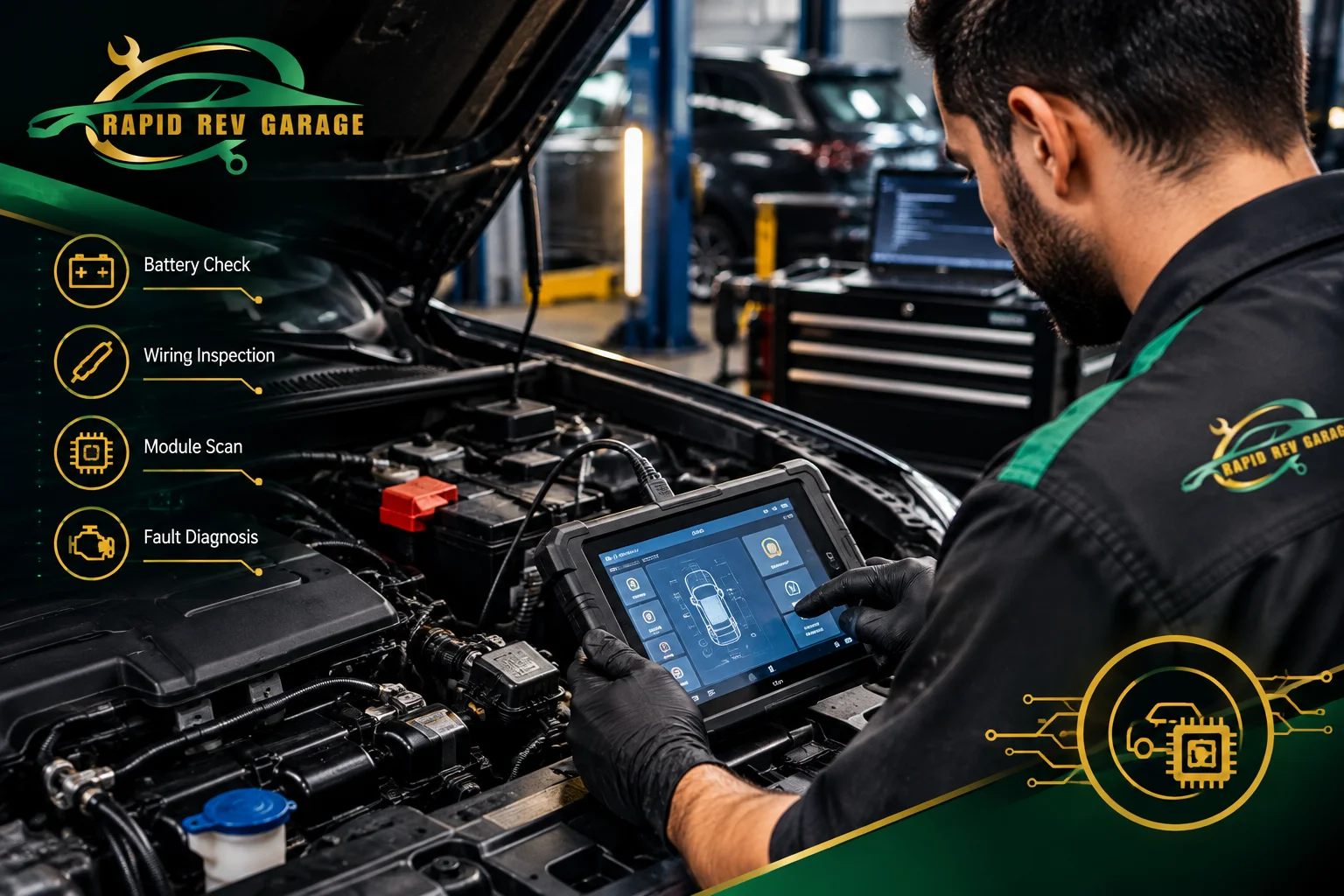
Live idle data first. Idle RPM, fuel trim, MAF reading, throttle position, and coolant temperature are monitored at idle before any physical inspection. The data narrows the fault category immediately.
Fault code scan. All stored and pending codes are read. CKP signal codes, IAC codes, MAF range codes, and TCC codes all point to specific components.
Throttle body visual inspection. The throttle body is inspected for carbon deposits. A sticking plate is confirmed by observing the plate’s movement across its full range.
Vacuum leak test. Each vacuum line and connection is tested for leaks with the spray or smoke method.
Fuel pressure test. Fuel pressure at idle is measured against the vehicle’s specification. Low pressure confirms a fuel pump or filter fault.
AC load response test. The idle RPM response when the AC compressor engages is observed in live data. A RPM drop that is not compensated confirms an idle compensation fault.
The Services That Fix Each Confirmed Cause
- Throttle body cleaning and adaptation reset. AED 150–400.
- IAC valve cleaning or replacement. AED 200–600.
- Vacuum leak repair. AED 100–500 depending on the hose or gasket.
- MAF sensor cleaning or replacement. AED 100–200 cleaning. AED 300–1,500 replacement.
- CKP sensor replacement. AED 200–800 depending on vehicle.
- Fuel pump replacement. AED 600–2,000 depending on vehicle.
- Fuel filter replacement. AED 100–400.
TCC solenoid replacement. AED 600–2,000. Our mobile car mechanic covers Al Quoz and nearby Dubai areas for on-site idle fault diagnosis. Our garage near me in Al Quoz serves drivers from Business Bay, Jumeirah, Barsha, Satwa, Downtown, and the Sheikh Zayed Road corridor.
What Does the Repair Cost in Dubai?
| Service | Cost Range |
| Throttle body cleaning and reset | AED 150–400 |
| IAC valve service | AED 200–600 |
| Vacuum leak repair | AED 100–500 |
| MAF sensor service | AED 100–1,500 |
| CKP sensor replacement | AED 200–800 |
| Fuel pump replacement | AED 600–2,000 |
| TCC solenoid replacement | AED 600–2,000 |
All costs confirmed after live idle data assessment and specific component testing.
Why Rapid Rev Garage?
Every engine stall at traffic lights has one specific confirmed cause. Live idle data — RPM, fuel trim, MAF output, throttle position — identifies the fault category before any component is opened. We do not replace parts based on probability. The data confirms which system is failing at idle before any repair is recommended.
The throttle body clean is always checked first — it is the most common cause and the cheapest fix. If the idle data is clean and the throttle body is clean, the investigation moves to MAF, vacuum, fuel pressure, and CKP in sequence.
FAQ — Engine Stall at Traffic Lights
Here are the questions Dubai drivers ask us most about stalling at lights.
Can a dirty air filter cause stalling at idle?
A severely clogged air filter reduces the total airflow enough to contribute to an idle stall. It is the easiest and cheapest check — replace the air filter first if it has not been changed recently. In Dubai's dusty conditions, replace every 8,000–10,000 km.
Why does the car restart immediately after stalling?
An immediate restart after a stall confirms the cause is not a fuel delivery failure or a no-spark condition — both of which would prevent restart. Immediate restart points to an idle RPM fault — the engine can fire but cannot sustain the low RPM of idle under load.
Does engine stalling damage the car?
An occasional stall from an idle fault does not cause immediate mechanical damage. Repeated stalling in traffic increases starter motor wear from frequent restart cycles. A stall-and-roll situation on a gradient is a safety concern. Address the fault promptly.
Can low fuel cause stalling at traffic lights?
Yes — if the tank is below the level where the fuel pump pickup is reliable, the pump draws air intermittently under acceleration and deceleration. The fuel pressure drops and the engine stalls at idle when the intermittent supply cannot sustain combustion. Keep the tank above a quarter to avoid pump pickup starvation.
Conclusion
An engine stall at traffic lights happens because the engine cannot maintain the RPM it needs to keep running at idle — from a restricted throttle body, a vacuum leak, a faulty sensor, low fuel pressure, or an unexpected mechanical load. In Dubai’s stop-start traffic, this fault is triggered dozens of times per commute.
Rapid Rev Garage in Al Quoz confirms every engine stall at traffic lights cause with live idle data — RPM, fuel trim, MAF output, and AC load response — before recommending any repair.
Rapid Rev Garage is in Al Quoz, serving Business Bay, Jumeirah, Downtown, Barsha, Satwa, and the Sheikh Zayed Road corridor. Book your appointment on WhatsApp or find us on Google Maps.
Rapid Rev Garage — Engine Stall at Traffic Lights | Al Quoz, Dubai