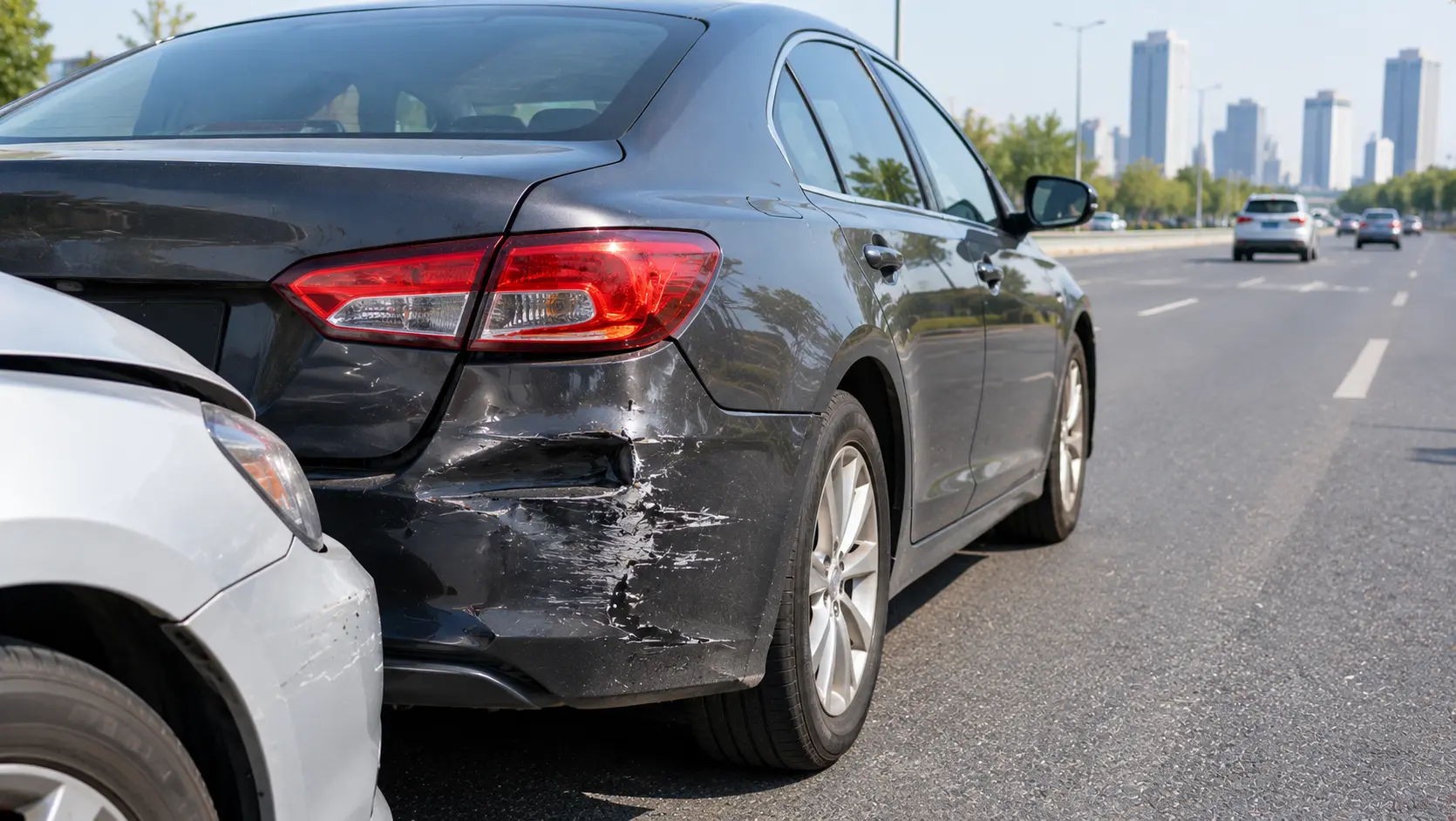
Whether you can drive after a minor collision safely depends entirely on what was damaged — not how small the collision looked from the outside. A low-speed car park impact can buckle a subframe. A slow rear-end shunt can push a bumper beam into the fuel line. A parking lot scrape can crack a headlight housing that is now pointing at the ground.
The problem with deciding to drive after a minor collision on appearances alone is that the most significant damage is often invisible from a visual inspection at the roadside. These hidden faults are what make a decision to drive after a minor collision risky without assessment.
At Rapid Rev Garage in Al Quoz, we assess every vehicle before confirming whether to drive after a minor collision — regardless of how minor it appeared — before recommending whether it is safe to drive and what repair is required.
Drive After a Minor Collision — Quick Answer
Whether to drive after a minor collision is answered by the inspection, not the bodywork. A purely cosmetic impact — a scratch or a small dent with no structural involvement, no fluid leaks, no warning lights, and no change in steering, braking, or handling — is generally safe to drive to a workshop for assessment. An impact that has produced any of the following means the vehicle should not be driven further: fluid leaking under the car, a warning light on the dashboard, any change in steering feel or brake response, a grinding noise from a wheel, visible misalignment of a wheel, or visible deformation of the bumper beam, radiator support, or wheel arch area near the tyre. When in doubt, have the vehicle transported rather than driven. A tow to a workshop costs far less than driving a damaged vehicle and causing secondary damage.
Table of Contents
- Why the Visible Damage Is Not the Full Picture
- Checks to Perform at the Scene Before Deciding to Drive
- Structural Damage That Is Not Visible From Outside
- Suspension Geometry Changes From a Minor Impact
- Fluid System Damage After a Collision
- Electrical and Sensor Faults From Impact
- Tyre and Wheel Damage That Is Not Immediately Obvious
- Dubai Traffic Law After a Minor Collision
- What a Post-Collision Assessment Covers at Rapid Rev Garage
- What Does a Post-Collision Assessment Cost in Dubai?
- Why Rapid Rev Garage?
- FAQ
- Conclusion
Why the Visible Damage Is Not the Full Picture
Modern vehicles are designed with crumple zones — areas of the structure that deform deliberately in a collision to absorb energy and protect the occupants. This design means that significant energy can be absorbed into the structure with relatively little visible external damage.
A bumper that looks scratched may have a completely crushed bumper beam behind it. A boot lid that closes normally may be hiding a floor pan that has buckled. A wheel arch with a small scrape may have a strut that has been pushed out of alignment.
The external bodywork is the visible layer. The structural components behind it — the bumper beams, the radiator support, the front rails, the subframe — are the parts that absorb impact energy. The decision to drive after a minor collision depends on these structural components, not on the external panel condition.
This is why a roadside visual inspection is not a reliable guide to whether driving is safe. Our car mechanic team performs a post-collision assessment that covers both the visible damage and the hidden structural and mechanical systems behind it.
Checks to Perform at the Scene Before Deciding to Drive
Before deciding to drive after a minor collision is safe, perform these checks.
Look under the vehicle. Any fluid dripping or pooling under the car — coolant, oil, brake fluid, fuel — means the vehicle should not be driven. Call for recovery.
Check all warning lights. Start the engine and let it idle for 30 seconds. Any warning light — engine, ABS, airbag, traction control, brake — means a fault has been detected. Do not drive until the fault is identified.
Test the steering. Gently turn the wheel left and right. Any resistance, grinding, or change from normal confirms steering system involvement. Do not drive.
Observe the wheels. From directly in front of the vehicle, check that all four wheels appear parallel and vertical. A wheel that is visibly toed out, cambered inward, or sitting at an unusual angle confirms suspension damage. Do not drive.
Check the tyres. Walk around and inspect each tyre for visible sidewall bulges, cuts, or rapid pressure loss. A damaged tyre at highway speed is a blowout risk.
Listen to the engine. Any new knocking, hissing, or rattling from the engine bay points to mechanical damage. Do not drive until the source is identified. For any breakdown or collision recovery needed immediately, our roadside assistance team covers Al Quoz and nearby Dubai areas.
Structural Damage That Is Not Visible From Outside
The front of a modern vehicle has several structural members behind the external bumper skin.
Bumper beam. A steel or aluminium beam that spans the vehicle width directly behind the bumper cover. A crushed bumper beam has absorbed significant energy. The bumper cover may be intact while the beam is destroyed.
Front rails. The longitudinal structural members that run from the front of the vehicle toward the firewall. Rail deformation means the entire front structure has been compromised. Driving after rail deformation risks fold at a secondary impact.
Radiator support. The frame structure that holds the radiator, condenser, and cooling fan. Impact deformation can press the radiator support into the cooling fan or reduce the cooling airflow path. The engine can overheat.
Subframe. The subframe mounts the engine, gearbox, and front suspension. A shifted or cracked subframe changes the geometry of every component mounted to it. Driving after subframe damage produces unpredictable handling.
None of these are visible without removing the bumper cover. A decision to drive after a minor collision based solely on the bumper cover condition is a decision made without the relevant information.
Suspension Geometry Changes From a Minor Impact
A front impact — even a low-speed one — can push the front wheel assembly rearward. This rearward force changes the caster angle at the affected corner. It may also damage the lower ball joint, the control arm, or the tie rod end connecting the steering rack to the wheel hub.
A rear impact can damage the rear trailing arms or the rear subframe mounts — changing the rear wheel geometry and potentially producing a vehicle that tracks sideways under acceleration.
The symptoms of post-collision suspension damage are not always immediate. A damaged ball joint may hold under normal driving and fail under emergency braking or a sudden lane change.
This is why the decision to drive after a minor collision should always include a suspension assessment — not just at the moment of the incident, but at a workshop where the geometry can be measured and the components physically loaded and tested. Our car service team measures wheel geometry at all four corners after any reported collision, regardless of speed.
Fluid System Damage After a Collision
The front of the vehicle contains several fluid systems that are vulnerable to impact damage.
Cooling system. The radiator sits directly behind the front bumper structure. Even a moderate impact can crack a radiator tank, push the radiator into the cooling fan, or rupture a coolant hose. Driving with a damaged cooling system in Dubai’s heat produces overheating within minutes.
Power steering. The power steering rack and its hydraulic lines are low-mounted at the front of the vehicle. A front impact that reaches the subframe level can crack a power steering line. The loss of hydraulic assist is gradual — the steering gets progressively heavier over several minutes until it requires extreme effort.
Fuel system. A rear impact can shift the fuel tank, crack a fuel line, or damage the filler neck. Any smell of fuel after a rear collision means the vehicle must not be driven — and the engine must be switched off immediately.
Brake system. A front impact that deforms the wheel area can pinch a brake line. The braking performance feels normal until enough fluid has leaked from the pinched line to produce a spongy pedal — and then brake failure.
Electrical and Sensor Faults From Impact
Modern vehicles have sensors distributed throughout the structure — radar modules in the front bumper, ultrasonic sensors around the perimeter, cameras in the mirror housings, and wheel speed sensors at each corner.
A minor collision can physically damage or misalign any of these sensors. The effects range from a disabled parking sensor to a miscalibrated front radar that causes the automatic emergency braking system to trigger incorrectly or fail to trigger when needed.
Any impact that has involved the front or rear bumper area should include an electronic scan to check whether any sensors have been damaged or displaced. A driver who decides to drive after a minor collision without an electronic scan may be driving with safety systems that are no longer functioning correctly.
Airbag module assessment is also important after any impact. Even a collision that did not deploy the airbags may have triggered a fault in the airbag control module that will prevent airbag deployment in a subsequent collision.
Tyre and Wheel Damage That Is Not Immediately Obvious
A kerb strike or a collision that loads the wheel sideways can damage the tyre in ways that are not immediately visible.
Sidewall impact damage. The inner sidewall — the side facing the suspension — can be cut or bruised without any visible damage on the outer face. An inner sidewall cut is a delayed blowout risk. The tyre holds pressure normally until the bruised or cut cord fabric fails under load — typically at highway speed.
Wheel rim deformation. A significant kerb impact can crack or bend the alloy rim. A cracked rim loses pressure slowly — the tyre appears normal until the pressure has dropped enough to be dangerous. A bent rim produces a subtle vibration that increases with speed.
Wheel bearing damage. An impact that loads the wheel hub laterally can damage the wheel bearing. The bearing may feel and sound normal immediately after impact and develop a noticeable rumble as the internal damage progresses over days or weeks. For any paint or body repairs after a collision, our car painting team handles colour-matched repairs at the same visit.
Dubai Traffic Law After a Minor Collision
Under Dubai traffic law, both vehicles involved in a collision where there are no injuries and the vehicles are drivable must be moved to the side of the road immediately. Blocking traffic after a minor collision is an offence.
An official police accident report — obtained either through the Dubai Police app or by calling the non-emergency line — is required before any insurance claim can be made, regardless of how minor the collision was.
A vehicle that has been assessed as unsafe to drive after a minor collision should be moved to the nearest safe stopping area and then transported by recovery vehicle to the workshop. Do not leave the vehicle in a moving traffic lane.
What a Post-Collision Assessment Covers at Rapid Rev Garage
External visual inspection. Bumper cover condition, panel misalignment, wheel arch proximity to the tyre, and visible structural exposure at the impact area.
Bumper beam and front structure inspection. The bumper cover is removed where appropriate to inspect the beam and front rail condition directly.
Fluid system check. Coolant level and condition, power steering fluid, brake fluid level, and underbody visual for any active leaks.
Suspension geometry measurement. Four-wheel alignment measurement to confirm whether the impact has changed any geometry angle at any corner.
Wheel and tyre inspection. Tyre sidewall — inner and outer — rim condition, and a wheel bearing rotation check for roughness.
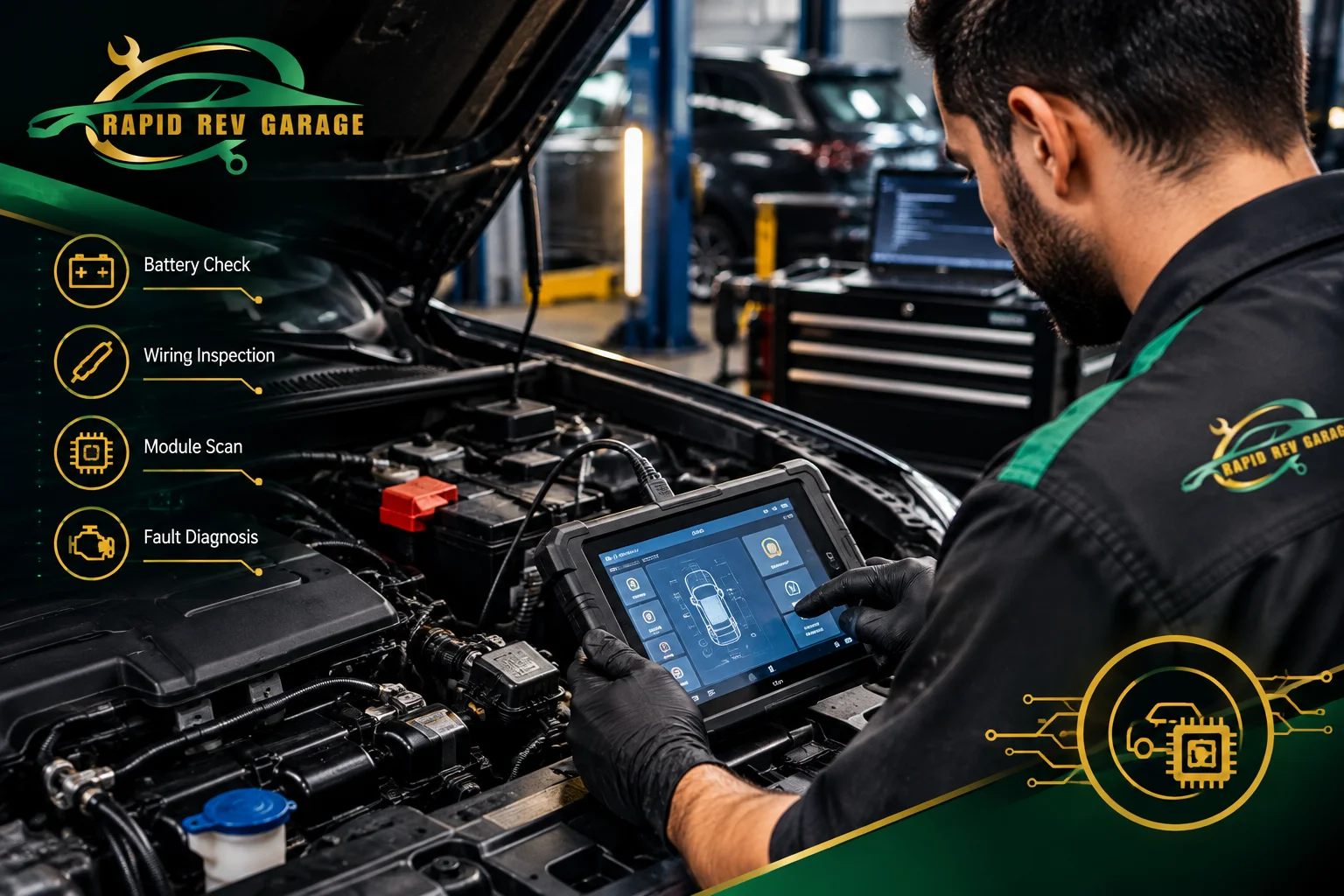
Full electronic scan. All modules scanned for impact-triggered fault codes — airbag module, ABS, traction control, ADAS sensors, radar, and camera systems.
Test drive. Steering feel, brake response, and handling assessed on a road test after the above inspections are complete. Our mobile car mechanic covers Al Quoz and nearby Dubai areas for on-site post-collision assessment. Our garage near me in Al Quoz serves drivers from Business Bay, Jumeirah, Barsha, Satwa, Downtown, and the Sheikh Zayed Road corridor.
What Does a Post-Collision Assessment Cost in Dubai?
| Service | Cost Range |
| Post-collision inspection and scan | AED 200–500 |
| Wheel alignment check post-impact | AED 200–400 |
| Bumper beam and structure inspection | AED 150–300 |
| Full ADAS sensor recalibration | AED 500–2,000 |
Assessment cost confirmed before any repair work begins.
Why Rapid Rev Garage?
Every decision to drive after a minor collision must be based on confirmed damage findings — not on what the bumper cover looks like. Structural deformation, suspension geometry change, fluid system damage, and sensor displacement are all possible from a collision that left the bodywork looking largely intact.
We remove the bumper cover, measure the geometry, scan the electronics, and test the fluid systems before recommending whether the vehicle is safe to drive and what repair is needed.
FAQ — Drive After a Minor Collision
Here are the questions Dubai drivers ask us most after a minor collision.
When is it safe to drive after a minor collision?
When there are no fluid leaks, no warning lights, no change in steering or brake feel, no visible wheel misalignment, and the tyres are intact. If all five of those conditions are met, driving slowly to a workshop for a full assessment is reasonable. If any one is not met, have the vehicle recovered.
Can a small collision damage the alignment?
Yes. A front or rear impact that loads the suspension laterally or longitudinally can change caster, camber, or toe at the affected corner. The geometry change may not produce obvious symptoms immediately but will produce tyre wear and handling issues over subsequent kilometres.
What warning lights might come on after a collision?
Airbag, ABS, traction control, and stability control warning lights are the most common after a collision. Each indicates a fault in that system triggered by the impact. Drive with any of these illuminated means driving without knowing whether that safety system will function correctly.
Should I call the police after a minor collision in Dubai?
Yes — even for a minor collision with no injuries, a police report is required for insurance purposes in Dubai. The Dubai Police app allows accident reports to be filed for minor collisions without a physical police attendance where both parties agree on the facts.
Can a collision affect the airbags without deploying them?
Yes. An impact below the deployment threshold can still trigger a fault in the airbag control module — damaging the clock spring, a sensor, or the module itself. The airbag warning light confirms whether a fault has been stored. A post-collision scan always includes the airbag module.
Conclusion
Whether you can drive after a minor collision safely depends on what was damaged, not on the visible panel condition. Structural deformation, suspension geometry changes, fluid leaks, electrical faults, and tyre damage are all possible from impacts that left the bodywork largely intact.
Rapid Rev Garage in Al Quoz assesses every post-collision vehicle completely — structure, geometry, fluids, electronics, and tyres — before confirming whether the vehicle is safe to drive and what repair is required.
Rapid Rev Garage is in Al Quoz, serving Business Bay, Jumeirah, Downtown, Barsha, Satwa, and the Sheikh Zayed Road corridor. Book your appointment on WhatsApp or find us on Google Maps.
Rapid Rev Garage — Drive After a Minor Collision | Al Quoz, Dubai