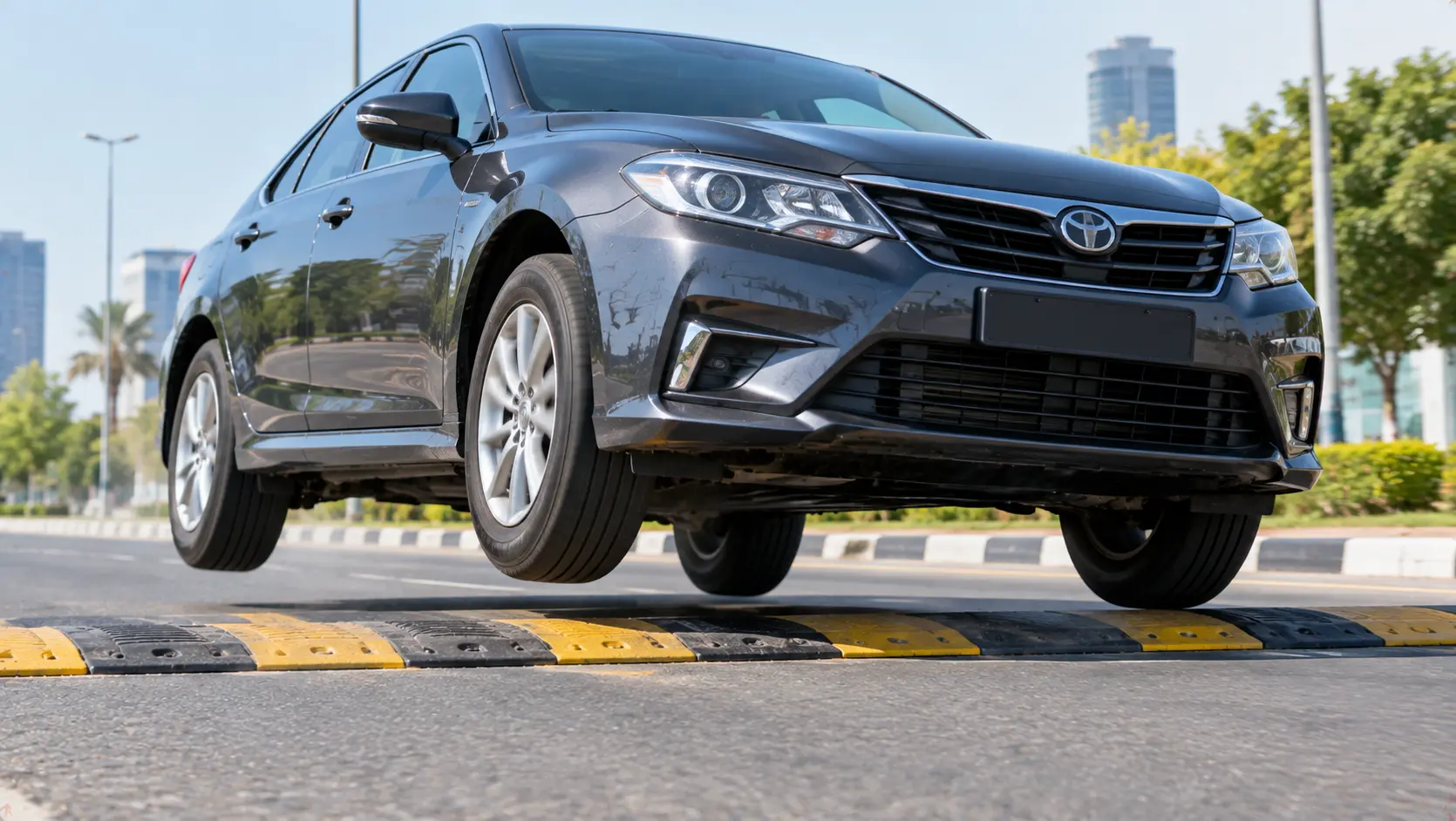
When a car bounce over speed bumps situation develops — the car continues to bob after crossing a bump instead of settling immediately — is a clear sign that something in the suspension system is no longer controlling the body movement it was designed to control.
In Dubai, car bounce over speed bumps is triggered constantly — every 100–200 metres. Every commute with a car bounce over speed bumps fault is a series of uncontrolled oscillations. The driver grips the wheel on every bump and waits for the car to settle. Passengers in the rear feel the effect most — the rear suspension often bounces more than the front because the driver instinctively anticipates and braces.
At Rapid Rev Garage in Al Quoz, every car bounce over speed bumps complaint is diagnosed with a corner bounce test and a ramp inspection before recommending any repair.
Car Bounce Over Speed Bumps — Quick Answer
A car bounces over speed bumps because the shock absorbers are no longer controlling the spring’s rebound movement after a bump. The spring compresses as the wheel rises over the bump — absorbing the impact energy — and then extends as the wheel comes back down. The shock absorber’s job is to damp this extension, allowing one controlled rebound before returning to rest. A worn shock absorber allows multiple rebounds — every car bounce over speed bumps starts here. In Dubai, shock absorbers reach their service limit faster than in any European market because the speed bump density means more compression cycles per kilometre. A shock absorber that would last 80,000 km in Europe may need replacement at 60,000 km in Dubai’s speed bump-intensive residential streets.
Table of Contents
- How Shock Absorbers Control Body Movement After a Bump
- The Bounce Test — Confirming Shock Absorber Condition at Each Corner
- Worn Shock Absorbers — The Primary Cause
- Broken or Sagged Springs Increasing Rebound Energy
- Worn Bump Stops Allowing Excessive Travel
- Worn Strut Mounts Losing Their Isolation Function
- How Dubai’s Speed Bump Density Accelerates Shock Absorber Wear
- How We Assess a Car That Bounces Over Speed Bumps
- The Services That Fix Each Confirmed Cause
- What Does the Repair Cost in Dubai?
- Why Rapid Rev Garage?
- FAQ
- Conclusion
How Shock Absorbers Control Body Movement After a Bump
A coil spring and a shock absorber work as a pair. The spring stores and releases energy — it compresses when the wheel hits a bump and extends as the wheel comes back down. Without any damping, the spring would continue to oscillate — compressing and extending repeatedly until friction gradually dissipated the energy. This is what a bouncing car bounce over speed bumps feels like.
The shock absorber provides hydraulic damping. As the spring extends after a bump, the shock absorber forces hydraulic fluid through calibrated internal orifices — converting the spring’s energy into heat. This resistance slows the extension and prevents multiple oscillations. A healthy shock absorber allows one controlled extension after a compression event. The car rises over the bump and settles immediately.
A worn shock absorber has degraded internal seals, worn piston rings, or lost hydraulic fluid through seal failure. The damping resistance is reduced. The spring extends rapidly and continues to bounce — the car oscillates two, three, or more times over each speed bump. Our car mechanic team performs the corner bounce test at each corner before any ramp inspection.
The Bounce Test — Confirming Shock Absorber Condition at Each Corner
The bounce test is the quickest way to assess shock absorber condition without removing a wheel.
Press firmly down on one corner of the vehicle — using body weight on the front wing or rear quarter — and release quickly. Count the oscillations before the corner settles.
One controlled rebound and settle: the shock absorber is functioning correctly.
Two or more bounces before settling: the shock absorber is worn and needs replacement.
The test is performed at all four corners — front left, front right, rear left, rear right — and the results compared. A single worn corner produces an uneven, unsettled feel after bumps. Two worn corners on the same axle produce the consistent car bounce over speed bumps pattern that affects both sides equally.
The bounce test is a reliable indicator but not definitive — a shock absorber can produce one clean rebound on a static test but perform worse under the higher energy of a speed bump at road speed. A ramp inspection and road test confirm the full picture.
Worn Shock Absorbers — The Primary Cause
Shock absorbers wear progressively. The internal seal that contains the hydraulic fluid degrades from millions of compression and rebound cycles. The piston rings that maintain pressure in the damping chambers wear against the cylinder bore.
As the seal degrades, hydraulic fluid leaks from the high-pressure damping chamber to the low-pressure reservoir. The damping force decreases. The shock absorber that was providing 100% of its designed resistance when new may be providing 60–70% after 60,000 km of Dubai driving.
At 70% damping, the car bounce over speed bumps is mild — one extra rebound that the driver barely notices. At 50% damping, the bouncing is clear and consistent. At 40% or below, the rear of the car can feel actively unsettled after a speed bump and the driver loses confidence in the car’s handling.
A shock absorber that is leaking visibly — oil weeping down the shock body — is confirmed failed. One that has no visible leak but is producing two or more bounces on the corner test is also worn — the internal seal is failing before reaching the point of external leakage. Our car service packages include a shock absorber bounce test and visual inspection at every major service.
Broken or Sagged Springs Increasing Rebound Energy
A broken spring — where the coil has cracked at a stress point — changes the effective spring rate at that corner. Depending on where the spring breaks, the ride height at that corner may drop suddenly, or the spring may continue to function at a lower rate.
A broken spring changes the energy dynamics of the bump response. The shock absorber was calibrated to damp a specific spring rate. A spring that is now stiffer or more compliant than designed produces a rebound energy the shock absorber was not calibrated for — resulting in more bouncing after a bump.
A sagged spring — one that has permanently set lower than its designed length — lowers the ride height at that corner and reduces the suspension travel available before the bump stop is reached. The car bottoms out on speed bumps that it would have cleared with correct ride height — producing a sharp thud on bump contact followed by a bounce.
Spring condition is confirmed by measuring ride height at all four corners against the manufacturer’s specification. A corner 20–30mm below specification has a sagged spring. A spring with a visible crack requires immediate replacement.
Worn Bump Stops Allowing Excessive Travel
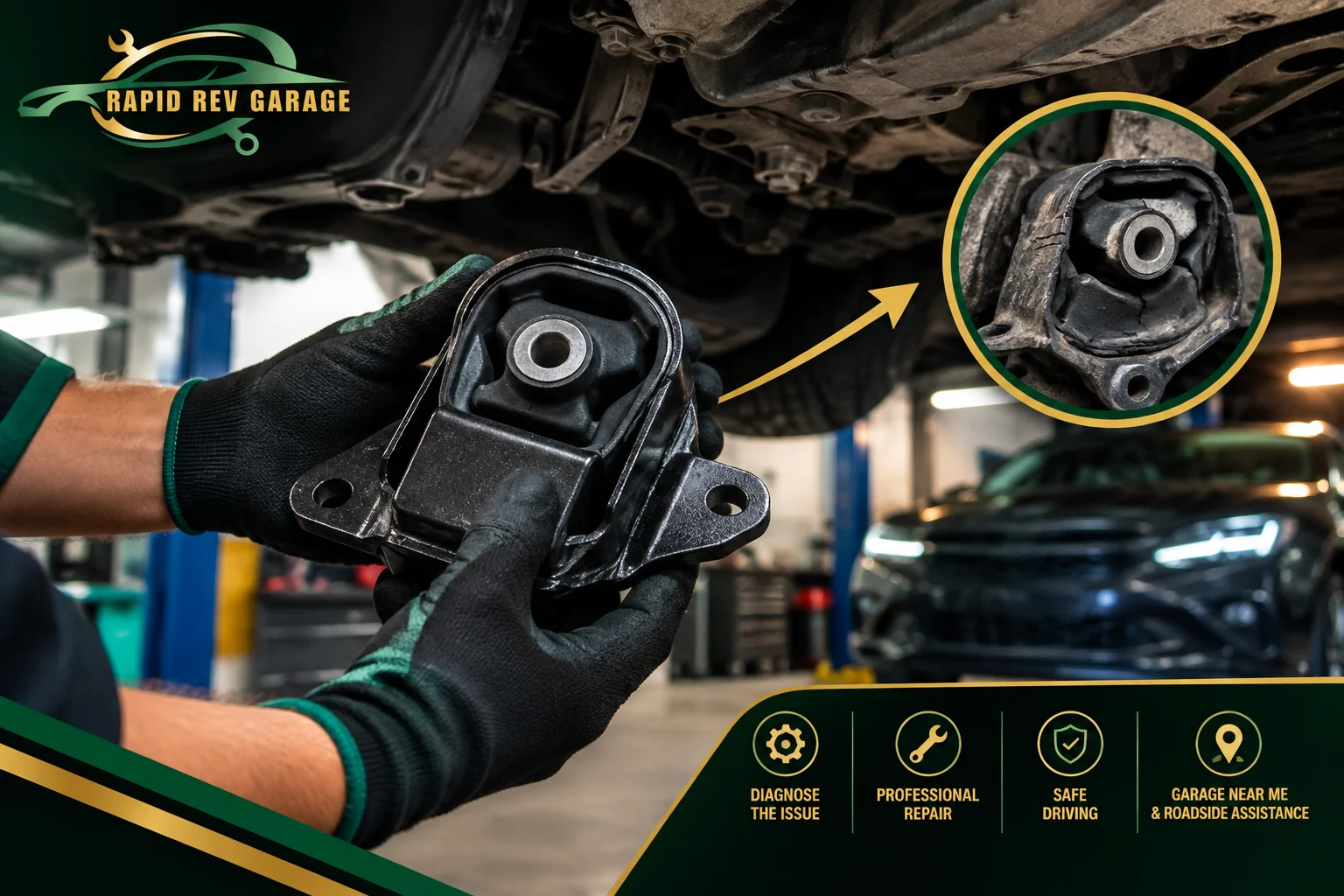
Inside each shock absorber body is a rubber bump stop — a cushion that limits the maximum compression travel of the suspension. The bump stop prevents metal-to-metal contact between the shock piston and its housing at full compression.
A worn or crumbled bump stop allows the shock absorber to compress beyond its designed travel limit. At full compression — on a sharp, fast speed bump — the piston contacts the housing directly. The sharp thud on bump contact is followed by a rebound with more energy than the shock absorber is designed to control — producing additional bouncing.
Bump stops are relatively inexpensive and are typically replaced when shock absorbers are replaced — they are often supplied as a kit with the new shock absorber. Replacing shocks without replacing worn bump stops leaves a component that will continue to produce the same bottoming-out thud with the new shocks.
Worn Strut Mounts Losing Their Isolation Function
The front strut mounts connect the top of the front struts to the vehicle body. They contain a rubber isolation element and a bearing that allows the strut to rotate with steering input.
The rubber isolation element in the strut mount is designed to absorb the high-frequency vibration from the road surface and prevent it from transmitting directly into the body. A worn strut mount with hardened, cracked rubber transfers road inputs more directly to the body — the car bounce over speed bumps from a strut mount issue feels harsher and more jarring than the slower oscillation of a worn shock absorber.
A worn strut mount bearing also produces a clunking or creaking sound when the suspension is compressed and the strut rotates with steering input. For any roadside assistance from a suspension failure, our roadside assistance team covers Al Quoz and nearby Dubai areas.
How Dubai’s Speed Bump Density Accelerates Shock Absorber Wear
Every speed bump crossing is one compression-rebound cycle for the shock absorber. The internal seal and piston rings complete one full working stroke.
A Dubai vehicle doing a 15-minute residential commute may cross 30–40 speed bumps. At five days per week, 50 weeks per year, that is 7,500–10,000 speed bump cycles per year — just from the commute. Highway driving adds further but less severe compression events.
A shock absorber rated for 500,000 compression cycles in a European environment — where those cycles come primarily from road surface undulations at highway speed — accumulates those cycles in fewer kilometres in Dubai’s speed bump environment. The seal and piston wear rates are mileage-and-cycle dependent. Dubai’s cycle-intensive driving reaches the wear threshold faster per kilometre.
This cycle accumulation explains why car bounce over speed bumps is so common on Dubai vehicles aged four to six years — the shock absorbers have completed their designed cycle life in Dubai’s conditions, even if the vehicle is not particularly high-mileage by European standards.
How We Assess a Car That Bounces Over Speed Bumps
Corner bounce test at all four corners. Each corner pressed and released. Number of oscillations recorded. Corners with two or more bounces confirmed as worn.
Visual inspection of shock absorber bodies. Oil weeping from the seal indicates confirmed internal seal failure. Dry bodies with a positive bounce test are worn internally without external leakage.
Ride height measurement. All four corners against manufacturer specification. Low corners identify sagged or broken springs.
Bump stop inspection. With the wheel removed, the bump stop condition is assessed on the ramp. Crumbled or compressed bump stops are noted.
Strut mount assessment. Upper strut mount rubber condition and bearing smoothness checked at the front corners.
Road test over a known speed bump. The car is driven over the same speed bump before and after repair — confirming the bounce is resolved before returning the vehicle.
The Services That Fix Each Confirmed Cause
Shock absorber replacement. Always in axle pairs — both front or both rear at the same time. Replacing one side only leaves unequal damping. AED 800–2,500 per axle depending on vehicle.
Spring replacement. In axle pairs where sag or breakage is confirmed. AED 600–2,000 per axle.
Bump stop replacement. Typically included in the shock absorber replacement kit. AED 100–300 per corner additional if separate.
Strut mount replacement. AED 400–1,200 per corner where worn. Our car painting team handles any paint or bodywork repairs alongside suspension work at the same visit. Our mobile car mechanic covers Al Quoz and nearby Dubai areas for on-site suspension assessment. Our garage near me in Al Quoz serves drivers from Business Bay, Jumeirah, Barsha, Satwa, Downtown, and the Sheikh Zayed Road corridor.
What Does the Repair Cost in Dubai?
| Service | Cost Range |
| Shock absorber replacement (per axle) | AED 800–2,500 |
| Spring replacement (per axle) | AED 600–2,000 |
| Bump stop replacement | AED 100–300 per corner |
| Strut mount replacement | AED 400–1,200 per corner |
All costs confirmed after the bounce test, visual inspection, and ride height measurement.
Why Rapid Rev Garage?
Every car bounce over speed bumps case is almost always worn shock absorbers — but the confirmation matters. A spring that has sagged produces bouncing that new shocks alone will not fully resolve. A worn bump stop produces a thud and bounce that is separate from shock absorber damping.
We confirm every car bounce over speed bumps root cause before recommending replacement. And we test over the same speed bump after the repair — the bounce must be gone before the vehicle is returned.
FAQ — Car Bounce Over Speed Bumps
Here are the questions Dubai drivers ask us most about bouncing over speed bumps.
How do I know if shock absorbers need replacing?
Press each corner of the car down firmly and release. More than one bounce before the car settles confirms a worn shock absorber at that corner. Also check for oil weeping down the shock body — this confirms a failed internal seal.
Should I replace all four shock absorbers at once?
Replace in axle pairs at minimum — both fronts or both rears together. Replacing only one side leaves unequal damping between the two corners of the same axle. Where the front and rear are similarly worn, replacing all four at one visit is more cost-effective than two separate visits.
Can worn shock absorbers affect tyre wear?
Yes. A shock absorber that allows excessive rebound after a bump causes the tyre to bounce — losing and regaining contact with the road rapidly. This produces tyre wear in a cupped or scalloped pattern — uneven wear around the circumference. If cupped wear is visible, shock absorbers are a likely cause.
Is it dangerous to drive with worn shock absorbers?
At city speeds on smooth roads, moderately worn shocks are uncomfortable but not immediately dangerous. On Dubai's speed bump-dense residential streets and at highway speeds where lane changes and emergency manoeuvres require controlled body movement, worn shocks reduce handling safety. Address the fault before the next significant highway trip.
How long do shock absorbers last in Dubai?
50,000–70,000 km in Dubai's speed bump-intensive conditions. European intervals of 80,000–100,000 km assume lower bump frequency per kilometre. Dubai's residential driving executes more compression cycles per kilometre — shock absorbers reach end-of-life earlier in terms of mileage.
Conclusion
A car bounce over speed bumps is the shock absorber’s damping failing to control the spring’s rebound after a bump. In Dubai, where speed bumps are crossed dozens of times per commute, shock absorbers complete their service life faster than any European interval assumes.
Rapid Rev Garage in Al Quoz fixes every car bounce over speed bumps case by confirming the worn corners, checks for spring sag and bump stop wear, and replaces the confirmed failed components in axle pairs — then tests over the same speed bump before returning the vehicle.
Rapid Rev Garage is in Al Quoz, serving Business Bay, Jumeirah, Downtown, Barsha, Satwa, and the Sheikh Zayed Road corridor. Book your appointment on WhatsApp or find us on Google Maps.
Rapid Rev Garage — Car Bounce Over Speed Bumps | Al Quoz, Dubai