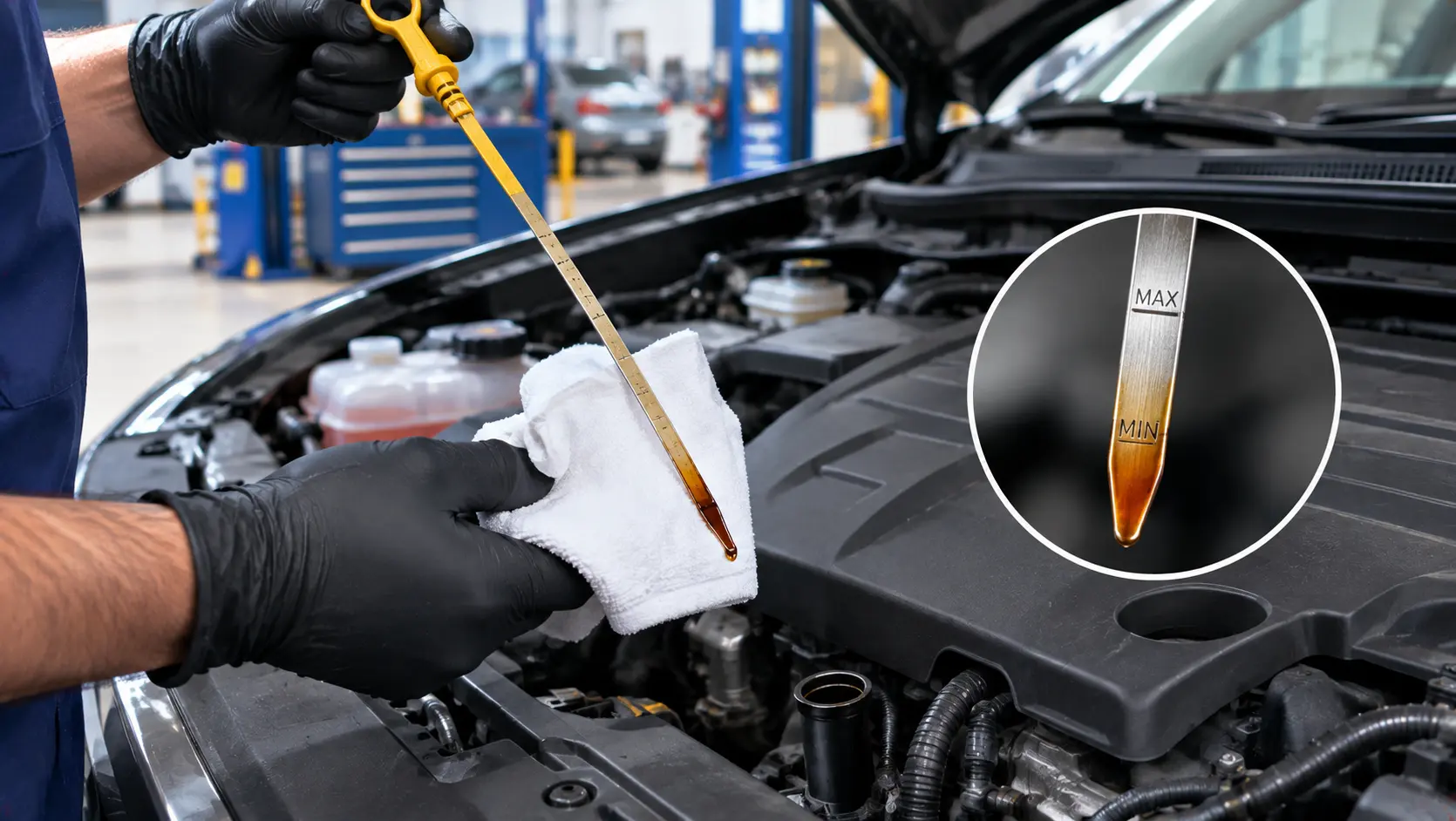
When an oil level dropping between services situation develops — the dipstick reads low a few weeks after a fresh oil change — is not normal. A healthy, sealed engine does not consume or lose meaningful quantities of oil between services. If the oil level dropping between services is confirmed, the oil is going somewhere specific. Every oil level dropping between services case is either a leak or internal combustion.
In Dubai, oil level dropping between services appears more often than in any cooler market than in cooler markets. Heat accelerates the degradation of every seal and gasket in the engine. Oil that thins in 45°C underbonnet temperatures passes through worn valve stem seals more easily. A small external leak burns off the hot engine surface before it ever reaches the ground — leaving no puddle to alert the driver.
At Rapid Rev Garage in Al Quoz, every oil level dropping between services case starts with finding exactly where the oil is going before recommending any repair.
Oil Level Dropping Between Services — Quick Answer
An oil level dropping between services means the engine is either leaking oil externally or consuming it internally. External leaks come from failed gaskets, worn seals, or loose drain plugs — the oil escapes the engine and either drips under the car or burns on hot exhaust surfaces. Internal consumption means oil is entering the combustion chamber and burning with the fuel — this produces blue smoke from the exhaust and leaves no external trace. The most common causes in Dubai are a worn cam cover or sump gasket leaking from heat-degraded rubber, worn valve stem seals allowing oil into the combustion chamber, worn or stuck piston rings that allow oil past the cylinder wall, a blocked crankcase ventilation system forcing oil into the intake, or a turbocharger seal failure on turbocharged engines. Dubai’s sustained heat degrades every rubber seal faster than European service intervals assume.
Table of Contents
- How Much Oil Loss Is Normal and When Does It Become a Problem
- External Oil Leaks — What Is Leaking and Where
- Valve Stem Seal Wear — Oil Burning in the Combustion Chamber
- Worn Piston Rings and Cylinder Wall Clearance
- Blocked Crankcase Ventilation System
- Turbocharger Seal Failure on Turbo Engines
- How Dubai’s Heat Accelerates Seal Degradation
- How to Tell If Oil Is Leaking or Burning
- How We Find the Source at Rapid Rev Garage
- The Services That Fix Each Confirmed Cause
- What Does the Repair Cost in Dubai?
- Why Rapid Rev Garage?
- FAQ
- Conclusion
How Much Oil Loss Is Normal and When Does It Become a Problem
Most manufacturers accept a small amount of oil consumption as within specification — typically up to 0.5–1 litre per 1,000 km in an older or high-mileage engine. This is from minor combustion chamber oil vapour that passes through the piston ring seal at high RPM under load.
A loss of more than 1 litre per 1,000 km is beyond normal consumption. A loss that requires topping up more than once between services is a fault that needs investigation.
Oil level dropping between services that requires a top-up within the first 2,000 km after a fresh oil change is always worth investigating — regardless of the quantity. The cause identified and fixed at an early stage is always a simpler and cheaper repair than the same cause at an advanced stage. Our car mechanic team performs a leak and consumption assessment before recommending any repair.
External Oil Leaks — What Is Leaking and Where
External leaks are the easiest to confirm and the most common cause of oil level dropping between services in Dubai.
Cam cover gasket. The rubber gasket under the cam cover seals the top of the engine. In Dubai’s sustained underbonnet heat — regularly reaching 100°C — this gasket hardens and cracks faster than in any cooler market. A cracked cam cover gasket allows oil to seep down the side of the engine. The oil burns on the hot exhaust manifold below, producing a burning oil smell but often no visible puddle.
Sump gasket or drain plug. The sump — the oil pan at the bottom of the engine — is sealed against the block with a gasket or sealant. A sump gasket that has failed leaks directly downward and is the most visible external leak — a puddle under the engine after parking. A loose or stripped drain plug leaks similarly.
Rear main seal. The rear crankshaft seal prevents oil from escaping where the crankshaft exits the engine block rearward. A failed rear main seal produces an oil leak between the engine and gearbox — visible as oil on the bellhousing or underneath the gearbox.
Front crankshaft seal. Where the crankshaft exits the front of the engine — to drive the timing belt or chain — the front seal can leak. Oil from this seal runs down the front of the engine and may contaminate the timing belt.
Oil filter and oil pressure sender. A loose or incorrectly installed oil filter, or a failed oil pressure sender seal, produces a slow leak that accumulates over time. Our car service packages include a full underbonnet and underbody oil leak inspection at every major service.
Valve Stem Seal Wear — Oil Burning in the Combustion Chamber
Valve stem seals are small rubber seals that fit around each valve stem where it enters the cylinder head. They prevent engine oil — which lubricates the valve stem — from being drawn into the combustion chamber.
When valve stem seals harden and crack from age and heat, they no longer seal the valve stem effectively. Oil seeps down the stem and into the combustion chamber — particularly when the engine is at idle and the intake vacuum is highest.
The characteristic symptom is blue smoke from the exhaust on startup — particularly after the engine has been sitting overnight. The oil that accumulated in the combustion chamber while the engine was off burns off in the first minute of running. Once the engine is warm and running, the smoke reduces or disappears.
In Dubai, valve stem seals reach end-of-life faster from sustained heat. A seal rated for 100,000 km in a European climate may begin leaking at 70,000 km in Dubai’s underbonnet temperatures. Valve stem seal replacement requires removing the cylinder head or using a special compression tool — it is a labour-intensive repair but far cheaper than the engine damage that results from sustained oil consumption.
Worn Piston Rings and Cylinder Wall Clearance
Piston rings seal the gap between the piston and the cylinder wall. They perform two functions — sealing combustion pressure in and keeping oil from the crankcase out of the combustion chamber.
When piston rings wear — from accumulated mileage and heat cycling — the sealing function for oil deteriorates. Oil from the crankcase passes the worn rings and enters the combustion chamber. It burns with the fuel and exits through the exhaust as blue smoke.
Unlike valve stem seal consumption — which produces blue smoke mainly on startup — piston ring oil consumption produces blue smoke throughout the drive, particularly under heavy acceleration when the piston loads are highest.
Piston ring wear is confirmed by a cylinder compression test and a cylinder leakdown test. Low compression at a specific cylinder, combined with oil consumption, confirms ring wear at that cylinder. Severe wear across multiple cylinders requires engine rebuild or replacement — a significant cost that could have been extended significantly by timely oil changes and avoiding sustained low oil level operation. For any roadside emergency from an oil or engine fault, our roadside assistance team covers Al Quoz and nearby Dubai areas.
Blocked Crankcase Ventilation System
The crankcase ventilation (PCV) system removes combustion blow-by gases — the small amount of combustion gas that passes the piston rings into the crankcase — by recirculating them back through the intake manifold to be burned.
A blocked PCV valve or a clogged crankcase ventilation hose causes pressure to build in the crankcase. This positive pressure forces oil through every seal and gasket in the engine — accelerating leaks at the cam cover gasket, the rear main seal, and every other sealing surface.
A blocked PCV is often the cause of oil level dropping between services that appears suddenly on a vehicle that was not previously leaking. The PCV blockage increases crankcase pressure, which forces oil through seals that were previously containing it adequately.
PCV valve replacement is an inexpensive repair — typically AED 100–300. It is always checked early in any oil loss investigation because it can be the root cause of multiple simultaneous leaks.
Turbocharger Seal Failure on Turbo Engines
Turbocharged engines — increasingly common on modern Dubai vehicles — have an additional oil consumption risk: the turbocharger.
The turbocharger’s central bearing housing is lubricated by engine oil. Internal seals prevent this oil from entering the compressor or turbine airflow passages. When these seals wear — from heat, from oil starvation during cold starts, or from high mileage — oil enters the intake air on the compressor side or exits through the exhaust on the turbine side.
Turbo seal failure produces blue or white smoke that increases with boost pressure — under hard acceleration when the turbo is working hardest. The intercooler pipes also show oil contamination when the compressor-side seal is leaking.
A turbocharger with failed seals is typically replaced rather than rebuilt — a rebuilt turbo with new seals at a specialist costs less than a new OEM unit and provides equivalent performance. For any paint or exterior repairs alongside engine work, our car painting team handles colour-matched bodywork at the same visit.
How Dubai’s Heat Accelerates Seal Degradation
Every rubber seal and gasket in the engine has a design life that is calculated for a specific operating temperature range. Dubai’s conditions push every seal beyond that range consistently.
Underbonnet temperatures in Dubai’s summer regularly reach 90–110°C with the engine at operating temperature. A cam cover gasket designed for 80°C continuous temperature operation is consistently above its specification limit. The rubber hardens faster, cracks sooner, and loses its compression set — the ability to maintain a seal — earlier than any European service interval assumes.
This heat factor is exactly why oil level dropping between services is so common on Dubai vehicles than on the same models in European markets. The seals are not inferior — they are simply operating in conditions that degrade them faster than their design life accounts for.
How to Tell If Oil Is Leaking or Burning
The diagnostic path splits immediately based on whether the oil is leaking externally or burning internally.
Signs of an external leak: Oil puddle under the engine after parking. Burning oil smell from the engine bay — oil on hot exhaust surfaces. Visible oil staining on engine external surfaces — around the cam cover, sump, rear of the engine.
Signs of internal consumption: Blue smoke from the exhaust — at startup for valve stem seals, throughout the drive for piston rings, under hard acceleration for turbo seals. No oil puddle under the car. Oily residue inside the exhaust tip. Oil level drops without any visible external trace.
Some vehicles show both — a small external leak and internal consumption simultaneously. Confirming which is present — and how much each contributes — directs the repair correctly.
How We Find the Source at Rapid Rev Garage
UV dye test for external leaks. UV-fluorescent dye is added to the engine oil. After a drive, a UV lamp reveals every external leak point as a bright trail. The brightest trail shows the primary leak source.
Smoke test for PCV blockage. Smoke introduced into the crankcase ventilation system confirms whether the PCV valve is flowing correctly or is blocked.
Blue smoke assessment during road test. Cold start, warm idle, and hard acceleration are assessed for blue smoke character — identifying whether the consumption pattern is valve stem seals, rings, or turbo seals.
Compression and leakdown test. Each cylinder tested for compression and ring seal integrity. A cylinder with significantly lower compression and leakdown confirms ring wear at that position.
Oil consumption measurement. Oil level documented at the start of an assessment period and again after a defined distance to quantify the consumption rate.
The Services That Fix Each Confirmed Cause
- Cam cover gasket replacement. AED 300–800 depending on engine.
- Sump gasket replacement. AED 400–1,000 depending on engine and access.
- Rear main seal replacement. AED 600–2,000 — requires gearbox or flywheel removal.
- PCV valve replacement. AED 100–300.
- Valve stem seal replacement. AED 1,500–4,000 — labour-intensive cylinder head access required.
- Piston ring replacement. AED 3,000–10,000 — engine removal and rebuild required.
Turbocharger replacement. AED 2,000–8,000 depending on vehicle and turbo specification. Our mobile car mechanic covers Al Quoz and nearby Dubai areas for on-site initial oil loss assessment. Our garage near me in Al Quoz serves drivers from Business Bay, Jumeirah, Barsha, Satwa, Downtown, and the Sheikh Zayed Road corridor.
What Does the Repair Cost in Dubai?
| Service | Cost Range |
| Cam cover gasket replacement | AED 300–800 |
| Sump gasket replacement | AED 400–1,000 |
| Rear main seal replacement | AED 600–2,000 |
| PCV valve replacement | AED 100–300 |
| Valve stem seal replacement | AED 1,500–4,000 |
| Piston ring replacement | AED 3,000–10,000 |
| Turbocharger replacement | AED 2,000–8,000 |
All costs confirmed after the UV dye test, smoke test, and compression assessment identify the specific source.
Why Rapid Rev Garage?
Every oil level dropping between services complaint has a specific confirmed source. We find it with UV dye for external leaks, a smoke test for PCV blockage, and a compression test for internal consumption — before recommending any repair.
We confirm each oil level dropping between services source before replacing any component without confirming the compression is adequate. And we do not replace the turbo without confirming the seals are the source rather than an upstream oil feed restriction.
FAQ — Oil Level Dropping Between Services
Here are the questions Dubai drivers ask us most about oil loss between services.
How often should I check my oil level in Dubai?
Every two weeks, or every 1,000 km — whichever comes first. Dubai's heat degrades oil faster and accelerates seal wear. A level that was correct after the last service can be 0.5–1 litre low within a month in summer driving conditions.
Is it safe to drive with low oil?
Not if the level is below the minimum mark. Oil provides lubrication, cooling, and cleaning for the engine's internal surfaces. Below minimum level, oil pressure at high RPM may drop below the threshold for full bearing lubrication. Engine damage at this point is rapid and irreversible. Top up immediately and find the source.
Can blue smoke mean something other than oil burning?
Blue smoke specifically means oil burning. White smoke means coolant burning. Black smoke means excess fuel. If the smoke from the exhaust is clearly blue — particularly on startup or under hard acceleration — oil is entering the combustion chamber.
Does a small external oil leak need immediate repair?
A very small seep — a thin film on a gasket face, no drip — can be monitored over a short period. A drip that produces a puddle under the car needs repair within the week. Any leak that drops the oil level below the minimum mark before the next service needs immediate attention.
Can using the wrong oil viscosity cause oil consumption?
Yes. An oil that is too thin for the engine's worn clearances passes through seals and rings more easily than a correctly-specified viscosity. On higher-mileage engines in Dubai, using the upper end of the manufacturer's specified viscosity range — or a semi-synthetic rather than full synthetic — reduces consumption in some cases. Never use a viscosity outside the manufacturer's specification range.
Conclusion
An oil level dropping between services always has a specific source — an external leak through a failed seal or gasket, or internal consumption through worn valve stem seals, piston rings, or a turbocharger. In Dubai, heat degrades every rubber seal faster, making this fault more common than any European service interval accounts for.
Rapid Rev Garage in Al Quoz traces every oil level dropping between services source precisely using UV dye, smoke testing, and compression measurement — then repairs the confirmed fault before it progresses to engine damage.
Rapid Rev Garage is in Al Quoz, serving Business Bay, Jumeirah, Downtown, Barsha, Satwa, and the Sheikh Zayed Road corridor. Book your appointment on WhatsApp or find us on Google Maps.
Rapid Rev Garage — Oil Level Dropping Between Services | Al Quoz, Duba