You are stopped at the lights on Al Khail Road, the AC is on full and the oil pressure gauge sinks toward the bottom. Or the red oil light flickers at idle, then goes out as soon as you pull away. An engine oil pressure drop at idle can be completely normal, or it can be the first warning of a fault that destroys an engine within minutes.
The difference comes down to how far the pressure falls and what else is happening. Some drop at idle is built into every engine, because the oil pump spins with the crankshaft and moves less oil at low speed. A red warning light, a ticking noise or a reading that keeps falling is a different story.
This guide explains how engine oil pressure works, what counts as normal at idle, the faults that cause a real problem, how a workshop tests for each one, and what the repair involves. It is written for Dubai drivers, where heat, long idling in traffic and dust make oil pressure faults more common than in cooler cities.
Engine Oil Pressure Drop at Idle: Quick Answer
Some engine oil pressure drop at idle is normal, because the oil pump turns slower and hot oil flows more easily. Jalopnik reports that normal oil pressure runs from about 25 to 65 psi depending on the engine, and stays above 20 psi at idle on most cars.
A real problem shows as a red oil light at idle, pressure that falls lower than usual, or ticking from the engine. The common causes are low oil level, oil that is too thin or overdue for a change, a faulty pressure sensor, a clogged oil pickup, a worn oil pump or worn engine bearings. If the red light stays on, switch off the engine and do not drive.
Table of Contents
- How Engine Oil Pressure Works
- How Much Oil Pressure Drop at Idle Is Normal
- Why Dubai Heat and Traffic Make Idle Pressure Lower
- Low Oil Level: The Most Common Cause
- Wrong Oil Grade or Overdue Oil Changes
- Faulty Oil Pressure Sensor or Switch
- Clogged Oil Pickup Screen and Sludge
- Worn Oil Pump or Pressure Relief Valve
- Worn Engine Bearings in High Mileage Engines
- Oil Pressure Warning Signs and What They Mean
- How a Workshop Tests Oil Pressure Properly
- What Each Oil Pressure Repair Involves
- Is It Safe to Drive With Low Oil Pressure at Idle?
- How to Prevent Oil Pressure Problems in Dubai
- FAQ
- Conclusion
How Engine Oil Pressure Works
Engine oil pressure is the force that pushes oil through the engine’s narrow passages to the crankshaft bearings, camshafts, timing chain and turbocharger. The oil pump draws oil from the sump through a pickup screen, sends it through the oil filter and forces it into the engine’s oil galleries.
The pressure comes from resistance. The bearings have very small gaps, often measured in hundredths of a millimetre, and oil has to squeeze through them. Tight gaps and thick oil create more pressure. Wide gaps and thin oil create less.
A thin film of oil keeps metal parts from touching. If pressure falls too low, that film breaks down and metal rubs on metal. Bearings can be damaged within minutes, which is why a red oil light is one of the few warnings that means stop now.
How Much Oil Pressure Drop at Idle Is Normal
Oil pressure always rises with engine speed and falls at idle. The oil pump is driven by the engine, so at 700 rpm it moves far less oil than at 3,000 rpm. A common rule of thumb among engine builders is about 10 psi for every 1,000 rpm, which puts a warm idle in the low teens to the 20s on many engines.
Jalopnik reports that normal oil pressure ranges from about 25 to 65 psi depending on the engine, and that most cars should stay above 20 psi at idle. Your owner’s manual or the workshop manual gives the exact figure for your engine.
Many modern engines also use variable displacement oil pumps that lower pressure at idle on purpose to save fuel. On these cars, a low idle reading can be normal. What matters is whether the pressure is lower than it used to be, and whether the warning light comes on.
Gauges Versus Warning Lights
Many cars do not have a real pressure gauge. Some show a needle that is really just an on or off switch with a fixed position. Others only have a red warning light. The light is triggered by a pressure switch set to a very low pressure, so by the time it glows, the engine is already short of oil pressure.
Why Dubai Heat and Traffic Make Idle Pressure Lower
Hot oil is thinner than cold oil, and thin oil flows through the bearing gaps faster, which lowers pressure. Dubai driving keeps oil hotter for longer than in most places. Long idling in stop and start traffic on Sheikh Zayed Road, queues at the Dubai Mall car park exit and school pick up lines in Al Barsha all keep the engine idling with the AC compressor adding load.
On a summer afternoon when the air passes 45°C, the radiator has less cooling margin, and oil temperatures climb. Each time the oil overheats, its additives break down faster and the oil loses some of its ability to hold pressure.
Short trips cause a different problem. A car that only drives a few kilometres between home and the office in Business Bay may never fully warm up, which lets moisture and fuel collect in the oil. Over time, that dilutes the oil and thins it out.
Low Oil Level: The Most Common Cause
Low oil level is the first thing to check, because it is common and simple to fix. If the oil level in the sump is low, the pickup can suck air when the oil sloshes on corners, braking or the slopes in basement car parks. Air in the oil causes pressure to drop, often at idle first.
Engines lose oil through leaks or by burning it. Common leak points are the valve cover gasket, the sump gasket, the oil filter seal and the front and rear crankshaft seals. Heat hardens rubber seals faster in the UAE, so older cars leak more often.
Check the level with the engine cold and the car on flat ground. If it is below the minimum mark, top up with the grade in your owner’s manual. If you top up yourself, wipe up spills on the bumper or wing straight away, because oil mixed with dust and baked in the sun can stain the clear coat and lead to paint and panel repair. If the level keeps dropping between services, the leak or oil burning needs to be found.
Wrong Oil Grade or Overdue Oil Changes
Oil grade matters for pressure. Jalopnik notes that oil with the wrong viscosity cannot hold the correct pressure, because thin oil slips through the gaps too easily. Always use the grade your manufacturer lists, including any hot climate grade in the manual.
DubiCars notes that 5W40 and 10W40 are popular choices in the UAE for their balance of heat resistance and cold start protection, and that full synthetic oils stay more stable at high temperatures. Modern engines designed for thin oils such as 0W20 should still use what the manual specifies, because thicker oil can cause other problems in those engines.
Old oil also loses pressure. As it ages, heat and fuel dilution thin it out and its additives wear out. DubiCars lists change intervals of about 5,000 km for conventional oil, 7,000 to 10,000 km for synthetic blends and 10,000 to 15,000 km for full synthetic. An oil change on schedule usually costs AED 150 to 400 in the UAE, according to the same source.
Faulty Oil Pressure Sensor or Switch
A faulty sensor is one of the most common reasons for a false low pressure warning. The sensor or switch screws into the engine block and sends a signal to the dashboard. Heat cycles can crack its internal parts, and oil can leak into its electrical connector.
A failing sensor often causes a light that flickers at idle, a gauge that jumps around, or a warning that comes on even with a full sump and fresh oil. The only way to know is to test the real pressure with a mechanical gauge. If the mechanical gauge shows normal pressure while the dashboard shows low, the sensor or its wiring is at fault.
Replacing a sensor is usually a short job. If the connector or wiring is damaged, an auto electrical repair fixes the circuit so the warning can be trusted again.
Clogged Oil Pickup Screen and Sludge
The oil pickup is a tube with a mesh screen that sits in the sump. If sludge builds up, the screen blocks and the pump cannot draw enough oil. Pressure falls at idle first, because the pump has less suction at low speed.
Sludge forms when oil is left in the engine too long, especially with heat and short trips. Jalopnik notes that overdue oil changes create sludge and clog filters, which restricts flow. A clogged or cheap oil filter can also restrict flow, although most filters have a bypass valve that opens if the filter blocks.
Fixing a blocked pickup means removing the sump, cleaning or replacing the pickup screen and checking for sludge in the rest of the engine. A quality oil filter change at every service helps prevent it from happening again.
Worn Oil Pump or Pressure Relief Valve
The oil pump creates the flow that becomes pressure. Over many years, its gears or rotors wear and lose efficiency, so it moves less oil at low speed. Jalopnik notes that a weak pump cannot generate enough pressure, which leaves the engine short of lubrication.
Every pump also has a pressure relief valve that opens to stop the pressure going too high. If this valve sticks open, oil returns to the sump instead of reaching the engine, and pressure stays low at all speeds.
On some engines the pump sits in the sump and can be changed with the engine in the car. On others it is driven from the front of the engine behind the timing cover, which makes it a bigger job. Replacing a worn pump is far cheaper than repairing the damage it causes if left alone.
Worn Engine Bearings in High Mileage Engines
Worn crankshaft and camshaft bearings are the most serious cause of low idle pressure. As bearings wear, the gaps grow wider and oil escapes faster, so the pump cannot build normal pressure at idle. Jalopnik lists worn bearings among the main causes, because the larger gaps leak oil.
Bearing wear usually shows with other symptoms. These include a deep knocking that rises with engine speed, metal particles in the oil when it is drained, and low pressure even with fresh oil of the correct grade. Bearing wear is often caused by earlier oil starvation, overheating or long service intervals.
Repairing worn bearings means taking the engine apart. On many cars, the choice is between a rebuild, a replacement engine or a used unit. An engine repair specialist can measure the wear and tell you which option makes sense for your car.
Oil Pressure Warning Signs and What They Mean
The way the pressure behaves tells a mechanic where to look first. This table shows the patterns seen most often and the likely cause behind each one.
| What you notice | Most likely cause | What to do |
| Light flickers at idle, goes out when revving | Low oil level, thin or old oil, worn pump | Check level now, book a pressure test |
| Light on with full sump and fresh oil | Faulty sensor or wiring | Mechanical gauge test |
| Gauge lower than usual only when hot | Thin or old oil, wrong grade, early bearing wear | Oil change with correct grade, then retest |
| Light on at all speeds | Very low oil, failed pump, blocked pickup | Stop the engine, do not drive |
| Low pressure with ticking or knocking | Worn bearings, oil starvation | Stop driving and arrange a tow |
| Light after a recent oil change | Wrong filter, loose filter, low fill | Check level and filter right away |
How a Workshop Tests Oil Pressure Properly
A proper diagnosis starts with the simple checks before any parts are replaced. The mechanic checks the oil level, smells and looks at the oil for fuel dilution or sludge, and reads any stored fault codes with an OBD2 scan tool.
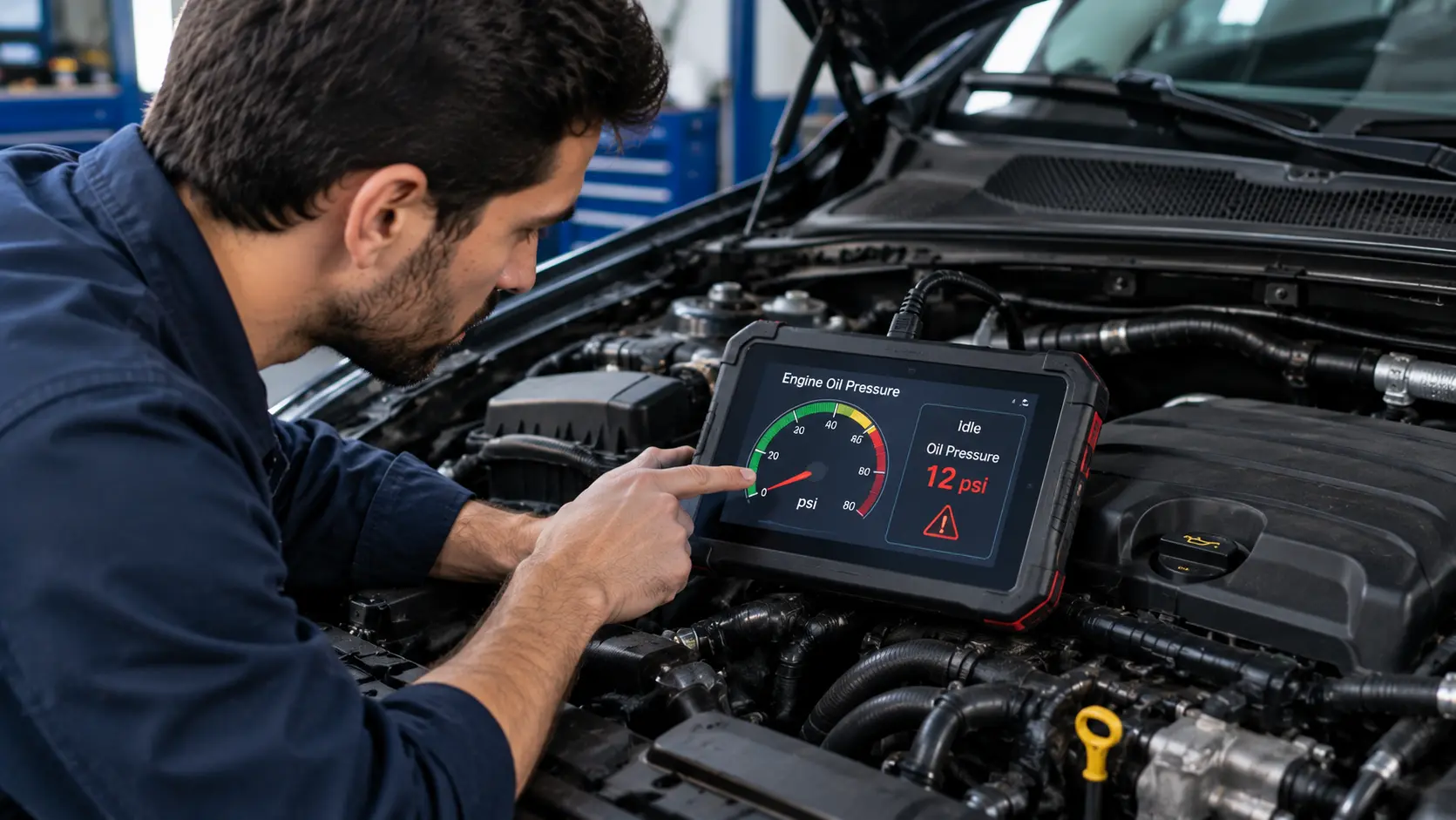
The key test is a mechanical oil pressure gauge. The mechanic removes the pressure sensor and screws a calibrated gauge into its port, then reads the real pressure at idle and at about 2,000 to 3,000 rpm with the engine fully warm. Those figures are compared with the manufacturer’s specification.
If the mechanical reading is normal, the fault is in the sensor or wiring. If it is low, the next steps are an oil change with the correct grade, a filter check and, if needed, removal of the sump to inspect the pickup and look for bearing material. Book this testing with an experienced car mechanic near you before replacing any parts.
What Each Oil Pressure Repair Involves
The repair depends on the cause, and the cheapest fixes are often the right ones. A low oil level needs a top up and a check for the leak or oil burning. Old or wrong oil needs an oil and filter change with the correct grade, followed by a retest of the pressure.
A faulty sensor needs replacing, and damaged wiring needs repairing. A clogged pickup needs the sump removed and the screen cleaned or replaced. A worn pump or stuck relief valve needs pump replacement, which may involve the timing cover on some engines.
Worn bearings need the engine opened up. Depending on the damage, the crankshaft may need grinding and new bearings, or the engine may need replacing. Getting the diagnosis right before starting avoids paying for an expensive repair the car did not need.
Is It Safe to Drive With Low Oil Pressure at Idle?
It depends on what the warning is doing. If the red oil light stays on, or comes on while driving, pull over safely and switch off the engine. Driving on can damage the bearings within minutes, turning a simple repair into a replacement engine.
If the light only flickers at idle and goes out above idle, check the oil level as soon as it is safe and book a pressure test within days. Avoid long idling and hard driving until it is checked.
If you are on a highway when the light comes on, do not stop in a live lane. Stopping in the middle of the road because of a breakdown brings a AED 1,000 fine and six black points under Article 98 of the UAE Federal Traffic Law. Get to the hard shoulder or the nearest exit, switch off and call roadside assistance. The car should then go on a flatbed tow truck, not be driven.
Can a Mobile Mechanic Check Oil Pressure at Home?
Yes, for the first checks. A mechanic visiting your home or office can check the oil level and condition, read fault codes and test the pressure sensor connection. Many can also carry out a mechanical pressure test in a driveway or building car park.
If the oil is low or old, an oil change on site may solve the problem. If the mechanical test shows low pressure with fresh oil, the car needs a workshop for sump removal or engine work. A mobile mechanic can tell you on the spot whether the car is safe to drive to the workshop or needs a flatbed.
Why Does Oil Pressure Drop After a Long Highway Drive?
After a long drive on Emirates Road or the highway to Abu Dhabi, the oil is at its hottest and thinnest. When you then slow down and idle in city traffic, pressure is at its lowest point. A small drop compared with a cold idle is normal.
A large drop, or a warning light that only appears after long drives, points to oil that is too thin, overdue for a change or diluted with fuel. It can also point to early wear in the pump or bearings. A pressure test with the engine fully hot, straight after a long drive, gives the most useful reading.
How to Prevent Oil Pressure Problems in Dubai
Most oil pressure problems start with oil that is low, old or the wrong grade. Check the oil level every two weeks or before long drives, and top up with the grade in your owner’s manual. Change the oil and filter at the interval your manufacturer lists for severe conditions, because heat, dust and stop and start traffic count as severe in most service books.
Use a quality filter that matches your engine, and fix leaks early before they drain the sump. Avoid long periods of idling with the AC on full when you can, and let a turbocharged engine idle for 30 to 60 seconds after hard driving so the turbo can cool.
A regular car service in Dubai covers the oil, the filter and a check of seals and gaskets. If you have already seen the oil light flicker, choose a car garage near you that tests with a mechanical gauge before replacing parts.
FAQ
Here are the questions Dubai drivers most often ask about oil pressure at idle.
Is low oil pressure at idle normal?
Some drop at idle is normal, because the oil pump turns slower and hot oil is thinner. Most engines stay above about 20 psi at a warm idle. A red warning light, a reading lower than usual or a ticking noise is not normal and needs testing.
Why does my oil light flicker at idle?
The most common causes are low oil level, old or thin oil, and a faulty pressure sensor. A worn oil pump or blocked pickup can also cause it. Check the oil level first, then book a test with a mechanical pressure gauge.
Can thin oil cause low oil pressure?
Yes. Oil that is too thin, overdue for a change or diluted with fuel slips through bearing gaps too easily and lowers pressure, especially when hot. Use the grade in your owner's manual and change it at the severe conditions interval.
How much does an oil pressure fix cost?
It depends on the cause. An oil and filter change costs about AED 150 to 400 in the UAE, according to DubiCars. A sensor is usually a smaller job, while pump or bearing repairs cost far more. A pressure test identifies the cause first.
Will low oil pressure damage my engine?
Yes, if it is truly low. Without enough pressure, the oil film breaks down and metal rubs on metal, which can damage the bearings within minutes. If the red oil light stays on, switch off the engine and arrange a tow.
Conclusion
A small engine oil pressure drop at idle is normal, especially in Dubai heat and traffic. A red light, a reading lower than usual or a ticking engine is not. Check the oil level first, then have the real pressure measured with a mechanical gauge so the cause is found before any parts are replaced.
Rapid Rev Garage is a full workshop open 24 hours at Al Khail Gate, 12th Street, Al Quoz Industrial Area 2, serving passenger cars across Al Quoz, Business Bay, Jumeirah, Al Barsha, Satwa, Downtown and the Sheikh Zayed Road corridor. Visit https://rapidrevgarage.com, send your car model and symptoms on WhatsApp, or get directions on Google Maps.
Rapid Rev Garage | Engine Oil Pressure Drop at Idle | Al Quoz, Dubai