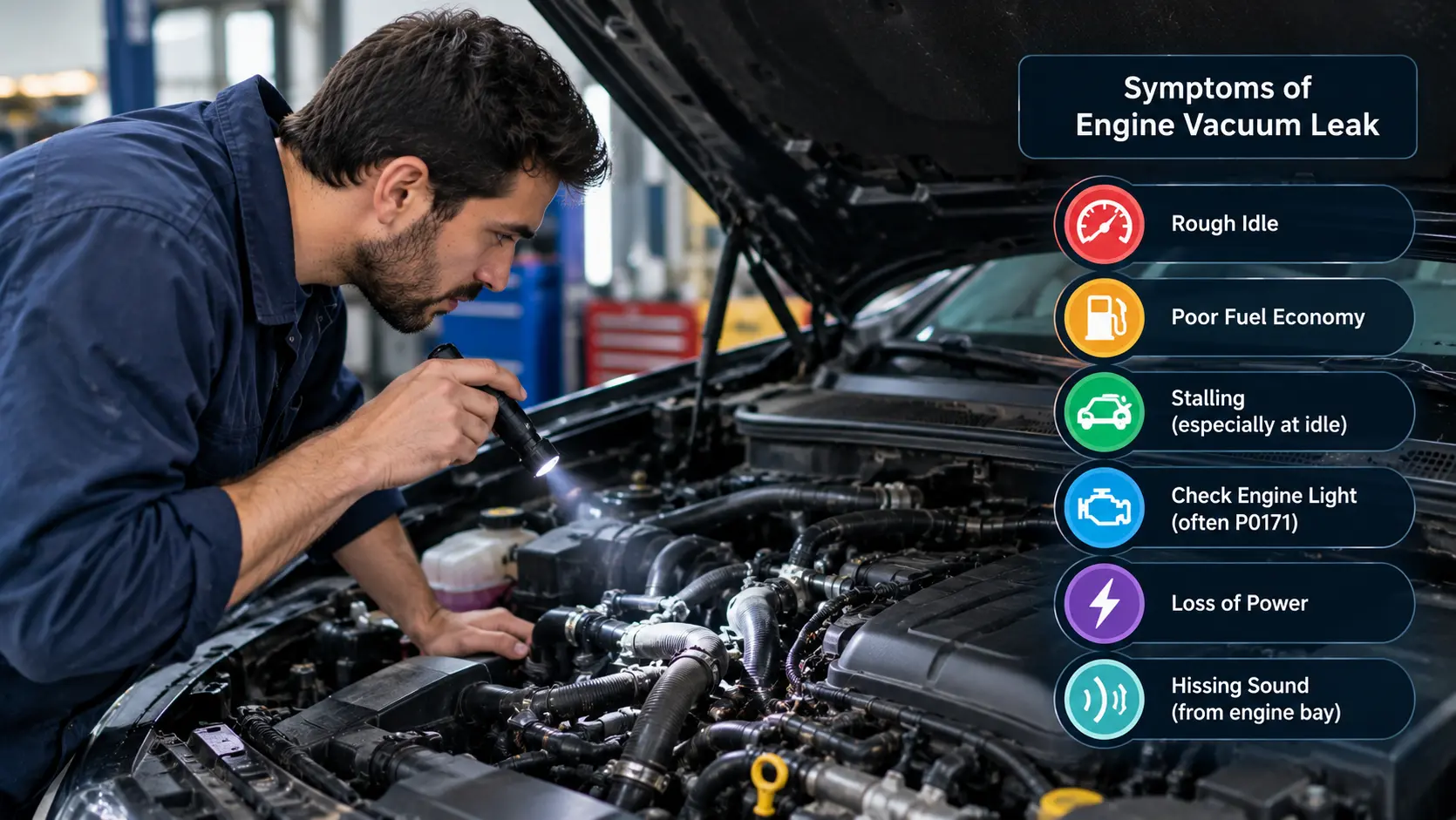
The engine idles unevenly at the lights near Mall of the Emirates, you hear a faint hiss under the bonnet, and the check engine light comes on with a code that says the engine is running lean. These are classic symptoms of engine vacuum leak problems, and they are far more common in Dubai than most drivers expect.
Heat is the reason. Rubber hoses, intake boots and gaskets harden and crack faster when engine bays bake in summer traffic and open car parks. A crack the width of a hair lets in air the engine computer never measured, and the engine stops running the way it should.
This guide explains what a vacuum leak is, the symptoms to watch for, where leaks usually hide, how a workshop finds them with a smoke test and fuel trim readings, and what the repair involves. It also covers faults that look like vacuum leaks but are not, so you do not pay for the wrong repair.
Symptoms of Engine Vacuum Leak: Quick Answer
The main symptoms of engine vacuum leak faults are a rough or high idle, a hissing or whistling sound from the engine, a check engine light with lean codes P0171 or P0174, hesitation when accelerating, stalling when you stop, a hard brake pedal and higher fuel use.
Leaks usually come from cracked vacuum hoses, a split air intake boot, a faulty PCV valve or hose, a leaking intake manifold gasket or a torn brake booster diaphragm. A workshop confirms the leak with fuel trim readings on a scan tool and a smoke test, which shows smoke escaping from the exact spot.
Table of Contents
- What an Engine Vacuum Leak Is
- Why Vacuum Leaks Are So Common in Dubai
- Rough or Unstable Idle
- High Idle Speed or Surging RPM
- Hissing or Whistling From the Engine
- Check Engine Light With Lean Codes P0171 or P0174
- Hesitation, Weak Acceleration and Stalling
- Hard Brake Pedal From a Brake Booster Leak
- Higher Fuel Use and Engine Knock
- Where Vacuum Leaks Usually Hide
- Faults That Look Like a Vacuum Leak
- How a Workshop Finds a Vacuum Leak
- What Vacuum Leak Repairs Involve
- Is It Safe to Drive With a Vacuum Leak?
- Can You Find a Vacuum Leak Yourself?
- How to Prevent Vacuum Leaks in Dubai
- FAQ
- Conclusion
What an Engine Vacuum Leak Is
A vacuum leak is any opening that lets air into the engine after it has passed the mass airflow sensor. When a petrol engine runs, its pistons create suction, called vacuum, in the intake manifold. That vacuum also powers the brake booster and draws gases through the PCV system.
The engine computer, or ECU, uses the mass airflow sensor to measure how much air enters and adds the right amount of fuel to match. Air that sneaks in through a crack is never measured. The mixture ends up with too much air and too little fuel, which is called running lean.
The ECU tries to correct this by adding extra fuel, which shows up as fuel trim on a scan tool. A small leak can be hidden by this correction. A larger one goes beyond what the ECU can fix and causes the symptoms below.
Why Vacuum Leaks Are So Common in Dubai
Rubber and plastic parts in the engine bay age faster in UAE heat. Engine bay temperatures climb far above the outside air in stop and start traffic on Sheikh Zayed Road, and on a summer afternoon when the air passes 45°C, the engine bay of a car in an open car park gets hotter still.
Each heat cycle makes rubber a little harder and less flexible. Cars parked in underground car parks at places like Dubai Mall go from a cool basement to hot roads several times a day, which speeds up the cracking. Once a hose is hard, engine vibration and the shake from speed bumps every 200 to 400 metres on residential streets open up small cracks.
Dust adds to the problem. Fine silica dust from Al Quoz industrial roads and construction sites can work its way into loose clamps and joints and wear the sealing surfaces of intake parts.
Rough or Unstable Idle
A rough idle is the most common sign of a vacuum leak. The engine shakes, the rpm needle wavers and you feel vibration through the steering wheel and seats while stopped at the lights. Samarins lists rough idle among the main symptoms of a lean engine caused by vacuum leaks.
The idle suffers most because vacuum is highest when the throttle is closed. At idle, the engine draws only a small amount of air, so extra air from a leak makes up a large share of the total. At higher speeds, the same leak is a much smaller share, which is why the car may drive normally on the highway.
A leak near one cylinder can make that cylinder misfire, which makes the shake worse. The check engine light may flash or store a misfire code alongside the lean code.
High Idle Speed or Surging RPM
Some vacuum leaks make the idle speed higher instead of rough. Extra air reaching the engine can raise the rpm to well above normal, sometimes to 1,200 rpm or more on a warm engine that should idle around 700 to 800 rpm.
Other cars surge, with the rpm rising and falling every few seconds as the ECU tries to correct the mixture. You may notice it most when the AC switches on, because the idle control system is already working hard.
A high idle also makes automatic cars creep forward more strongly at the lights, which drivers often notice in slow moving traffic on Al Khail Road before they notice anything else.
Hissing or Whistling From the Engine
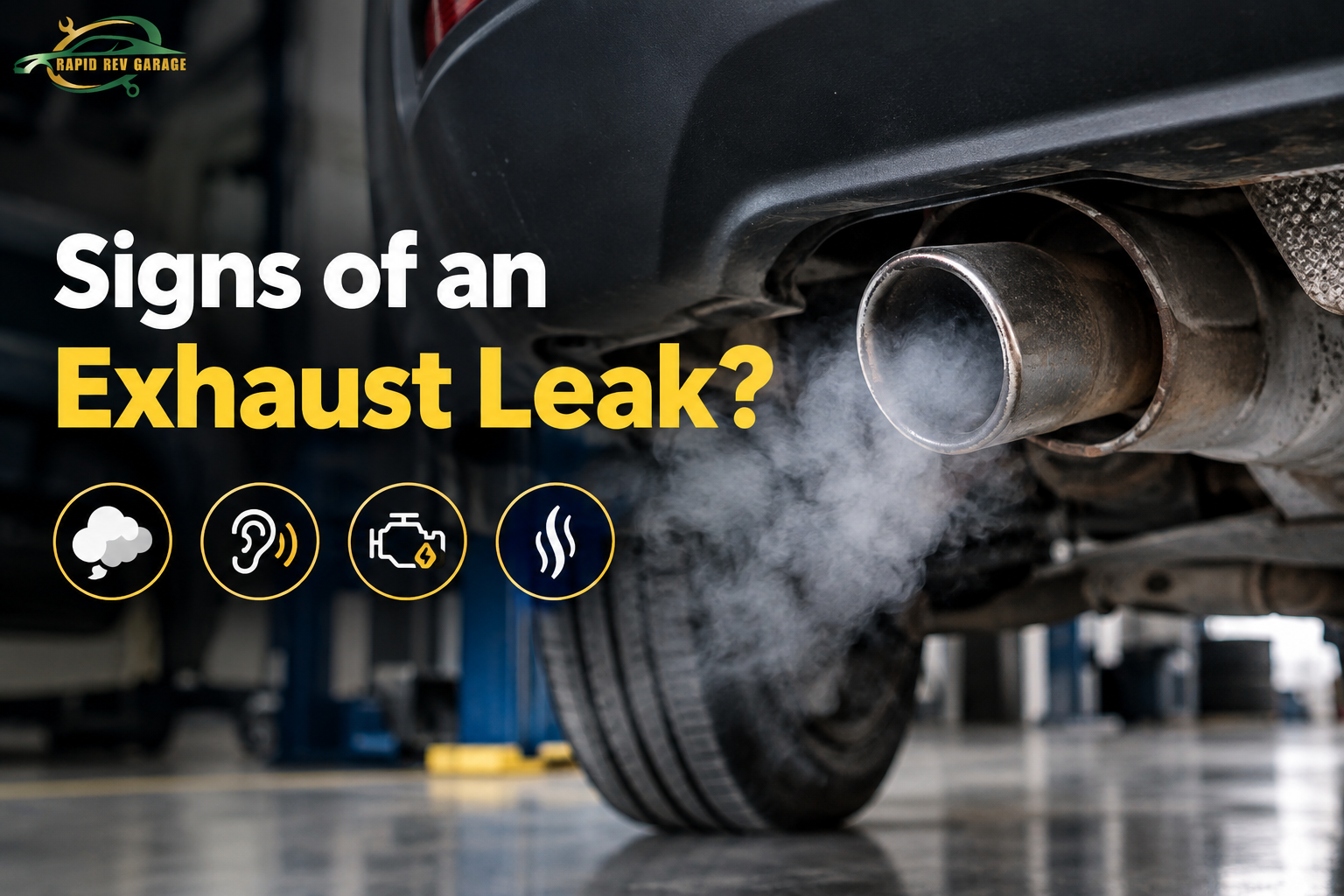
A hiss or whistle from under the bonnet with the engine running is a strong clue. Air rushing through a small crack makes a high pitched sound, much like air escaping from a tyre valve. Samarins lists a hissing noise among the signs of a vacuum leak.
The sound is often loudest at idle and may change when you press the brake pedal, because the brake booster draws vacuum. Listening carefully around the intake manifold, the hoses and the brake booster with the engine running can sometimes point to the area.
In a noisy car park, the hiss can be hard to hear. Never put your hands near the drive belts or the cooling fan when listening for a leak, because the fan can start without warning.
Check Engine Light With Lean Codes P0171 or P0174
A check engine light with code P0171 or P0174 is one of the most reliable signs of a vacuum leak. P0171 means bank 1 is running lean, and P0174 means bank 2 is running lean. On V6 and V8 engines, both codes together usually point to a leak that affects the whole intake, such as a split intake boot.
Samarins explains that the lean code usually sets when fuel trim exceeds about plus 25 percent. Rick’s Free Auto Repair Advice names a cracked intake boot as one of the most common causes of P0171 and P0174, especially when it opens up under vacuum.
Lean codes do not always mean a vacuum leak, though. A dirty mass airflow sensor, low fuel pressure or clogged injectors can set the same codes, which is why testing matters before replacing parts.
Hesitation, Weak Acceleration and Stalling
A lean engine often hesitates when you press the accelerator. The car feels flat pulling away from the lights or joining the highway, and it may stumble before picking up speed. Samarins notes that a lean engine may lack power and may stall when stopped.
Stalling happens most often when you slow to a stop, because the idle is already unstable. The car may restart straight away and run normally until the next stop. Our guide on what causes a car to stall on the road covers the other faults that cause the same symptom.
Starting can also get harder, especially on a warm engine. The ECU has to guess the mixture before the sensors settle, and a leak throws that guess off.
Hard Brake Pedal From a Brake Booster Leak
A brake pedal that feels hard and needs more force to stop the car can point to a vacuum leak in the brake booster or its hose. The booster uses engine vacuum to multiply the force of your foot. Rick’s Free Auto Repair Advice lists a torn brake booster diaphragm among the causes of lean codes.
You may also hear a hiss from under the dashboard when you press the pedal, and the idle may dip or change each time you brake. Because this affects braking, it needs checking straight away. A brake system inspection tests the booster, its check valve and the hose.
If the booster or master cylinder is replaced, brake fluid must be kept off the bodywork, because it strips paint quickly and leaves damage that needs paint and panel repair.
Higher Fuel Use and Engine Knock
A vacuum leak can raise fuel use because the ECU keeps adding extra fuel to correct the lean mixture, and because the engine runs less efficiently. Many drivers notice they are filling up more often before they notice any other symptom.
A lean mixture also burns hotter. Samarins notes that a lean engine can knock under load or when accelerating uphill. Knock, also called pinging, sounds like light metallic tapping and can damage pistons if it continues. Driving up the ramps of multi storey car parks or overtaking on the highway can bring it on.
If you hear knocking along with any other symptom on this list, get the car checked soon rather than waiting for the next service.
Where Vacuum Leaks Usually Hide
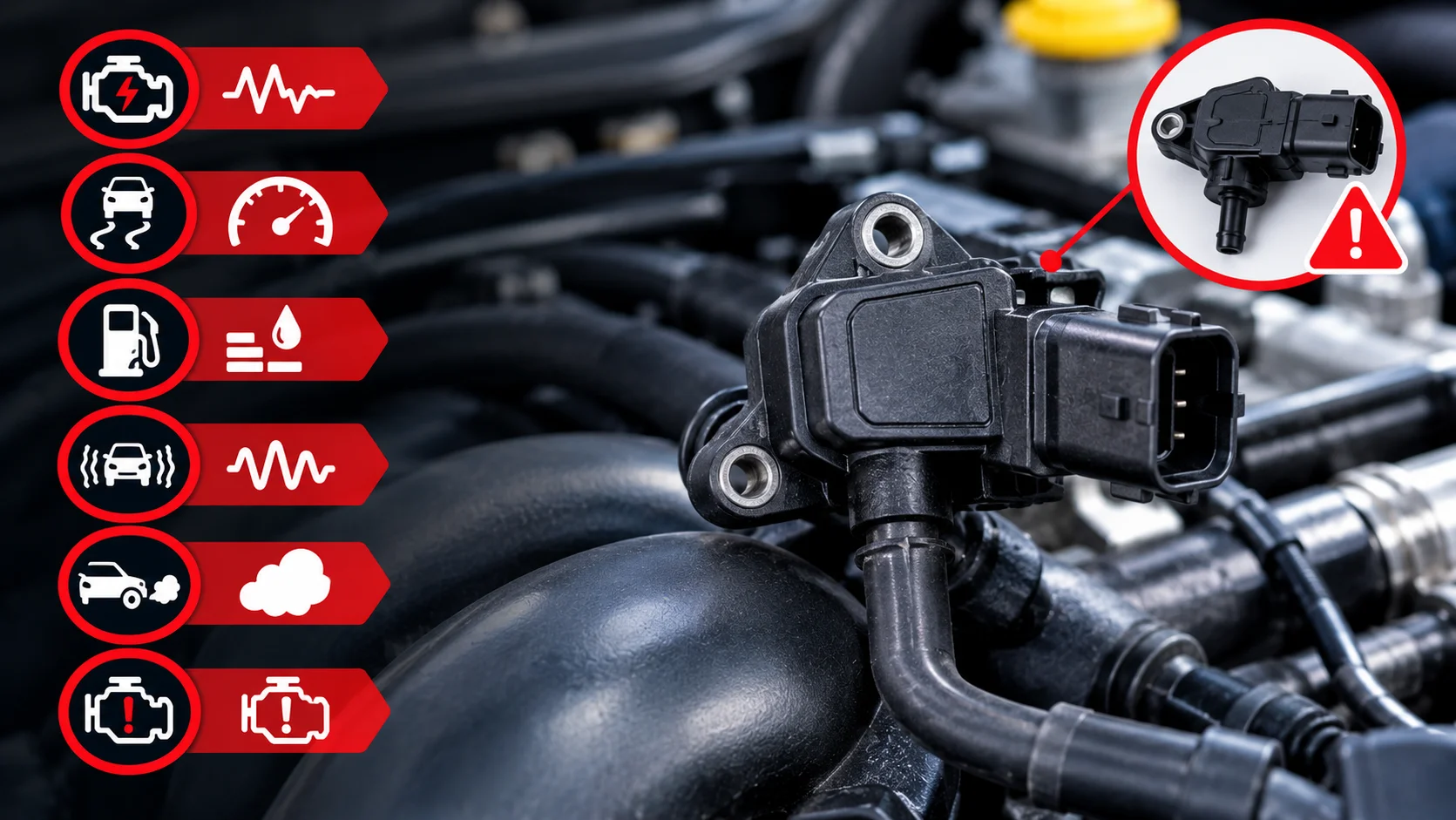
Vacuum leaks usually come from the same few parts. Samarins lists cracked or disconnected vacuum lines, a ripped intake boot, leaking intake manifold gaskets, a stuck or faulty PCV valve and a ripped PCV hose as common sources.
The air intake boot is the rubber tube between the mass airflow sensor and the throttle body. Its folds crack with age and heat, often on the underside where they are hard to see. A boot that is not seated properly after an air filter change can also leak.
The PCV system routes crankcase gases back into the intake, and its hoses and valve are frequent culprits. Intake manifold gaskets can shrink and leak as they age, and Rick’s Free Auto Repair Advice notes rubber O ring types are prone to shrinking. Other leak points include the brake booster hose, EVAP purge valve hoses and plastic intake manifolds that crack around their mounting points.
Faults That Look Like a Vacuum Leak
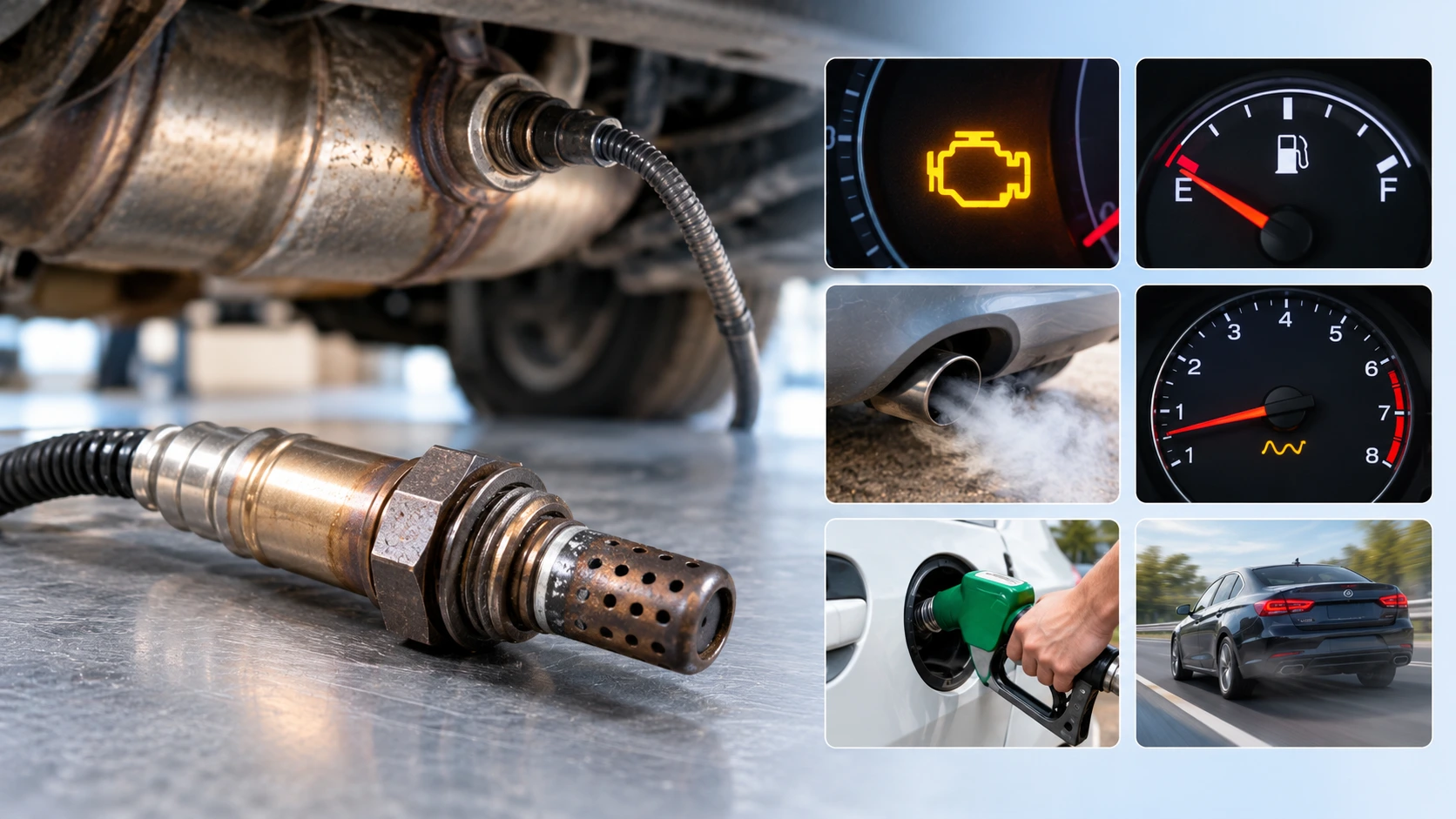
Several faults cause the same symptoms, and replacing hoses will not fix them. A dirty mass airflow sensor under reads the air entering the engine, so the ECU adds too little fuel. Rick’s Free Auto Repair Advice gives a rule of thumb of about 1 gram per second of airflow per litre of engine size at idle, so a 2.0 litre engine should read about 2 grams per second.
Low fuel pressure from a weak pump or clogged filter, and clogged injectors, also make the engine run lean. Exhaust leaks before the oxygen sensor can fool it into reading lean. A dirty throttle body or failing idle control can cause rough or surging idle without any leak at all.
Rick’s Free Auto Repair Advice suggests comparing fuel trims at idle and at about 2,500 rpm. A vacuum leak usually shows high trim at idle that drops at higher rpm, while a fuel delivery problem often gets worse under load.
How a Workshop Finds a Vacuum Leak
A proper diagnosis starts with a scan tool, not a guess. The mechanic reads stored fault codes, then watches live data with the engine warm. Samarins explains that if short term fuel trim rises above plus 15 to 20 percent at idle but drops at higher rpm, a vacuum leak is the most likely cause. Normal trims sit close to zero.
The mechanic also checks the mass airflow reading against the expected figure for the engine size, which helps rule out a dirty sensor. A visual check covers the intake boot, the hoses, the PCV system and the clamps.
The most reliable test is a smoke test. A machine fills the intake with harmless, visible vapour at low pressure while the engine is off. The smoke escapes from the exact spot that is leaking, even from cracks too small to see. Book this testing with an experienced car mechanic near me so the leak is found before any parts are changed.
What Vacuum Leak Repairs Involve
Most vacuum leak repairs are quick and inexpensive once the leak is found. A cracked vacuum hose is cut out and replaced, and a split intake boot is swapped for a new one. A faulty PCV valve and its hoses can usually be replaced in under an hour on many engines.
Intake manifold gaskets take longer, because the manifold has to be removed. On some V6 and V8 engines, that means several hours of work. A cracked plastic intake manifold usually needs replacing rather than repairing, and an engine repair specialist can confirm whether a manifold or gasket is at fault.
After the repair, the mechanic clears the codes, checks that fuel trims return close to zero and runs a road test. On some cars, an idle relearn with the scan tool is needed so the idle settles at the correct speed.
Is It Safe to Drive With a Vacuum Leak?
A small vacuum leak with a slightly rough idle is not an emergency, but it should be fixed soon. Driving for long periods with a lean engine can cause knock, overheating of the catalytic converter and stalling at junctions.
Some symptoms need action straight away. A hard brake pedal, stalling in traffic or a flashing check engine light means the car should be checked before you drive it far.
If the car stalls on a highway, do not stop in a live lane. Stopping in the middle of the road because of a breakdown brings a AED 1,000 fine and six black points under Article 98 of the UAE Federal Traffic Law. Get to the hard shoulder and call roadside assistance.
If the car still drives safely, a mobile mechanic can read the codes and fuel trims at your home or office and tell you whether it can be driven to the workshop for a smoke test.
Can You Find a Vacuum Leak Yourself?
You can do some simple checks, but a smoke test is far more reliable. With the engine off and cool, look along every rubber hose for cracks, splits or loose ends, and check the intake boot by squeezing its folds gently. Check that the clamps are tight and the hoses are fully pushed on.
With the engine running, listen for hissing around the intake and the brake booster hose. Keep your hands well away from the belts and the fan. Some people spray water or carb cleaner near suspected leaks and listen for a change in idle, but carb cleaner is flammable and should never be sprayed near hot exhaust parts.
A cheap OBD2 reader can show stored codes. Fuel trim readings need a scan tool that shows live data, and a smoke test needs proper equipment, so most drivers save time by booking a test.
Does a Vacuum Leak Affect the AC?
On many cars, a vacuum leak makes the idle unstable enough that it dips or stalls when the AC compressor switches on. The ECU raises the idle slightly to carry the AC load, and a lean engine with a leak may not have enough power to do it smoothly.
Some older cars also use vacuum to move the AC vent flaps, so a leak can make air come out of the wrong vents. If your idle drops or the car stalls only when the AC runs, ask for both a vacuum leak test and an AC system check, because a seizing compressor can cause the same symptom.
How to Prevent Vacuum Leaks in Dubai
You cannot stop rubber from ageing, but you can catch cracks early. Ask for the hoses, intake boot and PCV system to be inspected at every service, especially once the car is more than five years old. Replace hard or cracked hoses before they split.
Make sure the intake boot and clamps are refitted properly after any work on the air filter or throttle body. Use covered or shaded parking where you can, which keeps the engine bay cooler between drives. Avoid pressure washing the engine bay, which can loosen connections.
A regular car service in Dubai includes these checks along with oil, filters and fluids. If you already have a rough idle or a lean code, choose a car garage near you that confirms the leak with a smoke test before replacing parts.
FAQ
Here are the questions Dubai drivers most often ask about engine vacuum leaks.
What does a vacuum leak sound like?
It usually sounds like a hiss or a high pitched whistle from under the bonnet, loudest at idle. A leak in the brake booster can hiss from under the dashboard when you press the pedal. Small leaks may make no sound at all, so a smoke test is more reliable.
Can a vacuum leak cause a misfire?
Yes. Extra unmeasured air can make the mixture too lean for one or more cylinders to fire properly, especially at idle. The check engine light may show a lean code such as P0171 alongside a misfire code. Fixing the leak usually clears the misfire.
How do mechanics find a vacuum leak?
They read fuel trims on a scan tool, then run a smoke test. Short term fuel trim above about plus 15 to 20 percent at idle that drops at higher rpm points to a leak. The smoke test shows vapour escaping from the exact spot.
Is a vacuum leak expensive to fix?
Usually not. Most leaks come from a hose, an intake boot or a PCV valve, which are low cost parts and quick jobs. Intake manifold gaskets cost more, because the manifold has to come off. Testing first stops you paying for parts you do not need.
Will a vacuum leak drain my battery?
No. A vacuum leak affects the air and fuel mixture, not the charging system. It can make the car harder to start and cause stalling, which some drivers mistake for a battery fault. A battery and alternator test rules out an electrical cause.
Conclusion
A rough or high idle, a hissing sound, lean codes P0171 or P0174, hesitation, stalling at stops and a hard brake pedal are the signs to watch for. In Dubai, heat and engine bay temperatures crack rubber hoses and intake boots faster, so these leaks show up sooner than in cooler places. Fuel trim readings and a smoke test find the leak before any parts are replaced.
Rapid Rev Garage is a full workshop open 24 hours at Al Khail Gate, 12th Street, Al Quoz Industrial Area 2, serving passenger cars across Al Quoz, Business Bay, Jumeirah, Al Barsha, Satwa, Downtown and the Sheikh Zayed Road corridor. Visit https://rapidrevgarage.com, send your car model and symptoms on WhatsApp, or get directions on Google Maps.
Rapid Rev Garage | Symptoms of Engine Vacuum Leak | Al Quoz, Dubai