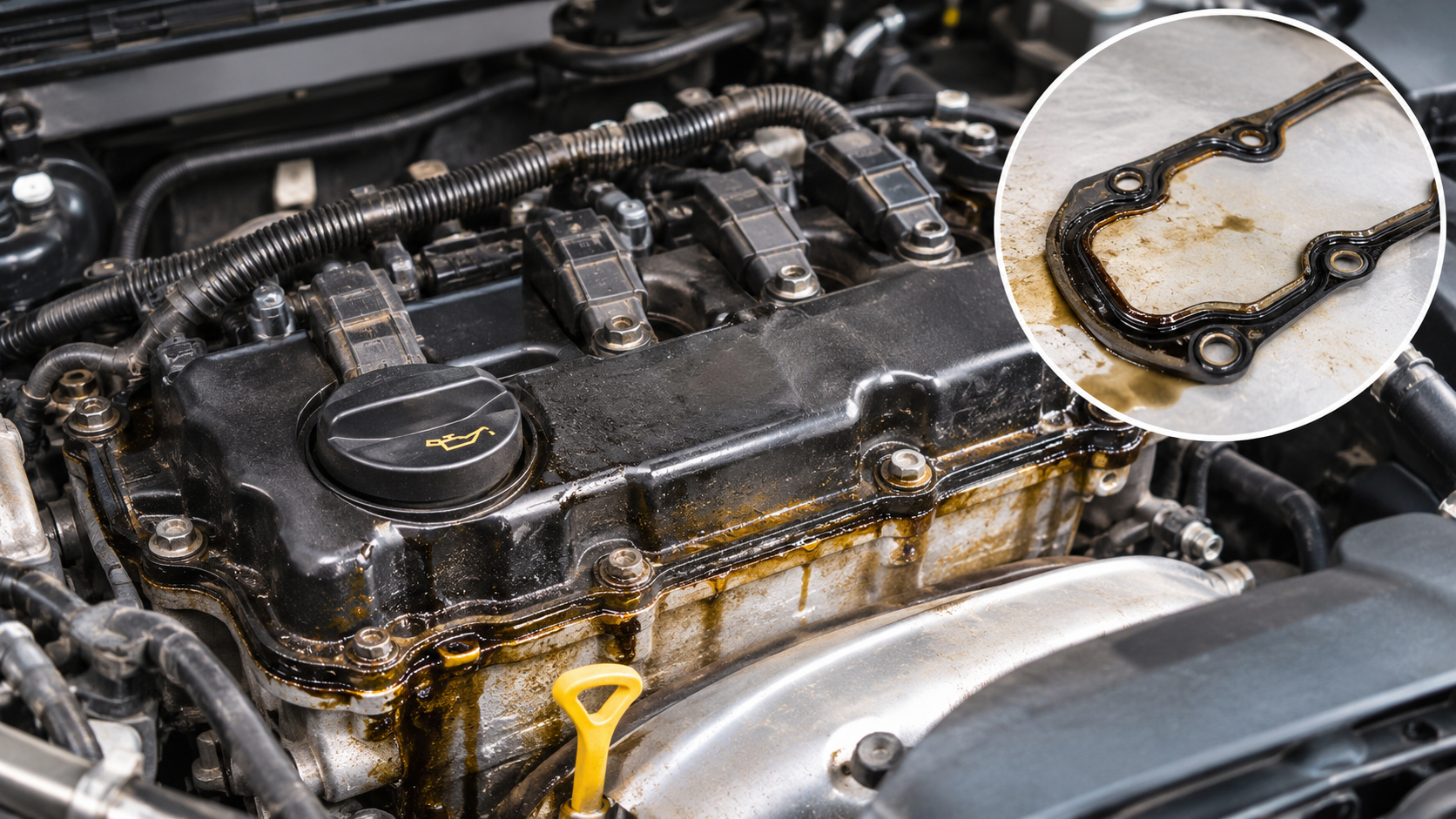
A burning smell drifts through the AC vents after you park in your building basement in Business Bay. The top of the engine looks dark and dusty, and the oil level is lower than it was a few weeks ago. These are some of the most common symptoms of bad valve cover gasket wear, and they usually start small.
The valve cover gasket seals the top of the engine. When it hardens and cracks, oil seeps out onto hot parts, into the spark plug wells and down the sides of the engine. Left alone, a small seep can turn into misfires, damaged ignition coils, low oil and even a fire risk.
This guide explains each warning sign, what causes it, how to check your own engine, how a mechanic confirms the leak and what replacement involves. If you already know the cover is leaking and want to know why, the companion guide on oil leaking from the valve cover covers the root causes.
Symptoms of Bad Valve Cover Gasket: Quick Answer
The main symptoms of bad valve cover gasket failure are a burning oil smell, oil and caked dust around the edge of the valve cover, smoke from the engine bay, oil in the spark plug wells, engine misfires and rough running, a falling oil level and oil drips under the car.
Some engines also show a rough idle from a vacuum leak at the cover, or a squealing belt where oil has run onto it. A mechanic confirms the leak by cleaning the engine, adding UV dye and tracing fresh oil to its source. The gasket set is then replaced along with any oil soaked parts.
Table of Contents
- What the Valve Cover Gasket Does
- Burning Oil Smell After Driving
- Oil and Caked Dust Around the Valve Cover
- Smoke From the Engine Bay
- Oil in the Spark Plug Wells
- Engine Misfires and Rough Running
- Falling Oil Level Between Services
- Oil Drips Under the Car
- Rough Idle From a Vacuum Leak at the Cover
- Squealing Belt or Oil on the Alternator
- Why Valve Cover Gaskets Fail Faster in Dubai
- How to Check Your Valve Cover Gasket Yourself
- How a Mechanic Confirms a Valve Cover Gasket Leak
- What Valve Cover Gasket Replacement Involves
- How Long Does a Valve Cover Gasket Last?
- Can a Bad Valve Cover Gasket Damage the Engine?
- Is It Safe to Drive With a Leaking Gasket?
- FAQ
- Conclusion
What the Valve Cover Gasket Does
The valve cover gasket seals the joint between the valve cover and the cylinder head. Under the cover, oil is pumped over the camshafts and valve parts the whole time the engine runs. The gasket keeps that oil inside.
Most modern gaskets are moulded rubber or silicone strips that sit in a groove around the cover. Many sets also include spark plug tube seals, which keep oil out of the spark plug wells. Older engines may use cork gaskets with metal covers.
When the gasket is new, its soft rubber presses into the gap and seals it. As it ages, it hardens, shrinks and cracks, and oil starts to escape. The symptoms below show where that oil goes.
Burning Oil Smell After Driving
A burning oil smell is often the first sign drivers notice. YourMechanic explains that when the gasket fails, oil drips onto the cylinder head, the intake or the exhaust, and these hot parts burn it.
The smell is strongest after a drive, when you stop and the engine is at its hottest. Because the AC draws air in through the cowl just in front of the windscreen, the smell often comes through the vents into the cabin. Drivers commonly notice it after parking in an enclosed basement, where the smell lingers.
A burning smell can also come from a coolant leak, a slipping clutch or overheated brakes. Oil smoke has a sharp, acrid smell, while coolant smells sweet. A quick look under the bonnet for wet oil on the exhaust side helps narrow it down.
Oil and Caked Dust Around the Valve Cover
A dirty, oily valve cover edge is one of the clearest signs. YourMechanic notes that oil collects dirt and debris under the bonnet and appears caked onto the valve cover or cylinder head.
In Dubai, fine silica dust from Al Quoz industrial roads and building sites sticks to any oily film within days. The leak shows up as a dark, crusty line along the joint between the cover and the head, often thickest at the rear corners and around the timing cover end.
The rear of the engine is hard to see on many cars, especially those with engine covers. Removing the plastic engine cover and using a torch often shows a leak that is invisible from above.
Smoke From the Engine Bay
Light smoke rising from under the bonnet after a drive or at idle often means oil is landing on the exhaust manifold. The smoke is usually bluish white and smells of burnt oil.
This symptom needs quick attention. SlashGear reports that General Motors recalled hundreds of thousands of vehicles in 2015 because oil leaking onto the exhaust manifold could start engine fires. Khaleej Times listed fluid leaks through the engine and missed maintenance among the reasons vehicles catch fire in UAE summers.
If you see heavy smoke or flames, pull over safely, switch off the engine, get everyone out and call 999. Do not open the bonnet if you see flames, because fresh air feeds the fire.
Oil in the Spark Plug Wells
On many engines, the spark plugs sit in tubes that pass through the valve cover, sealed by rubber tube seals. When these seals harden, oil leaks into the wells and pools around the spark plugs and the bottom of the ignition coils.
You often cannot see this without removing the coils. A mechanic pulling a coil and finding the boot wet with oil, or a pool of oil around the plug, is a sure sign the tube seals have failed. On engines with plug leads, the leads may feel oily at the plug end.
Oil in the wells softens the rubber coil boots and can crack them. The spark then leaks to the side of the well instead of reaching the plug, which leads straight to the next symptom.
Engine Misfires and Rough Running
Misfires are a common result of oil in the plug wells. YourMechanic explains that oil seeping into the spark plug wells can cause misfires. The engine shakes at idle, hesitates when accelerating and may feel weak climbing the ramps of multi storey car parks.
The check engine light often comes on with misfire codes, such as P0300 for random misfires or P0301 to P0304 for a specific cylinder. A flashing check engine light means the misfire is severe enough to damage the catalytic converter, so the car should not be driven far.
Fixing the misfire means replacing the tube seals and any coils or boots that oil has damaged. An ignition coil and electrical check confirms which coils still work properly.
Falling Oil Level Between Services
A steady drop in oil level between services can come from a gasket leak. YourMechanic notes that as oil keeps leaking from a faulty gasket, the oil level drops, which can trigger the oil warning light and reduce the engine’s ability to lubricate itself.
Check the dipstick every two weeks with the engine cold and the car on flat ground. If you are topping up regularly and see no blue smoke from the exhaust, an external leak is more likely than oil burning inside the engine.
Running low on oil is far more damaging than the leak itself. The guide on why oil pressure falls at idle explains how low oil level leads to low oil pressure and bearing wear.
Oil Drips Under the Car
Fresh drips on the floor of your parking bay often start at the top of the engine. Oil from the valve cover runs down the side of the cylinder head and the engine block, then drips from the lowest point, which may be the sump, the gearbox or the subframe.
Because oil travels so far, a drip under the car does not always mean the sump gasket is leaking. Many drivers replace a sump gasket only to find the drips continue because the real source is the valve cover.
Placing a piece of cardboard under the engine overnight shows how much oil is dropping and roughly where. Take a photo of it to show your mechanic.
Rough Idle From a Vacuum Leak at the Cover
On some engines, a failed valve cover gasket can let air in as well as oil out. YourMechanic notes that if the leak is bad enough it can cause a vacuum leak, especially on turbocharged or supercharged engines.
This happens because the crankcase is connected to the intake through the PCV system. Air entering at a cracked gasket or cover is unmeasured, so the engine runs lean. The symptoms are a rough or high idle and lean codes such as P0171.
Engines with the PCV valve built into the valve cover are most prone to this. The guide on the symptoms of an engine vacuum leak explains how a smoke test finds air leaks around the cover.
Squealing Belt or Oil on the Alternator
On engines where the valve cover leaks at the front, oil can run down onto the drive belt, the pulleys and the alternator. An oily belt slips on its pulleys and squeals, especially when the AC switches on or the engine is first started.
Oil on the alternator can also get inside it and shorten its life. A slipping belt may stop charging the battery properly or turn the water pump more slowly.
If you hear a new squeal and see oil on the belt, the belt needs replacing after the leak is fixed. Fitting a new belt without fixing the leak just soaks the new one.
Why Valve Cover Gaskets Fail Faster in Dubai
Heat is the main reason rubber gaskets harden. Long idling in stop and start traffic on Sheikh Zayed Road and Al Khail Road keeps engine temperatures high with little cooling airflow, while the AC adds load to the engine.
On a summer afternoon when the air passes 45°C, engine bay temperatures climb much higher. Cars that move between cool underground car parks and hot roads several times a day go through more heat cycles, and each cycle takes some flexibility out of the rubber.
Short trips add another problem. Engines that never fully warm up collect moisture and sludge, which can block the PCV valve. The guide on symptoms of a bad PCV valve explains how the resulting crankcase pressure pushes oil past the gasket.
How to Check Your Valve Cover Gasket Yourself
You can do a simple check with the engine cold. Remove the plastic engine cover if your car has one, and use a torch to look along the joint between the valve cover and the cylinder head. Look for wet oil, dark crusty dust and drips at the rear corners.
Check the oil filler cap and the area around it, because a worn cap seal can look like a gasket leak. Look at the exhaust manifold side of the engine for burnt oil stains. Check the dipstick and note the level.
Do not use harsh degreasers to clean the engine bay yourself, and keep them off the paintwork, because strong solvents can dull clear coat and lead to paint and panel repair. Never touch the exhaust manifold, which stays hot long after the engine stops.
How a Mechanic Confirms a Valve Cover Gasket Leak
A mechanic first cleans the top and sides of the engine so fresh oil can be traced. Oil runs downhill, so the visible wet spot is often below the real leak.
Many workshops add UV dye to the engine oil, run the engine to working temperature and check it with a UV lamp. The dye glows at the exact point where oil escapes. The mechanic also removes the ignition coils to check for oil in the plug wells and tests the PCV system, because crankcase pressure can cause the leak.
A scan with an OBD2 tool shows any misfire or lean codes. Book this inspection with an experienced car mechanic near you so the gasket, tube seals, coils and PCV valve are all checked in one visit.
What Valve Cover Gasket Replacement Involves
Replacement starts by removing the engine cover, ignition coils, wiring, hoses and any brackets on top of the valve cover. On some V6 and V8 engines, part or all of the intake manifold must come off to reach the rear cover, which adds labour.
The old gasket and tube seals are removed, the sealing surfaces are cleaned, and a new gasket set is fitted. Sealant is applied only at the points listed in the workshop manual, usually where the cover meets the timing cover. The bolts are tightened to the specified torque in the correct sequence.
Any coils, boots or plug leads damaged by oil are replaced. If the cover is cracked or warped, or the gasket is bonded to it, the full cover is replaced. On engines with a complex top end, an engine repair specialist can quote the labour before work begins.
How Long Does a Valve Cover Gasket Last?
There is no fixed lifespan, because heat, oil change intervals and the PCV system all affect it. Many gaskets start to harden after several years, and in UAE heat that process is faster than in cooler climates.
A good habit is to have the valve cover area checked at every service once the car passes five years or about 100,000 km. A gasket that shows early seepage can be replaced at a planned time rather than after it causes misfires or a burning smell.
Changing the oil at the severe conditions interval in your service book also protects the gasket, because old oil carries more sludge that can block the PCV system. An oil change on schedule is one of the simplest ways to slow gasket wear.
Can a Bad Valve Cover Gasket Damage the Engine?
The leak itself rarely damages the engine directly, but what it leads to can. A falling oil level can starve the engine of oil and damage the bearings. Oil in the plug wells ruins ignition coils and causes misfires that can overheat the catalytic converter.
Oil on the drive belt can make it slip and fail. Oil on the exhaust can start a fire. Each of these costs far more than a gasket set, which is why early repair makes sense.
Oil soaked rubber also ages faster. Hoses, engine mounts and wiring insulation below a long running leak can soften and crack, so a mechanic replacing the gasket should check the parts underneath it as well. Catching the leak early keeps that list of extra parts short.
Is It Safe to Drive With a Leaking Gasket?
A light seep with no smell, no smoke and a steady oil level can usually wait for a planned repair. Check the oil level every week until it is fixed.
A leak that causes smoke, a strong burning smell, misfires or a quickly falling oil level needs fixing straight away. If smoke appears while driving on a highway, get to the hard shoulder rather than stopping in a live lane, which brings a AED 1,000 fine and six black points under Article 98 of the UAE Federal Traffic Law. Switch off and call roadside assistance.
If the car is parked at home and still runs normally, a mobile mechanic can check the oil level and the leak before you drive it anywhere. A regular car service in Dubai catches gasket seepage early, and a car garage near you with UV dye equipment can confirm the exact source.
FAQ
Here are the questions Dubai drivers most often ask about valve cover gaskets.
What does a leaking valve cover smell like?
It smells like sharp, acrid burnt oil, usually strongest after driving when you stop. The smell often comes through the AC vents. A sweet smell points to coolant instead, so check under the bonnet to see which fluid is leaking.
Can a valve cover gasket cause misfires?
Yes. When the spark plug tube seals fail, oil fills the plug wells and softens the ignition coil boots. The spark leaks to the side instead of reaching the plug, causing misfires and codes such as P0300 to P0304.
How do I spot a valve cover leak?
Look for wet oil and caked dust along the edge of the valve cover, burnt oil stains on the exhaust side and oil around the spark plugs. A mechanic confirms the exact source with UV dye and a clean engine.
Is a leaking valve cover gasket serious?
A light seep is not urgent, but it gets worse over time. A leak that drips onto the exhaust can cause smoke and a fire risk, and a falling oil level can damage the engine. Book a repair once you notice it.
Will a valve cover leak cause low oil?
Yes, if it continues. Oil escapes steadily from a failed gasket, and the level falls between services. Check the dipstick every two weeks and top up with the correct grade until the gasket is replaced.
Conclusion
The common signs of a failing valve cover gasket are a burning oil smell, oil and caked dust around the cover, smoke from the engine bay, oil in the spark plug wells, misfires, a falling oil level, drips under the car, a rough idle and a squealing belt. Dubai heat hardens these gaskets faster, so checking the cover at each service catches the leak early.
Rapid Rev Garage is a full workshop open 24 hours at Al Khail Gate, 12th Street, Al Quoz Industrial Area 2, serving passenger cars across Al Quoz, Business Bay, Jumeirah, Al Barsha, Satwa, Downtown and the Sheikh Zayed Road corridor. Visit https://rapidrevgarage.com, send your car model and a photo of the leak on WhatsApp, or get directions on Google Maps.
Rapid Rev Garage | Symptoms of Bad Valve Cover Gasket | Al Quoz, Dubai