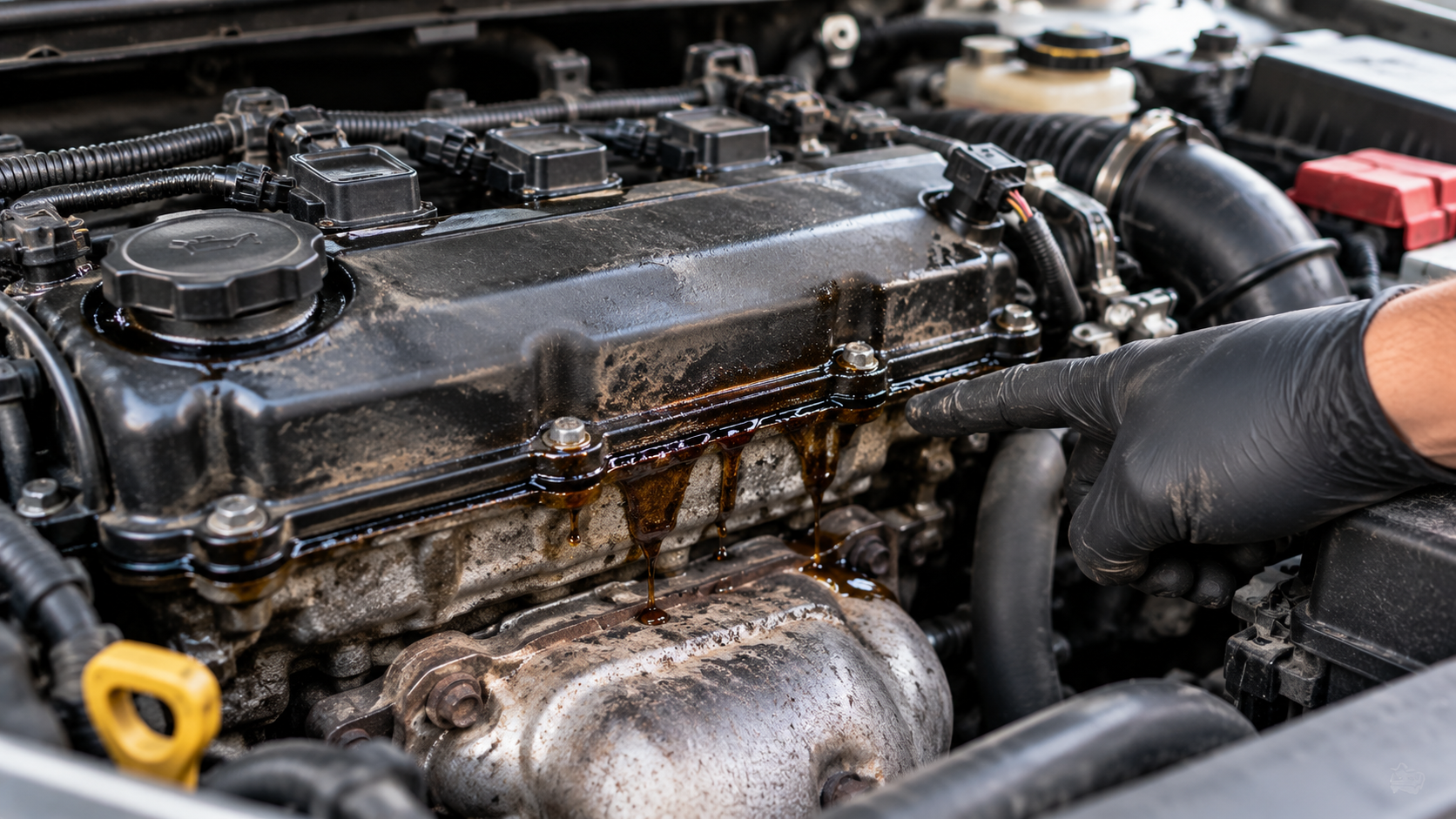
You lift the bonnet and see a dark, oily line running along the top of the engine, with dust caked onto it. Maybe there is a faint burning smell after a drive along Sheikh Zayed Road, or a few drops on the floor of your parking bay. Oil leaking from the valve cover is one of the most common engine leaks in Dubai, and most drivers assume the gasket is the only cause.
The gasket is often to blame, but not always. Loose or overtightened bolts, a cracked cover, worn spark plug tube seals and a blocked PCV valve all push oil out from the same area. Replacing the gasket without finding the real cause can leave you with the same leak a few months later.
This guide explains what the valve cover does, the main reasons it leaks, why UAE heat speeds up the problem, how a mechanic confirms the source and what each fix involves. If you want to check the warning signs first, the companion guide on symptoms of a bad valve cover gasket covers those in detail.
Oil Leaking From the Valve Cover: Quick Answer
Oil leaking from the valve cover usually comes from a valve cover gasket that has hardened or shrunk after years of heat cycles. Other causes include loose or overtightened bolts, a cracked or warped cover, worn spark plug tube seals, a leaking oil filler cap seal, sealant failing at the joints and a blocked PCV valve building pressure inside the engine.
A mechanic cleans the area, adds UV dye or runs the engine and traces the leak to its highest point. The fix may be a new gasket set with tube seals, a new cover, correct bolt torque or a PCV repair. Leaks that drip onto the exhaust manifold create a fire risk and need fixing straight away.
Table of Contents
- What the Valve Cover and Its Gasket Do
- Hardened or Shrunk Valve Cover Gaskets
- Loose Bolts or Bolts Tightened Too Hard
- Cracked or Warped Valve Covers
- Worn Spark Plug Tube Seals
- Leaking Oil Filler Caps and Cam Plugs
- Failed Sealant at the Corners and Joints
- A Blocked PCV Valve Pushing Oil Out
- Overfilled Engine Oil
- Why Dubai Heat Makes Valve Covers Leak Sooner
- Why a Valve Cover Leak Can Start a Fire
- How a Mechanic Finds the Real Leak Source
- What Each Valve Cover Repair Involves
- Can You Drive With Oil Leaking From the Valve Cover?
- Do Stop Leak Additives Fix Valve Cover Leaks?
- How to Stop the Leak Coming Back
- FAQ
- Conclusion
What the Valve Cover and Its Gasket Do
The valve cover sits on top of the cylinder head and closes in the camshafts, valve springs and rocker arms. Oil is pumped up to these parts constantly while the engine runs, and it splashes around under the cover before draining back to the sump.
The valve cover gasket seals the joint between the cover and the cylinder head. On most modern engines, it is a moulded rubber or silicone strip that sits in a groove around the edge of the cover. Many engines also have spark plug tube seals in the same set, which stop oil reaching the spark plug wells.
Older engines often use metal covers with cork or rubber gaskets. Many newer engines use plastic or aluminium covers, and some build the PCV valve and oil separator into the cover itself. Each design has its own weak points.
Hardened or Shrunk Valve Cover Gaskets
A gasket that has hardened, shrunk or cracked is the most common cause of a valve cover leak. Rubber gaskets are soft and flexible when new, which lets them press into the gap and seal it. Every time the engine heats up and cools down, the rubber loses a little flexibility.
After enough heat cycles, the gasket becomes hard and flat. It no longer springs back to fill the gap, and oil seeps past, usually at the corners and the rear of the engine first. YourMechanic notes that a leaking gasket has often broken, been pinched or been fitted incorrectly.
The leak usually starts as a damp, dusty film and slowly grows into drips. On many engines, it runs down the back of the cylinder head toward the exhaust or the gearbox, where it is hard to see from above.
Loose Bolts or Bolts Tightened Too Hard
Valve cover bolts must be tightened to a specific torque in a specific order. If they are too loose, the cover does not press the gasket evenly, and oil escapes through the gaps. Heat cycles and engine vibration can also loosen bolts over time.
Tightening bolts too hard causes a different problem. It crushes the gasket, squeezes it out of its groove and can crack a plastic cover or bend a thin metal one. A common mistake is trying to stop a leak by cranking the bolts down harder, which often makes it worse.
Most workshop manuals give a low torque figure for valve cover bolts and a tightening sequence that starts in the middle and works outward. Following that sequence presses the gasket evenly along its full length.
Cracked or Warped Valve Covers
A cracked or warped cover will leak even with a brand new gasket. Plastic covers become brittle after years of heat and can crack around the bolt holes, the oil filler neck and the edges. Aluminium covers can warp if the engine has overheated.
Cracks often start at a bolt hole where the bolt was overtightened at some point. On engines with the PCV valve built into the cover, the plastic around the PCV housing is another common crack point.
A cracked or warped cover needs replacing. A mechanic checks a metal cover for flatness on a flat surface before deciding whether it can be reused. Fitting a new gasket to a warped cover only wastes the gasket.
Worn Spark Plug Tube Seals
On many engines, the spark plugs sit in tubes that pass through the valve cover. Round seals around each tube stop oil from reaching the spark plug wells. When these seals harden, oil leaks into the wells and pools around the spark plugs.
YourMechanic explains that oil seeping into the spark plug wells can cause misfires. Oil softens the rubber boots on ignition coils and plug leads, which lets the spark jump to the side instead of reaching the plug. The engine may shake, lose power and set misfire codes.
Tube seals are usually included in a full valve cover gasket set. If oil is found in the plug wells, the coils should be checked for damage too, and an ignition and electrical check confirms whether any coils need replacing.
Leaking Oil Filler Caps and Cam Plugs
Not every leak on the top of the engine comes from the gasket. The oil filler cap has its own rubber seal, which hardens and shrinks over time. A worn cap seal lets oil mist escape and leaves a wet patch around the cap that spreads across the cover.
Some engines also have cam plugs or half moon seals at the ends of the cylinder head, where the camshafts sit. These seals harden like any other rubber and can leak at the rear of the engine. Variable valve timing solenoids mounted in the cover or head have their own O rings that can leak too.
A new filler cap is one of the cheapest fixes on any engine. That is why a mechanic checks these smaller seals before assuming the whole gasket needs replacing.
Failed Sealant at the Corners and Joints
Many engines need a small dab of silicone sealant where the valve cover meets the timing cover or cam caps. These corner joints are where the gasket has to bridge a step between two separate parts.
If the sealant was missed, applied too thickly or used past its shelf life during an earlier repair, the corners leak first. Too much sealant can also squeeze into the engine and block small oil passages.
A correct repair cleans off all old sealant, applies the type and amount listed in the workshop manual, and fits the cover within the working time of the sealant. Getting this step right decides whether the leak comes back.
A Blocked PCV Valve Pushing Oil Out
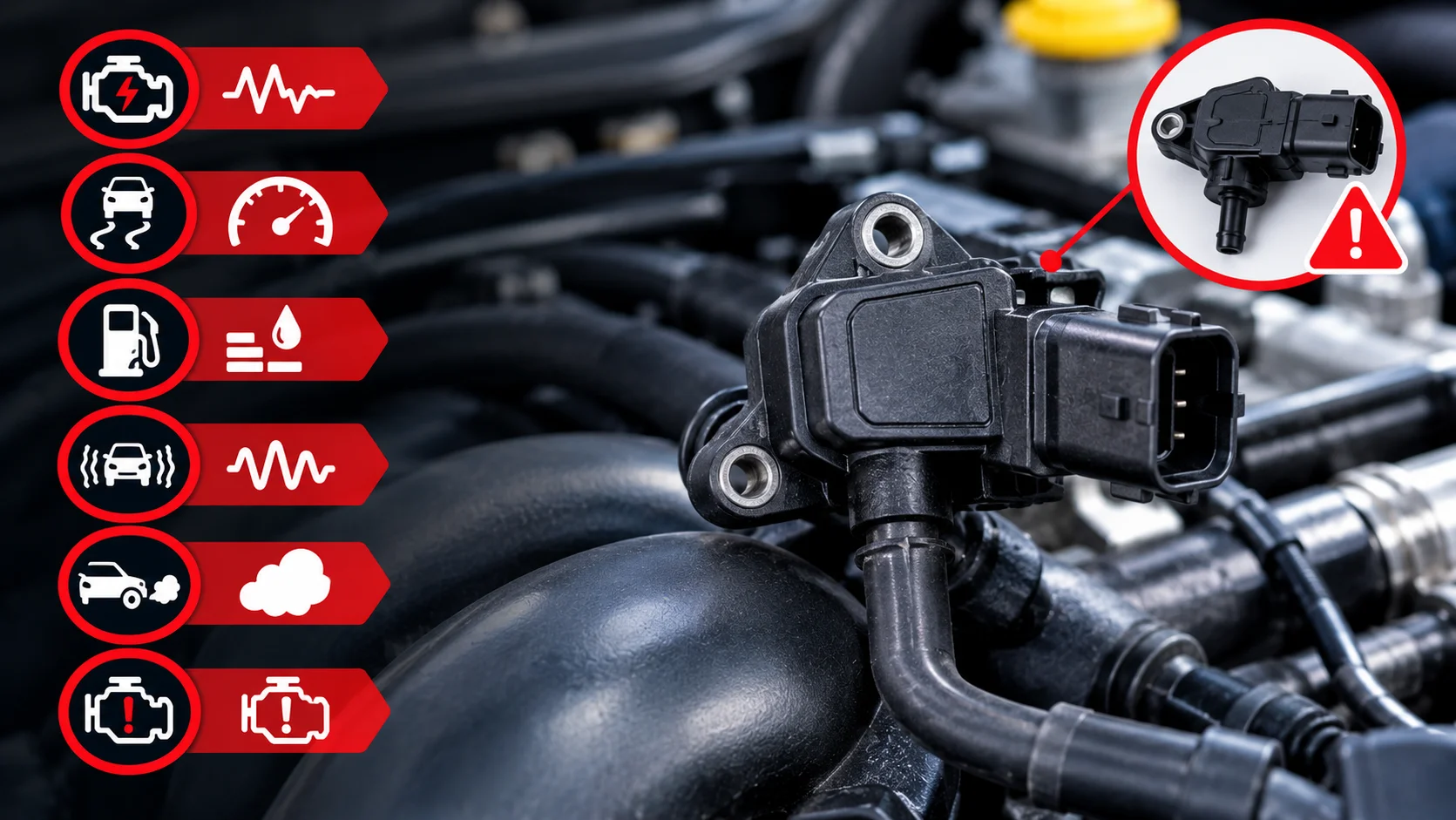
A blocked PCV valve is one of the most overlooked causes of valve cover leaks. The PCV system draws gases out of the crankcase using engine vacuum. When the valve blocks, pressure builds inside the engine and pushes oil past the weakest seal.
Brake and Front End magazine explains that a failing PCV system can cause ruptured gaskets and seals and oil in the air cleaner. On many engines, the valve cover gasket is one of the first seals to give way under that pressure.
Replacing the gasket without fixing the PCV valve means the new gasket will be under the same pressure. The guide on symptoms of a bad PCV valve explains how to test the system before any gasket work is done.
Overfilled Engine Oil
Too much oil in the sump can push oil past seals and gaskets. When the oil level is above the maximum mark, the spinning crankshaft can whip the oil into foam, and crankcase pressure rises.
Overfilling often happens when a driver tops up without waiting for the oil to drain back to the sump, or after an oil change where the level was not checked on flat ground. Check the dipstick with the engine off for a few minutes and the car parked on level ground.
If the level is well above the maximum mark, have the extra oil drained. An oil change done properly includes a final level check on flat ground with the engine settled.
Why Dubai Heat Makes Valve Covers Leak Sooner
Heat is the main reason rubber gaskets harden, and Dubai engines see more heat than most. Long idling in stop and start traffic on Al Khail Road keeps the engine hot with little cooling airflow, while the AC compressor adds load.
On a summer afternoon when the air passes 45°C, engine bay temperatures climb much higher. Cars parked in underground car parks at places like Dubai Mall go from a cool basement to hot roads several times a day, and each cycle hardens the rubber a little more.
Fine silica dust from Al Quoz industrial roads sticks to any oily film on the engine. That makes even a small leak look worse and hides the exact source, so a proper clean is needed before diagnosis.
Why a Valve Cover Leak Can Start a Fire
A valve cover leak becomes dangerous when oil drips onto the exhaust manifold. The exhaust manifold sits close to the cylinder head on many engines and gets hot enough to burn oil. A small amount causes smoke and a burning smell, while a larger leak can ignite.
This risk is real. SlashGear reports that General Motors recalled hundreds of thousands of vehicles in 2015 because oil leaking onto the exhaust manifold could start engine fires. In the UAE, Khaleej Times listed fluid leaks through the engine and lack of regular maintenance among the reasons vehicles catch fire in summer, and reported that Dubai Police attended 94 vehicle fires in the first four months of 2022.
An engine bay fire can destroy wiring, hoses and the bonnet’s paint, leading to engine work as well as paint and panel repair. If you see smoke from under the bonnet, pull over safely, switch off the engine, get everyone out and call 999.
How a Mechanic Finds the Real Leak Source
Oil runs downhill and spreads, so the wet spot you see is often below the real leak. A proper diagnosis starts by cleaning the top and sides of the engine with a degreaser, so fresh oil can be traced to where it starts.
The mechanic then runs the engine to working temperature and looks for the highest point where fresh oil appears. Many workshops add a UV dye to the engine oil and check the engine with a UV lamp, which makes the leak glow and shows its exact source.
The mechanic also checks the oil filler cap, the spark plug wells, the PCV system and crankcase pressure, and the oil level. Book this inspection with an experienced car mechanic near me so the right part is replaced the first time.
What Each Valve Cover Repair Involves
A gasket replacement means removing everything on top of the cover, which may include the engine cover, ignition coils, wiring, hoses and on some V6 and V8 engines the intake manifold. The old gasket is removed, the sealing surfaces are cleaned, and a new gasket set with tube seals is fitted.
The bolts are tightened to the correct torque in the correct order, and sealant is applied only where the manual specifies. Any oil soaked coil boots or plug leads are checked and replaced if damaged. On engines where the gasket comes bonded to the cover, the full cover is replaced.
A cracked or warped cover is replaced as a unit. A blocked PCV valve is replaced before the new gasket goes on. On engines where the valve cover sits under the intake manifold, an engine repair specialist can quote the extra labour before work starts.
Can You Drive With Oil Leaking From the Valve Cover?
A small seep that leaves a damp film but no drips is not an emergency. Check the oil level every week and book a repair at your next convenient time. Keep the level between the minimum and maximum marks.
A leak that drips onto the exhaust, causes a burning smell, sends smoke from the engine bay or drops the oil level quickly needs fixing straight away. Running the engine low on oil can damage the bearings and lower oil pressure, which the guide on why oil pressure falls at idle explains in more detail.
If smoke appears while you are driving on a highway, do not stop in a live lane. Stopping in the middle of the road because of a breakdown brings a AED 1,000 fine and six black points under Article 98 of the UAE Federal Traffic Law. Get to the hard shoulder, switch off and call roadside assistance.
Do Stop Leak Additives Fix Valve Cover Leaks?
Stop leak additives work by making rubber seals swell slightly. They can slow a very small seep from a seal that has only just started to harden, but they cannot fix a cracked cover, a pinched gasket, loose bolts or a blocked PCV valve.
Once a gasket is hard and flat, an additive will not restore it. Some products can also change how the oil performs, so check that any additive is compatible with the oil grade in your owner’s manual.
Additives are at best a short term measure until the car can be repaired. A leak that drips onto the exhaust should always be repaired properly, not treated with an additive.
How to Stop the Leak Coming Back
Most repeat leaks happen because the cause was not fixed the first time. Make sure the PCV valve is tested, the bolts are tightened to the correct torque and the sealant is applied where the manual says.
Use a quality gasket set that includes the spark plug tube seals, and replace the oil filler cap if its seal is hard. Keep the oil level between the marks, and change the oil at the severe conditions interval in your service book, because heat, dust and stop and start traffic count as severe in most schedules.
A regular car service in Dubai includes a check of gaskets, seals and the PCV system. If the leak has already started, a mobile mechanic can check the oil level and look for drips at your home, and a car garage near me can trace the source with dye and fit the right parts.
FAQ
Here are the questions Dubai drivers most often ask about valve cover oil leaks.
What causes oil to leak from valve covers?
The most common cause is a gasket that has hardened or shrunk with heat. Other causes are loose or overtightened bolts, a cracked cover, worn spark plug tube seals, a leaking filler cap seal, failed corner sealant and a blocked PCV valve building pressure.
Is a valve cover leak dangerous?
It can be. A small seep is not urgent, but oil dripping onto the exhaust manifold can smoke and catch fire. General Motors recalled hundreds of thousands of cars in 2015 over this risk. Fix any leak that causes smoke or a burning smell straight away.
Can tightening valve cover bolts stop leaks?
Only if the bolts are loose, and only to the specified torque in the correct order. Overtightening crushes the gasket and can crack plastic covers, which makes the leak worse. A hard or shrunk gasket needs replacing, not more bolt pressure.
Why does my new valve cover gasket leak?
Common reasons are a blocked PCV valve building pressure, bolts tightened unevenly or too hard, missing or excess sealant at the corners, or a warped or cracked cover. Ask the workshop to check these before fitting another gasket.
Will oil leaks affect my RTA inspection?
Visible oil leaks can be noted during a vehicle inspection, and leaks that drip onto hot parts are a safety risk. Fixing the leak before your registration renewal inspection avoids a failed test and a second visit.
Conclusion
Oil leaking from the valve cover usually starts with a gasket hardened by heat, but loose or overtightened bolts, cracked covers, worn tube seals, filler cap seals, failed sealant, overfilled oil and a blocked PCV valve can all cause the same leak. Cleaning the engine and tracing the leak with dye finds the real source, and fixing the cause stops it coming back.
Rapid Rev Garage is a full workshop open 24 hours at Al Khail Gate, 12th Street, Al Quoz Industrial Area 2, serving passenger cars across Al Quoz, Business Bay, Jumeirah, Al Barsha, Satwa, Downtown and the Sheikh Zayed Road corridor. Visit https://rapidrevgarage.com, send your car model and a photo of the leak on WhatsApp, or get directions on Google Maps.
Rapid Rev Garage | Oil Leaking From the Valve Cover | Al Quoz, Dubai