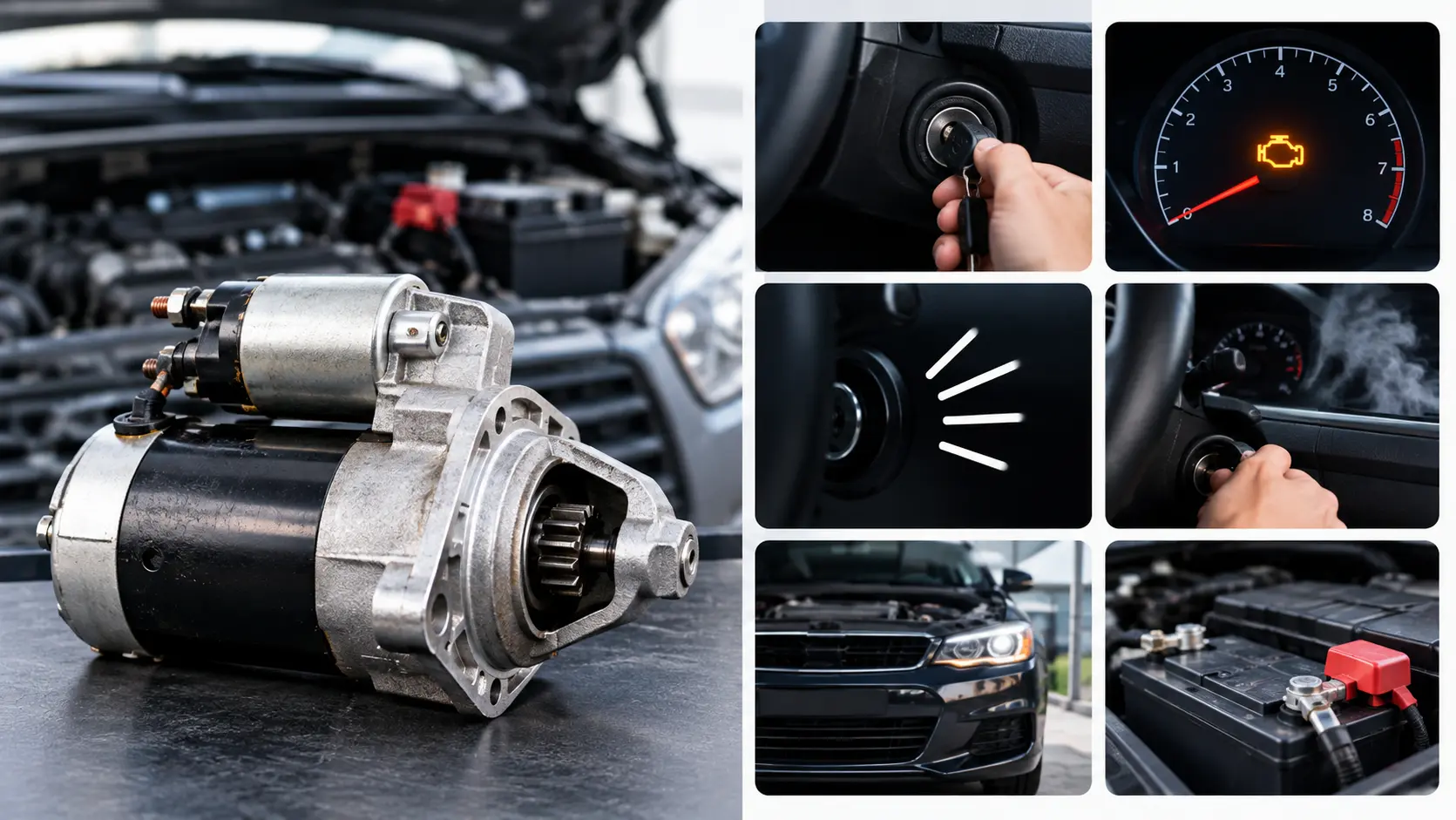
You press the start button in the basement at Ibn Battuta, hear a single click and nothing else. Or the engine turns over slowly, groans and finally catches. These are some of the most common bad starter motor symptoms, but they are also signs of a weak battery or a corroded cable. Telling them apart saves you from buying a starter you did not need.
The starter motor is a small, powerful electric motor that turns the engine until it fires. It draws a huge current for a few seconds every time you start the car. Any weakness in the battery, the cables, the solenoid or the motor itself shows up at that moment.
This guide explains how the starting system works, the warning signs of a failing starter, why Dubai heat affects it, how a workshop tests it, and what repair or replacement involves.
Bad Starter Motor Symptoms: Quick Answer
The main bad starter motor symptoms are a single click with no cranking, slow or laboured cranking, a grinding noise when starting, the starter spinning without turning the engine, a whirring sound after the engine starts, intermittent starting and smoke or a burning smell from under the car.
Rapid clicking usually points to the battery or a poor connection, not the starter. Proform notes that a corroded ground strap causes more no crank problems than actual starter failures. A mechanic tests the battery, cleans the connections and measures voltage at the starter during cranking before replacing it.
Table of Contents
- How the Starting System Works
- Why Starters and Batteries Struggle in Dubai
- A Single Click With No Cranking
- Rapid Clicking When You Try to Start
- Slow or Laboured Cranking
- Grinding Noise When Starting
- Starter Spins but the Engine Does Not Turn
- Whirring After the Engine Starts
- Intermittent Starting Problems
- Smoke or a Burning Smell
- Starter Problems on Start Stop Cars
- Battery or Starter: How to Tell the Difference
- How a Workshop Tests a Starter Motor
- What Starter Motor Repair Involves
- Is It Safe to Keep Jump Starting the Car?
- How to Protect the Starting System
- Why Does My Car Start Fine Cold but Not Hot?
- Can a Bad Ground Strap Stop the Car Starting?
- FAQ
- Conclusion
How the Starting System Works
When you turn the key or press the start button, a small current flows to the starter solenoid. The solenoid does two jobs. It pushes a small gear, called the pinion, forward to mesh with the ring gear on the engine’s flywheel, and it closes heavy contacts that send full battery current to the starter motor.
The motor then spins the flywheel, which turns the engine. Once the engine fires and runs on its own, you release the key, the solenoid pulls the pinion back and the starter stops.
A one way clutch inside the starter stops the running engine from spinning the starter too fast. The whole process takes only a second or two, but the starter can draw well over 100 amps while it works.
Why Starters and Batteries Struggle in Dubai
Heat is hard on the whole starting system. UAE car experts quoted by Gulf News say heat speeds up chemical reactions inside the battery and evaporates the electrolyte, so most batteries in the UAE last only a couple of years.
Proform explains that starter motors lose efficiency as they heat up, a problem known as heat soak. The starter sits close to the engine and exhaust, and after a drive on a summer afternoon when the air passes 45°C, it can be very hot. A hot starter cranks more slowly, and a weak starter may not crank at all until it cools.
Short trips add strain. Each start uses a lot of battery power, and a short drive may not fully recharge it. Cars with start stop systems start the engine many more times a day, which wears the starter faster.
A Single Click With No Cranking
A single click with no cranking is a classic starter symptom. Proform explains that the click confirms the solenoid is receiving a start signal, but does not confirm the high current side is healthy.
The click comes from the solenoid moving, but the heavy current never reaches the motor, or the motor is too worn to turn. Proform names a corroded ground as a common cause, and notes that if the voltage at the starter’s main terminal is fine during cranking, the solenoid contacts are the prime suspect.
A single click can also come from a flat battery in some cases. That is why testing the battery and the voltage at the starter comes before any part is replaced.
Rapid Clicking When You Try to Start
Rapid clicking, like a machine gun, is usually a battery or connection problem. Proform states that rapid clicking comes from insufficient current, and is a battery or connection problem almost every time.
The solenoid pulls in, the voltage drops because the battery cannot supply enough current, the solenoid drops out, the voltage recovers and the cycle repeats many times a second. The dashboard lights often dim or flicker at the same time.
Proform advises charging the battery, load testing it and cleaning every starting circuit connection, including the grounds, before replacing any starter part. A battery test and replacement is often the real fix.
Slow or Laboured Cranking
Slow cranking, where the engine turns over heavily before starting, can come from the battery, the cables or the starter. Proform lists heat soak, an undersized starter and a dying motor as starter related causes.
Proform explains that worn brushes and bushings inside the starter cause cranking to slow gradually over months. If cranking is slow only when the engine is hot, heat soak or high resistance in the cables is likely. If it is slow all the time, the battery is the first suspect.
A battery that is two or three years old in UAE heat may test fine with a basic meter but fail under load. A proper load test shows how it performs while cranking.
Grinding Noise When Starting
A grinding noise when you start the car usually means the starter’s pinion gear is not meshing cleanly with the flywheel ring gear. Proform notes that gradual grinding suggests worn pinion teeth and recommends checking the flywheel ring gear too.
Grinding can also happen if you turn the key again while the engine is already running, or if the starter is loose on its mounting bolts. A grinding noise that appears straight after a new starter is fitted can mean the engagement depth is wrong.
Ignoring grinding can damage the flywheel teeth, which is a much bigger repair, because the gearbox may need to come out to replace the flywheel or ring gear.
Starter Spins but the Engine Does Not Turn
If you hear the starter whirring at high speed but the engine does not turn, the pinion is not engaging with the flywheel. Proform points to a worn one way clutch inside the starter as the usual cause.
The motor itself works, but the drive does not grip, so it spins freely. Sometimes it engages on a second or third attempt, which makes the fault easy to dismiss at first.
The fix is usually a new starter or a rebuilt drive assembly. Damaged teeth on the flywheel ring gear can cause the same symptom in one position of the engine, so the ring gear is checked too.
Whirring After the Engine Starts
A whirring or high pitched noise that continues after the engine has started means the starter has not disengaged. The solenoid may be sticking, or the ignition switch may be holding the start circuit on.
This is serious, because the running engine can spin the starter far faster than it is designed for. The starter can overheat and fail, and the flywheel can be damaged.
Switch the engine off if you hear this noise and do not drive until it is checked. A faulty ignition switch or start button circuit can be tested through an auto electrical check.
Intermittent Starting Problems
A car that starts perfectly one day and only clicks the next often has a starter with a dead spot. As the brushes and commutator wear, the motor can stop in a position where it does not make good contact. A tap on the starter body sometimes gets it going, which is a strong sign the motor is failing.
Loose or corroded connections cause intermittent faults too. Heat makes metal expand, so a connection that works when cool may lose contact when hot, or the other way round.
Intermittent faults on push start cars can also come from the key fob, the brake pedal switch or the immobiliser. If the car does not recognise the key, it will not crank. A car key repair check rules this out.
Smoke or a Burning Smell
Smoke or a burning smell from the starter area means it has overheated. This can happen if the starter is cranked for a long time, if it stays engaged after the engine starts, or if a short circuit sends current through it constantly.
Stop trying to start the car if you smell burning, and let the starter cool. Crank in short bursts of no more than 10 to 15 seconds, with a pause between attempts, so the starter does not overheat.
A starter that smokes usually needs replacing, and the cables and solenoid wiring should be checked for damage.
Starter Problems on Start Stop Cars
Many newer cars switch the engine off at the lights and restart it when you lift your foot off the brake. These cars use a heavy duty starter or a belt driven starter generator, and an AGM or EFB battery designed for frequent starts.
In Dubai traffic, a start stop car may restart the engine dozens of times on a single commute along Al Khail Road. If the start stop system stops working, the car may be protecting a weak battery. If restarts feel slow or rough, the starter or battery may be wearing.
Always fit the battery type your car’s manufacturer specifies. A standard battery fitted to a start stop car wears out quickly and can cause starting problems.
Battery or Starter: How to Tell the Difference
Proform advises ruling out the battery and connections first, because they cause most no crank and rapid clicking complaints. Then the voltage at the starter’s main terminal during a crank attempt shows whether the solenoid or the supply is at fault.
Some simple clues help. Dim or flickering dashboard lights when you try to start point to the battery. Bright lights with a single click point to the starter or its connections. A car that starts with a jump start points to the battery, while one that still only clicks with a good jump points to the starter.
Corroded battery terminals cause problems that look like both. Clean, tight terminals and ground straps are the first thing a mechanic checks.
How a Workshop Tests a Starter Motor
A proper test starts with the battery. The mechanic load tests it to see how much voltage it holds under a heavy draw. A battery that drops too low under load cannot spin the starter properly.
Next, the mechanic checks every connection in the starting circuit, including the battery terminals, the main cable to the starter and the engine ground strap. Proform notes that a corroded ground strap causes more no crank problems than starter failures.
Then the mechanic measures the voltage at the starter’s main terminal while someone tries to start the car. Good voltage with no cranking points to the starter or solenoid. Low voltage points to the cables or battery. Book this testing with an experienced car mechanic near you before paying for a new starter.
What Starter Motor Repair Involves
On many cars, the starter is held by two or three bolts and can be reached from underneath. On others, the intake manifold or other parts must come off first, which adds labour time.
The mechanic disconnects the battery, removes the cables and bolts, and fits a new or remanufactured starter. Remanufactured starters are rebuilt units with new wear parts and are a common choice. Some starters can have just the solenoid or drive replaced.
After fitting, the mechanic checks cranking speed, listens for grinding and confirms the starter disengages cleanly. If the flywheel ring gear is damaged, it needs repair first.
The battery terminals and ground strap are cleaned and tightened at the same time. A new starter fitted to corroded cables can still crank slowly, so the whole circuit is checked before the car is handed back.
Is It Safe to Keep Jump Starting the Car?
Jump starting gets you moving, but it does not fix the cause. If the battery is failing, it will keep going flat. If the starter is failing, a jump may not help at all, and repeated jump starts put strain on the charging system.
Connect jump leads carefully, in the correct order, and keep the clamps away from each other. Batteries can release acid and gas, and battery acid on the bodywork damages paint quickly, leading to paint and panel repair.
If the car will not start at home, a mobile mechanic can test the battery and starter in your parking space. If it fails to restart after stalling on a highway, move to the hard shoulder rather than stopping in a live lane, which brings a AED 1,000 fine and six black points under Article 98 of the UAE Federal Traffic Law. Then call roadside assistance.
How to Protect the Starting System
Test the battery every year once it passes two years old, and replace it before summer if it is weak. Keep the battery terminals clean and tight, and have the ground straps checked at services.
Crank in short bursts and let the starter cool between attempts. Do not hold the key in the start position after the engine fires. Park in the shade when you can, so the starter and battery stay cooler.
A regular car service in Dubai includes a battery test and a check of the charging system. If you already hear clicking or slow cranking, choose a car garage near you that tests the whole circuit before replacing the starter.
Why Does My Car Start Fine Cold but Not Hot?
This is a classic sign of heat soak. Proform explains that starter motors lose efficiency as they heat up. After a long drive, the starter sits next to a hot engine and exhaust, and its copper windings resist current more when hot.
A healthy starter still copes. A worn one may crank very slowly, click or do nothing until it cools down. Drivers often find the car will not restart after a short stop at a petrol station or supermarket, then starts fine 30 minutes later.
Hot cables and loose connections add to the problem, because resistance rises with heat. A voltage test at the starter while the engine is hot shows whether the starter or the wiring is at fault. Some cars have a heat shield over the starter, and a missing shield makes heat soak worse.
Can a Bad Ground Strap Stop the Car Starting?
Yes, and it is more common than many drivers think. Proform states that a corroded ground strap causes more no crank problems than actual starter failures.
The starter’s current has to return to the battery through the engine block and the ground strap. If the strap is corroded, loose or broken, the current cannot flow properly, and the starter clicks or turns slowly.
Ground straps are cheap and quick to replace. Engine vibration and the shake from speed bumps every 200 to 400 metres on residential streets can loosen them over time. A mechanic checks them before replacing any starter part.
FAQ
Here are the questions Dubai drivers most often ask about starter motors.
What does a bad starter sound like?
A failing starter often makes a single click with no cranking, a grinding noise as it engages, or a high pitched whirring without turning the engine. Slow, groaning cranking can also come from a worn starter or a weak battery.
Why does my car click but not start?
A single click usually points to the starter solenoid or a poor connection. Rapid clicking almost always points to a weak battery or corroded terminals. Testing the battery and the voltage at the starter tells them apart.
Can heat cause starter problems?
Yes. Starter motors lose efficiency as they heat up, a problem called heat soak. After a hot drive, a worn starter may crank slowly or not at all until it cools. UAE heat also shortens battery life.
How do I know battery or starter?
Dim or flickering lights and rapid clicking point to the battery. Bright lights with a single click point to the starter. If the car starts with a jump, the battery is the likely cause.
Is a starter motor expensive to replace?
It depends on the car. On some engines, the starter is easy to reach, while others need parts removed first. Remanufactured starters cost less than new units. Testing first stops you paying for a starter when the battery is at fault.
Conclusion
A bad starter motor shows up as a single click, slow cranking, grinding, a starter that spins without turning the engine, whirring after starting, intermittent starting and burning smells. Rapid clicking and dim lights usually point to the battery or connections instead. Load testing the battery, cleaning the connections and measuring voltage at the starter confirms the fault before any part is replaced.
Rapid Rev Garage is a full workshop open 24 hours at Al Khail Gate, 12th Street, Al Quoz Industrial Area 2, serving passenger cars across Al Quoz, Business Bay, Jumeirah, Al Barsha, Satwa, Downtown and the Sheikh Zayed Road corridor. Visit https://rapidrevgarage.com, send your car model and symptoms on WhatsApp, or get directions on Google Maps.
Rapid Rev Garage | Bad Starter Motor Symptoms | Al Quoz, Dubai