The car sputters as you climb the ramp onto Sheikh Zayed Road, then picks up again. It cranks longer than usual in the morning, and there is a faint whine from the back seat when you switch on the ignition. These are classic failing fuel pump symptoms, and in the UAE they often appear in summer, when heat and low fuel levels push a tired pump past its limit.
The fuel pump sends petrol from the tank to the engine at a steady pressure. When it weakens, the engine gets less fuel than it needs, first under load and later at idle. Left alone, a weak pump can stop completely and leave you stranded.
This guide explains what the fuel pump does, the warning signs, why Dubai conditions wear pumps out faster, how a workshop tests fuel pressure and volume, and what replacement involves. It also covers the faults that look like a bad pump, so you do not replace an expensive part that was working.
Failing Fuel Pump Symptoms: Quick Answer
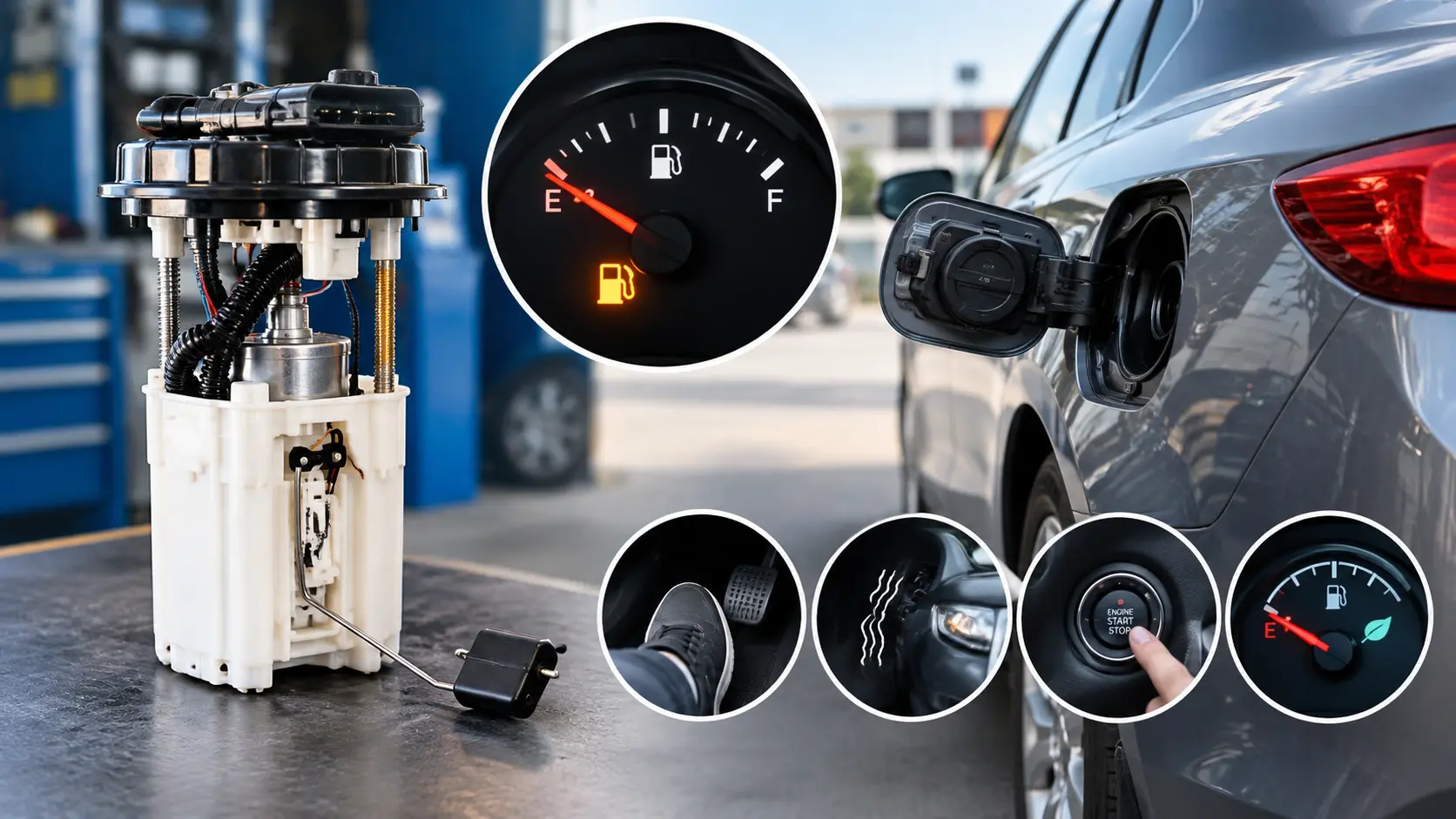
The main failing fuel pump symptoms are sputtering or loss of power at high speed or under load, long cranking before the engine starts, stalling at idle or low speed, a whining noise from the fuel tank, a car that will not start at all and a check engine light with fuel system codes. Rick’s Free Auto Repair Advice lists all of these as common signs.
Low fuel and heat speed up failure, because the in tank pump relies on fuel to stay cool. A mechanic checks the fuse and relay, then measures fuel pressure at cranking, at idle and after five minutes, and measures fuel volume before replacing the pump.
Table of Contents
- What the Fuel Pump Does
- Why Fuel Pumps Fail Faster in Dubai
- Sputtering or Power Loss at High Speed
- Long Cranking Before the Engine Starts
- Stalling at Idle or Low Speed
- Whining Noise From the Fuel Tank
- Car Will Not Start at All
- Check Engine Light and Fuel System Codes
- Higher Fuel Use and Poor Economy
- Stalling When Hot That Clears After Cooling
- Faults That Look Like a Bad Fuel Pump
- How a Workshop Tests a Fuel Pump
- What Fuel Pump Replacement Involves
- How Long Does a Fuel Pump Usually Last?
- Is It Safe to Drive With a Failing Fuel Pump?
- How to Make Your Fuel Pump Last Longer
- Why Does My Car Sputter Only When the Tank Is Low?
- Can a Clogged Fuel Filter Ruin a New Pump?
- FAQ
- Conclusion
What the Fuel Pump Does
Most modern cars have an electric fuel pump mounted inside the fuel tank. It draws petrol through a strainer, pushes it through the fuel filter and sends it along the fuel line to the injectors at a set pressure.
The engine computer controls the fuel injectors, but it can only work with the fuel the pump delivers. If pressure drops, the injectors spray less fuel than the computer expects, and the engine runs lean.
Many pumps also include a one way check valve that holds pressure in the line after the engine is switched off. That keeps fuel ready for the next start. Direct injection engines add a second, high pressure pump driven by the engine, but the in tank pump still supplies it.
Why Fuel Pumps Fail Faster in Dubai
Heat is the main reason. The in tank pump is cooled by the fuel around it. UAE mechanics told Khaleej Times that running on empty or close to empty leaves the pump without that cooling, so it overheats and fails early, and that outside heat speeds up the damage.
Fuel itself reacts to heat. Research published by SAE International explains that petrol can start to boil at around 40°C, and the vapour inside the tank lowers the pump’s output pressure until the engine stalls. On a summer afternoon when the air passes 45°C, a car parked in the open can have very hot fuel in the tank.
Driving habits add to it. Long idling with the AC on, short trips and frequently driving on the reserve all make the pump work harder for longer. Dirt or water in the fuel also wears the pump and clogs its strainer.
Sputtering or Power Loss at High Speed
Sputtering under load is one of the most common signs. Rick’s Free Auto Repair Advice lists sputtering or loss of power at high speed or under load among the main symptoms of a failing fuel pump.
At high speed, or when climbing ramps, overtaking or carrying a full car, the engine needs the most fuel. A weak pump can keep up at idle but falls behind when demand rises. The car jerks, hesitates or feels like it is running out of fuel, then recovers when you ease off.
Drivers often notice it on long highway runs, such as Emirates Road or the drive to Abu Dhabi, or on the steep ramps of multi storey car parks. A weak fuel filter can cause the same symptom, so both are checked.
Long Cranking Before the Engine Starts
Rick’s Free Auto Repair Advice lists long cranking after the car has been parked as a sign that fuel pressure has leaked away. This usually points to a faulty check valve inside the pump.
When the check valve leaks, fuel drains back to the tank after you switch off. The next time you start, the pump has to refill the line before the engine can run, so it cranks for several seconds. Once running, the car may drive normally.
Rick’s Free Auto Repair Advice describes a simple test. Turn the key to run for two to three seconds, then off, four times without cranking. If the engine then starts straight away, the check valve is likely bad.
Stalling at Idle or Low Speed
Rick’s Free Auto Repair Advice lists stalling, especially at idle or low speed, among the signs of a failing fuel pump. A pump with worn brushes or a failing motor can stop and start without warning.
The car may cut out at the lights or while creeping in traffic on Al Khail Road, then restart after a short wait. Stalls often become more frequent over days or weeks as the pump gets weaker.
The guide on what causes a car to stall on the road explains the other faults that cause this pattern, so a mechanic can rule them out at the same time. A stall in traffic can also lead to a rear bump from the car behind, which may leave scrapes that need paint and panel repair.
Whining Noise From the Fuel Tank
Rick’s Free Auto Repair Advice lists a whining noise from the tank as a symptom. Every electric pump makes a faint hum for a second or two when you switch on the ignition. A loud, constant whine while driving, or a noise that gets louder over time, points to a worn pump.
The noise is often easiest to hear from the back seat with the engine idling and the radio off. On many cars, the pump sits under the rear seat or in the boot floor.
A pump that whines more when the tank is low is a strong clue, because the pump is running hotter with less fuel around it.
Car Will Not Start at All
A completely failed pump means no fuel reaches the engine. The starter turns the engine normally, but the engine never fires. You may not hear the usual hum from the tank when you switch on the ignition.
Before assuming the pump has failed, a mechanic checks the simple things. Rick’s Free Auto Repair Advice advises checking the fuse first, then the relay. Tapping the relay and trying to start is a quick test, because a sticking relay can stop the pump.
A failed immobiliser, a crankshaft sensor fault or an empty tank with a faulty fuel gauge can also cause a crank but no start. Testing fuel pressure confirms whether fuel is reaching the engine.
Check Engine Light and Fuel System Codes
Rick’s Free Auto Repair Advice notes that a check engine light can come on with a failing pump, and a scan can show fuel system codes. Common examples include lean codes P0171 and P0174, because a weak pump makes the engine run lean.
Some cars have a fuel pressure sensor and set codes for low fuel rail pressure. Cars with a fuel pump control module can set codes for the pump circuit itself. Misfire codes may also appear if the mixture becomes very lean.
A code points to a system, not always a failed part. Low pressure codes can also come from a clogged filter or a failing regulator, which is why pressure and volume tests come next.
Higher Fuel Use and Poor Economy
A failing pump can make fuel use rise in some cases. A weak pump makes the engine run lean, so the computer adds more fuel through its corrections, and the driver presses the pedal harder to get the same power.
A faulty pressure regulator can cause the opposite problem, sending too much fuel to the engine. Either way, a noticeable rise in fuel use with no change in your driving is worth a check.
Keep a note of how many kilometres you get from a full tank. Changes are easier to spot when you have a normal figure to compare against.
Stalling When Hot That Clears After Cooling
A car that runs well when cool but stalls after a long drive on a hot afternoon, then restarts after 20 to 30 minutes, often has a heat related fuel problem. The pump may be weak enough that heat pushes it over the edge, or the fuel may be boiling in the tank.
SAE International research explains that fuel vapour in a hot tank lowers the pump’s output pressure until the engine stalls. A weak pump has less margin to cope with that vapour than a healthy one.
The same pattern can come from a failing crankshaft position sensor, which also cuts out when hot. Testing fuel pressure while the car is hot tells the two apart.
Faults That Look Like a Bad Fuel Pump
Several cheaper faults cause the same symptoms. A clogged fuel filter restricts flow and causes sputtering under load. A blown fuse, a faulty relay or a corroded connector stops the pump getting full power. A failing pressure regulator lets pressure drop or rise.
Rick’s Free Auto Repair Advice advises checking the filter, the connector condition and voltage drop, and the regulator before condemning the pump. Corroded or melted connectors at the tank show high resistance and should be cleaned or replaced first.
Ignition faults, a dirty MAF sensor and vacuum leaks also cause hesitation and stalling. The guides on bad MAF sensor symptoms and the symptoms of an engine vacuum leak explain those faults.
How a Workshop Tests a Fuel Pump
A proper test starts with the fuse, the relay and power at the pump connector. Rick’s Free Auto Repair Advice recommends checking for power and ground at the tank connector, and looking for a broken wire or bad ground if the fuse and relay are good.
The key test is fuel pressure. Rick’s Free Auto Repair Advice calls a dead head pressure test with a gauge the gold standard. The mechanic records pressure during cranking, at idle and about five minutes later, and warns not to assume the pump is good just because cranking pressure is correct.
Volume matters too. A pump can make the right pressure but too little flow. Rick’s Free Auto Repair Advice describes measuring the fuel volume over a 30 second crank and comparing it with the specification. Book these tests with an experienced car mechanic near you so the pump is only replaced when it has really failed.
What Fuel Pump Replacement Involves
On most cars, the pump is reached through an access panel under the rear seat or boot floor. On others, the fuel tank must be lowered. The old pump assembly is removed, the strainer is checked and a new pump is fitted with a new seal.
Rick’s Free Auto Repair Advice states that not cleaning the tank is the most common cause of repeat fuel pump failures. It recommends draining the tank, flushing it, drying it and inspecting it for rust when dirt or debris is found.
The fuel filter should be replaced at the same time if it is not part of the pump assembly. A fuel and air filter change costs little compared with a second pump. The connector and wiring are checked too, and any damage is repaired through an auto electrical repair.
How Long Does a Fuel Pump Usually Last?
There is no fixed replacement interval. Many pumps last well over 150,000 km, while others fail much sooner. Heat, low fuel levels, dirty fuel and electrical problems all shorten pump life.
In the UAE, driving on the reserve in summer is one of the biggest risks, because the pump runs hot without fuel around it. Cars that regularly run below a quarter tank tend to need pumps sooner.
If your car is past 150,000 km and shows early signs such as long cranking or sputtering on ramps, a pressure test is a sensible early check.
Is It Safe to Drive With a Failing Fuel Pump?
A failing pump can stop at any time, so it is not safe to ignore. A car that loses power or stalls at speed puts you and other drivers at risk, especially on fast roads.
If the car sputters or stalls on a highway, use the speed you have to reach the hard shoulder or the nearest exit. Stopping in the middle of the road because of a breakdown brings a AED 1,000 fine and six black points under Article 98 of the UAE Federal Traffic Law. Once safe, call roadside assistance.
If the pump has failed completely, the car will need towing to a workshop. If the car still starts at home, a mobile mechanic can check the fuse, relay and codes before you drive anywhere.
How to Make Your Fuel Pump Last Longer
Keep at least a quarter tank of fuel, especially in summer. That keeps the pump covered and cooler and reduces fuel vapour in the tank. Refuel before the warning light comes on.
Replace the fuel filter at the interval in your owner’s manual, and fill up at busy, well known stations where fuel turns over quickly. Fix corroded connectors and weak batteries, because low voltage makes the pump work harder.
A regular car service in Dubai covers filters and a scan for stored codes. If you already have long cranking or sputtering, choose a car garage near you that tests pressure and volume before replacing the pump.
Why Does My Car Sputter Only When the Tank Is Low?
Sputtering that only happens on a low tank points to the pump or its strainer. When fuel is low, it sloshes away from the pickup on corners, ramps and hard braking. The pump sucks air for a moment, and the engine stumbles.
A healthy pump copes with brief air gaps. A weak one does not, so the symptom shows up first on a low tank. The pump also runs hotter with less fuel around it, which makes a tired pump weaker still.
The spiral ramps in multi storey car parks at places like Dubai Mall are a common place to notice it. If the sputtering stops after you fill up, have the pump tested before it gets worse.
Can a Clogged Fuel Filter Ruin a New Pump?
Yes. A clogged filter makes the pump work against a blockage, so it runs harder and hotter. Over time, that strain wears the new pump out early.
Rick’s Free Auto Repair Advice advises replacing a filter that releases debris when tapped, and checking the filter before condemning the pump. On cars with the filter built into the pump assembly, it is replaced with the pump.
Always ask whether the filter was changed when a new pump is fitted. A new pump behind an old filter is a common reason for a second failure.
FAQ
Here are the questions Dubai drivers most often ask about fuel pumps.
What are signs of a bad fuel pump?
Common signs are sputtering or power loss at high speed, long cranking before starting, stalling at idle, a whining noise from the tank, a car that will not start and a check engine light with fuel system codes.
Can low fuel damage the fuel pump?
Yes. The in tank pump relies on the fuel around it to stay cool. Driving close to empty, especially in UAE summer heat, lets the pump overheat and fail early. Keep at least a quarter tank.
How do mechanics test a fuel pump?
They check the fuse, relay and power at the pump, then fit a pressure gauge. Pressure is recorded at cranking, at idle and after five minutes, and fuel volume is measured over 30 seconds of cranking.
Why does my car stall when hot?
A weak fuel pump, fuel boiling in a hot tank or a failing crankshaft sensor can all cause stalling when hot. Petrol can start to boil around 40°C. A fuel pressure test with the car hot tells them apart.
Will a bad fuel pump cause hard starting?
Yes. A leaking check valve inside the pump lets pressure drain back to the tank, so the engine cranks longer before it starts. A pump that is failing completely may stop the car starting at all.
Conclusion
A failing fuel pump shows up as sputtering at speed, long cranking, stalling, a whining tank, no start and fuel system codes. In Dubai, heat and driving on low fuel are the biggest reasons pumps fail early. Checking the fuse, relay, pressure and volume confirms the fault, and cleaning the tank stops the new pump failing the same way.
Rapid Rev Garage is a full workshop open 24 hours at Al Khail Gate, 12th Street, Al Quoz Industrial Area 2, serving passenger cars across Al Quoz, Business Bay, Jumeirah, Al Barsha, Satwa, Downtown and the Sheikh Zayed Road corridor. Visit https://rapidrevgarage.com, send your car model and symptoms on WhatsApp, or get directions on Google Maps.
Rapid Rev Garage | Failing Fuel Pump Symptoms | Al Quoz, Dubai