
Car Paint Protection Film in Al Quoz, Dubai
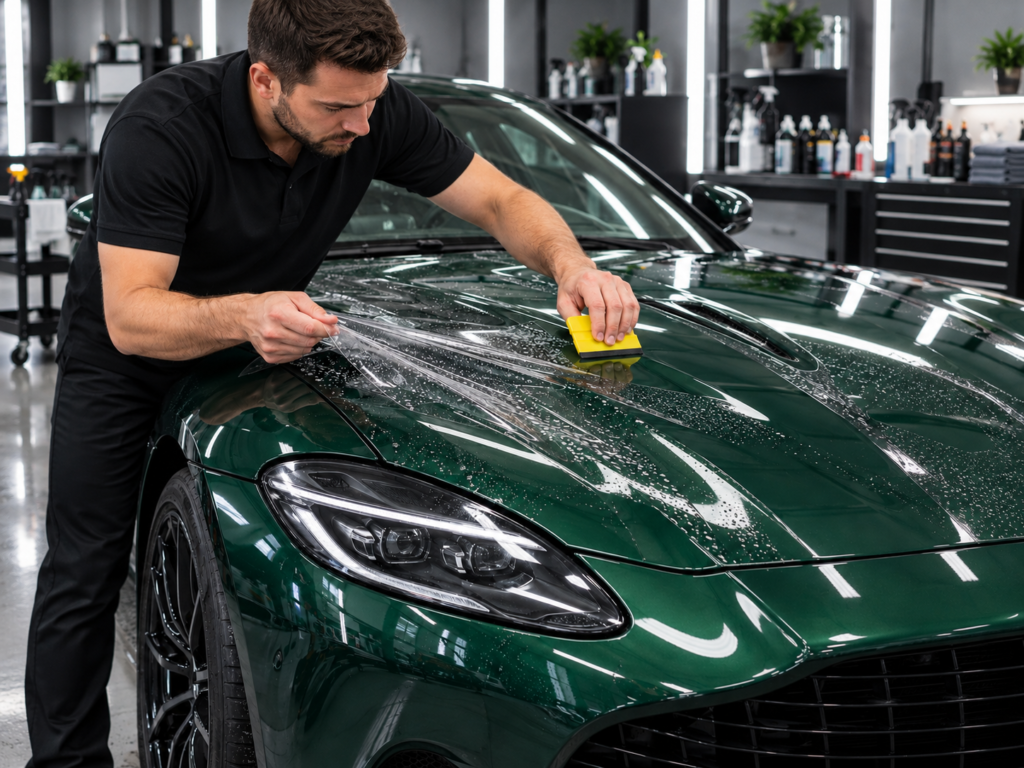
Paint protection film is a clear layer that sits on your car’s paint and takes the damage instead of it. In Dubai, gravel on Sheikh Zayed Road, sand from shamal winds and strong summer sun wear down clear coat fast. Rapid Rev Garage fits clear film at our Al Quoz workshop and repairs any damage before the film goes on.
- Stone chip protection
- Self healing film
- Repair before film
- Sensor safe fitting
Get a Paint Protection Film Quote in Al Quoz
Send us your car’s make, model and year and tell us which panels you want covered. We will reply on WhatsApp with the coverage we suggest and a price.
What Is Paint Protection Film (PPF) and How Does It Protect Your Paint?
Paint protection film, also called clear bra or clear paint film, is a transparent layer of thermoplastic urethane (TPU) that sticks to your car’s painted panels. It absorbs stone chips, road debris, light scratches, bug splatter and bird droppings before they reach the paint.
Many automotive films fall roughly in the 6 to 8.5 mil range, about 150 to 215 microns, although thickness varies by product and manufacturer. Quality film stays optically clear, so the original colour still shows.
A quality film has three layers. The base is a flexible TPU film that stretches around curves and edges.
Behind it sits an adhesive that bonds to the clear coat but lets go with heat when the film comes off. On top is a clear coat that resists stains and, on most modern films, heals light marks on its own.
The idea started with the military. During the Vietnam War, 3M developed a tough urethane tape to protect helicopter rotor blades from flying debris, according to both 3M and XPEL. The same material later moved to race cars and then to everyday road cars.
Film gives physical protection. Wax, sealants and ceramic coatings protect against UV, stains and dirt, but none of them can stop a stone chip.
Does the Self Healing Top Coat Really Remove Scratches?
Yes, for light surface scratches. Modern self healing film can make fine marks fade when the top coat is warmed by the sun or a rinse of warm water.
The top coat is an elastic polymer that flows back into shape as it heats, so a light mark from a car wash brush or a fingernail usually disappears after the car sits outside in Dubai for an afternoon.
XPEL says self healing film became available with the launch of its Ultimate Plus film in 2011. The healing only works on the top coat. A deep gouge that cuts through the film will not heal, and that piece of film needs replacing.
Why Dubai Roads Chip, Scratch and Fade Car Paint So Quickly
Dubai paint faces four threats at the same time: highway gravel, sand carried by the wind, strong UV and tight parking. Each one hits different panels, which is why most drivers protect the front of the car first.
Stone Chips and Road Debris at Highway Speed
Small stones thrown up by other vehicles at highway speed can chip clear coat and paint. On Sheikh Zayed Road, Emirates Road and Al Khail Road, trucks and construction traffic leave loose gravel on the road.
Chips usually show first on the front bumper, the leading edge of the hood and the side mirrors. If a chip reaches bare metal, moisture can start corrosion around it.
Sand Abrasion From Shamal Winds
The shamal is a hot, dry northwesterly wind that blows across the Gulf. NASA’s Earth Observatory notes that summer shamal winds usually start around the end of May, fade by mid August and peak around noon.
Gulf News has reported National Centre of Meteorology warnings of winds reaching 50 km/h with blowing dust. Sand at that speed works like fine sandpaper on bumpers, mirrors and the front of the hood, and over months it can dull the paint.
UV Fading and Clear Coat Oxidation
Dubai’s summer UV index often reaches 11 or higher, the “extreme” band on the World Health Organization scale. Long UV exposure breaks down clear coat over time, and darker colours tend to show fading first. Film with UV inhibitors slows this down on the panels it covers.
Door Dings, Bird Droppings and Parking Scuffs
Mall car parks and building basements around Al Barsha, Business Bay and Downtown are tight, so doors and shopping bags often touch paint. Bird droppings can etch clear coat if they are left on the car, and heat speeds this up.
How fast it happens depends on the paint and how long the droppings stay there. Film takes these light hits so the paint does not.
Is Paint Protection Film for Car Owners Worth It in Dubai?
For most drivers who use Dubai’s highways every day, yes. A partial front film kit can cost about the same as repainting one bumper, and it protects several panels for years. The table below shows typical market ranges, not fixed prices.
Option | Typical Dubai market range | What you get |
One front bumper respray | AED 1,500 to 3,000 | One panel repainted, with no protection against new chips |
Partial front film kit | AED 1,500 to 2,500 and up | Bumper, front of the hood, mirrors and headlights protected for years |
Full body film | AED 6,000 to 17,000 | Every painted panel protected |
Ranges based on prices published by Dubai installers, body shops and Al-Futtaim Toyota UAE, October 2026. Your price depends on your car, the film and the coverage.
Film makes the most sense if:
- You drive on Sheikh Zayed Road, Emirates Road or Al Khail Road most days
- Your car is new or still has its factory paint
- Your car is leased and you want to avoid paint charges at lease return
- You drive for Careem or Uber and spend long hours on the highway
- You plan to sell the car in a few years and want to keep the original paint
Repainted panels can affect how a used car is assessed, particularly when buyers or inspectors use paint depth readings to spot previous body work.
When Clear Film Is Not Worth Paying For
Film is a poor buy on a car with chipped, faded or peeling paint that you do not plan to repair, because the film will show every flaw underneath.
It also makes little sense if you are selling the car within a few months, or if the car rarely leaves the garage. In those cases, a good wash routine and a ceramic coating or sealant may be enough.
Where Should You Apply Paint Protection Film on Your Car?
Apply film first to the front bumper, hood, front fenders, side mirrors and headlights, because these panels face the road and take most stone chips. After that, the right choice depends on how and where you drive.
Panel | Main risk in Dubai | Suggested coverage |
Front bumper | Stone chips, sand, parking scrapes | Every package |
Hood | Chips on the leading edge, bird droppings | Partial or full |
Front fenders | Gravel thrown by the front tyres | Full front |
Side mirrors | Chips and sand at speed | Every package |
Headlights | Pitting and haze | Every package |
Rocker panels and rear wheel arches | Sand and gravel thrown by the tyres | Add on |
Door edges and door cups | Door dings, ring and nail scratches | Add on |
Rear bumper top | Scratches from loading the boot | Add on |
Partial Front Coverage for City Drivers
A partial front kit covers the bumper, the first part of the hood and fenders, the mirrors and the headlights. It suits drivers who mostly stay inside the city, such as short trips between Al Quoz, Al Barsha and Jumeirah. The downside is a visible line where the film ends on the hood, which some owners notice on dark paint.
Full Front Coverage for Daily Highway Commuters
Full front coverage protects the whole hood, both front fenders, the bumper, mirrors and headlights, with no line across the hood. It is a common choice for anyone commuting on Sheikh Zayed Road or driving between Dubai, Sharjah and Abu Dhabi every week.
Full Body Coverage for New and High Value Cars
Full body film covers every painted panel. It suits new cars, cars with special or matte paint, and owners who plan to keep the car for many years. It costs the most, but it also protects the doors, rear quarters and roof from sand and parking damage.
Add On Areas Most People Forget
Rocker panels and the area behind the rear wheels take a lot of sand and gravel, especially on SUVs like the Nissan Patrol and Toyota Land Cruiser. Door edges and the cups behind door handles collect scratches from rings, keys and nails.
The top of the rear bumper gets scraped when you load bags or shopping. Small pieces of film on these spots cost little and can save a touch up later.
Not sure which coverage your car needs? Send us your make, model and year and how you use the car, and we will suggest partial front, full front or full body.
How Much Does PPF Cost in Dubai and the UAE?
Typical market ranges in the UAE start at about AED 1,500 to 2,500 for a partial front kit and run from about AED 6,000 to 17,000 for a full body. These are ranges, not set prices.
Al-Futtaim Toyota UAE, for example, lists its packages from AED 6,999 for partial protection to AED 16,999 for a full body wrap, with VAT included. Some independent paint protection film Dubai installers advertise partial front kits from around AED 1,500, while others in Al Quoz start higher.
Coverage | Panels covered | Typical UAE market range |
Partial front | Bumper, front of hood and fenders, mirrors, headlights | AED 1,500 to 2,500 and up |
Full front | Full hood, full fenders, bumper, mirrors, headlights | Between partial front and full body, based on car size |
Full body | Every painted panel | AED 6,000 to 17,000 |
Prices vary by vehicle size, film brand, coverage, paint condition and installation method.
Five Things That Change Your Film Price
Five things decide most of the price on any quote:
- Coverage: a full body uses several times more film than a partial front kit
- Film grade: stronger self healing, better clarity and longer warranties cost more
- Car size and shape: a Nissan Patrol or Land Cruiser needs more film and hours than a compact sedan
- Paint condition: chips, scratches or swirl marks must be repaired or polished out first
- Finish: matte, satin and coloured films usually cost more than gloss
Ask for a written quote that names the exact film and states the warranty terms. A very low quote can mean a lower grade film that yellows or cracks sooner.
Want a price for your car? Send us the make, model and year with the panels you want covered, and we will reply with a quote.
Can PPF Be Applied on a Repainted or Older Car?
Yes, as long as the paint underneath is sound. Film bonds to whatever surface it covers, so the paint must be fully cured, free of chips and dents, and polished smooth before the film goes on. A good installer checks this first and tells you if a panel needs work.
Repair Chips, Dents and Scratches Before the Film Goes On
Clear film shows everything under it. A stone chip, a scratch or a small dent stays visible once film covers it, and the film seals it in. That is why we fix the damage first.
Our workshop handles dent repair, bumper repair and car painting in the same building, so panels can be repaired, cured and protected without moving the car between shops.
How Long Fresh Paint Must Cure Before Film
New paint keeps releasing solvents for weeks after it looks dry. Covering it too early can trap those solvents and cause bubbles or soft spots under the film. Cure times depend on the paint system and whether the panel was baked.
Many body shops wait at least 30 days, and some paint systems need up to 90 days. A paint depth reading and a check under strong light help confirm the panel is ready.
Why Cheap Resprays Can Lift When Film Is Removed
Factory paint is baked on and usually bonds very well. A poor respray may not stick as firmly to the layer below it. When film is removed years later, the adhesive can pull weak paint or clear coat off with it. If your car has had body work, tell your installer so they can test the panel first.
What We Check Before Installing PPF
Before any film goes on, we inspect the car and write down what we find. This checklist decides what repair or polishing comes first and where the film can safely go:
- Existing paint condition on every panel to be covered
- Repainted panels and paint depth readings
- Stone chips, scratches and clear coat damage
- Dents and panel alignment
- Old film, stickers or adhesive left from a previous install
- Radar, camera and parking sensor locations
- The coverage you want and how you drive
Let's work together.
At Rapid Rev Garage, your car’s performance is our passion. Whether it’s routine maintenance, complex repairs, or performance upgrades, our expert team in Dubai is ready to get you back on the road—better and faster. Let’s bring your vehicle the care it deserves. Book your service today and experience the difference.
How Professional Film Installation Works, Step by Step
A professional paint protection film service follows six steps: inspect, clean, cut, apply, shape and cure. Each step affects how clear the film looks and how long it stays stuck.
Step 1. Paint Inspection and Depth Check
The installer walks around the car under bright light and marks chips, scratches and repainted panels. A paint depth gauge shows which panels are original and which have been resprayed.
Step 2. Decontamination and Paint Correction
The car is washed, then cleaned with a clay bar to pull out embedded dirt and iron particles. Machine polishing then removes swirl marks and light scratches, because film magnifies any defect under it.
Step 3. Patterns Cut on a Plotter for Your Exact Model
Most installers use pattern software and a plotter to cut film to the shape of each panel for your make, model and year. Computer cut patterns can reduce or remove the need to cut directly on the paint, depending on the panel and the installation method. Some edges are left slightly larger so they can be wrapped around the panel.
Step 4. Film Laid With Slip Solution
The panel and the adhesive side of the film are sprayed with a slip solution, a mix of water and a mild soap or gel. The solution lets the installer slide the film into the right position before it grabs. 3M lists exact slip solution mixing rates for each of its films in its installation guidelines.
Step 5. Heat, Stretch and Edge Wrapping
Once the film is in place, a squeegee pushes the solution out from under it. A heat gun softens the film so it stretches around curves, vents and badges. Where the panel allows, edges are wrapped around the inside lip so they are harder to see and less likely to lift.
Step 6. Curing and Final Inspection
The film needs time to bond. 3M recommends waiting at least 72 hours after installation before washing the car, and many installers ask for a full week. Before handover, each panel is checked under strong light for trapped dust, bubbles and lifted edges. Small water pockets usually dry out on their own within a few days.
Ask about film installation for your car. Tell us the make, model and year, and we will explain which steps your paint needs.
Does Clear Film Affect Parking Sensors, Cameras or Radar?
It can, if it is fitted in the wrong place. Many modern cars hide radar units and parking sensors behind the bumper and grille, and some carmakers do not allow any film over those zones. Film should never be installed over a radar or camera sensing area unless the carmaker specifically permits it.
The rules come straight from the carmakers. BMW and Mini state that no stickers or film, clear or coloured, may be fitted over the areas their radar sensors look through, according to repair guidance published by I-CAR. Porsche went further after Taycan owners reported false warnings.
In a November 2025 service bulletin filed with the US National Highway Traffic Safety Administration, Porsche told technicians to keep protective film and decals away from the assistance system sensors.
After installation, check that the parking sensors beep at the right distance, that adaptive cruise control and blind spot warnings work, and that no warning lights appear on the dash. If anything feels wrong, book a car diagnostic scan so the sensor zones can be checked.
How to Choose the Best Paint Protection Film for Your Car
Choose on three things: the film material, the installer’s process and the way you drive. A good film fitted badly will still peel, so the installer matters as much as the product.
Pick TPU Film, Not Cheaper PVC
Choose TPU film. Modern film is made from thermoplastic urethane, which is flexible, very clear and available with self healing top coats. Older and cheaper films use PVC, which is stiffer, does not heal and tends to crack in heat.
Lubrizol, which supplies the TPU used in many premium films, explains that some types of TPU hold their clarity under UV much better than others, which is why film quality varies so much.
Check for a Self Healing Top Coat and UV Protection
Look for a clear coat that heals light scratches with heat and blocks UV. Without UV inhibitors, film can yellow and turn cloudy in the UAE sun.
Gloss, Matte, Satin or Colour Film
Gloss film keeps the factory look and adds depth. Matte and satin films give gloss paint a flat finish, or protect cars that already have matte paint. Coloured film changes the colour of the car, and that brings a legal step.
In Dubai, a colour change needs approval through Dubai Police before the work, and your Mulkiya must be updated after it. Gulf News reports that changing colour without approval can lead to an AED 800 fine under Ministerial Resolution No. 178 of 2017.
Clear gloss film over the original colour does not change the registered colour. If you are unsure about a matte or satin finish, check with the RTA first.
What Your Film Warranty Should Cover in Writing
A good warranty names the film and covers yellowing, cracking, peeling, bubbling and delamination. XPEL, for example, warranties its Ultimate Plus film for 10 years against these problems. A manufacturer warranty covers the film itself, while the installer’s warranty covers the workmanship, such as lifting edges. Keep the warranty card with your car documents.
Questions to Ask Before You Book
Ask these five questions before you pay a deposit:
- Which film brand and series will you install, and is the warranty in writing?
- Do you use computer cut patterns or cut the film on the car?
- Will you wrap the edges where the panel allows?
- What paint repair or polishing does my car need first?
- How long should I wait before the first wash?
Well known film brands sold in Dubai include XPEL, SunTek, 3M, LLumar and Avery Dennison. Ask any installer, including us, to show you the box and warranty card for the film on your car.
Paint Protection Film vs Ceramic Coating vs Vinyl Wrap
Film gives physical protection against chips and scratches. Ceramic coating gives chemical and UV protection and makes washing easier. Vinyl wrap changes the colour but protects far less.
Feature | Clear film | Ceramic coating | Vinyl wrap |
Main job | Stops chips and scratches | UV, stains and easier washing | Colour change |
Thickness | Often about 150 to 215 microns | A few microns | Often around 100 microns |
Stops stone chips | Yes | No | Partly |
Heals light scratches | Yes, with heat | No | No |
Typical warranty | Up to 10 years on premium films | 2 to 5 years | Depends on the brand |
Needs colour change approval | No, if clear | No | Yes, if the colour changes |
Many Dubai owners use both: film on the front panels and a ceramic coating over the whole car, including the film. The coating helps sand and dust rinse off faster, and the film stops the chips the coating cannot. Our car detailing page covers the cleaning and coating side.
Paint Protection Film Repair for Peeling, Yellow or Damaged Film
Damaged film can usually be fixed one panel at a time. Because film is fitted panel by panel, a lifted edge, a deep cut or a yellow hood piece can be removed and replaced without redoing the whole car.
Lifting Edges and Bubbles
Edges usually lift when a pressure washer is aimed at them, when dirt got under the film during fitting, or when the edge was never wrapped. Small bubbles in the first week are often water and fade as the film cures.
Bubbles that stay after two weeks, or edges that collect a dark line of dirt, usually need that piece refitted or replaced.
Yellow, Cloudy or Stained Film
Yellowing is usually a sign of low grade film without UV inhibitors, or film that has reached the end of its life. Bird droppings or tree sap left in the sun can also stain the top coat. Cleaning does not fix true yellowing, so that piece of film needs replacing.
Film Damaged in an Accident
After a collision, the film on the damaged panel comes off with the paint repair. Once the new paint has cured, a fresh piece of film is fitted to that panel only.
If you claim on insurance, list the film in the claim, as some policies cover it as part of the panel repair. Our car accident repair team handles the panel, the paint and the new film together.
Safe Film Removal Without Paint Damage
Film should be removed slowly with heat, which softens the adhesive so it lets go of the paint. Any glue left behind is cleaned off with an adhesive remover that is safe for clear coat. Pulling film off cold, or removing it from a weak respray, can lift paint with it.
Curious what's wrong before you commit to anything? Send us a photo or video of the issue on WhatsApp and we'll take a look
Signs of a Badly Fitted Clear Bra
A good fit is hard to see from a metre away. Check your car in daylight after handover and look for these problems:
- Edges lifting or already collecting dirt
- Dust, hair or grit trapped under the film
- Stretch marks or a wavy orange peel texture
- Visible joins in the middle of a panel
- Knife cuts in the paint along the film edges
- Haze or cloudy patches that do not clear after two weeks
Raise any of these with your installer early, while the job is still under warranty.
How Long Does PPF Last in Dubai, and How Do You Care for It?
Quality film usually lasts 5 to 10 years in Dubai, and premium films carry up to a 10 year manufacturer warranty. How long yours lasts depends on the film grade, the fit and how you wash the car. These care habits add years:
- Wait at least 72 hours before the first wash, or a full week if your installer asks.
- Rinse sand and dust off with water before a mitt touches the film.
- Use a pH neutral car shampoo and a clean microfibre mitt.
- Hold pressure washer nozzles at least 30 cm away and at a right angle to the film, as 3M advises, and never aim at the edges.
- Avoid brush car washes, which can catch and lift edges. Touchless washes are safer.
- Remove bird droppings quickly, especially in summer.
- Have the edges checked once a year, ideally before summer.
Why Rapid Rev Garage for Paint Protection Film Service in Al Quoz
Rapid Rev Garage is a strong choice for film in Dubai if your car has chips, dents or scratches that need fixing first. We are a full repair workshop, so the panel work, paint and film are handled by one team instead of three different shops.
Repairs and Film Done in One Workshop
Body repair, scratch repair and painting happen in our own workshop before any film goes on. You get a clean, cured surface and one team that answers for the final result.
Rated 5.0 on Google by Dubai Drivers
Our Google reviews come from Dubai drivers who brought their cars to us for repairs and service. You can read them on our reviews page or Google Maps listing before you book.
Easy to Reach From Sheikh Zayed Road and Al Khail Road
The workshop sits at Al Khail Gate, 12th Street, Al Quoz Industrial Area 2, between Sheikh Zayed Road and Al Khail Road. It is a short drive from Al Barsha, Al Safa, Jumeirah, Business Bay and Dubai Hills. If your car needs other work during the same visit, see our car garage services.
Open 24 Hours for Drop Off
The workshop is open 24 hours. You can drop your car off after work or late at night, so a film job that takes a few days does not cost you a day off work.
Paint Protection Film FAQs
Does clear bra turn yellow in the sun?
Quality film with UV inhibitors resists yellowing for its full warranty period. Cheaper film can yellow much sooner in Dubai sun. A written warranty that covers yellowing is the best proof of film quality.
Does PPF damage paint when removed?
Not usually on factory paint, when it is removed slowly with heat. The adhesive is designed to release cleanly. The risk comes from poor resprays, which can lift with the film, and from pulling film off cold.
Is PPF worth it on a leased car?
Often, yes. Lease returns in the UAE are checked for chips, scuffs and door dings, and paint charges can add up. A partial front kit protects the panels that take most damage, and you can leave it on or have it removed before return.
How long does PPF installation take?
A partial front kit usually takes 1 to 2 days, a full front about 2 to 3 days, and a full body about 3 to 5 days, depending on the car. After that, wait at least 72 hours before the first wash so the film can bond.
Can you put ceramic coating over film?
Yes, once the film has cured. Many owners do this to make sand and dust rinse off faster. If you use wax instead, XPEL advises avoiding products with dyes or with more than 5% naphtha or kerosene.
Can clear film go on headlights?
Yes. Headlights take a lot of chips, and film protects the lens from pitting and haze from sand. Most partial front and full front kits include them. If a lens is already hazy, it can be restored first through our car headlight repair service.
Is PPF better than ceramic coating?
They do different jobs. Film stops stone chips and scratches, while ceramic coating protects against UV and stains. For Dubai highway driving, film on the front with a coating on top gives the most protection.
Does clear film need RTA approval?
No, not when the film is clear and the colour of the car stays the same. Coloured film is different. A colour change needs Dubai Police approval before the work and a Mulkiya update after it, or you risk an AED 800 fine.
Can people see film on a car?
On a good fit, not from a metre away. Up close, you may see the edge line on a hood or a join on a large panel. Visible haze, dust or wavy texture points to a poor fit or low grade film.
Get a Quote for Your Car
Tell us your car’s make, model and year and which panels you want covered, and we will recommend the coverage that fits how you drive. Call us on +971 52 797 9525 or visit the Rapid Rev Garage homepage to see everything else we fix.
Come see us in person. Find Rapid Rev Garage on Google Maps and drop by whenever suits you.
Car Repair Services We Offer at Rapid Rev Garage
- Car AC Repair
- Car Detailing
- Car Battery Replacement
- Car Body Repair
- Car Electrical Repair
- Engine Repair
- Car Oil Change
- Car Mechanic
- Car Painting
- Car Suspension Repair
- Car Window Tinting
- Car Tyres
- Car Garage
- Mobile Car Mechanic
- Vehicle Inspection
- Roadside Assistance
- Transmission Oil Change
- Car Towing Service
- Car Upholstery
- Car Maintenance
- Car Workshop
- Car Service
- Car Repair
- Car Recovery
- Car Key Repair
- Car Dent Repair
- Car Headlight Repair
- Car Bumper Repair
- Car Dashboard Repair
- Car Collision Repair
- Car Filter Change
- Car Accident Repair
- Car Brakes Repair
Get Your Car Fixed Today!
Don’t wait until it’s too late—restore your car’s performance with expert care.
Book your service now and drive worry-free!

