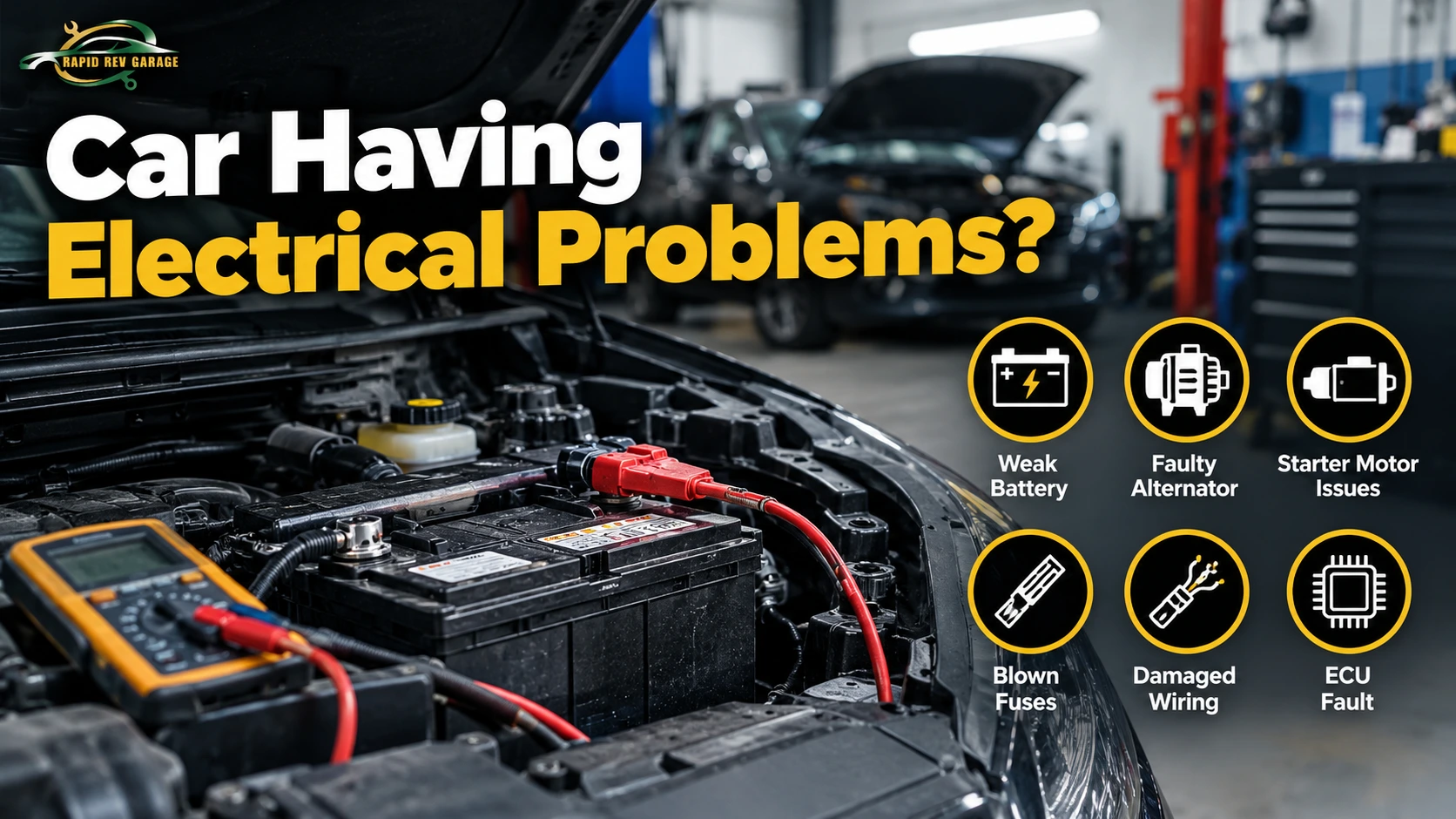
Usually, car electrical problems stem from a weak battery, a failed alternator, a loose ground wire, or broken wiring. The heat is Dubai’s biggest trigger. It can shorten battery life to around two years and dry out wire insulation. Common indicators include flickering lights, a battery that keeps dying, delayed power windows, and warning lights on the dash. Begin with a battery voltage test. A healthy battery will read about 12.6 volts with the engine off. With the engine running, it should read between 13.8 and 14.7 volts. If those figures are OK and you still have issues, the problem is likely a fuse, relay, wire, or control module. They need a scan tool and proper testing at a shop.
What a Car Electrical Fault Really Means
Your car runs on a 12-volt system. The battery starts the engine. Once the engine is running, the alternator takes over. It powers the car and recharges the battery at the same time.
Every light, motor, sensor, and screen connects to that system through wires, fuses, relays, and ground points. Modern cars also have 20 to 70 small computers, called modules. They talk to each other over a network inside the car.
So a car having electrical problems can mean many things. It might be a dead battery. It might be one broken wire inside a door hinge. The symptom often shows up far from the real fault, and guessing wastes money.
Warning Signs Your Car’s Electrical System Is Failing
Car having electrical problems rarely appear all at once. They start small and get worse. These are the signs that point to a car having electrical problems:
- Headlights or dash lights flicker or dim at idle, then brighten when you rev.
- The battery keeps draining overnight or after a few days parked.
- The engine cranks slowly, or you only hear a click.
- The car won’t start, but the battery is good, and the lights still work.
- Dashboard lights stop working, or the battery, ABS, and engine lights come on at the same time.
- Power windows move slowly or stop working.
- Central locking works on some doors but not others, or locks by itself.
- The radio or screen resets while you drive.
- You smell burning plastic, or one fuse keeps blowing.
Some defects fade away. They come with heat, or bumps, or rain. They go. Intermittent electrical faults are the hardest to find in an automobile. Note the time, the weather, what you were doing when it happened. That record can save hours of testing time.
Seeing two or more of these signs? Book a check with a qualified car mechanic before it breaks down.
Match the Symptom to the Likely Cause
Use this table to narrow down the fault before you visit a workshop. It lists the most common signs of a car having electrical problems and how soon you should act.
|
What You Notice |
Most Likely Cause |
How Soon to Fix |
| Lights flicker or dim at idle | Weak alternator or slipping belt | Within a few days |
| Battery keeps draining overnight | Dashcam, stuck relay or a module that won’t sleep | This week |
| Clicks but won’t crank | Flat battery or corroded terminals | Before your next drive |
| Won’t start, but battery tests good | Starter motor, ignition switch or bad ground cable | Before your next drive |
| Several dash warning lights at once | Low charging voltage or a network fault | Today |
| Car losing electrical power while driving | Alternator failure or loose main cable | Stop safely now |
| Power windows not working | Switch, window motor or broken door wiring | When convenient |
| Central locking malfunction | Lock actuator or broken wire in the door hinge | When convenient |
| Burning smell or fuse keeps blowing | Short circuit | Stop driving |
The Real Reasons Car Electrics Fail
Most electrical faults come from a short list of parts. Below are the most common failures, and why they fail faster in Dubai.
A Battery Worn Out by Heat
Heat is a car battery’s main enemy. High temperatures speed up the chemistry inside it and dry out the cells. In the UAE, most batteries last about 18 to 30 months. In cooler countries, many last four or five years.
A weak battery can still start the car on a normal morning. Then one day it can’t. It can also cause strange faults, because modules start acting up when voltage drops below about 12 volts.
An Alternator That Stops Charging
While the engine is running, the alternator produces power. Inside are brushes, bearings, and a voltage regulator that wears down over time. Running your AC on full blast for hours adds to the load, forcing it to work more.
If the alternator is bad the automobile runs on batteries alone. You’ve got 20 to 40 minutes before it all goes down. That’s a classic cause of car electrical trouble while driving.
Loose or Corroded Ground Straps
Every circuit needs a path back to the battery. That path runs through ground straps bolted to the engine and the body. If a strap is loose or rusty, current can’t flow properly.
A bad ground causes some of the oddest symptoms. Gauges jump, lights dim when you use the indicators, or the car won’t start with a good battery. Speed bumps and engine shake slowly loosen these bolts.
Blown Fuses and Failing Relays
A fuse protects a circuit by blowing when too much current flows. A relay is a switch that lets a small signal turn on a big load, like the fuel pump or radiator fan.
One blown fuse can kill the power windows or the radio. A relay that sticks on can drain the battery overnight. If a new fuse blows again straight away, something in that circuit is shorting.
Short Circuits and Damaged Wiring
A short happens when a bare wire touches metal or another wire. Insulation cracks with age and heat. Wires also rub through on sharp edges or get chewed by rodents in parked cars.
Signs of a car electrical short circuit include blown fuses, a burning smell, hot wires, and parts that switch on by themselves. Door wiring is a common weak point. “Every time you open the door, you bend the wires. They break inside the rubber boot after a few years. If you have power windows and central locking and one door just stops working, check the hinge wiring first.
Dashcams and Add-On Wiring, the Cause Most Guides Skip
Many Dubai cars have a dashcam, tracker or extra lights fitted after purchase. These add-ons are one of the most common causes of a car battery that keeps draining.
Dashcam in parking mode might drain power all night long. Some are linked to a continuous live feed with no low-voltage cut-off. They can run the battery flat in a day or two. Cheap installs also employ tap connectors that cut into the OEM wires. Those taps rust, and new defects appear months later.
If you’ve fitted anything to your car recently, tell the mechanic first. It can save an hour of testing.
Faulty Modules and Software Glitches
Modern cars use modules to run the windows, locks, lights, and engine. A module can fail due to water, heat, or a voltage spike during a bad jump start. Sometimes it only needs a software update.
When car electronics aren’t working properly, but the battery and wiring test fine, a module is often to blame. Some modules need coding after replacement, which takes brand-level software.
How Mechanics Track Down an Electrical Fault
Fixing a car with electrical problems starts with finding the exact fault, not swapping parts. Good diagnosis follows a set order. It starts with simple checks and goes deeper only when needed. Searching for a garage near me brings up plenty of options, so ask how they test before they replace anything.
Simple Checks You Can Do at Home First
You can rule out a few things yourself in about five minutes.
- Look at the battery terminals. White or green crust means corrosion.
- Try to wiggle the battery cables by hand. They should not move.
- Check the fuse box for a blown fuse. Your owner’s manual shows what each fuse controls.
- With a cheap multimeter, test the battery with the engine off. 12.6 volts is full. 12.2 volts or less means it’s weak.
- Start the engine and test again. You should see 13.8 to 14.7 volts. A lower reading means the alternator may not be charging.
Battery and Charging System Test
A workshop uses a battery tester that measures cold cranking amps, not just voltage. A battery can show 12.6 volts and still fail under load. The charging test checks alternator output with the lights, AC and fan all switched on.
Scanning for Fault Codes
Every part of the car’s OBD2 scan tool can read the stored codes. Codes don’t always say what part is broken. They point to the wheel. When several modules show the “low voltage” code at the same time, it usually means a charging or ground fault, not five broken modules.
Parasitic Drain Test and the 30-Minute Rule
If the battery keeps dying, the mechanic checks how much current the car uses when it’s not running. Most cars use less than 50 milliamps when they’re not running.
This is wrong on a lot of quick tests. Some new cars need twenty to forty-five minutes to fall asleep after being locked. You blame the wrong part because you took the reading too soon and it looked high. A good test waits until the drain drops, then pulls each fuse one at a time. You can see which circuit is broken by the breaker that stops the drain.
Voltage Drop and Wiring Tests
A mechanic checks the voltage drop across the main wires and grounds when a car won’t start even though the battery is fine. If you lose more than 0.5 volts across a wire, the connection is bad. Some faults may need a wiggle test, in which the mechanic moves the wires by hand while keeping an eye on the meter.
How Electrical Repair Is Carried Out
Once the fault is found, the electrical repair itself is often simple. The right fix depends on what failed:
- Battery replacement. On many European cars, the new battery must be registered to the car’s computer.
- Terminal cleaning, or new clamps if the corrosion is heavy.
- Alternator replacement or rebuild, plus a new drive belt if the old one is worn.
- Clean, tighten, or replace the ground strap.
- Fuse and relay replacement, but only after you fix the short behind them.
- Wiring repair with soldered joints and heat-shrink sleeves. Twist-and-tape repairs fail fast in Dubai heat.
- Window switch, motor, or regulator replacement.
- Door lock actuator replacement for central locking faults.
- Module repair, replacement or reprogramming.
- Rewiring dashcams and other add-ons to a switched supply or a proper low-voltage cut-off.
After the repair, the codes should be cleared, the charging test run again, and the car road tested. Ask for the before-and-after readings. An honest workshop will show you the numbers.
What Happens If You Ignore Electrical Faults
Electrical faults rarely fix themselves. A weak battery puts extra strain on the starter and alternator. One cheap part can end up taking out two expensive ones.
A short circuit is more serious. It can melt wiring and, in rare cases, start a fire. Low voltage can also corrupt module software, and some cars then need reprogramming that costs more than the first repair.
There is also the risk of a breakdown. A dead car on Sheikh Zayed Road in August is unsafe, not just inconvenient.
Can You Keep Driving a Car Having Electrical Problems?
It depends on the symptom. A slow power window or one dead interior light won’t stop you from driving. You can book a repair when it suits you.
It’s safe to pull over if the battery light comes on, the headlights dim, or more than one warning shows up at the same time. Those mean the charging didn’t work. In minutes, the car could stop working, and the handling could suddenly feel heavy.
If you smell burning or see smoke, stop and switch off the engine. Don’t try to drive to a workshop. Call roadside assistance instead. If the car won’t start at home or work, a mobile car mechanic can test it where it’s parked. For late-night breakdowns, Rapid Rev Garage in Al Quoz is a good option. It runs as a full workshop 24 hours a day.
How Long Electrical Repair Takes
Repair time depends on how hard the fault is to find. These are typical times:
- Battery test and replacement: 20 to 40 minutes
- Full diagnostic scan: 30 to 60 minutes
- Alternator or starter replacement: 1.5 to 3 hours
- Parasitic drain test: 1 to 2 hours, because of the sleep wait
- Window motor or lock actuator: 1 to 2 hours
- Hidden wiring faults: half a day to two days
Intermittent faults take the longest. The car has to show the fault before it can be traced.
What Changes the Cost of Electrical Repair in Dubai
The cost of fixing a car with electrical problems depends on what failed and what you drive. These are typical Dubai market ranges, not fixed prices:
- Diagnostic scan and electrical test: AED 100 to 350
- Standard battery: AED 300 to 700
- AGM battery for start-stop cars: AED 700 to 1,500
- Alternator: AED 800 to 2,500, new or rebuilt
- Starter motor: AED 600 to 1,800
- Fuse or relay: AED 50 to 250 with labor
- Wiring repair: AED 250 to 1,500, depending on access
- Window motor or regulator: AED 400 to 1,200
- Module replacement and coding: AED 1,500 and up
Prices go up for European luxury cars, where parts cost more, and batteries need registering. Labor also rises when the fault hides behind the dashboard or inside a door. A proper diagnosis first is often the cheapest step, because it stops you paying for parts you didn’t need.
How to Stop Electrical Faults Coming Back
Most electrical faults can be caught early with a few habits:
- Test your battery every six months, and always before summer.
- Plan to replace the battery at around two years in the UAE.
- Keep the terminals clean and tight.
- Have an auto electrician fit dashcams and trackers, with a low-voltage cut-off.
- If the car will sit for more than two weeks, use a battery maintainer or disconnect the negative terminal.
- Don’t pressure-wash the engine bay or the fuse box.
- Replace a worn drive belt before it starts slipping.
- Ask for a charging test at every car service in Dubai.
Dubai Heat, Car Washes and Parking Damage
Dubai puts unusual stress on car electrics. A car parked outside in summer can reach cabin temperatures above 60°C, and the engine bay gets hotter still. Batteries and wire insulation age faster. Plastic connectors turn brittle and crack.
Parking also plays a part. Moving from a hot street into a cool basement car park can cause moisture to form on connectors. Over months, that moisture turns into green corrosion.
Car washes are another trigger. High-pressure jets push water into connectors, lamp housings and door switches. Many intermittent faults start in the week after a wash.
Summer travel also throws people off. Many owners who leave their cars in July or August come back to find the batteries dead. This is especially true if they left the dashcam in parking mode. Fine dust from places like Al Quoz, which has many factories, can get into plugs and switches too.
If your car’s wiring issues started right after a wash or a long trip, let the mechanic know. The timing is a strong hint.
Why Choose Rapid Rev Garage for a Car Having Electrical Problems
For a car having electrical problems in Dubai, Rapid Rev Garage in Al Quoz is a strong pick for diagnosis and repair. The reasons below are specific to this kind of job.
Open 24 Hours as a Full Workshop
Electrical failures don’t wait for office hours. Many 24/7 services in Dubai are mobile vans that can jump-start a battery but can’t trace a wiring fault on the roadside. This garage runs as a full workshop around the clock so that a car can be properly tested at any hour.
A 5.0 Rating on Google
The workshop holds a 5.0 rating on Google. Electrical work takes patient testing, and past customer reviews are a fair guide to how a garage handles diagnosis.
Focused on Passenger Cars
The workshop services passenger cars only and does not take trucks. Its work is centered on the cars most Dubai residents drive every day.
Easy to Reach in Al Quoz
It’s located at Al Khail Gate, 12th Street, Al Quoz Industrial Area 2, close to Al Khail Road. That makes it reachable from most parts of the city and easy for a recovery truck to drop off.
FAQs
Q1: Why does my car battery keep draining?
Most often it’s a parasitic drain. A dashcam in parking mode, a stuck relay, or a module that won’t sleep can flatten it in one to three days. An old battery that can’t hold a charge causes the same symptom.
Q2: Why won’t my car start with a good battery?
Check the starter motor, the main battery cables, and the ground strap. A corroded cable can pass enough power for the lights but not for the starter. A faulty ignition switch or immobilizer can also stop the car from starting.
Q3:What causes car lights to flicker?
Flickering lights usually mean the voltage is unstable. A weak alternator, a slipping belt or a loose ground connection are the usual causes. LED bulbs fitted without the right resistor can also flicker.
Q4: Can a bad alternator drain the battery?
Yes. A failed diode inside the alternator can let current leak out of the battery while the car is parked. A charging test with a ripple check finds it.
Q5: How do I spot a short circuit?
Watch for a fuse that blows again right after you replace it. A burning smell, hot wires, or parts switching on by themselves are other signs. Stop using that circuit and get it checked.
Q5: Why do power windows and locks stop working together?
They often share wiring that runs through the door hinge. Those wires bend each time the door opens and can break inside the rubber boot. A shared fuse or faulty door module can also knock out both.
Q6: How much is electrical repair in Dubai?
Most repairs fall between AED 250 and AED 2,500. A battery or fuse sits at the low end. Alternators, wiring behind the dash, and module coding sit at the high end.
Related Services
Electrical faults often connect to other parts of the car. These services cover the most common follow-up work:
- Car battery replacement, for batteries that fail a load test
- Car electrical repair, for wiring, fuses, relays, and alternators
- ECU programming, for modules that need coding after replacement
- Car dashboard repair, for gauges and screens that stop working
- Car headlight repair, for lights that flicker or fail
- Car key repair, for immobilizer faults that stop the car starting
- Car painting and rust repair around door seals and the battery tray, where water can reach the wiring
Get Your Car’s Electrical Fault Traced in Al Quoz
A car having electrical problems usually gives warning signs before it fails. A battery and charging test takes less than an hour and can stop a small fault from turning into a breakdown.
For proper diagnosis and electrical repair at any hour, call Rapid Rev Garage. Message on WhatsApp, call, or find the workshop on Google Maps.