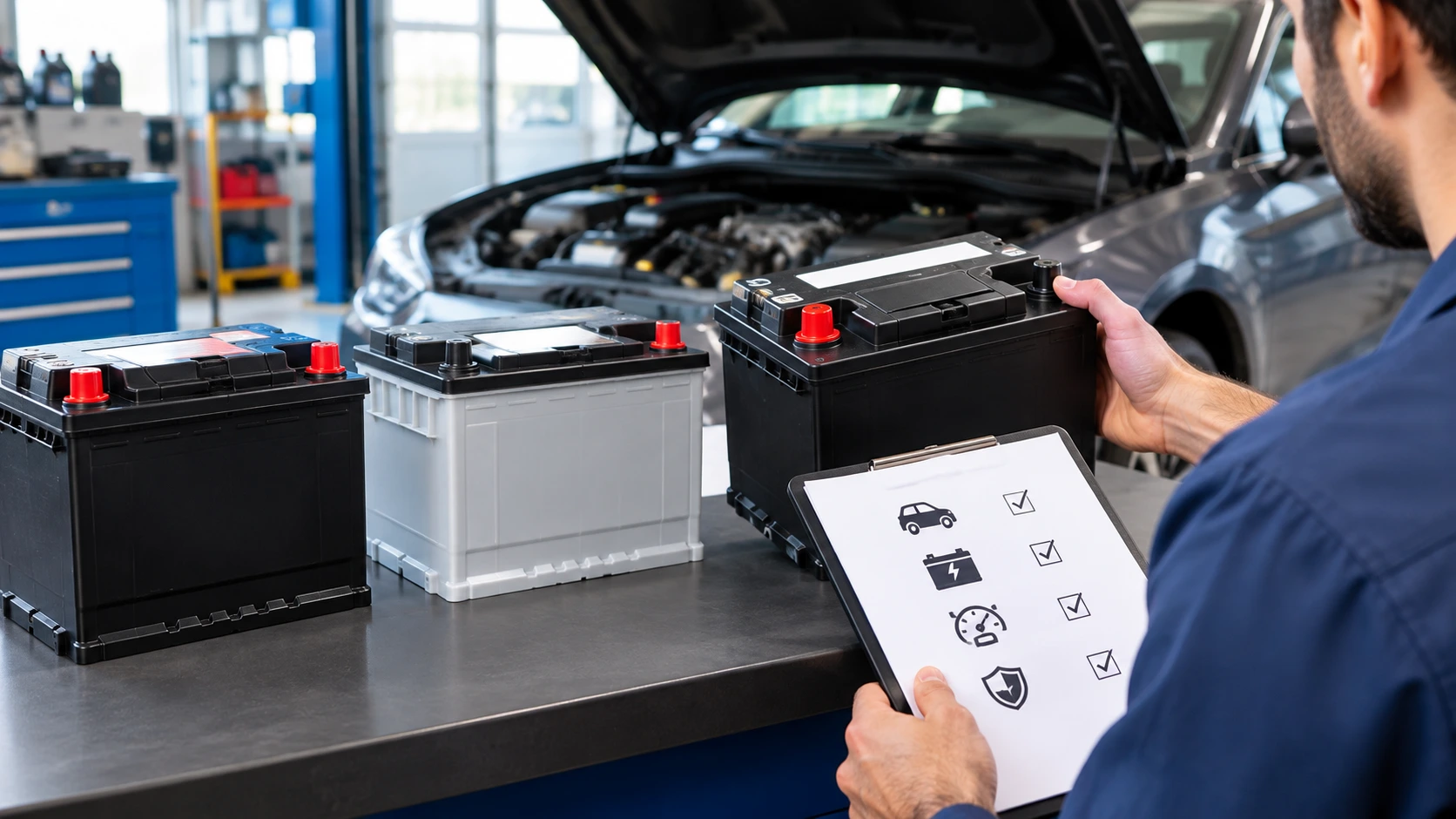
A few weeks after a cheap battery replacement, your SUV starts showing a start stop warning at every set of lights on Al Khail Road.
The infotainment screen resets on start up, a warning about a weak battery appears and the new battery feels tired already. The car was fine before. On a modern car, choosing the correct car battery is not only about whether the engine starts. The battery is part of an electronic system that manages charging, start stop and many comfort features.
Older cars had a simple setup. The alternator charged the battery, and any battery that fitted and had enough power would usually work. Modern cars use battery sensors, smart alternators, start stop systems and, on some models, braking energy recovery. These systems expect a specific type of battery and adjust their charging to match it.
This guide explains how modern cars manage their batteries and why the type and size matter. It covers what goes wrong with the wrong battery, why registration matters and why Dubai heat raises the stakes. It uses information from battery maker Varta and named UAE sources.
Choosing the Correct Car Battery: Quick Answer
Choosing the correct car battery matters because modern cars use battery sensors, smart charging and start stop. These systems are built around one battery type and size. The wrong battery can switch off start stop and comfort features, set warning lights, upset charging and fail early.
Varta states that cars fitted with an AGM battery must only use an AGM replacement. Varta warns that the wrong battery can cause start stop faults, failures of comfort functions and reduced service life. Many cars also need the new battery registered with a scan tool. A workshop should match the original type, size and capacity, then register the battery so the car charges it correctly.
Table of Contents
- How Battery Needs Have Changed in Modern Cars
- Battery Sensors and Battery Management Systems
- Smart Alternators and Charging Strategies
- Start Stop Systems and Why They Need Special Batteries
- Braking Energy Recovery and AGM Batteries
- EFB, AGM and Flooded Batteries Compared
- What Happens if You Fit the Wrong Type
- Why Capacity and Size Still Matter
- Why Battery Registration Matters
- Hybrids and Their 12 Volt Batteries
- Why Battery Choice Affects Fuel Use
- Why Some Batteries Sit in the Boot or Under a Seat
- Electrical Faults That Follow a Wrong Battery
- Why Dubai Heat Raises the Stakes
- How Workshops Choose the Right Battery
- What a Correct Battery Costs in Dubai
- How to Check What Your Car Needs
- Can a Wrong Battery Damage the Car?
- What to Do if the New Battery Fails Early
- FAQ
- Conclusion
How Battery Needs Have Changed in Modern Cars
A car built twenty years ago used its battery mainly to start the engine and power a few lights and a radio. Once the engine was running, the alternator did almost all the work.
Modern cars use far more electricity. They have engine computers, many control modules, screens, cameras, parking sensors, power seats, heated or cooled seats, keyless entry and driver assistance systems. Many of these stay partly awake even when the car is parked.
The battery now has to supply sudden large loads, recover quickly and work closely with the car’s electronics. That is why battery choice has become a technical decision rather than a simple size match.
Battery Sensors and Battery Management Systems
Many modern cars have an intelligent battery sensor on the negative terminal. It measures current flowing in and out of the battery, voltage and temperature. The car’s battery management system uses that data to work out the battery’s state of charge and health.
Varta explains that EFB and AGM batteries are monitored by a battery sensor and closely linked to the battery management system. The system uses this data to decide when and how hard to charge. It also decides when to allow start stop and when to switch off comfort features to save starting power.
If the system is set up for one type of battery and a different type is fitted, its calculations are wrong. It may charge the battery too much or too little.
Smart Alternators and Charging Strategies
Older alternators charged the battery all the time. Many modern cars use smart charging, where the alternator output is controlled by the engine computer.
To save fuel, the car may cut charging while cruising. It then charges harder when you lift off or brake, using energy that would otherwise be wasted. The battery must accept charge quickly in short bursts and work well when it is not fully charged.
Batteries designed for this, such as EFB and AGM types, handle partial charge better than standard flooded batteries. A standard battery in a smart charging car can be undercharged for long periods, which shortens its life.
Start Stop Systems and Why They Need Special Batteries
Start stop systems switch the engine off when the car stops in traffic. They restart it when you lift off the brake. While the engine is off, the battery runs the AC fan, lights, screens and other systems.
In Dubai traffic, that can mean dozens of stops and restarts on a single commute along Sheikh Zayed Road. Each restart takes a burst of power from the battery.
Varta explains that EFB batteries suit compact and mid range cars with simple start stop. AGM batteries suit larger cars, SUVs and premium cars with more demanding systems. Varta also notes EFB batteries offer twice the charging cycles of conventional starter batteries. A standard battery is not built for that many deep cycles and wears out quickly.
Braking Energy Recovery and AGM Batteries
Some cars recover energy when braking or coasting by running the alternator harder, then use that stored energy later. Varta notes that cars with start stop plus braking energy recovery are among those that need AGM batteries.
AGM batteries hold the acid in glass mats, which lets them accept high charging currents and handle repeated deep cycles. They are also sealed and leak proof.
A battery that cannot accept high charge rates wastes recovered energy and may overheat or wear faster. That is why the car maker specifies AGM for these systems.
EFB, AGM and Flooded Batteries Compared
Here is how the main types compare, based on Varta’s descriptions:
- Flooded lead acid: the traditional type, suited to older cars and simpler electrical systems without start stop.
- EFB: an improved flooded design with a special layer on the positive plate. It suits simple start stop cars and cars with demanding city use. Varta says it offers twice the charging cycles of a conventional battery.
- AGM: a sealed design with acid held in glass mats. It suits premium cars, SUVs and cars with start stop and braking energy recovery.
Varta states that if a car came with an AGM battery, only an AGM battery may be used as a replacement. A car that came with EFB can use EFB, or upgrade to AGM if it has high power demand.
What Happens if You Fit the Wrong Type
Varta warns that using the wrong battery can cause start stop deficiencies, failures of comfort functions and reduced battery service life.
In practice, drivers may see start stop stop working or show an unavailable message. The car may switch off seat heating, rear window heating or other loads to protect starting power. Warning lights or messages about the battery or charging system may appear.
A flooded battery fitted in place of an AGM often fails within months, because it cannot handle the deep cycling and charging pattern. That turns a cheaper battery into a more expensive choice.
Why Capacity and Size Still Matter
Even with the correct type, size and capacity matter. A battery with too little capacity runs down faster when the engine is off and has less margin in heat.
The battery management system on many cars is also set to the capacity of the battery, often during registration. Fitting a much larger or smaller battery without updating the setting can lead to incorrect charging.
The battery must also fit the tray and hold down and have terminals on the correct side. A loose battery can vibrate and fail early. Terminals on the wrong side can stretch cables.
Why Battery Registration Matters
On many modern cars, especially European models, a new battery must be registered with the car’s computer using a scan tool. Registration tells the battery management system that a new battery has been fitted, and on some cars records its type and capacity.
Without registration, the system may treat the new battery as the old, worn one. It may then charge it too hard, which can overheat it. Or it may apply settings meant for a different battery type.
CarSwitch lists an OBD diagnostic scan at about AED 50 to 150 in the UAE. Registration usually takes a few minutes with the right tool. A professional battery replacement should include it where the car needs it.
Hybrids and Their 12 Volt Batteries
Hybrid cars have a large high voltage battery for driving and a separate 12 volt battery for the car’s electronics. The 12 volt battery powers the computers that start the hybrid system.
Many hybrids use an AGM 12 volt battery, sometimes fitted in the boot or under a rear seat. It must be the correct type, size and venting style for its location.
A weak 12 volt battery in a hybrid can stop the car from starting even when the main hybrid battery is fully charged. Choosing the correct replacement is just as important as on a petrol car.
Why Battery Choice Affects Fuel Use
Start stop and smart charging exist mainly to save fuel. When the battery is the wrong type or poorly charged, the car often disables start stop and charges the battery harder while driving.
That means the engine idles at every stop again and the alternator takes more power from the engine. In stop and start traffic on Sheikh Zayed Road or in Deira, the fuel saving the system was built for is lost.
The correct battery lets these systems work as designed, so the car uses less fuel in exactly the conditions where it spends most of its time.
Why Some Batteries Sit in the Boot or Under a Seat
Many modern cars move the battery out of the engine bay. It may sit in the boot, under the rear seat or under the floor. That keeps it away from engine heat and improves weight balance.
Batteries inside the cabin or boot must be sealed or vented to the outside. AGM batteries are sealed, which is one reason they are used in these positions. A flooded battery in the boot without a vent tube can release gas into the car.
When replacing a battery in these locations, the type and venting must match the original exactly.
Electrical Faults That Follow a Wrong Battery
A wrong or poorly fitted battery can cause faults that look unrelated. Drivers report flickering dashboard lights, slow power windows, infotainment glitches and random sensor warnings. CarSwitch lists these among electrical symptoms that UAE drivers notice in summer.
Low voltage can make control modules set fault codes, which then stay stored even after the battery is fixed. Some cars lose window, sunroof or steering angle settings after a battery change and need them reset.
Keyless entry and immobiliser systems can also behave oddly if the voltage is low or unstable. If a key stops being recognised after a battery change, a car key repair specialist can check the key and immobiliser.
Why Dubai Heat Raises the Stakes
Heat shortens battery life in every car. CarSwitch explains that extreme heat is harder on batteries than cold, because heat speeds up chemical breakdown. PitStopArabia notes that batteries in Dubai usually last 2 to 3 years, and can fail at about 18 months without proper care.
On a summer afternoon when the air passes 45°C, the engine bay of a car stuck in traffic gets far hotter. A battery that is the wrong type, or that is overcharged by an unregistered management system, suffers even more.
A start stop car in Dubai also runs the AC fan from the battery at every stop. That adds load in exactly the conditions where a battery is under the most stress.
How Workshops Choose the Right Battery
A careful workshop checks the original battery type, size code, capacity and cold cranking amps. It then confirms them against the maker’s figures for the exact model and engine.
The technician tests the alternator and starter, then fits the new battery. The terminals and hold down are tightened, any vent tube is connected and the battery is registered if needed. Some cars also need settings reset after the change.
A trained car mechanic near you will also check whether a drain or charging fault caused the old battery to fail. If the car has repeated electrical faults, an auto electrical repair check can find wiring or module problems.
What a Correct Battery Costs in Dubai
PitStopArabia notes that battery replacement in Dubai costs between AED 150 and AED 1,500. Most saloons and SUVs fall between AED 300 and 800.
AGM batteries usually cost more than flooded or EFB batteries. Batteries for premium cars, large SUVs and cars with boot mounted batteries often sit at the upper end, especially when registration is included.
The correct battery may cost more up front. It avoids the repeat cost of a battery that fails early.
How to Check What Your Car Needs
Look at the label on the current battery. It usually shows whether it is AGM or EFB, along with the size code and CCA. Take a clear photo of the label before the old battery is removed, so you can compare it with the replacement.
Check your owner’s manual. Many manuals state the battery type and warn if a special battery is required. Some cars also have a sticker under the bonnet or near the battery.
If the car has start stop, assume it needs EFB or AGM until confirmed otherwise. If you are not sure, ask a workshop to look up the exact specification for your car’s VIN.
Can a Wrong Battery Damage the Car?
Usually it damages itself more than the car. A wrong battery is most likely to fail early, cause start stop and comfort features to switch off and trigger warning messages.
There are some risks to the car too. A battery that is overcharged can overheat, swell or leak acid. Acid can damage the battery tray, wiring and nearby paint. If acid has marked the area, it can be repaired through paint and panel repair.
A battery fitted in the cabin or boot without the correct vent tube can release gases inside the car. That is why the correct type and fitting matter for boot mounted batteries.
What to Do if the New Battery Fails Early
If a new battery goes flat or shows warnings within months, have it tested along with the charging system. Check the invoice for the type and warranty.
If the battery is the wrong type, ask for the correct one to be fitted and registered. If a charging fault or drain is found, it must be fixed first, or the next battery will fail too.
If the car will not start at home, a mobile mechanic can test and replace the battery where it is parked. If it fails on the road, move to the hard shoulder rather than stopping in a live lane. Stopping in a live lane because of a breakdown brings a AED 1,000 fine and six black points under Article 98 of the UAE Federal Traffic Law. Once safe, call roadside assistance.
A regular car service in Dubai should include a battery and charging check. When replacing a battery on a modern car, choose a car garage near you that checks the type and registers the new battery.
FAQ
Here are the questions Dubai drivers most often ask about choosing a battery.
Why does my car need an AGM battery?
Cars with advanced start stop and braking energy recovery need batteries that handle deep cycles and fast charging. Varta states that cars fitted with AGM must only use AGM replacements.
What happens if I fit the wrong battery?
Varta warns that the wrong battery can cause start stop faults, comfort features to switch off and shorter battery life. Warning lights and charging problems are also common.
Does a new battery need registration?
On many modern cars, yes. Registration tells the battery management system a new battery is fitted, so it charges correctly. It takes a few minutes with a scan tool.
Can I use EFB instead of AGM?
No, if the car came with AGM. Varta states that only AGM may replace AGM in these cars. A car that came with EFB can use EFB or upgrade to AGM.
Why does start stop fail after battery change?
The usual causes are the wrong battery type, a battery that was not registered or a battery that is not fully charged yet. The management system disables start stop to protect starting power.
Conclusion
Choosing the correct car battery matters on modern cars. Battery sensors, smart charging and start stop are built around one battery type, size and capacity. The wrong battery can switch off start stop and comfort features, trigger warnings and fail early, especially in Dubai heat. Matching the original specification, testing the charging system and registering the new battery gives the best result.
Rapid Rev Garage is a full workshop at Al Khail Gate, 12th Street, Al Quoz Industrial Area 2, open until 9 PM and serving passenger cars across Al Quoz, Business Bay, Jumeirah, Al Barsha, Satwa, Downtown and the Sheikh Zayed Road corridor. Visit https://rapidrevgarage.com, send your car model and a photo of the battery label on WhatsApp, or get directions on Google Maps.
Rapid Rev Garage | Choosing the Correct Car Battery | Al Quoz, Dubai