Your car pulls fine around Al Barsha, then stumbles when you press hard to merge onto Sheikh Zayed Road. Some mornings it cranks for a few seconds longer than it used to, and the check engine light comes on with a lean code. These are classic signs of low fuel pressure, and the cause is not always the fuel pump.
Fuel pressure is the push that sends petrol from the tank to the injectors. If that push is too weak, the injectors spray less fuel than the engine computer expects, and the engine runs lean. Power drops first under load, then at idle, and in time the car may stall or refuse to start.
This guide explains what fuel pressure does, the warning signs and the seven most common causes. It shows how a workshop tests pressure, volume and voltage, and what each fix involves. It also covers faults that copy the same symptoms, so you do not pay for a pump when a cheap filter was the real problem.
Low Fuel Pressure: Quick Answer
Low fuel pressure is usually caused by a weak fuel pump, a clogged filter or pump strainer, or a faulty pressure regulator. Voltage drop at the pump plug and leaks in the lines or injectors are also common. On direct injection engines, a worn high pressure pump can also be the cause.
The signs are hesitation under load, long cranking, stalling, poor fuel economy and lean codes such as P0171. Before replacing any part, a mechanic runs a pressure gauge test, a volume test, a fuel trim check and a voltage drop test.
Table of Contents
- What Fuel Pressure Does in Your Engine
- Warning Signs of Weak Fuel Pressure
- A Weak or Worn Fuel Pump
- A Clogged Fuel Filter or Pump Strainer
- A Faulty Fuel Pressure Regulator
- Voltage Drop at the Pump Connector
- Leaks in the Fuel Line or Injector Rail
- A Failing High Pressure Pump on Direct Injection Engines
- Why Dubai Heat and Low Tank Levels Make It Worse
- How a Mechanic Confirms the Pressure Problem
- Faults That Look Like a Fuel Pressure Problem
- Is It Safe to Keep Driving?
- How to Prevent Fuel Pressure Problems
- Why Choose Rapid Rev Garage for Fuel Pressure Testing
- FAQ
- Conclusion
What Fuel Pressure Does in Your Engine
Fuel pressure sets how much petrol leaves each injector every time it opens. The engine computer decides how long each injector stays open, but it assumes the pressure behind the fuel is correct. When pressure falls, the same opening time delivers less fuel.
Most port injected petrol engines run at roughly 40 to 60 psi in the fuel rail. Direct injection engines add a second pump driven by the engine. It raises pressure to well over 2,000 psi so fuel can be sprayed straight into the cylinder. The electric pump in the tank still feeds that second pump, so a weak tank pump can starve both systems.
Brake and Front End magazine explains that very low fuel pressure causes a lean air and fuel mixture. The engine computer tries to correct this by holding the injectors open longer, which can also spoil the spray pattern. That is why a pressure fault often shows up as rough running and poor economy before the car stops completely.
Warning Signs of Weak Fuel Pressure
The first sign is usually hesitation when the engine needs the most fuel. Pulling away on Al Khail Road, climbing a ramp at Dubai Mall or overtaking with a full car all raise fuel demand. A system with weak pressure keeps up at idle but falls behind under load, so the car jerks or feels flat.
Long cranking is the second common sign. If pressure bleeds away after you switch off, the pump has to refill the line before the engine can start. The car may crank for three or four seconds in the morning, then start normally once warm.
Other signs include stalling at low speed, a rough or hunting idle, higher fuel use and a check engine light. Lean codes P0171 for bank 1 and P0174 for bank 2 are common. On many direct injection cars, code P0087 means the fuel rail or system pressure is too low.
A Weak or Worn Fuel Pump
A tired pump is the most common cause, but it should be the last part condemned. Brake and Front End notes that a worn pump that cannot deliver enough volume often causes problems with no fault code at all. Surging, loss of power and stalling are typical.
Pumps wear in two ways. The electric motor’s brushes and armature wear, so the pump spins slower and moves less fuel. The pumping parts also wear, which lowers pressure even when the motor is healthy.
Brake and Front End points out that high current draw suggests worn bushings or a restriction. Low current draw points to mechanical wear inside the pump. A lab scope on the pump’s power wire shows these patterns, so the mechanic can tell a bad pump from a blockage.
A Clogged Fuel Filter or Pump Strainer
A blocked filter restricts flow, so pressure drops as soon as the engine asks for more fuel. Many cars have a sock shaped strainer on the pump inlet inside the tank. Many also have a separate filter in the fuel line or inside the pump module.
Dirt, rust flakes and debris from old fuel collect on these screens. Brake and Front End lists a restricted filter among the causes of high pump current, because the pump works harder to push fuel through. That extra work also shortens the pump’s life.
Changing the filter at the interval in your owner’s manual is cheap insurance. If your car has an external filter, a fuel and air filter replacement is usually a short job. Brake and Front End recommends new in tank and in line filters whenever a pump is replaced.
A Faulty Fuel Pressure Regulator
The regulator controls the pressure in the fuel rail. On older return style systems, it sits on the rail and sends extra fuel back to the tank. On returnless systems, it sits inside the pump module in the tank.
If the regulator’s spring weakens or its valve sticks open, too much fuel returns to the tank and rail pressure drops. On vacuum referenced regulators, Brake and Front End explains that pressure should rise by about 4 to 6 psi at full throttle. A regulator that does not respond this way can leave the engine lean under load.
A torn diaphragm inside the regulator can also let fuel into the vacuum hose. A mechanic checks for wet fuel in that hose and watches the pressure gauge as the hose is removed. The guide on why a car smells of fuel and runs rich covers the opposite failure, where pressure climbs too high.
Voltage Drop at the Pump Connector
A healthy pump will run slow if it is not getting full voltage. MS Motorservice, the parts maker behind Pierburg pumps, notes that a typical fuel pump draws about 5 to 8 amps. At that current, even a small amount of corrosion in a plug or ground wire causes a real drop in voltage.
MS Motorservice says the pump should see at least 12.5 to 13 volts with the engine running. A reading under 11 volts points to a fault. Lower voltage means lower pump speed, lower pressure and lower flow.
Common causes are a corroded plug on the pump module, a weak ground, a relay with burnt contacts and heat damaged wiring. MS Motorservice advises checking every contact before replacing the pump, because a bad connection can mimic a failed pump. An auto electrical repair specialist can trace the drop with a meter and fix the wiring for far less than a pump.
Leaks in the Fuel Line or Injector Rail
A leak lets fuel escape before it reaches the injectors. External leaks are easy to spot by smell, a wet patch under the car or fuel on the engine. Internal leaks are harder, because the fuel goes somewhere you cannot see.
Brake and Front End explains that the system should hold residual pressure for a set time after the engine is switched off. If pressure falls quickly, the mechanic checks the lines, the injectors, the regulator and the check valve inside the pump. A leaking injector drips fuel into a cylinder, while a leaking check valve lets fuel drain back to the tank.
A cracked filler neck or a weeping pump seal can also drip petrol onto the paint near the fuel flap. Petrol softens clear coat over time, and repeated spills leave dull patches that may need paint and panel repair. Any fuel leak is a fire risk and should be fixed before the car is driven again.
A Failing High Pressure Pump on Direct Injection Engines
Direct injection is now common on Hyundai, Kia, Toyota, Volkswagen and BMW models in the UAE. These engines have a mechanical high pressure pump driven by the camshaft. It takes fuel from the tank pump and raises it to the very high pressure the injectors need.
When this pump wears, the car may run fine at idle and lose power at speed, sometimes with code P0087. The engine computer may limit power to protect the engine. A worn cam lobe or cam follower can cause the same fault. On some engines it also leaves metal particles in the oil.
The mechanic reads both the low side and high side pressure on a scan tool and compares them with the commanded value. If the low side is correct and the high side is not, the high pressure pump, its control valve or the drive is checked. This is deeper engine repair, so it is worth confirming the readings before buying parts.
Why Dubai Heat and Low Tank Levels Make It Worse
Heat lowers fuel pressure in two ways. The in tank pump is cooled by the fuel around it. UAE mechanics quoted by Khaleej Times warn that driving close to empty leaves the pump without that cooling, so it wears early.
Hot fuel also turns to vapour more easily. Research published by SAE International explains that petrol can start to boil at around 40°C. Vapour in the tank then lowers the pump’s output until the engine stalls. When the air passes 45°C, a car parked in the open at Ibn Battuta can have very hot fuel in the tank.
Stop and go traffic adds to it, because the engine bay heats the fuel lines while the car crawls. A pump that is already weak may pass a test on a cool morning and fail on a hot afternoon. That is why some cars only show the pressure fault in summer.
How a Mechanic Confirms the Pressure Problem
A proper diagnosis measures pressure, volume and voltage before any part is replaced. Book these tests with an experienced car mechanic near you who records the readings and shows them to you.
Pressure Gauge Test
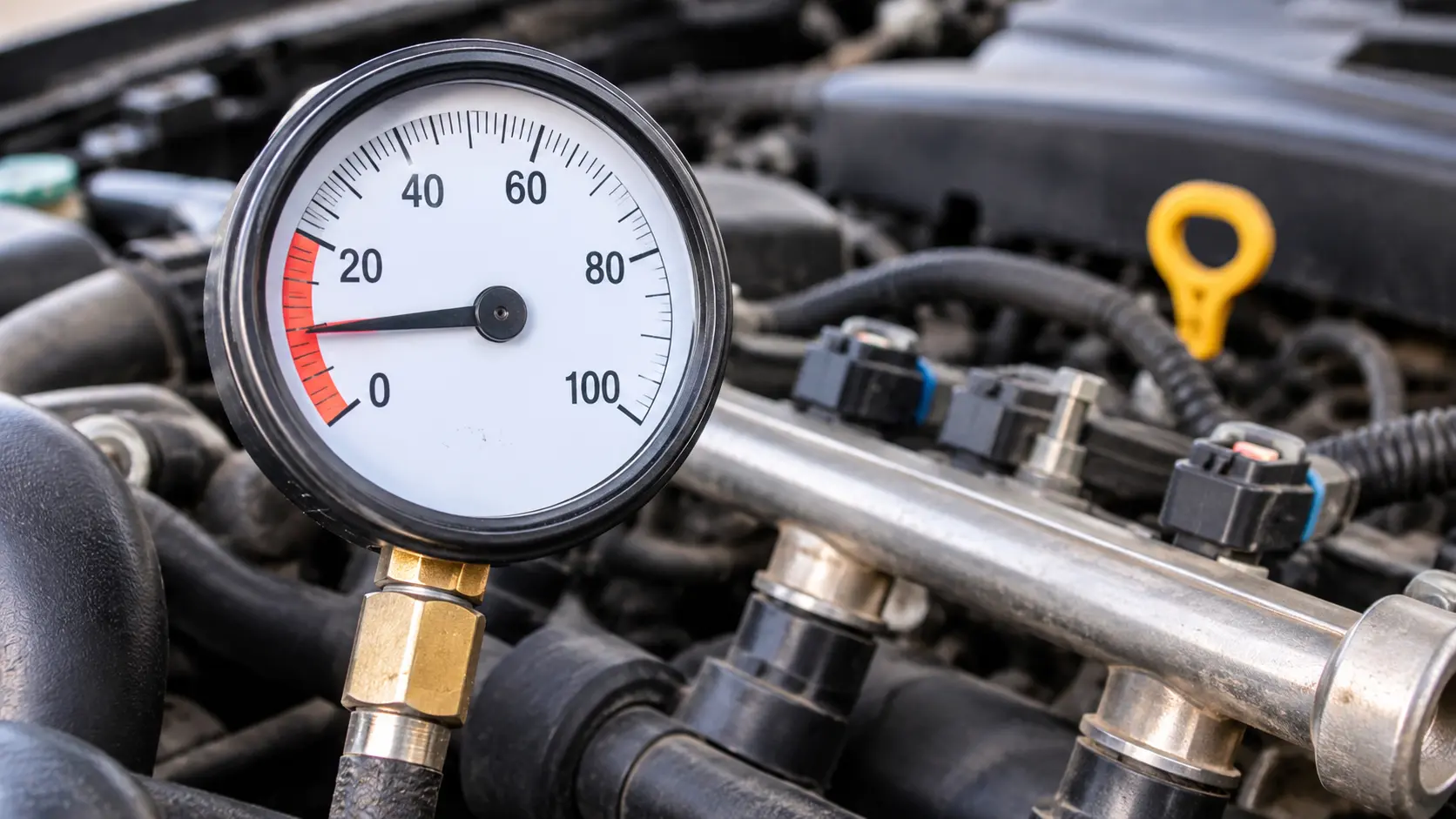
A gauge is connected to the fuel rail or in line between the pump and the rail. The mechanic records pressure at key on, during cranking, at idle and at higher engine speed, then compares each reading with the maker’s specification. The gauge is left on after the engine is switched off to see whether pressure holds.
Fuel Volume Test
Pressure alone can mislead. Brake and Front End calls a static pressure test a poor guide to pump health. A pump can reach the right pressure while moving too little fuel. The mechanic measures how much fuel the pump delivers into a marked container over a set time and compares it with the specification.
Fuel Trim Reading
A scan tool shows how much the engine computer is adding or removing fuel. Brake and Front End says short term fuel trims should read within about plus or minus 5 percent. Readings above plus 10 percent under hard acceleration can point to a blocked filter or a weak pump.
Voltage Drop Test
The mechanic measures voltage at the pump plug with the engine running, then checks each part of the circuit for drop. MS Motorservice recommends measuring pressure and flow first, then checking every electrical contact before the pump is replaced.
Faults That Look Like a Fuel Pressure Problem
Several other faults cause the same hesitation and lean codes. A vacuum leak lets unmeasured air into the engine, so the mixture runs lean even when fuel pressure is perfect. A dirty mass airflow sensor under reads the air entering the engine, so the computer adds too little fuel.
Ignition faults such as worn spark plugs or a failing coil cause misfires that feel like fuel starvation. A blocked catalytic converter makes the car feel weak at speed. A failing crankshaft sensor can cause stalling and long cranking when hot.
A good car garage near you checks these with a smoke test, live sensor data and a misfire count before blaming the fuel system. The guides on the symptoms of an engine vacuum leak and on failing mass airflow sensors explain those faults in more detail.
Is It Safe to Keep Driving?
Driving with weak fuel pressure is risky because the car can lose power or stall without warning. A lean engine also runs hotter, and long periods of lean running can damage pistons, valves and the catalytic converter.
If the car stumbles or stalls on a highway, use the speed you have to reach the hard shoulder or the next exit. Stopping in a live lane because of a breakdown brings a AED 1,000 fine and six black points under Article 98 of the UAE Federal Traffic Law. Once safe, call roadside assistance.
If the car will not restart, it will need towing to a workshop. If it still starts at home, a mobile mechanic can read the codes and test the fuse, relay and pump voltage before you drive it further.
How to Prevent Fuel Pressure Problems
Keep at least a quarter tank, especially from June to September. That keeps the pump covered and cooler and reduces vapour in the tank. Khaleej Times reported Special 95 at AED 4.28 a litre in October 2026. At that price, a quarter tank in a 62 litre saloon costs about AED 66.
Replace the fuel filter on schedule if your car has a serviceable one, and fill up at busy stations where fuel turns over quickly. Keep the battery healthy, since a weak battery lowers system voltage and slows the pump.
Avoid filling up while a tanker is unloading at the station, since the delivery can stir up sediment in the underground tank. If the car has sat unused for months, for example over a long summer holiday, old fuel can leave varnish on the pump strainer. Have the fuel system checked before a long drive if the car cranks longer than usual after that kind of break.
A regular car service in Dubai includes a scan for stored codes and a look at fuel trims. Those numbers can reveal a weak pump or filter months before it fails. Ask for the trim figures to be noted on your service record so changes are easy to spot.
Why Choose Rapid Rev Garage for Fuel Pressure Testing
Rapid Rev Garage in Al Quoz is a good choice for drivers chasing a fuel pressure fault. Fuel, electrical and filter work are handled at the same workshop, so the cause can be found and fixed in one visit.
Fuel, Electrical and Filter Work at One Workshop
The workshop offers engine repair, auto electrical repair and filter replacement as separate services. A fault that turns out to be a corroded plug or a blocked filter does not need to go elsewhere. A failed pump can also be replaced on site.
Readings You Can Ask to See
Drivers can ask for the pressure, volume, fuel trim and voltage readings before approving a new pump. That keeps the decision based on numbers, which matters when a pump costs far more than a filter.
Easy to Reach From the Main Roads
The workshop sits at Al Khail Gate, 12th Street, Al Quoz Industrial Area 2, a short drive from Sheikh Zayed Road and Al Khail Road. Drivers from Business Bay, Al Barsha, Jumeirah and Downtown can reach it without a long trip on a car that hesitates.
FAQ
Here are the questions Dubai drivers most often ask about fuel pressure problems.
What are the symptoms of weak fuel pressure?
The most common signs are hesitation under load, long cranking, stalling at low speed and a rough idle. Higher fuel use and lean codes such as P0171 or P0174 are also typical.
Can a clogged fuel filter cause this?
Yes. A blocked filter or pump strainer restricts flow, so pressure drops when the engine needs more fuel. It also makes the pump work harder and wear faster.
How do mechanics test fuel pressure?
They fit a gauge to the rail and record pressure at key on, cranking, idle and higher speed. They also measure fuel volume, read fuel trims and check voltage at the pump plug.
Will weak fuel pressure damage my engine?
It can. A lean engine runs hotter, and long periods of lean running can harm pistons, valves and the catalytic converter. Stalling in traffic is the more immediate risk.
Is a bad fuel pump always the cause?
No. A clogged filter, a faulty regulator, a corroded plug or a leaking injector can all cause the same symptoms. Testing comes first.
Conclusion
Low fuel pressure starves the engine of fuel, so it hesitates under load, cranks longer and may stall. The pump may be at fault, but a clogged filter, a faulty regulator, voltage drop or a leak are just as common. Testing pressure, volume, fuel trims and voltage tells them apart, so only the failed part is replaced.
Rapid Rev Garage is a full workshop at Al Khail Gate, 12th Street, Al Quoz Industrial Area 2, open until 9 PM and serving passenger cars across Al Quoz, Business Bay, Jumeirah, Al Barsha, Satwa, Downtown and the Sheikh Zayed Road corridor. Visit https://rapidrevgarage.com, send your car model and symptoms on WhatsApp, or get directions on Google Maps.
Rapid Rev Garage | Low Fuel Pressure | Al Quoz, Dubai