The car feels flat pulling up the ramp out of the Dubai Mall car park. It hesitates when you join Sheikh Zayed Road, and once or twice it has stalled at a junction. A mechanic may suspect the fuel pump, the spark plugs or the gearbox, but these are also common bad MAF sensor symptoms, and the sensor is often the cheaper fix.
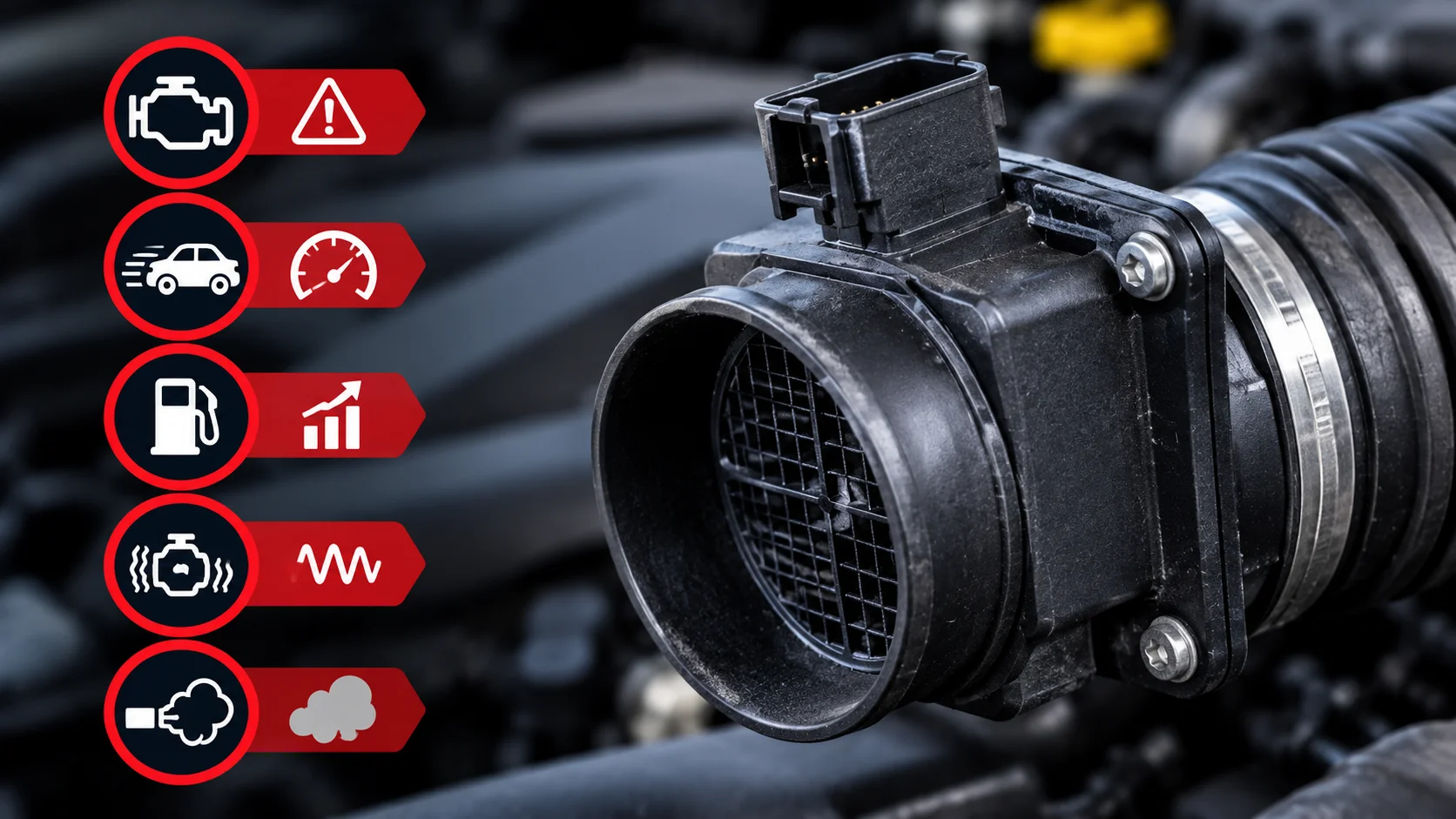
The mass airflow sensor, or MAF sensor, measures how much air enters the engine. The engine computer uses that reading to decide how much fuel to inject. When the sensor reads wrong, the mixture goes wrong too, and the engine runs weak, rough or rich.
This guide explains how the MAF sensor works, the signs it is failing, why Dubai dust makes it worse, how a workshop tests it, and when cleaning is enough or replacement is needed. It also covers the faults that look like a bad MAF sensor, so you do not replace the wrong part.
Bad MAF Sensor Symptoms: Quick Answer
The main bad MAF sensor symptoms are hesitation and poor acceleration, lack of power, rough idle, stalling, hard starting, higher fuel use, black smoke or a fuel smell, odd automatic gear changes and a check engine light. Samarins lists codes P0100 to P0103 for the sensor circuit, plus lean codes P0171 and P0174.
A dirty sensor usually under reads airflow, so the engine runs lean. A mechanic compares the sensor’s reading in grams per second with the expected figure at idle and at higher rpm. Cleaning with MAF cleaner can fix a dirty sensor, while a failed one needs replacing.
Table of Contents
- What the MAF Sensor Does
- Why MAF Sensors Get Dirty Faster in Dubai
- Hesitation and Poor Acceleration
- Lack of Power on Ramps and Highways
- Rough Idle and Stalling
- Hard Starting
- Higher Fuel Use, Black Smoke or Fuel Smell
- Odd Automatic Gear Changes
- Check Engine Light and MAF Fault Codes
- Faults That Look Like a Bad MAF Sensor
- How a Workshop Tests a MAF Sensor
- Cleaning or Replacing a MAF Sensor
- Can You Clean a MAF Sensor Yourself?
- Can a Bad Air Filter Damage the MAF Sensor?
- Is It Safe to Drive With a Bad MAF Sensor?
- How to Protect the MAF Sensor
- Why Does My Car Hesitate After an Air Filter Change?
- Do Aftermarket Air Intakes Cause MAF Problems?
- Can a MAF Sensor Fail Without a Code?
- FAQ
- Conclusion
What the MAF Sensor Does
The MAF sensor sits in the air intake tube between the air filter box and the throttle body. Samarins explains that it measures the amount of air entering the engine, so the engine computer can calculate how much fuel to inject and keep the air and fuel ratio correct.
Most modern MAF sensors use a heated wire or film. Samarins describes how the more air flows over the wire, the more current is needed to keep it hot, and that current is proportional to the airflow. The sensor turns this into a signal the computer reads.
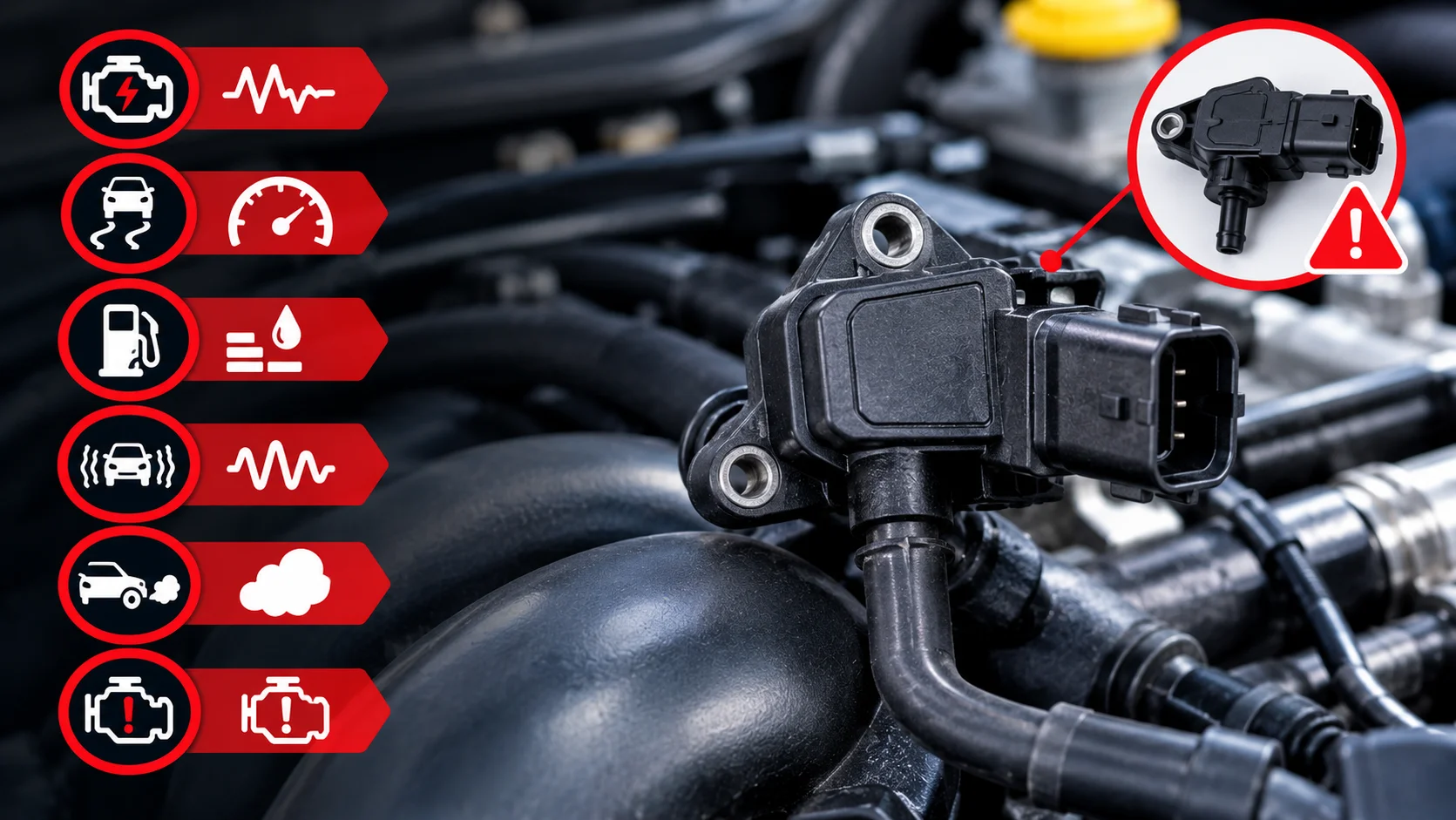
Many sensors also include an intake air temperature sensor in the same housing. Some engines, especially turbocharged ones, use both a MAF sensor and a MAP sensor. The guide on the symptoms of a bad MAP sensor explains how the two differ.
Why MAF Sensors Get Dirty Faster in Dubai
The sensing wire is very fine, and anything that coats it changes the reading. Dust, oil mist and debris all stick to it. A coated wire cools differently, so the sensor usually reports less air than is really flowing.
Dubai’s fine silica dust is a big part of the problem, especially around Al Quoz industrial roads, construction sites and desert roads such as Al Qudra. A clogged, torn or poorly seated air filter lets dust past its edges. Samarins lists an improperly installed or collapsed air filter as a cause of MAF trouble.
Oil is the other enemy. Samarins warns that over oiling a washable air filter can contaminate the sensor. Oil mist from the PCV system can also reach the sensor on some engines when the engine is switched off.
Hesitation and Poor Acceleration
Hesitation is one of the most common signs. Samarins lists lack of power and poor acceleration among the driveability problems a defective MAF sensor causes. You press the accelerator, and the engine stumbles before it picks up speed.
The cause is a wrong fuel mixture. If the sensor under reads the air, the computer injects too little fuel, and the engine runs lean as you accelerate. The car feels flat, especially when pulling out at busy junctions or merging onto Al Khail Road.
Hesitation can come from many faults, including a dirty throttle body, a weak fuel pump or worn spark plugs. Testing the sensor’s readings is the only way to know.
Lack of Power on Ramps and Highways
A failing MAF sensor often shows most under load. Climbing the spiral ramps of multi storey car parks, overtaking on the highway or driving with a full car and the AC on full all need the engine to deliver more power.
If the sensor reports less air than is really flowing, the computer limits the fuel, and the engine cannot produce full power. Some cars also reduce boost on turbo engines when the airflow reading does not match what the computer expects.
The car may feel fine around town and only weak when you ask for full power. That pattern is a useful clue for a mechanic.
Rough Idle and Stalling
Samarins lists stalling among the problems a defective MAF sensor causes. At idle, the engine uses very little air, so even a small reading error makes a big difference to the mixture. The idle may shake, hunt up and down or drop low enough to stall.
Stalling often happens just after starting or as you slow to a stop. The car may restart straight away and run until the next stop. The guide on what causes a car to stall on the road covers the other faults that cause the same pattern.
Hard Starting
Samarins notes that a defective MAF sensor can cause a no start. A sensor that sends a badly wrong signal at cranking gives the computer the wrong fuel amount, and the engine struggles to fire.
Some cars start, run for a second and then stall. A useful test is to start the engine with the MAF sensor unplugged. Many computers then use a backup value, and if the car starts and idles better without the sensor, the sensor is likely at fault.
That test should be done by a mechanic, because unplugging sensors with the engine running can set extra codes, and some engines behave differently.
Higher Fuel Use, Black Smoke or Fuel Smell
A MAF sensor that over reads airflow makes the engine run rich. The computer injects more fuel than needed, so fuel use rises, the exhaust may smell of fuel, and black smoke or soot can appear at the tailpipe.
A sensor that under reads can also raise fuel use over time. The engine feels weak, so you press the pedal harder, and the computer’s long term corrections may overshoot.
Keep an eye on how often you fill up. A noticeable rise in fuel use with no change in your driving is worth a check.
Odd Automatic Gear Changes
Samarins notes that a bad MAF sensor can alter the shifting pattern of an automatic gearbox. Many automatic gearboxes use engine load, which the computer works out from the MAF reading, to decide when to change gear and how firmly.
A wrong reading can make the gearbox shift too early, too late, too harshly or too softly. Drivers often think the gearbox is failing. Before booking a gearbox repair or a transmission fluid service, have the MAF sensor readings checked.
Check Engine Light and MAF Fault Codes
A failing MAF sensor often turns on the check engine light. Samarins lists these common codes. P0100 is a MAF circuit malfunction, P0101 is a range or performance problem, P0102 is a low input and P0103 is a high input.
Lean codes P0171 and P0174 often appear too, because a dirty sensor under reads the air. Samarins lists both codes among those linked to MAF problems.
A code points to a circuit or a condition, not always a failed part. Damaged wiring, a loose connector or a vacuum leak can set the same codes. An auto electrical check tests the wiring and connector before the sensor is replaced.
Faults That Look Like a Bad MAF Sensor
Several faults cause the same symptoms. A vacuum leak lets in air after the MAF sensor, so the engine runs lean even with a perfect sensor. A split intake boot between the sensor and the throttle body does the same.
A dirty throttle body causes rough idle and stalling. A weak fuel pump or clogged fuel filter causes hesitation and lean codes. A faulty oxygen sensor can make the computer adjust the mixture wrongly.
This is why testing matters. The guides on the symptoms of an engine vacuum leak and the symptoms of a bad throttle body explain those faults in detail.
How a Workshop Tests a MAF Sensor
Samarins explains that technicians measure the MAF sensor reading at different engine speeds with a scan tool, typically at idle, 1,000, 2,000 and 3,000 rpm. A contaminated or bad sensor will usually show lower airflow readings than expected.
A common rule of thumb, given by Rick’s Free Auto Repair Advice, is about 1 gram per second of airflow per litre of engine size at a warm idle. A 2.0 litre engine should read about 2 grams per second, and a 3.5 litre engine about 3.5.
The mechanic also checks fuel trims, looks for vacuum leaks with a smoke test and inspects the air filter and intake tube. Book the test with an experienced car mechanic near you so a vacuum leak or wiring fault is ruled out before a new sensor is fitted.
Cleaning or Replacing a MAF Sensor
If the sensor is dirty but working, cleaning often restores the correct reading. Samarins notes that cleaning is available as a fix, although it may only be temporary if the cause of contamination is not dealt with.
The sensor is removed from the intake tube and sprayed with a cleaner made for MAF sensors. Nothing should touch the wire or film, because it is very fragile. The sensor must dry fully before it is refitted.
If the readings are still wrong after cleaning, or the sensor has failed electrically, it needs replacing. Samarins gives parts prices from about 89 to 380 US dollars, depending on the car. Use a quality sensor, because cheap units often read inaccurately.
Can You Clean a MAF Sensor Yourself?
Yes, on many cars it is a simple job, but care is needed. Disconnect the connector, remove the sensor from the intake tube and spray it with MAF sensor cleaner only. Carburettor or brake cleaner can damage the sensing element.
Never touch the wire or film with a cloth, brush or finger. Let the sensor dry fully before refitting it, and make sure the intake tube clamps are tight afterwards, so no air leaks past.
Spray the cleaner away from the bodywork, because solvent overspray can dull paint and lead to paint and panel repair. If the problem returns within weeks, find out why the sensor is getting dirty.
Can a Bad Air Filter Damage the MAF Sensor?
Yes. A torn, clogged or poorly seated air filter lets dust reach the sensor. Samarins lists an improperly installed or collapsed air filter as a cause of MAF problems. Over oiled washable filters can coat the sensor with oil.
In Dubai, dust storms and dusty roads clog filters quickly. Check the air filter at every service, and replace it more often if you drive on dusty roads. A filter change costs far less than a new MAF sensor.
After fitting a new filter, make sure the air box lid is clipped down evenly and the intake tube is tight. A lid that is not sealed lets unfiltered air in.
Is It Safe to Drive With a Bad MAF Sensor?
A slightly dirty sensor causing mild hesitation is not an emergency, but it should be checked soon. Running lean for a long time can cause knock and overheat the catalytic converter.
Stalling, hard starting and a sudden loss of power are safety problems. A car that hesitates when you pull out into traffic can be dangerous. If the car stalls or loses power on a highway, move to the hard shoulder rather than stopping in a live lane, which brings a AED 1,000 fine and six black points under Article 98 of the UAE Federal Traffic Law. Then call roadside assistance.
If the car still drives safely, a mobile mechanic can read the codes and MAF readings at your home or office.
How to Protect the MAF Sensor
Keep the air filter clean and properly fitted. Replace it at the interval in your service book, and sooner if you drive on dusty roads or after a dust storm. Avoid over oiling washable filters.
Fix PCV faults early, because oil mist from a faulty PCV system can reach the sensor. Make sure the intake tube and clamps are tight after any engine bay work.
A regular car service in Dubai covers the air filter and intake checks. If you already have hesitation, stalling or a MAF code, choose a car garage near you that tests the airflow readings before replacing the sensor.
Why Does My Car Hesitate After an Air Filter Change?
Hesitation straight after a filter change usually means something was disturbed during the job. The most common causes are an air box lid that is not clipped down evenly, an intake tube clamp left loose or the MAF sensor connector not pushed fully home.
A loose clamp or a gap in the air box lets air into the intake without passing the MAF sensor in the normal way. The sensor then reads less air than the engine is really taking in, so the mixture goes lean. A loose connector can make the signal drop in and out.
Check that every clip on the air box is closed and the intake tube is tight at both ends. Make sure the filter itself sits flat in its housing. If the problem started after a service, ask the workshop to recheck the intake before looking for other faults.
Do Aftermarket Air Intakes Cause MAF Problems?
They can. The MAF sensor is calibrated for the size and shape of the original intake tube. An aftermarket intake with a wider tube or a different shape changes how air flows over the sensor, so its reading may no longer match what the computer expects.
Some aftermarket intakes use oiled cotton filters. Samarins warns that over oiling a washable filter can contaminate the MAF sensor. Fine Dubai dust also gets past some open cone filters more easily than a paper filter in a sealed box.
If your car hesitates, stalls or sets lean codes after an intake upgrade, refitting the original intake is often the quickest test. Many manufacturers also note that aftermarket intakes can affect warranty claims on related parts.
Can a MAF Sensor Fail Without a Code?
Yes. A MAF sensor can drift slowly out of accuracy while still sending a signal the computer accepts as normal. The engine then runs slightly lean or rich, and the computer corrects it with fuel trims, so no code appears.
The first signs are often small. Fuel use creeps up, the car feels a little flat on ramps, or the idle is less smooth than it used to be. Only when the error grows large does the computer set a code.
Live data shows the problem before the code does. Comparing the sensor’s grams per second reading with the expected figure, and checking the fuel trims, often reveals a drifting sensor. Ask for these readings at your next service if the car feels weaker than it used to.
FAQ
Here are the questions Dubai drivers most often ask about MAF sensors.
What does a bad MAF sensor feel like?
It usually feels like hesitation when you press the accelerator, weak pulling up ramps or on the highway, a rough idle and sometimes stalling. Fuel use may rise, and automatic gear changes may feel too early, too late or harsh.
Can a dirty MAF sensor cause stalling?
Yes. At idle, the engine uses very little air, so even a small reading error upsets the mixture. A dirty sensor can make the idle hunt and drop until the engine stalls, often just after starting or when slowing down.
Will cleaning a MAF sensor fix it?
Often, if the sensor is only dirty. Use MAF sensor cleaner, never touch the wire and let it dry fully. If the readings are still wrong after cleaning, or the sensor has failed electrically, it needs replacing.
What codes does a bad MAF sensor set?
Common codes are P0100, P0101, P0102 and P0103 for the MAF circuit, plus lean codes P0171 and P0174. Wiring faults and vacuum leaks can set the same codes, so testing comes before replacement.
Can a bad MAF sensor affect shifting?
Yes. Many automatic gearboxes use engine load, calculated from the MAF reading, to decide when to shift. A wrong reading can cause early, late or harsh shifts. Check the MAF sensor before suspecting the gearbox.
Conclusion
A bad MAF sensor causes hesitation, lack of power, rough idle, stalling, hard starting, higher fuel use, odd automatic shifts and codes P0100 to P0103 or lean codes. Dubai dust and poorly fitted air filters make the problem more common. Comparing the sensor’s airflow readings with the expected figures, and ruling out vacuum leaks, confirms the fault before cleaning or replacement.
Rapid Rev Garage is a full workshop open 24 hours at Al Khail Gate, 12th Street, Al Quoz Industrial Area 2, serving passenger cars across Al Quoz, Business Bay, Jumeirah, Al Barsha, Satwa, Downtown and the Sheikh Zayed Road corridor. Visit https://rapidrevgarage.com, send your car model and symptoms on WhatsApp, or get directions on Google Maps.
Rapid Rev Garage | Bad MAF Sensor Symptoms | Al Quoz, Dubai