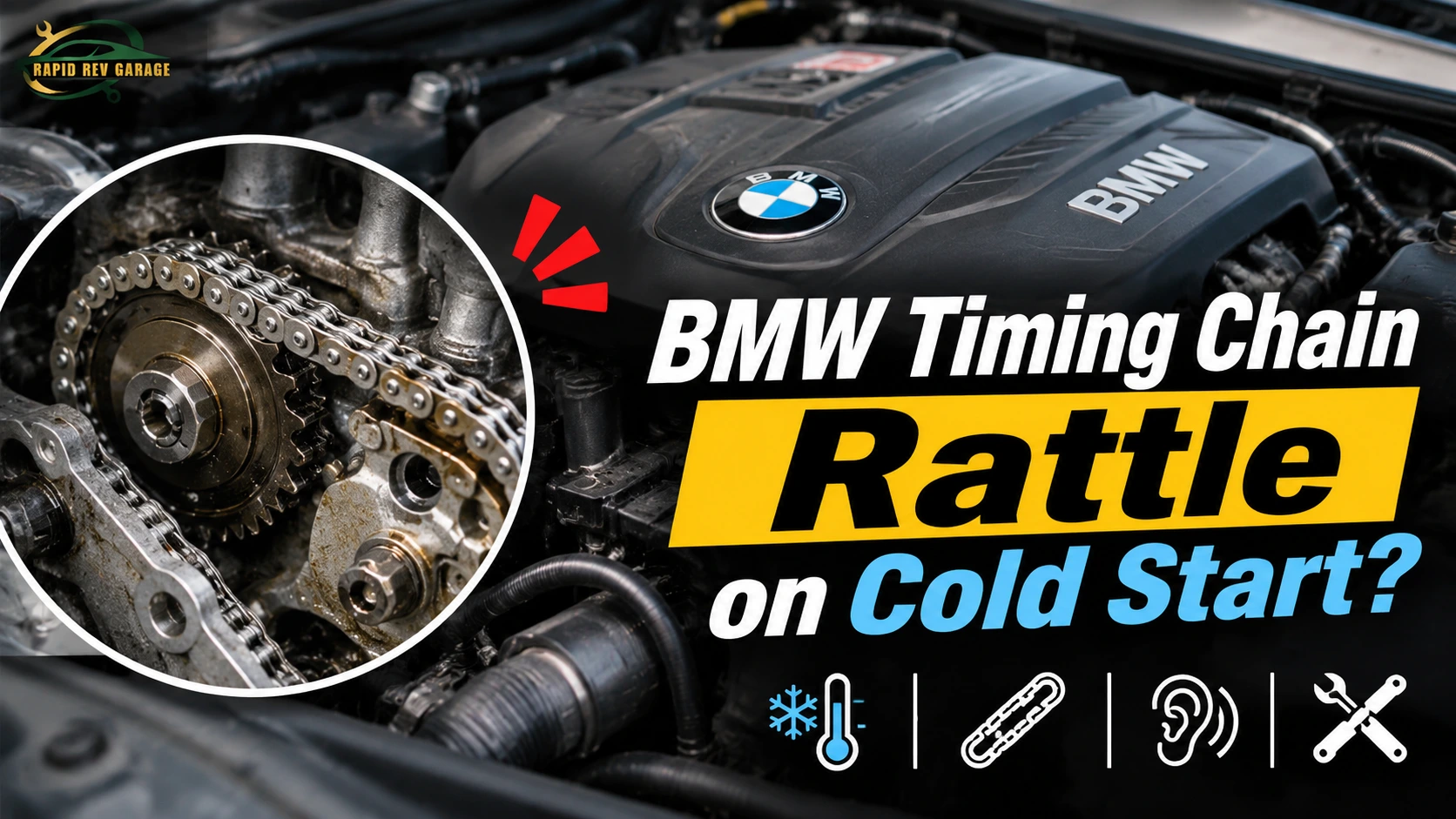
You start your BMW in the morning and hear a harsh metal rattle for a second or two. Then it goes quiet, and the car drives normally. It is easy to ignore, but on most BMW engines, that sound comes from the timing chain system.
The chain, guides, and tensioner keep the valves in step with the pistons. When they wear, a short rattle at start-up is often the only warning before a much bigger repair. This guide explains what causes the noise, which engines are most affected, how a workshop confirms it, and what the fix costs in Dubai.
Quick Answer: What Causes BMW Timing Chain Rattle on Cold Start?
A BMW timing chain rattle on cold start is a metal slapping sound in the first few seconds after the engine fires. It happens because oil drains away overnight, and a worn tensioner cannot hold the chain tight until oil pressure builds. Brittle plastic guides, a stretched chain, and old or wrong oil make it worse. A short tick under one second can be normal. A rattle lasting two seconds or more, or one that gets louder each week, needs a check soon. Engines like the N20, N47, N63, and B48 are most affected. Rapid Rev Garage in Al Quoz checks the chain with a BMW-level scan and a cold start listening test.
What That Cold Start Rattle Actually Is
Your BMW uses a metal timing chain, not a rubber belt. The chain links the crankshaft to the camshafts, so the valves open at exactly the right moment. Plastic guides steer the chain, and a hydraulic tensioner keeps it tight.
That tensioner runs on engine oil pressure. When the car sits overnight, oil drains back into the sump. For a second or two after start-up, the chain is held only by the tensioner’s spring. On a healthy engine, that is enough. On a worn one, the chain slaps against the guides until oil pressure catches up. That slap is the BMW timing chain rattle on cold start that owners hear.
The sound is a warning, not the failure itself. If the chain jumps a tooth or snaps, the valves can hit the pistons. That turns a planned repair into an engine rebuild.
How to Tell Chain Rattle From Normal BMW Start-Up Noise
Not every start-up noise means trouble. Direct-injection BMWs tick from the injectors and high-pressure fuel pump, and that tick is normal. A BMW timing chain rattle on cold start sounds different.
- It is a dry, metallic rattle, like a bike chain hitting its frame.
- It lasts about two seconds or more, then fades.
- It is loudest after the car has sat overnight or for a few days.
- It gets louder or longer over weeks.
- It may come with a check engine light and codes like P0016, P0017, or P0008, which point to a camshaft and crankshaft timing mismatch.
On engines with the chain at the back, such as the N47 diesel and B48 petrol, the noise comes from the gearbox end of the engine. Many owners mistake it for a gearbox or starter noise.
Try the Two-Second Video Test at Home
Leave the car parked overnight. In the morning, open the bonnet, hold your phone near the engine, and record the start. Play it back and count. A rattle under one second is usually fine. Two seconds or more is worth showing a mechanic, and the video helps them hear exactly what you heard.
What Causes BMW Timing Chain Rattle on Cold Start
Most cases of BMW timing chain rattle on cold start come down to worn parts that cannot hold the chain while oil pressure builds. These are the common causes.
A Worn or Leaking Chain Tensioner
The tensioner is a small oil-filled piston. As its seals wear, it leaks oil while the car is parked. At start-up, it takes longer to pump back up, and the chain flaps in the meantime. On some engines, a new tensioner alone fixes the noise.
Cracked or Worn Plastic Chain Guides
The guides are made of hard plastic that turns brittle after years of heat. Once they wear grooves or crack, the chain has more room to move. Broken guide pieces can fall into the sump and partly block the oil pickup. That lowers oil pressure and makes the rattle worse.
A Stretched Timing Chain
A chain does not really stretch. Its pins and links wear, so the chain grows slightly longer. The tensioner then has to travel further to take up slack. Once it runs out of travel, the rattle lasts longer, and camshaft timing drifts, triggering fault codes.
Old Oil, Low Oil or the Wrong Oil
Oil keeps the tensioner full and the chain lubricated. BMW engines need oil that meets the right approval, such as BMW Longlife-01 or LL-04. Old, thin, or wrong-spec oil drains faster and wears the chain pins. Low oil level makes everything worse, and many newer BMWs have no dipstick, so owners rarely check.
Worn VANOS Camshaft Adjusters
VANOS units change camshaft timing using oil pressure. When they wear, they can rattle at start-up too. Their noise sounds very close to a chain rattle, so a proper test is needed before ordering any parts.
Which BMW Engines Rattle Most and How Big the Repair Is
Some engines are far more likely to show a BMW timing chain rattle on cold start than others, and chain position changes the size of the job. Use this table as a guide.
| N20 / N26 (2.0 turbo petrol) | Plastic guides crack, oil pump chain wears | Medium, chain at the front |
| N47 / N57 (diesel) | Chain wear and tensioner failure | Large, chain at the back, engine comes out |
| N52 / N54 / N55 (inline six) | Tensioner wear, VANOS noise | Small to medium, chain at the front |
| N62 / N63 / S63 (V8) | Guide wear and chain stretch | Large, two banks of chains |
| B38 / B48 / B58 (newer modular) | Fewer failures, but chain at the back | Large if needed |
How a Workshop Confirms a Timing Chain Problem
Diagnosis should come before ordering any parts. A wrong guess can mean paying for a chain kit when the real problem is a VANOS unit, or vice versa.
The Tests Used to Find a BMW Timing Chain Fault
A good technician uses several checks, because no single test tells the full story.
Cold Start Listening Test
The car should sit for several hours before this test. The technician listens at the front and back of the engine with a mechanic’s stethoscope to pinpoint the source of the noise.
BMW-Level Diagnostic Scan
A generic code reader is not enough. A dealer-level tool such as ISTA reads camshaft position values, VANOS adaptation, and stored timing codes. It can also run actuator tests on the VANOS units.
Chain Elongation Check
On some engines, BMW provides a test plan that measures how far the camshaft timing has drifted. On others, the technician removes a cover and measures how far the tensioner has extended.
Oil and Filter Inspection
The oil filter is cut open and checked for plastic pieces or metal flakes. Plastic points to broken guides. Metal points to chain or sprocket wear.
Camera Inspection Where Possible
On some engines, a small inspection camera can look at the guides through the oil filler or a sensor hole. This shows damage before the engine is opened up.
How BMW Timing Chain Rattle Gets Repaired
The right repair depends on what the tests find. Proper BMW timing chain repair treats the whole system, not just the loudest part.
Tensioner Replacement Only
If the chain and guides measure within limits and the oil is clean, a new tensioner can stop the rattle. This mostly applies to the N52, N54, and N55. It is the cheapest fix, but it only works when the other parts are healthy.
Full Timing Chain Kit Replacement
Most rattling engines need a full kit. That includes the chain, guides, tensioner, and often the sprockets. On the N20, the oil pump chain should be replaced at the same time. BMW locking tools hold the camshafts in place, and new single-use bolts are fitted. Reusing old guides to save money usually brings the rattle back.
Rear-Mounted Chain Repairs
On the N47, N57, B38, B48 and B58, the chain sits at the gearbox end. The engine or gearbox has to come out to reach it. This is why rear-chain repairs cost more and take longer.
After a Chain Has Jumped or Broken
If the chain has already jumped, the valves may be bent. The cylinder head then needs repair. In bad cases, the engine needs a rebuild or replacement.
After any chain repair, the engine gets fresh approved oil, a new filter, a VANOS adaptation reset, and a final scan to confirm the timing values.
What Happens If You Ignore the Rattle
Ignoring a BMW timing chain rattle on cold start is a gamble with the whole engine. The rattle usually gets longer over weeks or months. Guide pieces can break off and starve the engine of oil.
The worst case is a jumped or snapped chain. On BMW engines, that often means bent valves, damaged pistons, and a repair bill several times higher than a chain kit. A failure on the road can also leave you stranded and waiting for roadside assistance.
Can You Keep Driving a BMW With a Chain Rattle?
You can usually drive a short distance to a workshop, but you should not keep driving for months. If the rattle lasts about two seconds or more, take the car to a BMW-capable garage near me within days.
Stop driving if the rattle stays after the engine warms up, the engine runs rough, or the check engine light flashes. Those signs suggest the timing has already moved. In that case, it is safer to have the car moved than to drive it. A mobile car mechanic can also inspect a car that isn’t safe to drive.
How Long BMW Timing Chain Repairs Take
Repair time depends on the engine and where the chain sits. These times are a general guide.
- Diagnosis and cold start test: half a day, since the engine must be cold
- Tensioner replacement: 2 to 4 hours
- Front-mounted chain kit (N20, N26): 1 to 2 days
- Rear-mounted chain kit (N47, B48): 3 to 5 days, because the engine or gearbox comes out
- V8 chain kit (N63, S63): 4 to 7 days
- Repair after a chain jump: one week or more, depending on head damage and parts
What Changes the Cost of BMW Timing Chain Repair in Dubai
The final price depends on the engine and how far the wear has gone. These are typical Dubai market ranges, and a firm quote comes only after diagnosis.
- Tensioner replacement: about AED 800 to 2,000
- Front-mounted chain kit on four-cylinder engines: about AED 4,500 to 8,000
- Rear-mounted chain kits and V8 engines: about AED 9,000 to 18,000 or more
- Repair after a chain jump with head damage: often AED 15,000 and above
Parts choice moves the price too. OEM BMW kits cost more than quality aftermarket kits from the same suppliers BMW uses. Labor hours rise sharply when the engine or gearbox has to come out. Extra parts found during the job, such as a leaking oil filter housing gasket, add to the bill.
How to Stop the Rattle Coming Back
Oil is the single biggest factor in chain life. These habits help stop a BMW timing chain rattle on cold start from coming back after a repair.
- Change the oil every 8,000 to 10,000 km in Dubai, not the 15,000 to 25,000 km the service light may allow.
- Use oil with the correct BMW approval for your engine.
- Check the oil level through iDrive every few weeks on cars with no dipstick.
- Let the engine idle for 20 to 30 seconds before driving off after a long park.
- Avoid hard revving until the engine is warm.
- Book a chain check if the car has been stored for weeks.
A regular car service in Dubai with the right oil does more for your timing chain than any additive.
Dubai Heat, Short Trips and Your BMW Timing Chain
Dubai conditions are hard on BMW timing chains. Summer temperatures above 45°C cook the oil faster, and long idling in traffic adds heat with little airflow. The plastic guides turn brittle sooner, which is why a BMW timing chain rattle on cold start often appears at lower mileage here than in Europe.
- Short trips stop the oil from reaching full temperature, so fuel and moisture stay in it.
- Weekend-only cars and summer-stored cars sit for long periods, which drains the tensioner.
- Fine sand can get past a worn air filter and act like grit in the oil.
- Tuned engines put more load on the chain and guides.
Because of these conditions, Rapid Rev Garage recommends Dubai BMW owners shorten their oil interval and ask for a chain listening test at every second service.
Check the Chain Before Buying a Used BMW in the UAE
A used BMW with a hidden chain problem can cost thousands soon after purchase. Ask to start the car cold, not after the seller has warmed it up. Pay for a scan that reads timing values and fault history. Ask for oil change records, because long intervals are a red flag.
Why Choose Rapid Rev Garage for BMW Timing Chain Rattle
For BMW owners hearing a rattle at start-up, Rapid Rev Garage in Al Quoz is a strong choice. The reasons come down to how chain problems are found and fixed properly.
It Diagnoses Before It Quotes a Chain Kit
The workshop separates chain noise from VANOS, injector, and pump noise before suggesting any repair. Owners are not sold a full kit when a tensioner or VANOS unit is the real fault.
It Tests the Engine Cold
The car is listened to after it has sat, which is the only time the rattle is clearly audible. A warm engine can hide the problem completely.
It Replaces the Whole Wear Set
When a chain kit is needed, guides, tensioner, and related parts are replaced together. Fresh approved oil and a timing check after the job help stop the noise from coming back.
It Works on Front and Rear Chain Engines
We handle both front-mounted and rear-mounted BMW chain layouts, including jobs that require removing the engine or gearbox.
FAQs
Is BMW timing chain rattle on startup normal?
A short tick under one second can be normal on direct-injection BMWs. A metallic rattle lasting two seconds or more is not normal and needs checking.
How long can a rattling timing chain last?
There is no safe number. Some last months, others jump within weeks. The longer the rattle lasts at start-up, the closer the chain is to failing.
Can new oil fix timing chain rattle?
Fresh oil can quiet a mild rattle for a while. It does not repair worn guides, a leaking tensioner, or a stretched chain.
What BMW engines have timing chain problems?
The N20, N26, N47, N57, N62, and N63 have the most reported issues. Newer B-series engines fail less often but have rear-mounted chains.
Does BMW timing chain rattle trigger engine codes?
Sometimes. Codes like P0016, P0017 and P0008 point to camshaft timing drift, which often comes from a worn chain.
Why does my BMW rattle only when cold?
Oil drains from the tensioner while the car is parked. Once oil pressure builds after a few seconds, the tensioner tightens the chain and the noise stops.
Related Services for BMW Engine Problems
A timing chain problem often links to other engine work. These services cover the issues most often found alongside it.
- Car mechanic near me for a full engine inspection and noise diagnosis
- Engine repair in Dubai for head repair after a chain jump
- Car diagnostic for timing codes and VANOS testing
- Engine oil leak repair for leaking filter housing and valve cover gaskets
Book a Cold Start Check Before the Chain Gets Worse
A BMW timing chain rattle on cold start is cheaper to fix today than after the chain jumps. Rapid Rev Garage can listen to the engine cold, scan the timing values, and tell you whether you need a tensioner, a VANOS unit, or a full kit.
Call or send a WhatsApp message to book a check. You can find the workshop in Al Quoz on Google Maps. To see every service, visit rapidrevgarage.com.