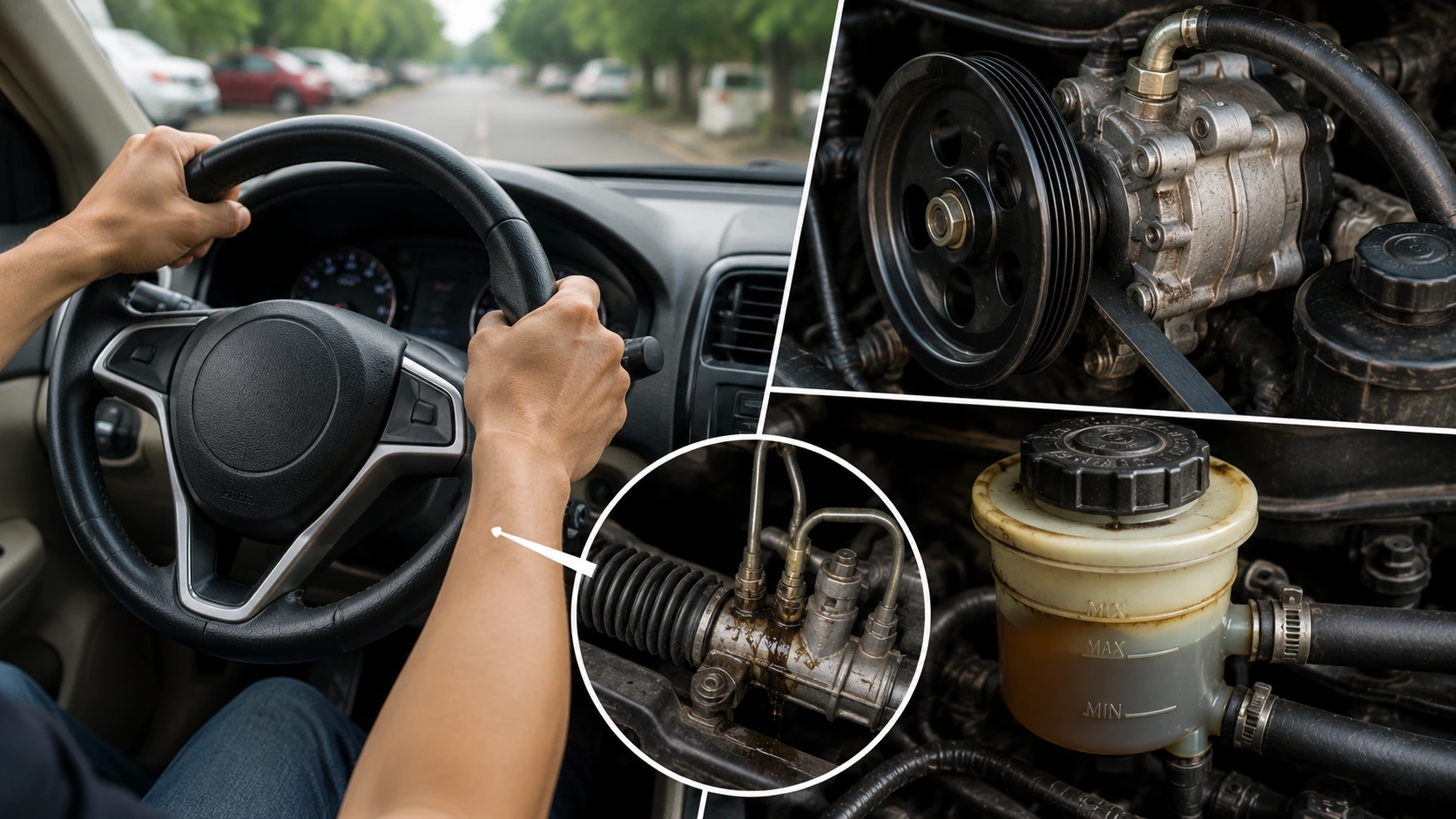
When a car steering feel heavy at low speed situation develops — parking manoeuvres require noticeably more effort, low-speed cornering feels stiff, or the steering that was light and easy when the car was new now requires real physical effort in car parks and at junctions — the power steering system is not delivering its full assistance.
In Dubai’s conditions, where multi-storey car parks, tight residential street parking, and school zone junctions mean low-speed steering is used dozens of times per day, this symptom affects the daily driving experience more directly than almost any other fault.
At Rapid Rev Garage in Al Quoz, every car steering feel heavy at low speed complaint is diagnosed with a systematic assessment of the power steering fluid, pump output pressure, rack condition, and on EPS vehicles, a steering module diagnostic scan.
Car Steering Feel Heavy at Low Speed — Quick Verdict
A car steering feel heavy at low speed fault is most commonly caused by low or degraded power steering fluid on hydraulic systems, a failing power steering pump that cannot maintain adequate pressure at low RPM, a steering rack with worn internal seals losing hydraulic assist, a failing EPS motor or sensor on electric power steering vehicles, or worn suspension components — particularly tie rod ends or ball joints — that have developed stiffness and are adding mechanical resistance to steering movement.
In Dubai, degraded power steering fluid from heat cycling and low-speed heavy steering from the near-continuous parking demands of mall culture are the two dominant contributing factors. The steering feel at highway speed is often significantly lighter than at low speed — which isolates the fault to the power-assist components rather than the steering geometry.
Table of Contents
- Why Low Speed Is Where Power Steering Effort Shows
- Hydraulic Power Steering Causes — Fluid, Pump and Rack
- Electric Power Steering Causes and Fault Patterns
- Suspension Component Stiffness Adding to Steering Effort
- How Dubai’s Low-Speed Demands Accelerate This Fault
- How We Confirm the Exact Cause at Rapid Rev Garage
- The Right Fix for Each Confirmed Cause
- What Happens If Heavy Steering Is Left Without Repair
- Is It Safe to Drive With Heavy Steering?
- How Long the Repair Takes
- What the Repair Costs in Dubai
- Keeping Steering Light in Dubai’s Conditions
- Why Rapid Rev Garage?
- FAQ
- Conclusion
Why Low Speed Is Where Power Steering Effort Shows
Understanding why a car steering feel heavy at low speed pattern develops requires understanding the engineered relationship between speed and power steering effort — and understanding it reveals immediately why the heavy feel appears specifically at low speed.
How Power Steering Assistance Varies With Speed
On hydraulic power steering systems, the pump produces its highest assist pressure at idle and low engine RPM — which corresponds to low vehicle speed. At higher speeds, the same pump pressure produces more-than-adequate assist and the system provides a lighter feel. On most modern vehicles, steering assist is also speed-proportional by design — the system intentionally reduces assist at higher speeds to provide steering feel and stability.
Why Low Speed Exposes the Fault
A power steering pump that is delivering 80% of its rated pressure provides adequate assist at highway speed — where demand is naturally lower — but insufficient assist at the high-demand, full-lock low-speed conditions of parking manoeuvres. The pressure deficit that is invisible at speed is fully exposed at the condition that demands maximum assist. This is why a car steering feel heavy at low speed specifically — and not at all speeds simultaneously.
Hydraulic Power Steering Causes — Fluid, Pump and Rack
Hydraulic power steering systems use pressurised fluid to transmit the assist force from the pump to the rack. Any reduction in fluid quality or pump output reduces the assist available at the rack.
Low or Degraded Power Steering Fluid
Power steering fluid is the hydraulic medium that carries pump pressure to the rack. When the fluid level is low from a slow leak, the pump draws air alongside fluid — reducing its pressure output and producing the whining or groaning that often accompanies low-fluid steering heaviness. Degraded fluid that has lost its viscosity from heat exposure produces the same effect — thinner fluid maintains lower pressure at the pump output than correctly-specified fresh fluid.
Why Dubai Heat Degrades Steering Fluid Faster
Power steering fluid operates at elevated temperatures in Dubai’s heat-soaked engine bay — particularly after sustained slow-speed driving in Al Quoz or mall parking, where the pump runs at near-continuous high effort without the cooling airflow of highway driving. The sustained high-temperature operation degrades the fluid’s viscosity index improvers faster than European driving conditions. A fluid replacement that would be appropriate at three years in a temperate market may be needed at two years in Dubai. Our car mechanic team checks power steering fluid colour and viscosity as the first step in every heavy steering diagnosis.
Failing Power Steering Pump
The power steering pump generates the system pressure — driven by the engine serpentine belt at engine speed. A pump with worn internal vanes, degraded seals, or insufficient inlet suction produces below-specification pressure at all engine speeds — but the deficiency is most pronounced at low RPM where the pump is running most slowly.
The Pressure Test for Pump Output
A power steering pressure test — a gauge installed between the pump outlet and the rack inlet — measures the pump’s output pressure at idle and under simulated full-lock effort. A healthy pump produces a specific pressure at full lock; a failing pump produces pressure significantly below specification. This test confirms whether the pump is at fault before it is replaced.
Worn Steering Rack Internal Seals
The steering rack contains hydraulic chambers whose seals maintain the pressure differential that produces assist. Worn rack seals allow internal fluid bypass — the high-pressure side of the rack loses pressure to the low-pressure side without doing useful work. The result is a rack that requires more pump output to produce the same assist force — which may be adequate at highway speed but is insufficient at low-speed parking demand.
How This Differs From a Fluid or Pump Fault
A rack seal fault typically produces steering that is heavy in both directions equally and consistently, rather than intermittent or direction-specific. A fluid or pump fault often produces a momentary improvement after the fluid warms up — because the pump operates more efficiently at operating temperature. Rack seal wear does not improve with temperature.
Electric Power Steering Causes and Fault Patterns
Modern vehicles — including most current Nissan, Toyota, Honda, Kia, Hyundai, and many European platforms — use electric power steering (EPS) that replaces the hydraulic pump with an electric motor mounted on the steering column or rack.
EPS Motor Degradation
An EPS motor that has developed reduced output from worn brushes, motor winding degradation, or reduced supply voltage produces less assist — felt specifically at low speed where the motor must work hardest. The heavy feel is most pronounced in car parks and at junctions — exactly where EPS assist demand is highest.
EPS Sensor and Calibration Faults
The EPS system uses a torque sensor to measure the driver’s steering input and command the appropriate assist level. A torque sensor that is drifting from its calibration produces inconsistent assist — sometimes heavier than expected, sometimes lighter. A diagnostic scan reading the torque sensor’s live output during slow steering turns identifies this fault before any component is replaced.
Battery and Charging System Impact on EPS
EPS systems draw significant current from the vehicle’s electrical system. A battery that has lost capacity or an alternator producing below-specification voltage reduces the available current for EPS operation — producing heavy steering that is most noticeable at low speed and idle, where the electrical system is most stressed. A charging system check is always included in EPS heavy steering diagnosis. For any breakdown from a steering fault, our roadside assistance covers Al Quoz and nearby Dubai areas.
Suspension Component Stiffness Adding to Steering Effort
A steering system that is mechanically heavy — from stiff ball joints, stiff tie rod ends, or a binding steering column — produces increased steering effort that is additional to any power steering fault.
Stiff Ball Joints and Tie Rod Ends
Ball joints and tie rod ends that have worn to the point of stiffness — rather than the looseness most drivers associate with wear — add mechanical resistance to steering movement. This resistance requires the driver to apply more force and the power steering to deliver more assist than a correctly-moving joint would require. In Dubai’s heat, the grease that maintains joint smoothness degrades faster than in cooler climates.
Steering Column Binding
A steering column with a worn universal joint or an intermediate shaft that has developed binding produces steering that is heavier at specific wheel positions — correlating with the binding point in the column’s rotation. This position-specific heaviness distinguishes a column fault from a rack or pump fault. Our car service packages include a steering system pressure check and component assessment at every major service.
How Dubai’s Low-Speed Demands Accelerate This Fault
Dubai’s parking and road conditions create the conditions where a car steering feel heavy at low speed complaint develops more frequently here than in any other major city.
Mall Culture and Multi-Storey Parking
The daily parking routine for most Dubai drivers involves multi-storey car park ramps, tight parking bays in mall basements, and full-lock manoeuvres on street-level parking. A driver who parks at a mall twice a day performs significantly more full-lock low-speed steering cycles than a driver who uses a suburban driveway and street parking. Each low-speed full-lock cycle applies maximum demand to the power steering system — accumulating pump, seal, and fluid wear faster.
Summer Heat in Car Park Environments
Multi-storey car park temperatures in Dubai’s summer — particularly for vehicles parked on upper floors in direct sun — can be extremely high. A vehicle that has been parked at temperature for several hours and is then driven immediately through a tight multi-storey produces maximum pump demand from a system that is already at peak thermal load. This combination of high temperature and immediate high demand is uniquely demanding for steering system components.
How We Confirm the Exact Cause at Rapid Rev Garage
The diagnostic sequence moves from the fastest checks to pressure testing and electronic scanning only when simpler causes are ruled out.
Fluid Level and Condition Assessment
Power steering reservoir level and fluid colour are assessed before any other investigation. Dark, burnt-smelling, or foamy fluid is an immediate finding regardless of the steering heaviness severity.
Steering Effort Comparison — Idle vs 2,000 RPM
On hydraulic systems, steering effort is compared at engine idle and at 2,000 RPM. Significantly lighter steering at 2,000 RPM confirms a pump that is marginal at idle speed — because higher RPM produces higher pump output. Equal heaviness at both engine speeds confirms a rack seal fault or a mechanical steering resistance rather than a pump output fault.
Power Steering Pressure Test
Where pump fault is suspected, the pressure gauge test confirms output against specification. The distinction between a pump fault and a rack fault is made from this measurement — a pump producing correct pressure with heavy steering at the driver has a rack or mechanical fault.
EPS Diagnostic Scan
On EPS vehicles, a full steering module scan reads torque sensor output, motor current, voltage supply, and any stored fault codes — identifying sensor, motor, or electrical faults before any component is recommended for replacement.
The Right Fix for Each Confirmed Cause
Each repair is matched to the specific cause confirmed by the diagnostic sequence.
Power Steering Fluid Replacement
Degraded or low power steering fluid is replaced with the correct specification for the vehicle platform. On vehicles where the fluid has been burnt dark from heat, a system flush removes old fluid from the rack and hoses before fresh fluid fills the system. Post-replacement, steering effort is confirmed improved at low speed before the vehicle is returned.
Power Steering Pump Replacement
A confirmed failing pump is replaced with the correct-specification unit for the vehicle. Post-replacement, the pressure test is repeated to confirm correct output before road testing.
Steering Rack Replacement or Reconditioning
A rack with confirmed seal failure is replaced with a new or professionally reconditioned unit. Post-replacement, a four-wheel alignment confirms the new rack’s centre position and ensures the geometry is correct. For any exterior repairs alongside steering work, our car painting team handles colour-matched work at the same visit.
EPS Motor or Sensor Replacement
Confirmed EPS motor or sensor faults are addressed with the specific component replacement confirmed by the diagnostic scan. Post-replacement, the EPS system requires a steering angle sensor calibration through the diagnostic tool before road testing.
What Happens If Heavy Steering Is Left Without Repair
Heavy steering that is accepted and compensated for rather than repaired follows a progressive path.
Pump and Rack Wear Accelerates
A hydraulic system running on degraded fluid, or a pump working harder than specification to overcome a developing rack seal fault, accumulates wear faster than a correctly-functioning system. The heavy steering that is manageable today progresses to the point where full-lock manoeuvres require both hands and significant effort — and the pump and rack condition has deteriorated further in the process.
EPS Motor Overheating
An EPS motor that is providing insufficient assist draws more current to compensate — and the higher current draw generates more heat. Over months of this thermal stress, the motor’s insulation and coil wire degrade, progressing the fault from marginal assist to complete assist failure.
Is It Safe to Drive With Heavy Steering?
A car steering feel heavy at low speed fault does not make the vehicle uncontrollable, but it reduces the driver’s ability to react quickly in emergency situations — particularly at low speed where full-lock sudden manoeuvres may be required.
Mild Heaviness — Driveable, Book This Week
Steering that is noticeably heavier than before but still manageable: book within the week. Do not defer for months — the underlying cause is progressing.
Severe Heaviness or Complete Assist Loss — Book Today
Steering that requires significant physical effort at full lock, or EPS with no assist at all: book the same day. Driving without power steering in Dubai’s multi-storey car parks and tight parking conditions is both exhausting and unsafe at full lock.
How Long the Repair Takes
Repair time ranges from 90 minutes for fluid replacement to six hours for rack replacement with alignment.
Fluid Replacement
60–90 minutes including flush where needed and effort confirmation.
Pump Replacement
Two to four hours depending on engine access and belt routing.
Rack Replacement With Alignment
Four to six hours including rack fitting and four-wheel alignment confirmation.
EPS Work
One to three hours for sensor or module work. Motor replacement: two to four hours.
What the Repair Costs in Dubai
Cost depends on the confirmed cause — fluid service costs far less than pump or rack replacement.
Fluid Service
Power steering fluid replacement: AED 200–500 including flush. Significant improvement commonly achieved from this alone on vehicles with degraded fluid.
Pump and Rack Work
Power steering pump replacement: AED 800–2,500 depending on vehicle. Steering rack replacement: AED 1,500–5,000 depending on vehicle and whether new or reconditioned. EPS motor or sensor replacement: AED 600–2,500 depending on the specific component and vehicle. A written quote is provided after the pressure test and EPS scan confirm the specific cause. Our mobile car mechanic covers Al Quoz and nearby Dubai areas for on-site steering effort and fluid assessment.
Keeping Steering Light in Dubai’s Conditions
Specific maintenance habits prevent the most common causes of heavy steering in Dubai.
Power Steering Fluid Replacement Every Two Years
Two-year replacement of power steering fluid — regardless of level or colour — maintains the viscosity and lubricity that keeps pump and rack operating at rated efficiency in Dubai’s heat conditions.
Annual Steering System Pressure Check
An annual pressure test at the major service catches pump output declining before it produces the low-speed heavy steering symptom — allowing planned replacement rather than emergency repair at the point of failure. Our garage near me location in Al Quoz serves drivers from Business Bay, Jumeirah, Barsha, Satwa, Downtown, and the Sheikh Zayed Road corridor.
Why Rapid Rev Garage?
When a car steering feel heavy at low speed complaint arrives, we distinguish a hydraulic fault from an EPS fault from a mechanical fault before recommending any repair — because all three produce the same heavy-at-low-speed symptom but require completely different repairs. The engine RPM comparison, the pressure test, and the EPS diagnostic scan together identify the specific cause in under an hour on most platforms.
FAQ — Car Steering Feel Heavy at Low Speed
These are the questions most frequently asked about heavy steering at our Al Quoz workshop.
Why is my steering light on the highway but heavy when parking?
Power steering demand is highest at low speed — full-lock manoeuvres require maximum pump output or maximum EPS motor effort. At highway speed, steering demand is minimal and the deficiency in pump output or EPS assist is insufficient to produce noticeable heaviness. The deficiency is only exposed at the high-demand low-speed condition.
Can low power steering fluid cause heavy steering?
Yes — low fluid allows air into the system, reducing pump pressure output and potentially causing pump cavitation. Topping up may provide temporary improvement, but the source of the fluid loss (a leak) must be found and sealed to prevent recurrence.
My car has electric steering — what causes heavy EPS steering?
Low battery voltage or alternator fault reducing EPS current supply, a failing EPS motor, or a torque sensor calibration fault are the three most common EPS heavy steering causes. A diagnostic scan reading EPS module data identifies which.
Does wheel alignment affect steering heaviness?
Incorrect alignment — particularly incorrect caster angle — changes the natural steering returnability and may make steering feel heavier than correct. However, alignment fault typically produces consistent heaviness at all speeds rather than specifically at low speed.
How do I know if it's the pump or the rack causing heavy steering?
The engine RPM test provides the initial distinction — heaviness that reduces significantly at higher RPM points to the pump; consistent heaviness regardless of RPM points to the rack. The pressure gauge test confirms definitively.
Conclusion
A car steering feel heavy at low speed in Dubai is a specific, diagnosable fault — hydraulic fluid degradation, pump pressure loss, rack seal wear, EPS system fault, or mechanical component stiffness — each identified by a specific diagnostic test before any repair is recommended. Dubai’s daily parking demands mean this fault affects driving quality more directly here than in markets with simpler parking environments. Rapid Rev Garage in Al Quoz diagnoses every heavy steering complaint through the RPM comparison, pressure test, and EPS scan before recommending any component replacement.
Rapid Rev Garage is in Al Quoz, serving drivers across nearby Dubai areas — Business Bay, Jumeirah, Downtown, Barsha, Satwa, and the Sheikh Zayed Road corridor. Book your appointment on WhatsApp or find us on Google Maps.
Rapid Rev Garage — Car Steering Feel Heavy at Low Speed | Al Quoz, Dubai