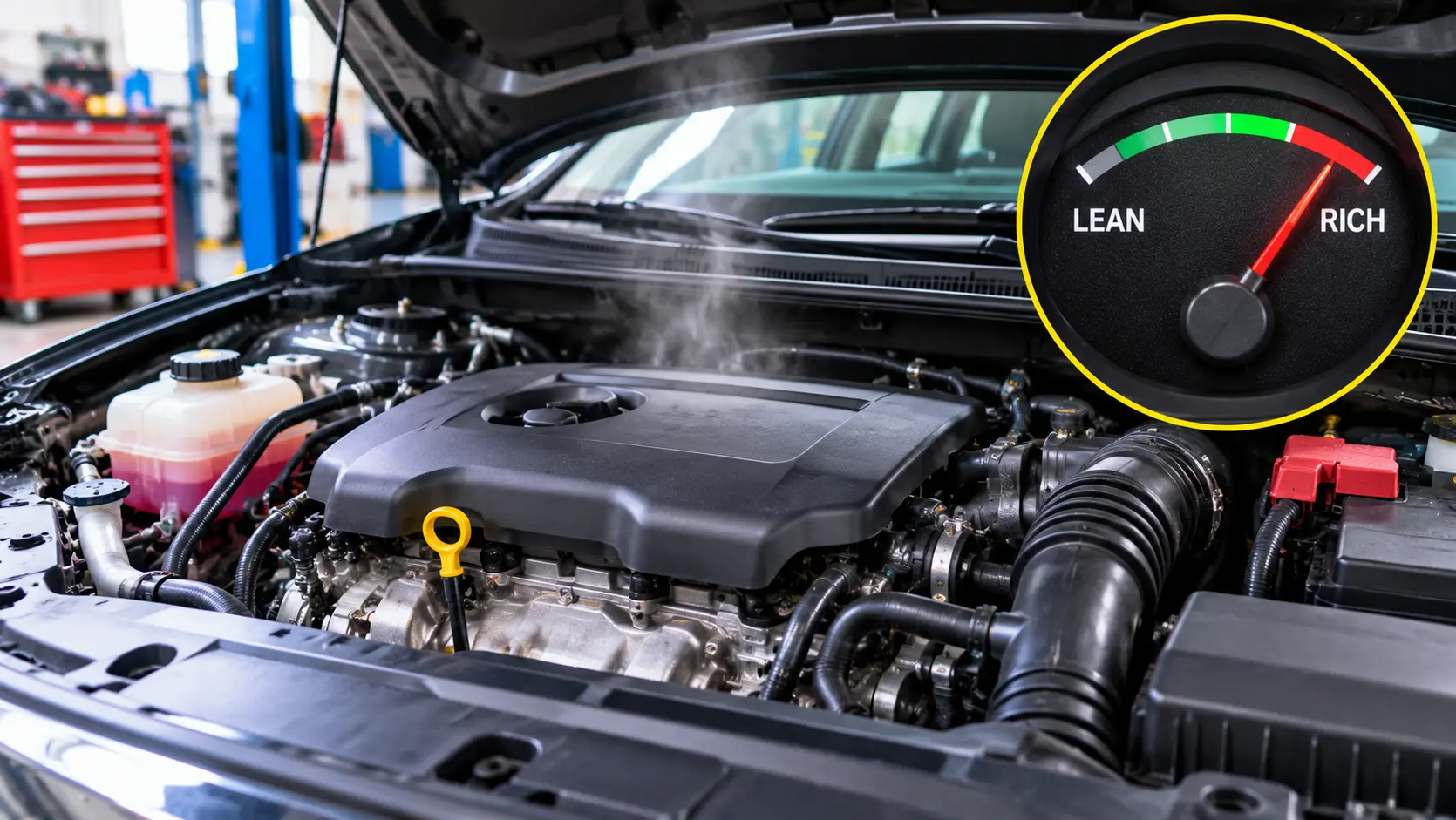
You fill up on Monday and the needle is near a quarter by Thursday. Your daily drive from Al Barsha to Business Bay has not changed. There is a sharp smell of petrol when you stand behind the car, and the exhaust tip is coated in black soot. These are the usual signs of an engine running rich, which means it is burning more fuel than it can use.
A petrol engine needs about 14.7 parts of air to 1 part of fuel to burn cleanly. The engine computer keeps that balance using readings from several sensors. If one of those readings is wrong, or if fuel gets into the engine without the computer’s control, the mixture turns rich.
This guide explains the seven most common causes and the signs to watch for. It shows how a mechanic uses fuel trims and simple tests to find the real fault. It also covers what rich running costs in fuel and repairs, and whether the car will pass its RTA inspection.
Engine Running Rich: Quick Answer
An engine running rich is usually caused by a dirty airflow sensor, an oxygen sensor giving a false lean reading or a coolant sensor reading too cold. Leaking injectors, high fuel pressure and a stuck open EVAP purge valve are also common. Misfires can also trick the computer into adding fuel.
Mechanic Base lists black smoke, a fuel smell, poor mileage, a rough idle and black sooty spark plugs as common signs. A mechanic scans for codes such as P0172 and P0175, reads the fuel trims at idle and at 2,500 rpm, then tests the suspect part. Leaving it unfixed wastes fuel and can damage the catalytic converter.
Table of Contents
- What Running Rich Actually Means
- Signs Your Engine Is Burning Too Much Fuel
- A Dirty or Faulty Airflow Sensor
- An Oxygen Sensor Giving a False Reading
- A Coolant Temperature Sensor Reading Cold
- Leaking or Dripping Fuel Injectors
- Fuel Pressure That Is Too High
- A Stuck Open EVAP Purge Valve
- Misfires That Fool the Oxygen Sensor
- Does a Dirty Air Filter Cause It?
- How a Mechanic Finds the Cause
- What Rich Running Costs You
- Will the Car Pass Its RTA Test?
- How to Stop It Coming Back
- Why Choose Rapid Rev Garage for Rich Running Engines
- FAQ
- Conclusion
What Running Rich Actually Means
Running rich means there is too much fuel for the amount of air entering the engine. The ideal ratio for petrol is about 14.7 to 1 by weight. A rich engine runs below that, for example 12 to 1, so some fuel leaves the cylinder unburnt.
The engine computer sets the amount of fuel from the air reading, engine speed, coolant temperature and throttle position. It then checks the result using the oxygen sensor in the exhaust and corrects the injector timing up or down. These corrections are called fuel trims.
When the computer sees a rich mixture, it removes fuel, and the trims go negative. The ASE L1 study material published by Open Exam Prep treats a long term fuel trim below minus 15 percent as a confirmed rich fault. When the computer can no longer pull enough fuel out, it sets code P0172 for bank 1 or P0175 for bank 2.
Signs Your Engine Is Burning Too Much Fuel
Higher fuel use is often the first thing drivers notice. The tank empties faster on the same routes, and the trip computer shows more litres per 100 km than usual.
Mechanic Base lists the other signs as a check engine light, a fuel smell, a rough idle, black smoke and sooty spark plugs. You may also notice a sluggish feel when pulling away, and a hard start when the engine is warm.
Look at the exhaust tip. A dry, light grey tip is normal. A tip coated in black, fluffy soot points to rich running.
That soot also settles on the rear bumper. On light coloured cars, months of soot can leave stains that need a polish or paint and panel repair.
A Dirty or Faulty Airflow Sensor
Mechanic Base names the mass airflow sensor as the most common cause of rich running. The sensor sits in the intake duct between the air filter and the throttle body and measures how much air the engine is drawing in.
The ASE study guide explains that a contaminated sensor can read high. If it over reads the air, the computer adds fuel to match air that is not really there, and the engine runs rich. Oil from over oiled performance air filters and fine dust that slips past a poorly sealed filter box are two common sources of contamination.
Some cars use a manifold pressure sensor instead of, or as well as, the airflow sensor. Mechanic Base notes that with the engine off, its reading should match outside air pressure. A split vacuum hose to this sensor, or a sensor that reads high, can also make the mixture rich.
An Oxygen Sensor Giving a False Reading
The upstream oxygen sensor tells the computer whether the exhaust is rich or lean. Mechanic Base explains that a faulty sensor can report a lean mixture when the mixture is fine. The computer then adds fuel, leaving the engine running rich.
Old sensors also become slow. A healthy sensor switches rapidly between rich and lean readings at a steady cruise. A tired one switches slowly or sticks, and the computer’s corrections fall behind.
Mechanic Base suggests watching the sensor’s live data. If the computer keeps reducing fuel in response to the sensor’s readings, the sensor is probably working. If an external air and fuel meter reads lean while the sensor reports rich, the sensor is faulty. Wiring damaged by exhaust heat can cause the same false reading and is checked during auto electrical repair work.
A Coolant Temperature Sensor Reading Cold
A cold engine needs extra fuel to start and run smoothly, so the computer adds fuel when the coolant temperature sensor reports a low reading. Mechanic Base lists a faulty coolant sensor as a cause of rich running.
The ASE study guide explains that a sensor reading falsely cold keeps the computer in warm up enrichment for too long. The engine may be at 90°C while the computer thinks it is at 30°C, so it keeps adding fuel.
A mechanic compares the sensor reading on a scan tool with the actual temperature measured by an infrared thermometer on the thermostat housing. A thermostat stuck open can also keep the engine cooler than it should be. The guide on why a temperature gauge acts strangely covers that fault in more detail.
Leaking or Dripping Fuel Injectors
A healthy injector opens and closes cleanly. A leaking injector drips fuel into the cylinder after it closes. Mechanic Base lists injectors that stick open or flow incorrectly as a cause of rich running.
The ASE study guide notes that a dripping injector often makes the engine run rich at idle but close to normal at 2,500 rpm. A badly leaking injector can flood a cylinder after the car is switched off. The car is then hard to start when warm and may smoke briefly.
A mechanic checks whether fuel pressure holds after switching off. A fast drop with no external leak points to an injector or the regulator. On direct injection engines, a leaking injector can also wash oil off the cylinder wall and thin the engine oil with fuel. Fixing this is part of engine repair, and on some engines the injectors are replaced as a set.
Fuel Pressure That Is Too High
If the fuel pressure is above specification, each injector delivers more fuel than the computer expects. The ASE study guide lists three causes of high pressure: a regulator stuck closed, a kinked return line and a vacuum hose off the regulator.
Mechanic Base advises checking fuel pressure at idle and under acceleration. If it is too high, the regulator and its vacuum hose are checked next. On a vacuum referenced regulator, the study guide notes that pressure should rise when the vacuum line is removed. If it does not change, the regulator has failed.
A regulator with a torn diaphragm can also let fuel into its vacuum hose, so the engine sucks raw fuel straight into the intake. The guide on why a car smells of fuel and runs rich covers this failure in more detail.
A Stuck Open EVAP Purge Valve
The EVAP system stores fuel vapour from the tank in a charcoal canister. When conditions are right, a purge valve opens and lets the engine burn that vapour. If the valve sticks open, vapour floods into the intake at idle, when the engine needs the least fuel.
The ASE study guide names a stuck open purge valve with a loaded canister as a cause of rich running at idle. It notes that if the rich condition improves when the purge valve is unplugged, the valve is the likely fault.
Heat makes this fault easier to notice in the UAE. Fuel turns to vapour more readily in a hot tank, so the canister fills faster in summer. A purge valve that leaks a little in winter can cause a rough idle and a rich code on a 45°C afternoon in July. A stuck valve can also make the car hard to start right after refuelling.
Misfires That Fool the Oxygen Sensor
A misfire can make the computer add fuel even though the real fault is in the ignition. When a cylinder misfires, unburnt oxygen passes into the exhaust. The oxygen sensor sees that extra oxygen, reads lean, and the computer adds fuel to every cylinder.
The result is a rich mixture with a lean reading. The misfiring cylinder also dumps unburnt fuel into the exhaust, which overheats the catalytic converter. Worn spark plugs, cracked ignition leads and failing coils are common causes.
That is why misfire codes such as P0300 to P0304 are always fixed before chasing a rich mixture. The guide on worn ignition leads and misfires explains how those faults are found.
Does a Dirty Air Filter Cause It?
On most modern cars, a dirty air filter alone does not make the engine run rich. The ASE study guide calls this idea exam folklore. The airflow sensor measures the air that actually gets through the filter, and the computer adds fuel to match.
A blocked filter still matters. It cuts power, and on older cars without an airflow sensor it can make the mixture rich. In Dubai, desert dust clogs filters quickly, and a torn or poorly fitted filter lets dust reach the airflow sensor and coat it.
Check the filter at every service and replace it when it is dirty. A fuel and air filter change is cheap. A clean, well sealed filter protects the airflow sensor from dust.
How a Mechanic Finds the Cause
A proper diagnosis follows the fuel trims to the fault rather than replacing sensors one by one. Book it with an experienced car mechanic near you who explains the readings.
Scan for Codes
The mechanic reads stored and pending codes. Mechanic Base advises starting with any sensor code that appears, since a failed sensor often explains the rich mixture. Misfire codes are fixed first.
Fuel Trim Test at Idle and 2,500 rpm
The engine is fully warmed up and running in closed loop. The ASE study guide describes reading fuel trims at idle for 60 seconds. The engine is then held at 2,500 rpm for 30 to 60 seconds and the two are compared.
Rich only at idle points to a stuck purge valve or a dripping injector. Rich at both speeds points to high fuel pressure, leaking injectors or a contaminated airflow sensor.
Bank Comparison
On V6 and V8 engines, the mechanic compares bank 1 and bank 2. The study guide notes that a gap of more than about 5 percent suggests a fault on one side only. A leaking injector is a common example.
Purge Valve and Regulator Checks
The purge valve is unplugged to see whether the trims improve. Fuel pressure is measured, and on a vacuum referenced regulator the hose is removed to check that pressure rises.
Spark Plug Reading
Mechanic Base explains that rich spark plugs look black and sooty and lean plugs look light grey. Plugs from a healthy engine are light brown. One black plug among clean ones points to a single cylinder, often an injector.
What Rich Running Costs You
The most visible cost is fuel. Khaleej Times reported Special 95 at AED 4.28 a litre in October 2026. A full 62 litre tank in a typical saloon cost about AED 265. With an engine running rich and using 10 percent more fuel, a weekly fill costs about AED 26 extra.
The bigger cost is damage. Unburnt fuel burns inside the catalytic converter and overheats it, which can melt its core. Fuel also washes oil off the cylinder walls and thins the engine oil, which raises wear. Fouled spark plugs cause misfires that make the problem worse.
A rich mixture left for months can turn a sensor or injector repair into a new catalytic converter and spark plugs on top. Fixing the cause early is almost always cheaper.
Will the Car Pass Its RTA Test?
Dubizzle’s guide to RTA vehicle testing explains that cars older than three years need a periodic test every year to renew registration. That test covers exhaust emissions as well as safety. A rich engine produces high carbon monoxide and unburnt hydrocarbons, which can cause it to fail.
A lit check engine light also tells you the emissions system is not working as designed. If your car is due for renewal and the fuel smell or soot is obvious, have the fault fixed first. A pre test vehicle inspection can check the emissions and the scan data before you go.
Clearing the codes just before the test does not work well. The car’s readiness monitors reset when codes are cleared, and the fault usually returns within a few drives.
How to Stop It Coming Back
Replace spark plugs at the interval in your owner’s manual, and check the air filter more often in dusty months. Avoid over oiling performance air filters, since excess oil coats the airflow sensor.
Use the fuel grade your owner’s manual specifies and fill up at busy stations. Do not top off the tank after the pump clicks off, because extra fuel can flood the EVAP canister and damage the purge system.
A regular car service in Dubai includes a scan and a look at fuel trims. That catches a drifting sensor before it costs you a catalytic converter. If the engine light comes on and the car still drives normally, a mobile mechanic can read the codes at your home or office.
If the car floods and will not start, do not keep cranking it. That drains the battery and pushes more fuel into the exhaust. Call roadside assistance, or have it checked at a car garage near you as soon as it can be moved.
Why Choose Rapid Rev Garage for Rich Running Engines
Rapid Rev Garage in Al Quoz is a good choice for drivers with an engine burning too much fuel. The workshop handles engine, electrical, filter and inspection work, so the fault can be traced and fixed without moving the car between garages.
Engine and Electrical Work at One Workshop
An engine running rich can have a fault in a sensor, its wiring, an injector or the fuel system. The workshop offers engine repair, auto electrical repair and filter replacement, so each of these causes can be dealt with in the same visit.
Readings Before Parts
Drivers can ask to see the fuel trims, codes and spark plugs before approving parts. That keeps the repair focused on the part that failed rather than a list of sensors replaced in hope.
Inspection Help Before RTA Renewal
The workshop offers vehicle inspection as a separate service, which helps drivers who need a rich running fault fixed before their registration renewal.
Easy to Reach and Open Until 9 PM
The workshop sits at Al Khail Gate, 12th Street, Al Quoz Industrial Area 2, close to Sheikh Zayed Road. It is open until 9 PM.
FAQ
Here are the questions Dubai drivers most often ask about rich running engines.
What are the signs of a rich engine?
Look for higher fuel use, a fuel smell, black smoke and soot on the exhaust tip. A rough idle and codes P0172 or P0175 are also common.
Can a bad O2 sensor cause rich running?
Yes. A faulty upstream oxygen sensor can report a lean mixture when the mixture is fine, so the computer adds fuel and the engine runs rich.
Is it bad to drive while running rich?
It will not cause instant damage. Over weeks, though, it wastes fuel, fouls spark plugs, thins the oil and can damage the catalytic converter.
How do mechanics diagnose a rich mixture?
They scan for codes and read fuel trims at idle and at 2,500 rpm. Then they test the purge valve and fuel pressure and read the spark plugs.
Will running rich damage the catalytic converter?
It can. Unburnt fuel burns inside the converter and overheats it, which can melt its core. A damaged converter is far more expensive than the sensor or injector that caused it.
Conclusion
An engine running rich is burning more fuel than it can use. Usually a sensor is giving the wrong reading or fuel is getting in without the computer’s control. Airflow sensors, oxygen sensors, coolant sensors, leaking injectors, high fuel pressure, purge valves and misfires are the usual causes. Fuel trims at idle and at 2,500 rpm point a mechanic to the right one, and fixing it early protects the catalytic converter.
Rapid Rev Garage is a full workshop at Al Khail Gate, 12th Street, Al Quoz Industrial Area 2, open until 9 PM and serving passenger cars across Al Quoz, Business Bay, Jumeirah, Al Barsha, Satwa, Downtown and the Sheikh Zayed Road corridor. Visit https://rapidrevgarage.com, send your car model and symptoms on WhatsApp, or get directions on Google Maps.
Rapid Rev Garage | Engine Running Rich | Al Quoz, Dubai