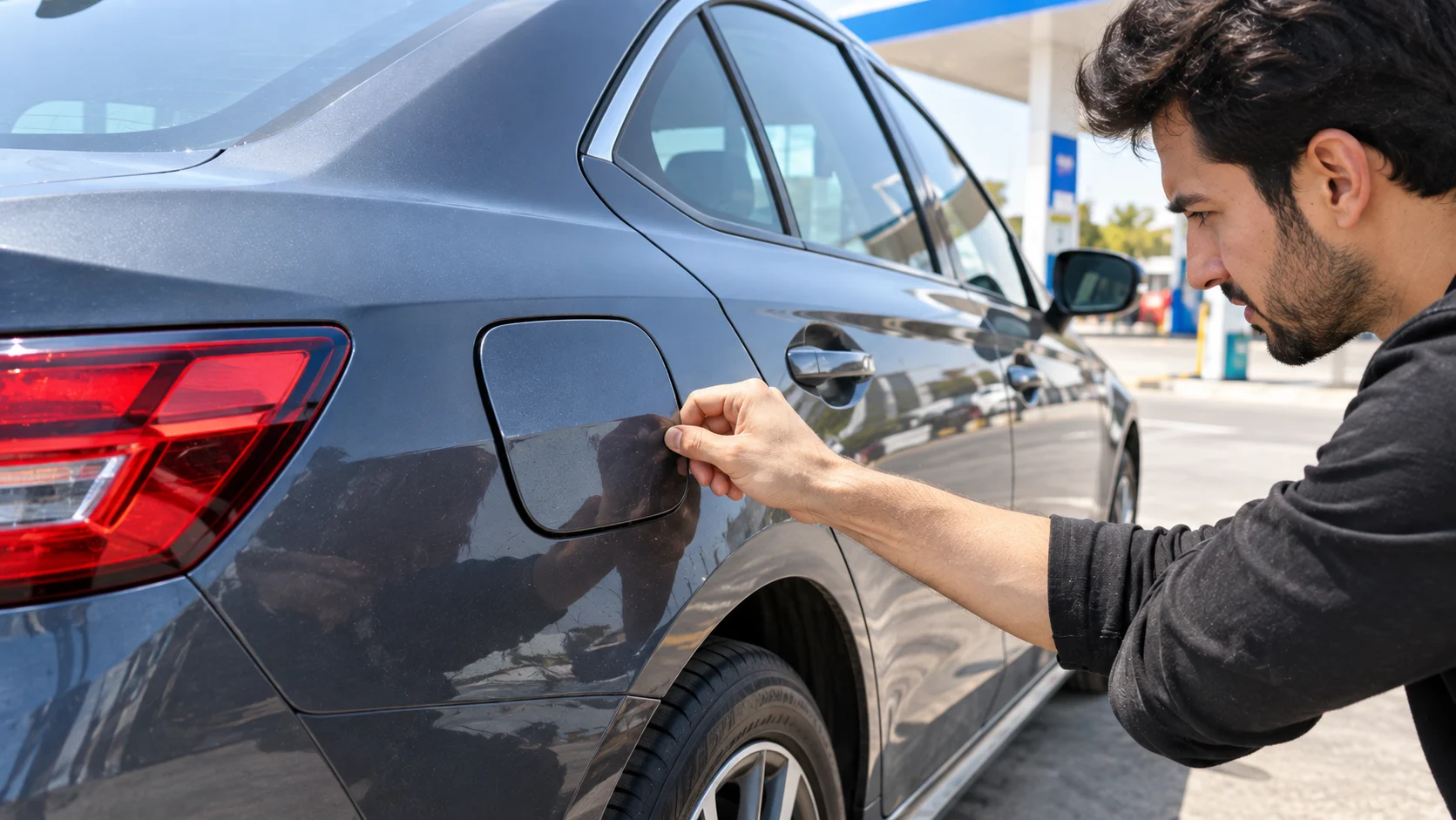
When a fuel door does not open in Dubai you’re stranded at a petrol station with a full queue behind you. It’s one of those faults that feels minor until it isn’t. You pull the release lever. Nothing happens. You push the door. It doesn’t budge.
The fuel door does not open situation has a small number of specific causes — and most of them are straightforward to fix. The cable is broken, the release latch is seized, the spring has snapped, or the lock actuator has failed. Each cause requires a different repair, but none of them involves major work.
At Rapid Rev Garage in Al Quoz, we diagnose and repair fuel door faults quickly. This guide explains every cause and what fixes it.
Fuel Door Does Not Open — Quick Answer
A fuel door does not open because the mechanism connecting the interior release to the fuel door has failed somewhere along its path. On cable-operated systems, the most common causes are a broken or disconnected release cable, a seized or corroded release latch, or a broken return spring that holds the latch in the open-ready position. On electrically-operated fuel doors, the causes include a failed solenoid actuator, a blown fuse, a faulty switch, or a jammed central locking integration that is keeping the door locked. In Dubai, cable corrosion from humidity and heat-degraded plastic latch components are the most frequent causes of a fuel door that does not open.
Table of Contents
- How the Fuel Door Release System Works
- Broken or Disconnected Release Cable
- Seized or Corroded Release Latch
- Broken Return Spring Inside the Fuel Door
- Failed Solenoid Actuator on Electrically-Operated Doors
- Blown Fuse or Faulty Release Switch
- Central Locking Integration Fault
- How Dubai’s Conditions Degrade Fuel Door Components
- Emergency Methods to Open a Stuck Fuel Door
- How We Diagnose and Fix a Fuel Door That Does Not Open
- What Does Fuel Door Repair Cost in Dubai?
- Why Rapid Rev Garage?
- FAQ
- Conclusion
How the Fuel Door Release System Works
Most fuel doors operate through one of two systems.
Cable-operated. A flexible steel cable runs from the interior release lever — typically in the driver’s footwell or door — to a latch mechanism at the fuel door itself. Pulling the lever pulls the cable, which releases the latch, and the fuel door springs open. This system has no electrical components and fails mechanically.
Electrically-operated. A solenoid or small electric motor at the fuel door releases the latch when triggered by a dashboard switch, the central locking system, or a touch sensor on the door itself. Some vehicles combine both — a primary electrical release with a backup cable for emergencies.
Knowing the system type is the first step in diagnosing why the fuel door does not open. Most vehicles sold in Dubai before 2018 use cable systems. Most newer vehicles use electrical systems. Our car mechanic team identifies the system type before starting any diagnosis.
Broken or Disconnected Release Cable
A broken cable is the most common reason a fuel door does not open on older Dubai vehicles.
The cable is a steel wire inside a plastic conduit. It has a hooked end that attaches to the interior lever and another that clips to the latch arm at the fuel door. In Dubai, the plastic conduit degrades from UV and heat — it becomes brittle, cracks, and loses its shape. When the conduit deforms, the cable can’t travel freely inside it, and pulling the lever produces no movement at the latch.
The steel wire itself can also snap — particularly at the end connections where stress concentrates. A snapped cable produces a lever that pulls freely with no resistance — there is nothing at the other end.
Confirmation: pull the interior lever and listen. A healthy cable produces a slight click at the fuel door. No movement and no click confirms the cable is broken or disconnected. Replacement involves routing a new cable from the lever to the latch, which typically takes under an hour.
Seized or Corroded Release Latch
The fuel door latch is a small spring-loaded mechanism that hooks onto a striker on the fuel door frame. When the cable or actuator releases it, the spring pushes the door open.
In Dubai’s inter-season humidity — particularly October to February — moisture reaches the latch mechanism and corrodes the moving parts. A corroded latch seizes in the closed position. The release lever or switch works correctly — the cable or actuator is moving — but the latch cannot move because corrosion has locked it.
The confirming test: with the cable confirmed functional, apply firm palm pressure to the fuel door while operating the release. If the door pops open, the latch was partially seized and the added pressure was enough to overcome it. This confirms the latch needs cleaning, lubrication, or replacement.
A seized latch — one of the most common reasons a fuel door does not open — is repaired with penetrating lubricant in mild cases, or latch replacement in advanced corrosion. For any roadside emergency when the fuel door won’t open before a long drive, our roadside assistance team covers Al Quoz and nearby Dubai areas.
Broken Return Spring Inside the Fuel Door
Every fuel door has a small return spring — either at the latch or at the hinge — that pushes the door open when the latch releases. Without this spring, the fuel door opens only when pushed from inside.
In Dubai, the combination of UV degradation and thermal cycling fatigues small springs faster than in cooler climates. A spring that has lost its tension produces a fuel door that barely opens — it releases from the latch but doesn’t spring outward, and it may appear to the driver as though the door is still locked.
A spring that has snapped completely means the door must be pulled open manually after releasing the latch. At petrol stations where the driver cannot easily reach around to the fuel door, this becomes a practical problem.
Spring replacement is inexpensive and quick — the fuel door or filler housing assembly is removed, the spring is replaced, and the assembly is refitted and tested. Our car service packages include a fuel door spring and latch check at every major service for vehicles over four years old.
Failed Solenoid Actuator on Electrically-Operated Doors
On vehicles with an electrical fuel door release, a solenoid or small electric motor pulls the latch open when the switch is activated. The solenoid receives a 12V signal from the switch circuit and retracts a plunger that releases the latch.
A solenoid can fail from a burned-out coil — the electromagnet inside has shorted — or from a seized plunger that is corroded in place. A failed solenoid means the electrical signal reaches the component but nothing moves.
The diagnostic test: with the ignition on, operate the fuel door switch and listen at the fuel door. A working solenoid produces an audible click. No click confirms the solenoid is not activating. Voltage testing at the solenoid connector confirms whether the issue is the solenoid itself or the circuit supplying it.
Blown Fuse or Faulty Release Switch
On electrically-operated systems, the fuel door release circuit shares a fuse with related accessories. A blown fuse cuts power to the entire circuit.
The fuse check takes under two minutes. The vehicle’s fuse diagram — in the owner’s manual or printed inside the fuse box cover — identifies the fuel door release fuse. A blown fuse is visibly broken and replaced immediately.
A faulty switch produces the correct visual indicator — the switch activates — but no voltage output at the solenoid terminal. Switch replacement is straightforward on most vehicles once the dashboard or door panel is partially removed to access the switch wiring.
Central Locking Integration Fault
On many modern vehicles, the fuel door lock is integrated with the central locking system. When the vehicle is locked, the fuel door is locked. When unlocked, it can be opened.
A central locking fault that keeps the fuel door locked even when the vehicle is unlocked produces a fuel door does not open situation that appears identical to a solenoid fault from outside. The distinguishing test: check whether all doors unlock correctly. If the doors unlock but the fuel door doesn’t, the integration relay or the specific fuel door actuator is the fault. If the doors also have locking faults, the central locking module is the cause. For any cosmetic paint or body repairs near the fuel door area, our car painting team handles colour-matched work at the same visit.
How Dubai’s Conditions Degrade Fuel Door Components
Dubai’s environment attacks fuel door components through two main mechanisms.
UV and heat. The fuel door is on the exterior of the vehicle — it receives full UV and heat exposure every time the vehicle is parked outdoors. The plastic latch housing becomes brittle. The cable conduit cracks. The rubber seal around the fuel door frame hardens and distorts, which sometimes causes the door to bind in its frame rather than spring open freely.
Humidity corrosion. The fuel door cavity — the recessed area the door sits in — is not fully sealed. Humidity enters and condenses on the metal latch and spring components. In Dubai’s inter-season months, daily humidity cycles in this enclosed cavity corrode small steel components significantly faster than ambient outdoor corrosion.
Emergency Methods to Open a Stuck Fuel Door
When the fuel door does not open at a petrol station and you need fuel immediately:
Press and release. Push the fuel door firmly inward, then release while simultaneously pulling the interior lever. On a door with a partially seized latch, the push-and-pull technique sometimes frees it.
Lubricate through the gap. A spray of penetrating lubricant — WD-40 or similar — along the edge of the fuel door can reach the latch mechanism. Apply, wait 60 seconds, then try the release again.
Access through the boot. On most vehicles, the fuel door release cable and latch are accessible from inside the boot area by removing a side panel. Manually operating the latch arm directly with a finger or thin tool opens the door without replacing any component.
Check the solenoid fuse. For electrically-operated doors, check the fuel door fuse before concluding the solenoid has failed. A blown fuse is replaced in two minutes with a spare from the fuse box.
Do not pry the fuel door open with a screwdriver. The plastic fuel door and its painted outer surface are easily damaged beyond cosmetic repair by forcing. Our mobile car mechanic covers Al Quoz and nearby Dubai areas for on-site fuel door release where getting to a workshop isn’t immediately possible.
How We Diagnose and Fix a Fuel Door That Does Not Open
Interior lever feel assessment. The release lever is operated while a technician listens at the fuel door. Lever resistance and door response together identify whether the cable is intact, the latch is seized, or the spring is failed.
Cable continuity check. On cable systems, the cable conduit is traced and the cable tension is confirmed at both ends. A slack cable confirms disconnection. A stiff conduit confirms deformation.
Voltage test at solenoid. On electrical systems, voltage is measured at the solenoid connector during switch activation. Voltage present but no solenoid movement confirms solenoid fault. No voltage confirms a fuse or switch fault.
Manual latch operation. With the fuel door area accessed from the boot interior, the latch arm is manually operated. If the door opens freely, the mechanism is intact — the fault is in the release path upstream.
What Does Fuel Door Repair Cost in Dubai?
| Service | Cost Range |
| Cable replacement | AED 250–600 |
| Latch cleaning and lubrication | AED 100–200 |
| Latch replacement | AED 200–500 |
| Spring replacement | AED 150–350 |
| Solenoid replacement | AED 300–800 |
| Fuse replacement | AED 20–50 |
| Switch replacement | AED 200–500 |
All costs confirmed after diagnosis. Written quote before any work begins. Our garage near me in Al Quoz serves drivers from Business Bay, Jumeirah, Barsha, Satwa, Downtown, and the Sheikh Zayed Road corridor.
Why Rapid Rev Garage?
Every fuel door does not open fault has a specific cause. These three tests identify why the fuel door does not open in under 20 minutes. We don’t replace the solenoid when the fuse is the cause, and we don’t replace the cable when the latch is simply corroded.
The diagnosis comes first. The repair matches exactly what the diagnosis confirms.
FAQ — Fuel Door Does Not Open
Here are the questions Dubai drivers ask us most when the fuel door stops opening.
Why won't my fuel door open even after I pull the lever?
The most likely cause is a broken or disconnected release cable. The lever moves freely because there is nothing at the other end. Check whether the lever feels lighter than usual — a cable with no load at the end has almost no resistance when pulled.
Can I drive without fixing a stuck fuel door?
Only until you need fuel. A fuel door that can't open on demand is a practical emergency at every refuel. On most vehicles the emergency method through the boot works once — but it's not a long-term solution. Book the repair within the same week.
Why did my fuel door suddenly stop working?
Sudden failure without any gradual warning typically indicates a cable that has snapped at its end connection, or a solenoid that has burned out. Gradual stiffening before failure suggests latch corrosion or cable conduit deformation. Either way, the cause is identifiable quickly.
Is it expensive to fix a stuck fuel door?
No. Most fuel door does not open faults cost AED 100–600 to repair. A fuse is AED 20–50. A corroded latch cleaned and lubricated is AED 100–200. Even a full cable or solenoid replacement is under AED 800 on most vehicles.
What if I can't open my fuel door and I need petrol right now?
Try the boot access method — remove the interior boot side panel, locate the cable arm at the latch, and manually push the latch arm toward the hinge. This opens the door without any tools in most cases. If that doesn't work, call us — our mobile team can come to you.
Conclusion
Every time a fuel door does not open, the cause is in the release mechanism — cable, latch, spring, solenoid, fuse, switch, or locking integration. Dubai’s heat and humidity cause a fuel door does not open situation faster than any other market than manufacturer service schedules anticipate. Most repairs are quick and inexpensive once the specific cause is confirmed.
Rapid Rev Garage in Al Quoz diagnoses every fuel door does not open fault through lever feel, cable continuity, and electrical testing — then repairs specifically what is confirmed faulty before returning the vehicle.
Rapid Rev Garage is in Al Quoz, serving Business Bay, Jumeirah, Downtown, Barsha, Satwa, and the Sheikh Zayed Road corridor. Book your appointment on WhatsApp or find us on Google Maps.
Rapid Rev Garage — Fuel Door Does Not Open | Al Quoz, Dubai