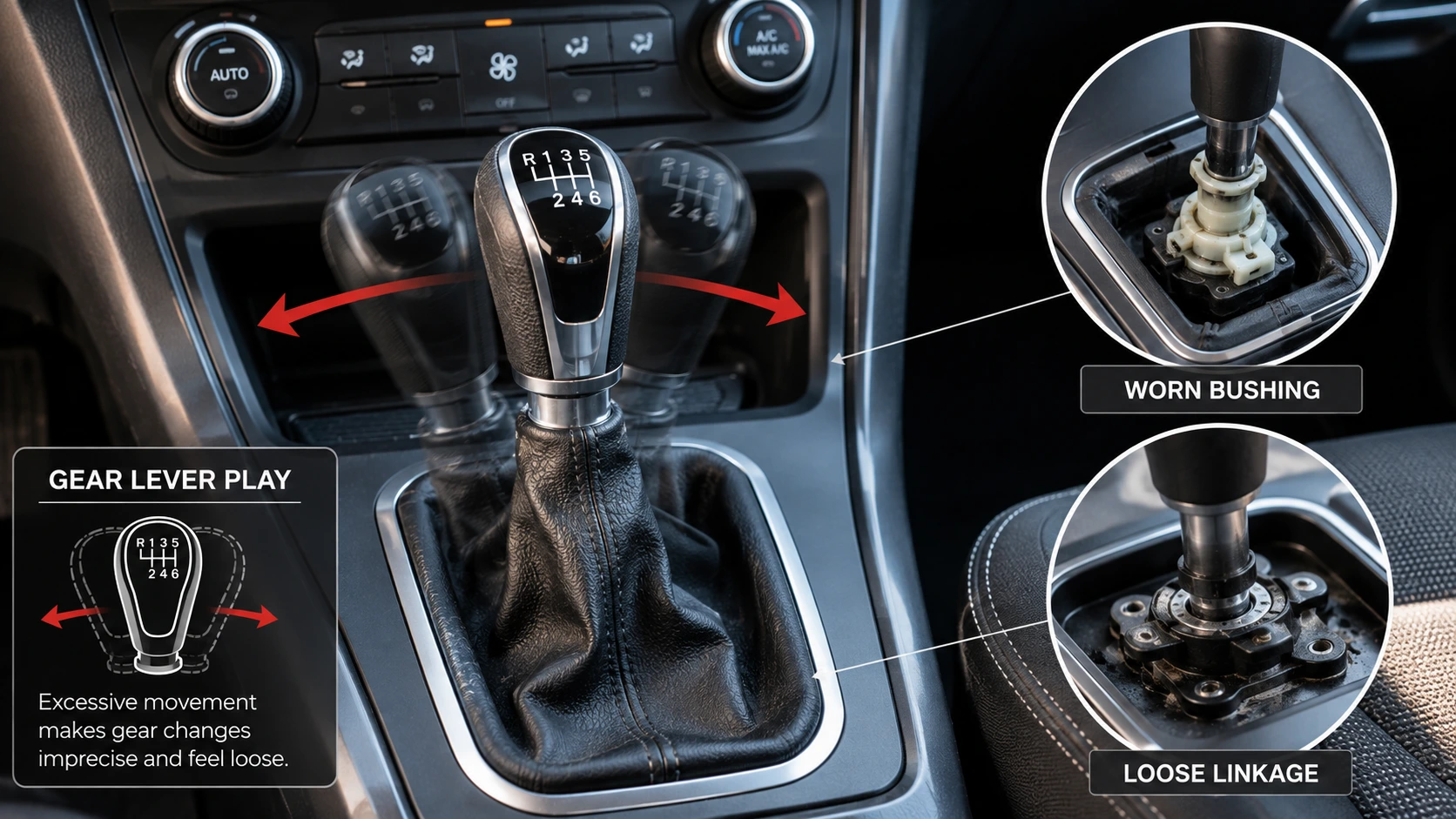
When a gear lever feels loose — moving further than it should, wobbling when you let go, or shifting without the solid, defined action it once had — something in the gear selection circuit is no longer constrained correctly. This isn’t a cosmetic issue. A gear lever feels loose situation — where the lever has excessive play or imprecise action is telling you that a mechanical or structural component between your hand and the transmission is worn, damaged, or disconnected. In Dubai’s heat and stop-start driving conditions, the components that maintain gear lever precision degrade faster than any factory service interval assumes.
At Rapid Rev Garage in Al Quoz, we diagnose gear lever complaints across all makes and models — manual gearboxes, automatic selectors, and dual-clutch systems — using a structured inspection that identifies the specific failing component before any work begins.
Gear Lever Feels Loose — Quick Verdict
When a gear lever feels loose, the cause is almost always one of four things: worn or disintegrated shift bushings that allow excessive lever movement, a stretched, frayed, or disconnected shift cable or linkage that’s lost its precision, worn or failed transmission or engine mounts that allow the entire gearbox to move under load, or in the case of automatic vehicles, a worn selector mechanism or detent spring that no longer provides defined position feedback. Manual and automatic transmissions develop this fault through different mechanisms — and diagnosing which component is responsible determines whether the repair is a simple bushing replacement or a more involved mount or linkage repair.
Table of Contents
- What a Loose Gear Lever Is Actually Telling You
- How to Read the Looseness — What Each Type of Play Means
- The Most Common Causes on Manual Gearboxes
- The Most Common Causes on Automatic Selectors
- Why Engine and Transmission Mounts Are Often Overlooked
- How Dubai’s Conditions Accelerate Gear Lever Wear
- Is It Still Safe to Drive With a Loose Gear Lever?
- When This Needs Immediate Inspection — Not Next Week
- How We Find the Exact Cause at Rapid Rev Garage
- Repair vs Replacement — What the Right Fix Actually Is
- What the Repair Costs in Dubai
- How to Keep Gear Selection Precise in Dubai
- Why Rapid Rev Garage?
- FAQ
- Conclusion
What a Loose Gear Lever Is Actually Telling You
The gear lever is not directly attached to the gearbox in most modern vehicles. Between the lever in the cabin and the transmission itself lies a series of components — bushings, cables, rods, pivot points, and brackets — all of which work together to translate the driver’s hand movement into precise gear selection. When any one of these components develops excessive wear or mechanical failure, the lever’s precision is lost.
The Difference Between Normal and Excessive Play
All gear levers have a small amount of designed movement — a fraction of play is normal and engineered into the system. What is not normal is a lever that rocks, wobbles, or travels significantly further than it used to before selecting a gear, or one that no longer sits in a defined position between gear changes. The driver’s perception of this change is reliable — if the shift action has changed noticeably from how it felt when the car was new, something mechanical has changed.
Why the Location of the Looseness Matters
A gear lever feels loose complaint that manifests as sideways wobble at the lever base points toward shift bushings or the lever housing. A looseness that appears as excessive travel before gear engagement points toward shift cable stretch or linkage wear. A looseness that is accompanied by vibration through the lever at idle and changes with engine load points toward engine or transmission mounts. Each location of the play identifies a different part of the mechanical chain between the lever and the gearbox.
How to Read the Looseness — What Each Type of Play Means
Before any inspection, understanding the character of the looseness directs the diagnosis accurately.
Wobble at Neutral With Engine Running
A gear lever that wobbles noticeably from side to side at neutral with the engine running — and the wobble changes with engine RPM or load — is almost certainly an engine mount or transmission mount fault. Engine vibration is being transmitted through the drivetrain to the lever because the mount isolation is no longer working. This type of looseness is felt rather than seen, as a continuous low-frequency vibration through the lever even when no gear selection is being attempted.
Excessive Travel Before Gear Engages
A lever that moves further than usual before the gear engages — requiring more lever movement to select the same gear that once engaged with a shorter throw — indicates shift cable stretch, linkage wear, or bushing degradation at the pivot points. The mechanical connection is still present, but it has developed slack that must be taken up before the selection reaches the gearbox.
Lever Doesn’t Sit Firmly in Gear
A lever that can be wiggled in its selected gear position — moving noticeably within the gate when it should be firmly located — indicates the detent mechanism is worn on a manual gearbox, or the selector position detent spring is failing on an automatic. The component that holds the lever in its selected position has lost its ability to maintain that location under the small forces the driver’s hand and the vehicle’s vibration apply.
Clunking When Selecting Gears
A clunk or thud felt through the lever when engaging a gear — alongside the looseness — suggests the looseness is severe enough that the components are making contact outside their normal range of movement. This is a more advanced stage of any of the causes and warrants immediate rather than deferred inspection.
The Most Common Causes on Manual Gearboxes
Manual gearboxes have a direct mechanical connection from lever to gearbox — through pivot bushings, a remote shifter assembly, and a gear selector rod or cable. Each component in this chain is a potential source of looseness.
Worn Gear Shifter Bushings
The shift lever pivots on rubber or nylon bushings — typically one at the base of the lever and one at the point where it connects to the shift rod or cable. These bushings constrain the lever’s movement to its designed range. When they wear — the rubber compresses permanently, the nylon cracks, or the bushing bond to its housing fails — the lever gains freedom to move in directions it should not, producing the loose, imprecise feel the driver notices.
Why Dubai Heat Destroys Bushings Faster
Shift bushings in Dubai operate in an environment significantly hotter than any European test cycle. The gearbox tunnel and transmission area in a Dubai vehicle in summer reaches temperatures that permanently compress rubber bushing material faster than the same component experiences in moderate climates. A bushing that would last 80,000–100,000 km in Europe may begin producing looseness before 60,000 km in Dubai’s stop-start heat.
How Bushing Wear Progresses
Initial bushing wear produces a slight vagueness in the gear selection — the lever doesn’t quite snap to position as crisply as before. This progresses to visible wobble, then to difficulty locating specific gears as the lever’s path through the shift gate becomes imprecise, and finally to misselection risk if the bushing deterioration is severe enough.
Damaged or Stretched Shift Cable
Most modern manual gearboxes use a cable-operated shifter rather than a direct shift rod. The cable runs from the gear lever housing through the firewall and gearbox tunnel to the transmission selector. A cable that has stretched — from sustained use and heat — develops slack that must be taken up before any movement is transmitted to the gearbox. A cable that has frayed or developed a partially broken inner wire produces intermittent sticking alongside the looseness.
The Hot Garage Phenomenon in Dubai
Shift cables parked in direct sun in Dubai can reach temperatures that accelerate sheath degradation and inner cable stretch. A vehicle that sits on uncovered parking throughout the work day in Dubai’s summer experiences sustained cable temperatures that add meaningfully to cable wear over years of this exposure.
Worn Remote Shifter Assembly
On vehicles where the gearbox is mounted away from the driver’s position — rear-wheel-drive vehicles with a long transmission tunnel, for example — a remote shifter assembly bridges the distance between the lever and the gearbox using a series of rods, levers, and pivot points. Any wear in these pivot bearings, or looseness in the rod-to-lever connection points, introduces cumulative slack across the entire assembly. The driver experiences this as a lever that seems to have disconnected partially from what it is supposed to be doing.
Our car mechanic team assesses each component in the shift circuit — bushing condition, cable tension, remote assembly pivot wear — before identifying which specific part is causing the gear lever feels loose complaint.
The Most Common Causes on Automatic Selectors
Automatic gear selectors work differently from manual levers — they route through cables, electronic sensors, and detent mechanisms rather than a direct mechanical shift connection — but they develop their own form of looseness.
Worn Selector Cable or Linkage
Automatic selectors connect to the transmission through a selector cable that communicates the chosen position — Park, Reverse, Neutral, Drive — to the transmission valve body or shift module. A stretched or worn selector cable produces a lever that moves further than expected before the transmission responds, and in advanced cases, a misalignment between what the selector display shows and what the transmission has actually selected.
The Safety Risk of Cable Misalignment on Automatics
A selector cable that is worn enough to produce positional misalignment is a genuine safety concern. If the cable position does not correctly match the displayed selector position, the vehicle may be in Neutral when the display shows Park, or in Drive when the indicator shows Neutral. This is not a fault to monitor — it requires immediate diagnosis.
Failing Detent Spring or Selector Mechanism
The detent mechanism provides the positive click-into-position feel of each selector position on an automatic. A spring or roller that has worn produces a lever that moves through its range without the defined detent feedback the driver expects. The lever feels vague and imprecise — it can be pushed between positions without the resistance that confirms a specific gear is selected.
Electronic Selector Faults — Shift-by-Wire Systems
Many modern premium vehicles — BMW, Mercedes, Jaguar, Range Rover — use shift-by-wire systems where the physical selector sends electronic signals rather than mechanical force to the transmission. A fault in the sensor, the control module, or the selector’s return mechanism produces a lever that doesn’t behave as expected. The lever may feel physically loose if the selector’s self-centring mechanism — which returns the lever to centre after each selection in some designs — is failing.
Why Engine and Transmission Mounts Are Often Overlooked
Engine and transmission mounts are the components that hold the powertrain in position within the engine bay. When they fail, the entire engine and gearbox assembly moves under load — and this movement is transmitted to the gear lever through the shift mechanism.
How a Failed Mount Produces Lever Looseness
A transmission mount that has collapsed allows the gearbox to move rearward under acceleration torque and forward under deceleration. This movement is larger than the clearances in the shift mechanism are designed to accommodate. The driver feels this as a shift lever that moves and clunks under acceleration — particularly noticeable in first and second gear on manual gearboxes, and as a selector lever that develops play in the selector gate on automatics.
Distinguishing Mount Failure From Bushing Failure
A key distinction between mount failure and bushing failure is the load-dependence of the looseness. Worn bushings produce looseness that is present at all times regardless of acceleration or load. Failed mounts produce looseness and clunking that is specifically worse under engine torque — acceleration, gear changes under load, aggressive throttle application. This distinction is observable during the diagnostic road test and directs the inspection to the correct component.
For any breakdown caused by a transmission mount that has failed completely and produced a drivetrain disconnect, our roadside assistance covers Al Quoz and nearby Dubai areas.
How Dubai’s Conditions Accelerate Gear Lever Wear
Dubai’s specific driving environment creates gear lever feels loose faults at lower mileages than the same vehicles experience in European or Japanese markets.
Stop-Start Driving Multiplies Gear Selection Events
A Dubai commuter selecting gears through Al Quoz and Business Bay traffic selects gears significantly more times per kilometre than the same vehicle would on a motorway run. Each gear selection is a cable, bushing, and linkage event. The accumulated number of selection cycles on a Dubai city-driven vehicle over 60,000 km is significantly higher than the same mileage in highway-dominated driving.
Heat Degrades Rubber and Nylon Components Specifically
Shift bushings, cable sheaths, and mount rubber compounds all share a vulnerability to sustained high temperature. Dubai’s peak underbonnet temperatures in summer — particularly for vehicles parked in direct sun — expose these components to temperatures at or beyond their design limits for extended periods daily. The permanent compression, cracking, and sheath degradation that results shortens component life in a way that mileage-based replacement intervals cannot capture.
Underground Parking Thermal Cycling
The daily thermal cycle between Dubai’s underground parking cool and peak summer heat is one of the widest temperature swings any vehicle’s rubber components experience globally. Each cycle stresses the rubber’s material structure. The accumulated cycle count over years of Dubai ownership produces hardening and cracking that is mileage-independent — a low-mileage vehicle used daily still accumulates this thermal cycling damage.
Is It Still Safe to Drive With a Loose Gear Lever?
The safety assessment depends on the severity of the looseness and which component is causing it.
Mild Bushing Wear — Drive Carefully, Book This Week
A gear lever that is slightly vaguer than before but still selects all gears reliably and sits firmly in each selected position is safe for careful short-term driving. The risk is that the fault progresses — and bushing wear that is mild this week may be severe enough to cause misselection in three weeks of daily driving.
Cable Wear Causing Difficult Gear Selection — Book Today
A gear lever feels loose complaint where specific gears are becoming difficult to select, or where the lever needs to be moved further than usual to find the gear, indicates cable or linkage wear that is already affecting function. This is a same-day inspection priority — not a defer-until-next-service situation.
Automatic Selector with Positional Uncertainty — Stop and Inspect
If there is any doubt about whether the automatic selector is correctly selecting the displayed position — particularly Park — the vehicle should not be driven until inspected. An automatic that is in Neutral when the display shows Park will roll on any incline the moment the driver exits.
Clunking Under Load From Mount Failure — Urgent
A loose feel accompanied by clunking under acceleration from a mount failure means the gearbox is moving significantly under load. This can damage the shift mechanism through contact outside its designed clearance range. Inspect within the day.
When This Needs Immediate Inspection — Not Next Week
Some presentations of a loose gear lever move beyond the normal “book within a week” advice.
Cannot Select a Specific Gear
If reverse, first, or any gear cannot be reliably selected — the lever travels into that position but the gear doesn’t engage — the shift mechanism has already deteriorated beyond inconvenience into functional failure. This is an immediate inspection situation.
Automatic Won’t Confirm Park Properly
If the parking mechanism on an automatic doesn’t engage with the normal firm feel and the selector indicator is uncertain, do not rely on the automatic parking mechanism as the sole restraint on any incline.
Lever Vibrates Severely at Idle
Severe vibration through the gear lever at idle — significantly worse than any previous driving experience with the vehicle — indicates a mount failure that may already be producing contact between drivetrain components and surrounding structure.
How We Find the Exact Cause at Rapid Rev Garage
Accurate diagnosis of a gear lever feels loose complaint follows a specific sequence at our Al Quoz workshop.
Road Test to Characterise the Looseness
The diagnostic road test assesses exactly how the looseness presents — whether it is load-dependent or constant, which gears are affected, whether it is present at idle or only during shifts, and whether any sounds accompany the lever movement. This characterisation determines which inspection steps are prioritised.
Shift Mechanism Physical Inspection
With the vehicle stationary, the lever is assessed for play type and direction. The lever base, the cable attachment, and the remote assembly pivot points are checked for movement outside their designed range. On manual gearboxes, bushing condition at each pivot point is assessed by attempting to move the lever in directions it should not move — any movement in these directions confirms bushing failure.
Under-Vehicle Mount Inspection
With the vehicle raised on the ramp, all engine and transmission mounts are visually inspected and physically loaded — a lever is used to apply torque to the mount and the deflection is measured against specification. A mount that deflects significantly under minimal load has failed.
Cable Tension and Condition Assessment
Where cable stretch is suspected, the cable tension and adjustment are verified against the manufacturer’s specification. A cable that is outside its adjustment range has stretched beyond compensation and requires replacement. Our car service team documents the specific fault confirmed by this sequence before any repair cost discussion begins.
Repair vs Replacement — What the Right Fix Actually Is
The repair decision depends entirely on the confirmed cause — and on whether an individual component or the assembly containing it is the correct scope.
Bushing Replacement
Worn shift bushings are replaced with correctly-specified units — rubber specification, nylon type, or polyurethane upgrade depending on the vehicle platform and the driver’s preference for precision versus isolation. On vehicles where aftermarket polyurethane bushing kits are available, these provide longer service life than original rubber specification in Dubai’s heat. Post-replacement, the shift action is tested through all gears before the vehicle is returned.
Shift Cable Replacement
A stretched or damaged shift cable is replaced with the correct cable for the specific vehicle — length, end fitting type, and sheath specification all affect shift quality. On modern vehicles where the cable is combined with the outer housing in a single assembly, the complete assembly is replaced rather than attempting to stretch or shorten an individual cable. A new cable is adjusted to the manufacturer’s specification at installation.
Remote Shifter Assembly Overhaul or Replacement
Where multiple pivot points in a remote shifter assembly have worn simultaneously, overhauling the entire assembly — replacing all bushings and worn pivot pins — is more effective than addressing individual wear points sequentially.
Mount Replacement
Failed transmission or engine mounts are replaced with correctly-specified units. On vehicles with multiple mount points, all mounts are assessed — a single failed mount on a vehicle with two other borderline mounts warrants replacing all three at the same visit, since the labour access is already available and the remaining mounts are unlikely to outlast the new one by much. For any exterior repairs needed alongside mechanical work, our car painting team handles colour-matched work at the same visit.
Electronic Selector Recalibration or Replacement
On shift-by-wire systems where an electronic fault is confirmed, software recalibration through manufacturer-compatible diagnostic tools — VCDS for Audi/VW, ISTA for BMW, STAR for Mercedes — corrects the selector position mapping before any hardware replacement is recommended. Where the selector mechanism itself is confirmed faulty, replacement with recalibration is the correct repair.
What the Repair Costs in Dubai
Cost is determined by the confirmed fault — which is why diagnosis before quoting matters.
Bushing Replacement
Shift bushing replacement — single or full set: AED 400–900 depending on the vehicle and bushing accessibility. Some vehicles require gearbox tunnel trim removal for access; others are accessible from under the vehicle on a ramp.
Cable Replacement
Shift cable replacement: AED 600–1,500 depending on cable length, routing complexity, and vehicle platform. European vehicles with specific cable routing through the firewall sit toward the higher end.
Mount Replacement
Single mount replacement: AED 500–1,200 for parts and labour. Full set of engine and transmission mounts: AED 1,500–3,500 depending on vehicle and the number of mount points. Our mobile car mechanic covers Al Quoz and nearby Dubai areas for on-site assessment of shift looseness before bringing the vehicle in.
Remote Shifter Assembly and Electronic Work
Remote shifter overhaul: AED 800–2,000 depending on the assembly complexity and parts availability. Electronic selector work: AED 400–1,500 depending on whether the resolution is recalibration or hardware replacement. A written quote is provided after the diagnostic sequence confirms the specific cause.
How to Keep Gear Selection Precise in Dubai
Specific habits extend shift mechanism component life in Dubai’s conditions.
Avoid Resting Your Hand on the Gear Lever
A persistent habit among many drivers — particularly in stop-start Dubai traffic — is resting the hand on the gear lever between gear changes. This applies a continuous sideways load to the shift mechanism, accelerating bushing wear and cable bending fatigue at the attachment points. Returning the hand to the steering wheel between gear changes eliminates this load.
Allow Full Gear Engagement Before Accelerating
Partial gear engagement — accelerating before the gear is fully selected — applies load to the shift mechanism while the cable and linkage are still in motion. On vehicles with cable shift systems, this accelerates cable stretch. Allowing the lever to fully seat in the gate before applying throttle protects both the shift mechanism and the gearbox synchromesh.
Transmission Fluid Service at Dubai-Appropriate Intervals
Manual gearbox oil and automatic transmission fluid both affect shift quality — and both degrade faster in Dubai’s heat than factory service intervals assume. A manual gearbox with degraded oil produces more resistance in its synchromesh, which increases the force the driver applies to the lever, which accelerates cable and bushing wear. Our garage near me location in Al Quoz serves drivers across Business Bay, Jumeirah, Barsha, Satwa, Downtown, and the Sheikh Zayed Road corridor.
Why Rapid Rev Garage?
We identify the specific component causing the gear lever feels loose complaint before recommending any repair — because a bushing replacement on a vehicle whose actual problem is a stretched shift cable resolves nothing, and a cable replacement on a vehicle whose actual problem is a failed mount addresses the symptom while the mount continues to damage the surrounding shift components. The diagnostic road test, physical shift mechanism assessment, mount inspection, and cable tension check together identify the actual fault in most cases within an hour.
We work across all platforms — manual gearboxes, conventional automatics, dual-clutch transmissions, and shift-by-wire systems — with the platform-appropriate diagnostic tools to read electronic selector faults on BMW, Mercedes, and Audi platforms that a generic OBD scanner would never detect.
FAQ — Gear Lever Feels Loose
These are the questions most frequently asked when this fault is noticed.
Is a loose gear lever dangerous to drive with?
It depends on the severity. A slight vagueness in a manual gearbox from worn bushings is an inconvenience. A loose automatic selector that may not be correctly selecting Park is a genuine safety issue. The specific symptom determines the urgency.
Can a loose gear lever cause the car to jump out of gear?
Yes — on a manual gearbox, worn shift bushings or a stretched cable that fails to fully seat the gear can allow the lever to drift back out of gear under vibration or load. If the vehicle is jumping out of a specific gear, the shift mechanism fault is already producing functional failure beyond mere looseness.
Why is my gear lever loose only when the engine is running and not when it's off?
Looseness present only with the engine running indicates mount failure — the engine and gearbox are vibrating abnormally and transmitting that vibration through the shift mechanism. With the engine off, there is no vibration to transmit. This is a clear mount fault presentation.
Can shift bushings be replaced without removing the gearbox?
In most cases, yes. Shift bushings at the lever base and remote assembly are accessible without gearbox removal. Some remote assembly pivot points require the vehicle to be raised on a ramp for access but do not require transmission work.
How long does gear lever looseness take to repair?
Bushing replacement: typically two to three hours same-day. Cable replacement: two to four hours. Mount replacement: two to five hours depending on the vehicle and mount configuration. Most cases are resolved same-day at our Al Quoz workshop.
Conclusion
A gear lever feels loose in Dubai for specific, identifiable reasons — worn shift bushings, stretched or damaged cables, failed engine or transmission mounts, or selector mechanism wear on automatic transmissions — all of which are accelerated by the heat, stop-start driving cycles, and thermal cycling that Dubai’s conditions produce. The correct repair is determined by the specific component the diagnostic sequence confirms has failed. Rapid Rev Garage in Al Quoz diagnoses every gear lever complaint through a structured road test, physical inspection, and mount assessment before any repair is recommended or any cost is discussed.
Rapid Rev Garage is in Al Quoz, serving drivers across nearby Dubai areas — Business Bay, Jumeirah, Downtown, Barsha, Satwa, and the Sheikh Zayed Road corridor. Book your appointment on WhatsApp or find us on Google Maps.
Rapid Rev Garage — Gear Lever Feels Loose | Al Quoz, Dubai