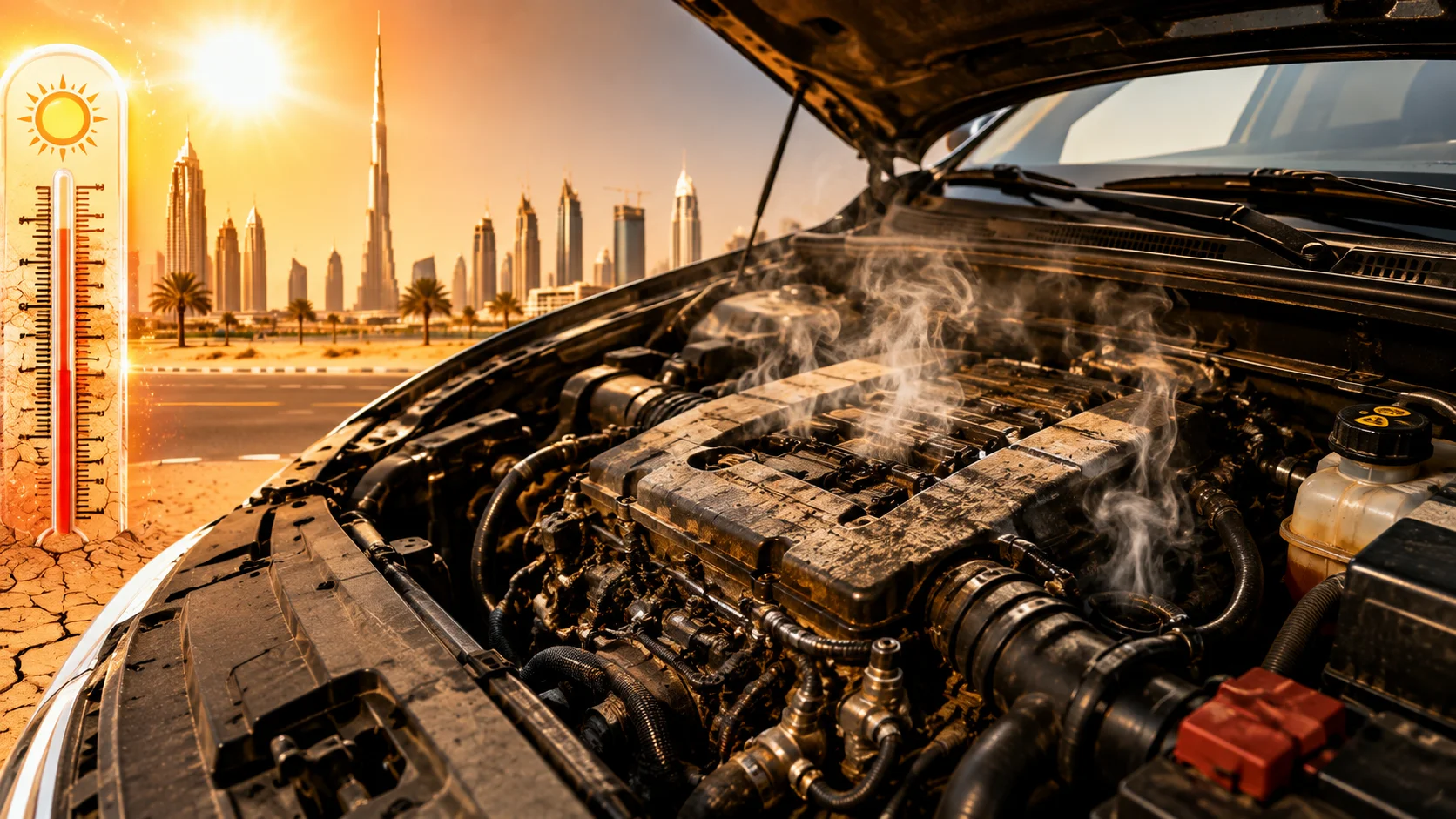
Dubai heat damages car engines in ways that are predictable, specific, and more rapid than the manufacturers who built those engines ever designed for. The UAE is not a market these vehicles were originally engineered around — the sustained temperatures, the intensity of UV exposure, the combination of heat and stop-start traffic, and the short daily trips that prevent proper warm-up cycles all accelerate engine wear in patterns that are consistent and recognisable at any experienced Al Quoz workshop.
Every dubai heat damages car engines situation we see at our Al Quoz workshop. Accurate diagnosis of dubai heat damages car engines starts with. Understanding dubai heat damages car engines helps Dubai drivers act at the right time. The most important thing to know about dubai heat damages car engines. Managing dubai heat damages car engines in Dubai requires a different approach. At Rapid Rev Garage, our engine repair in Dubai team sees these heat-specific patterns daily. Understanding them is what allows proactive maintenance rather than reactive repair.
Dubai Heat Damages Car Engines — Quick Verdict
Dubai’s extreme heat damages car engines through five primary mechanisms: accelerated oil degradation that reduces lubrication quality faster than factory service intervals assume, thermal cycling of rubber gaskets and seals that causes earlier failure, coolant system stress from sustained near-maximum operating conditions, timing chain tensioner wear from heat-thinned oil on cold starts, and carbon buildup from short-trip driving in heat that never allows proper combustion temperature. All five are preventable or manageable with maintenance adjusted for Dubai conditions rather than European assumptions.
An engine is designed to operate within a specific temperature range — not at the peak of that range continuously, but within a comfortable margin below it. In Dubai’s summer, that margin shrinks or disappears entirely. Ambient temperatures above 45°C mean the cooling system is already working near its design limit before the engine adds its own heat to the equation. Components that rely on temperature margins for longevity — gaskets, seals, oil additives, timing chain tensioners — are all working under conditions that accelerate their service life consumption.
The result is a vehicle population in Dubai that develops specific faults earlier than the same models experience elsewhere — a pattern so consistent that it’s reflected in the advice any experienced technician gives about maintenance intervals in this market.
How Dubai Heat Damages Engine Oil
The first and most significant way Dubai heat damages car engines is through oil. Engine oil is the engine’s primary defence against internal wear — and it degrades faster here than anywhere else the vehicle might be driven.
Thermal Oxidation Accelerates in High Temperatures
Engine oil degrades through thermal oxidation — heat breaks down the molecular structure of the base oil and additives over time. In Dubai’s sustained underbonnet temperatures, which regularly exceed 110°C in summer stop-start traffic, this process runs faster than it does in a German workshop’s test cycle. An oil that would protect the engine for 15,000 km on an autobahn may be significantly degraded by 8,000 km of Dubai city driving.
Short Trips Compound the Heat Damage
Dubai’s dominant driving pattern — multiple short trips daily rather than sustained highway runs — means the engine reaches full operating temperature, cycles back to ambient in air-conditioned parking, and repeats. Each cold start at elevated ambient temperature puts fresh thermal stress on the oil before it has reached its full operating viscosity. This cycle accumulates combustion blowby and moisture in the oil faster than any sustained-temperature test anticipates.
What Degraded Oil Does to Engine Components
Oil past its effective service life loses its protective film thickness — the microscopic layer that prevents metal-to-metal contact between moving parts. Timing chain tensioners, camshaft bearings, connecting rod bearings, and VVT actuators all require this film to function without accelerated wear. The first sign is often a cold-start rattle from the timing tensioner, or increased engine noise under load.
How Heat Damages Gaskets and Seals
The rubber components that seal every fluid passage in the engine — valve cover gaskets, oil filter housing o-rings, coolant hoses, cam seals, and the rear main seal — are all degraded by sustained heat exposure.
Thermal Cycling Is the Mechanism
It’s not just sustained heat but the repeated cycle of heat and cool that causes rubber to harden, crack, and lose its ability to compress and seal effectively. A valve cover gasket on a Dubai vehicle goes through this cycle hundreds of times per year — from basement parking temperature to peak engine bay heat and back again, every day.
Which Seals Fail First in Dubai
The valve cover gasket and oil filter housing o-ring are the two most commonly replaced seals on any make at our workshop, for exactly this reason. Coolant hoses — which carry pressurised coolant at 100°C+ while the outside of the hose sits in 50°C+ engine bay air — develop hardening and small cracks at their connection points before any obvious visible damage appears.
Our car mechanic team inspects all seal and gasket conditions at every major service visit rather than only when leaks have already appeared.
How Heat Damages the Cooling System
The cooling system is the engine’s only defence against the heat it generates. In Dubai, that system operates near its limit for months at a time — which means any weakness in the system is amplified rather than compensated for.
Coolant Degradation and Corrosion
Coolant has a service life — not just a level, but an effective protective life of its additive package. Old coolant becomes acidic, and acid corroding aluminium cylinder heads and coolant passages is an internal process with no visible external symptoms until the damage is already significant. Coolant replacement every two years is more important in Dubai than any other maintenance item specifically because the heat accelerates the depletion of the inhibitor package.
Radiator Fin Blockage From Dust
Al Quoz’s industrial environment deposits dust between radiator fins at a rate that meaningfully reduces airflow and heat rejection capacity. A radiator that’s 30% blocked by dust doesn’t fail outright — it just makes the cooling system work proportionally harder to maintain the same temperature, accelerating wear on the water pump, thermostat, and head gasket.
How Heat Causes Carbon Buildup
Carbon buildup on direct-injection engine intake valves is a fault that exists in every market, but Dubai’s heat and short-trip pattern accelerates it significantly.
Why Direct Injection and Short Trips Are a Bad Combination in Heat
Direct-injection engines spray fuel into the combustion chamber rather than over the intake valves, which means the valves never receive the cleaning effect of fuel wash. Oil vapour from the PCV (crankcase ventilation) system deposits carbon on valve backs continuously. In Dubai’s heat, where the PCV system generates more vapour than in cooler conditions, and where short trips prevent the sustained combustion temperature that slows deposit formation, carbon accumulates faster than the same engine experiences elsewhere.
The Symptoms That Point to Carbon Buildup
Rough idle, hesitation under acceleration, and gradual power loss before 60,000 km on a Dubai city-driven vehicle are the characteristic pattern. VCDS or equivalent fuel trim data confirms the fault before the intake manifold is removed for walnut blasting — the correct fix for this specific problem.
For any breakdown caused by overheating or other heat-related failure, our roadside assistance covers Al Quoz and nearby Dubai areas.
How Heat Affects Timing Chain Tensioners
The cold-start rattle that many Dubai drivers normalise as “just how the car sounds” is heat-related timing chain tensioner failure — directly caused by oil that’s been thermally stressed to the point where it doesn’t maintain overnight hydraulic pressure in the tensioner.
The Dubai-Specific Pattern
Vehicles doing multiple short daily trips accumulate more cold starts per year than vehicles doing fewer, longer drives. Each cold start on a failing tensioner adds chain stretch. Dubai heat accelerates the oil degradation that leads to tensioner failure, and the city driving pattern maximises the number of cold starts that stress the failing tensioner.
Prevention — Adjusting Maintenance for Dubai Reality
The most effective response to how Dubai heat damages car engines is maintenance calibrated for local conditions rather than European factory schedules.
Oil Changes at 8,000 km for City Drivers
Not the 15,000 km maximum that many factory service reminders suggest. Degraded oil is the primary mechanism behind most heat-related engine damage, and changing it at the point where it’s still protective rather than after it’s already degraded is the most cost-effective preventive measure available.
Coolant Replacement Every Two Years
Regardless of colour, level, or how the car feels to drive. The additive depletion that makes coolant damaging rather than protective has no visible external symptom until internal corrosion has already occurred.
Our car service packages are built around Dubai-appropriate intervals rather than European factory schedules — specifically because the conditions here are different enough to justify different maintenance timing.
Dubai-Specific Advice
The three habits that prevent the most common heat-related engine damage in Dubai are short oil change intervals, regular coolant replacement, and monthly oil level checks. These three things, done consistently, prevent the majority of the expensive engine repairs that arrive at our workshop. For exterior damage from Dubai’s conditions alongside engine maintenance, our car painting team handles colour-matched repairs in the same visit.
Why Rapid Rev Garage?
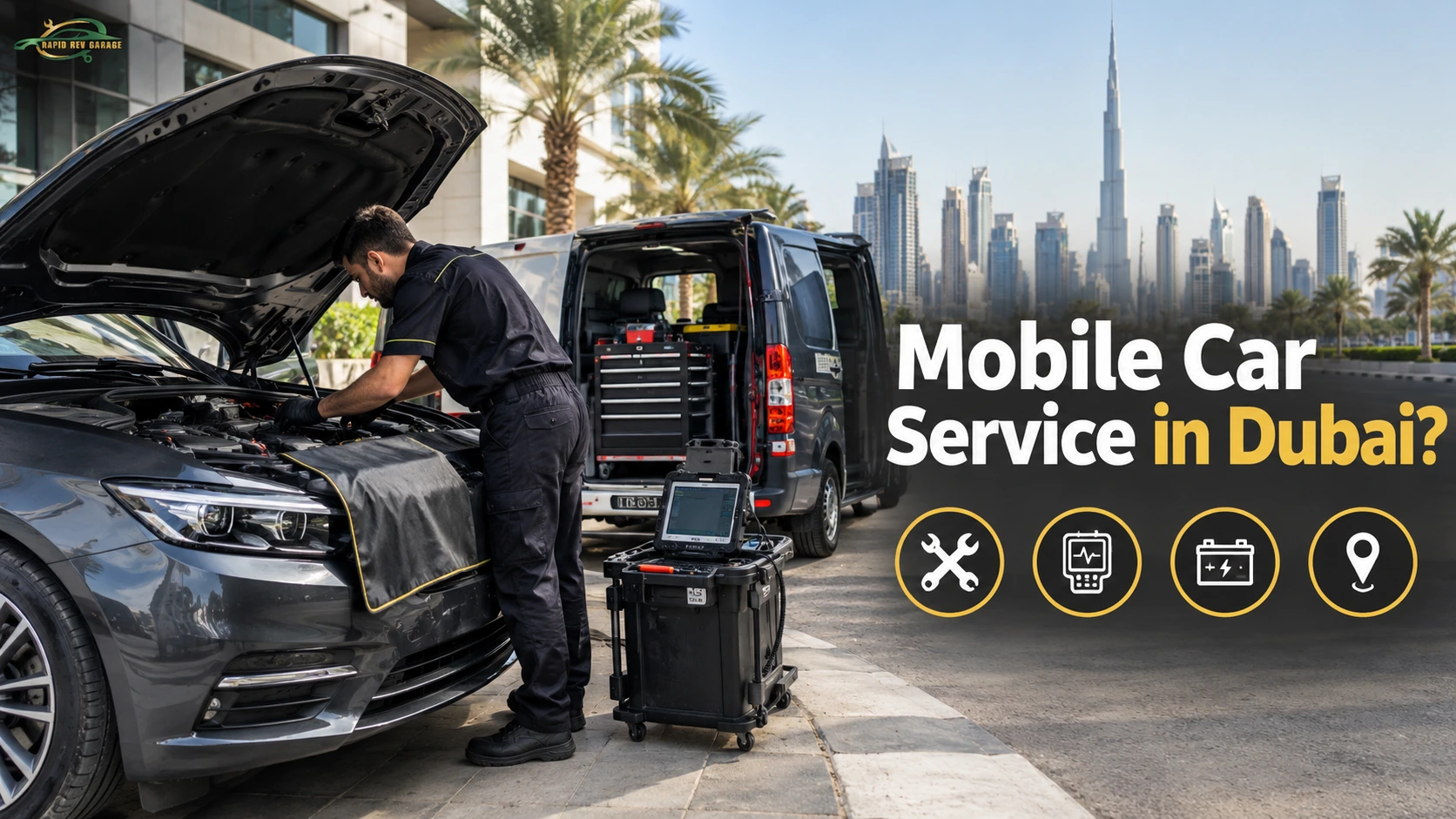
We service vehicles to Dubai-appropriate standards rather than European factory assumptions — because the conditions here aren’t the conditions those factory schedules were designed around. Every recommendation we make accounts for the heat, the stop-start driving pattern, the dust, and the short-trip usage that define how vehicles are actually used in this market. Our mobile car mechanic covers Al Quoz and nearby Dubai areas for on-site assessment.
FAQ — How Dubai Heat Damages Car Engines
These are the questions most commonly asked about heat’s effect on engines in Dubai.
How often should I change my oil in Dubai?
Every 8,000 km for city drivers doing regular stop-start commuting — the factory maximum interval isn’t appropriate for Dubai’s driving pattern and heat conditions.
Does the heat in Dubai affect engine oil that quickly?
Yes — thermal oxidation at sustained underbonnet temperatures above 100°C degrades oil measurably faster than European test cycles account for, particularly in stop-start conditions that prevent sustained operating temperature.
What’s the biggest risk of not changing coolant in Dubai?
Internal aluminium corrosion from acidic depleted coolant — an invisible process until it has already damaged cylinder heads, coolant passages, or the head gasket sealing surface.
Can carbon buildup be prevented in Dubai?
Partially — correct oil specification reduces PCV vapour deposit, and periodic walnut blasting on direct-injection engines removes existing buildup. It cannot be entirely prevented in a stop-start city driving environment, only managed.
Is it worth buying a maintenance plan for Dubai heat conditions?
Yes — a maintenance package calibrated for Dubai’s conditions costs less over the ownership period than the reactive repairs that heat-related damage causes when preventive maintenance is deferred.
Conclusion
Dubai heat damages car engines through oil degradation, seal failure, cooling system stress, carbon buildup, and timing chain tensioner wear — all on timelines shorter than the factory service schedules that govern most vehicle maintenance in this market. The response is adjusted maintenance, not resigned acceptance. Rapid Rev Garage in Al Quoz builds every service recommendation around Dubai’s actual conditions rather than European assumptions.
Rapid Rev Garage is in Al Quoz, serving drivers across nearby Dubai areas. Find us through a garage near me search, book your appointment on WhatsApp, or find us on Google Maps.
Rapid Rev Garage — Dubai Heat Damages Car Engines | Al Quoz, Dubai