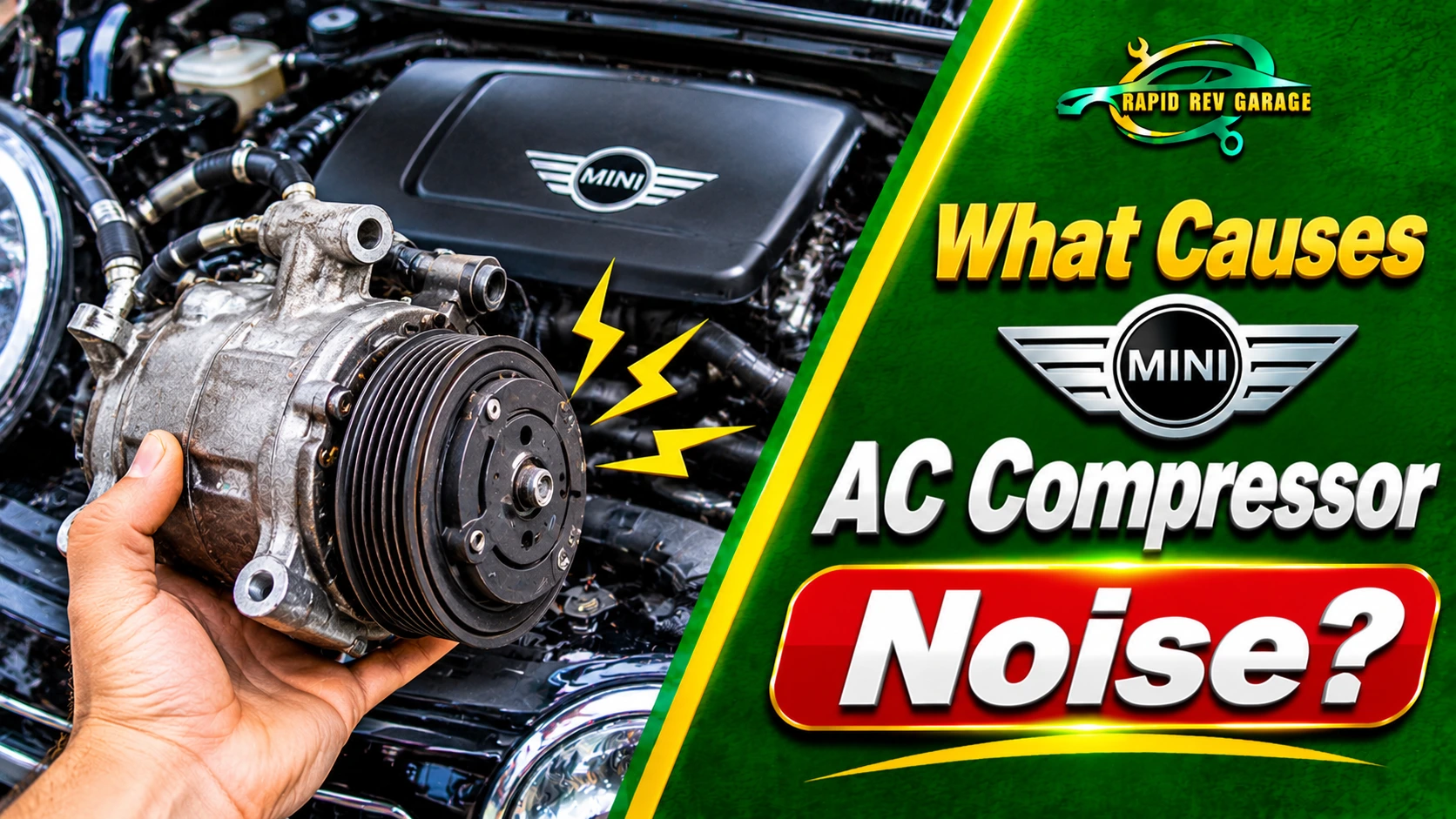
Mini Cooper AC compressor noise can happen due to worn bearings, low refrigerant, a damaged compressor clutch, loose parts, or internal compressor damage. You may hear rattling, grinding, whining, or clicking sounds when you turn on the AC. These noises can become louder over time. In some cases, the AC may also stop cooling properly. Start by checking when the noise occurs and whether the cooling has changed. Avoid running the AC if the noise is loud or comes with a burning smell. A professional AC inspection can help find the faulty part before it causes more damage.
Table of Contents
- Problem Overview
- Common Symptoms
- Main Causes
- How Mechanics Diagnose the Noise
- AC Compressor Repair Process
- Risks of Ignoring the Noise
- Can You Continue Driving?
- Repair Time and Cost Factors
- Estimated Repair Costs in Dubai
- Prevention Tips
- Dubai-Specific Advice
- Why Choose Rapid Rev Garage?
- Relevant Service Page
- FAQs
- Final Thoughts
1. Problem Overview: Why Is Your Mini Cooper AC Making Noise?
Your Mini Cooper’s air conditioning system has several parts that work together to keep the cabin cool. One of the most important parts is the AC compressor.
The compressor moves refrigerant through the AC system. It helps remove heat from the air inside your car. When it works properly, the system provides cool air without unusual sounds.
However, you may hear strange noises when you switch on the AC. The sound may come from the compressor, its pulley, the clutch, or another nearby part.
Mini Cooper AC compressor noise should not be ignored, even if the AC is still cooling. A small fault can become a bigger repair if the damaged part continues to run.
The first step is to understand the type of noise and when it happens.
2. Common Symptoms of a Faulty Mini Cooper AC Compressor
A faulty compressor may show several warning signs. Some are easy to notice, while others may start slowly.
Common symptoms to watch for:
- ⚠️ Rattling sound: You may hear a loose or shaking sound when the AC starts.
- ⚠️ Grinding noise: A rough metal-on-metal sound may point to worn internal parts or a damaged bearing.
- ⚠️ Whining noise: A high-pitched sound may come from a worn bearing, pulley, or compressor.
- ⚠️ Clicking sound: Repeated clicking may point to a clutch or electrical problem.
- ⚠️ Weak cooling: The AC may blow warm or less cool air than usual.
- ⚠️ AC stops working: The compressor may fail to move refrigerant through the system.
- ⚠️ Noise changes with engine speed: The sound may become louder as you press the accelerator.
- ⚠️ Burning smell: A slipping belt or damaged compressor can create excess heat.
Checklist: What Should You Notice?
- ✅ Does the noise start when you switch on the AC?
- ✅ Does the sound become louder when you accelerate?
- ✅ Is the AC cooling weaker than before?
- ✅ Can you hear rattling or grinding near the engine?
- ✅ Does the noise stop when you turn off the AC?
- ✅ Is there a burning smell or visible belt damage?
These details can help a mechanic understand the problem. However, they do not confirm which part has failed.
3. Main Causes of Mini Cooper AC Compressor Noise
Several reasons can cause the compressor or nearby AC parts to make unusual sounds. Let’s look at the most common causes.
3.1 Worn AC Compressor Bearings
The compressor uses bearings to support smooth movement. Over time, these bearings can wear out due to heat, age and regular use.
When this happens, you may hear a grinding, humming, or whining sound.
Common signs:
- Noise increases when the AC is running.
- Grinding sound near the compressor.
- Sound changes with engine speed.
- AC performance may become weak.
Fix: A mechanic should inspect the bearing and compressor. If the bearing is not separately serviceable, the compressor may need replacement.
3.2 Damaged Compressor Clutch
Some Mini Cooper models use a compressor clutch to control compressor operation. It connects the compressor to the engine drive when cooling is needed.
A worn clutch or damaged clutch plate may create clicking, rattling, or scraping sounds.
Common signs:
- Repeated clicking when AC starts.
- Noise when the compressor engages.
- AC cooling turns on and off.
- Visible wear around the clutch area.
Fix: The clutch and its electrical controls should be inspected. The faulty component should be repaired or replaced where the design allows it.
3.3 Low Refrigerant or Incorrect AC Gas Pressure
Refrigerant helps carry heat away from the cabin. If the system has low refrigerant, the compressor may not work under the correct conditions.
Low refrigerant often points to a leak. Incorrect pressure can also affect compressor operation.
Common signs:
- Weak cooling.
- AC turns on and off frequently.
- Unusual sounds during operation.
- Cooling takes longer than normal.
Fix: The mechanic should check refrigerant pressure and inspect the system for leaks. Add the correct refrigerant only after the cause of low pressure is addressed.
3.4 Internal Compressor Damage
The compressor has moving parts inside. These parts can wear out or become damaged over time.
Poor lubrication, excess heat and long-term wear may affect its performance.
Common signs:
- Loud grinding noise.
- Metal-like sounds from the compressor.
- AC stops cooling.
- Compressor struggles to operate.
Fix: A mechanic should check the compressor and refrigerant circuit. If internal damage is severe, replacement may be the safest option. The system may also need cleaning if metal debris has spread through it.
3.5 Loose or Damaged Drive Belt
The drive belt helps power different engine accessories. Depending on the Mini Cooper model, it may also drive the AC compressor.
A loose, cracked, or worn belt can create squealing or rattling sounds.
Common signs:
- Squealing when the AC starts.
- Noise during engine startup.
- Visible belt cracks.
- Sound changes with engine speed.
Fix: The belt, tensioner and pulleys should be checked. Replace worn parts and set the correct belt tension.
3.6 Faulty Compressor Pulley
The compressor pulley helps transfer engine power to the compressor. A worn pulley bearing can create noise even before the compressor itself fails.
Common signs:
- Humming or grinding near the pulley.
- Noise changes with engine speed.
- Rough pulley movement.
- Belt vibration.
Fix: The pulley and bearing should be inspected. Replace the faulty part if it is separately serviceable.
4. How Do Mechanics Diagnose AC Compressor Noise?
The sound alone is not enough to confirm compressor failure. A similar noise can come from the drive belt, tensioner, alternator, or another engine part.
A proper inspection helps avoid unnecessary replacement.
| Inspection | What the mechanic checks | Purpose |
|---|---|---|
| Visual inspection | Compressor, belt, pulley and connections | Finds visible damage |
| Noise inspection | Sound during AC operation | Helps locate the noise |
| Refrigerant pressure test | AC gas pressure | Finds pressure problems |
| Leak detection | Hoses, seals and connections | Finds refrigerant leaks |
| Clutch inspection | Clutch operation, where fitted | Checks engagement problems |
| Diagnostic scan | Available AC and electrical fault codes | Finds electronic faults |
How to Tell Different AC Noises Apart
The type of sound can provide useful clues.
| Noise Type | Possible Cause | Recommended Action |
|---|---|---|
| Rattling | Loose parts or clutch wear | Inspect compressor and mounting |
| Grinding | Worn bearing or internal damage | Stop using AC and arrange inspection |
| Whining | Bearing or pulley wear | Check pulley and compressor |
| Clicking | Clutch or electrical fault | Test clutch and controls |
| Squealing | Belt or tensioner problem | Inspect belt drive system |
These are possible causes, not final diagnoses. A mechanic should inspect the system before replacing any part.
5. AC Compressor Repair Process: Step-by-Step
The repair depends on the actual fault. A professional workshop should inspect the complete AC system before starting work.
Here is how the process usually works.
Step 1: Listen to the Noise
The mechanic checks when the sound starts. They may compare the noise with the AC switched on and off.
Step 2: Inspect the Compressor and Belt
The compressor, pulley, clutch, belt and tensioner are checked for wear or damage.
Step 3: Test Refrigerant Pressure
Special tools help check the refrigerant pressure. This can show whether the system has low or incorrect pressure.
Step 4: Find the Faulty Part
The mechanic identifies whether the problem is related to the compressor, bearing, clutch, pulley, belt, or another AC component.
Step 5: Repair or Replace the Damaged Part
The faulty component is repaired or replaced with a suitable part for your Mini Cooper model.
Step 6: Recharge the AC System
If the system has been opened, it should be properly evacuated and recharged with the correct refrigerant amount.
Step 7: Test the AC System
The mechanic checks cooling performance, pressure readings, compressor operation and unusual sounds.
This final check helps confirm that the repair has solved the problem.
6. Risks of Ignoring AC Compressor Noise
A strange sound may seem like a small issue. However, ignoring it can lead to more damage.
Some possible risks:
- Complete compressor failure: A worn compressor may stop working.
- Belt damage: A faulty pulley can put extra stress on the drive belt.
- Poor cooling: Your cabin may become warm, even at the lowest AC setting.
- Metal debris: A damaged compressor may spread metal particles through the AC system.
- Higher repair costs: Extra damage may require more parts and labour.
- Sudden AC failure: The system may stop cooling without much warning.
Early inspection can help reduce the risk of a major repair.
7. Can You Continue Driving With a Noisy AC Compressor?
It depends on the cause of the noise.
If the sound is mild, the AC still works and there are no other warning signs, the car may remain driveable. However, you should switch off the AC and arrange an inspection as soon as possible.
Do not continue driving if you notice:
- Loud grinding or metal scraping.
- A burning rubber smell.
- Smoke from the engine area.
- A damaged or loose drive belt.
- Engine warning lights or other unusual behaviour.
A seized compressor or damaged pulley can affect the belt system on some models. This may cause further problems.
If your car becomes unsafe to drive, arrange roadside assistance instead of taking the risk.
8. AC Compressor Repair Time and Cost Factors
The repair time depends on the faulty part and your Mini Cooper model.
A simple belt repair may take less time than a full compressor replacement. If metal debris has spread through the AC system, extra cleaning and repairs may also be needed.
How Long Does the Repair Take?
| Repair Type | Estimated Time |
|---|---|
| Initial AC inspection | 30–60 minutes |
| Refrigerant pressure check | 30–60 minutes |
| Belt or tensioner replacement | 1–2 hours |
| Compressor clutch repair, where serviceable | 1–3 hours |
| AC compressor replacement | 3–5 hours |
| AC system cleaning and flushing | 2–4 hours |
These are general estimates. The actual time may change based on the vehicle model, parts availability and repair work required.
What Affects the Repair Cost?
Several factors can change the final bill:
- Mini Cooper model: Cooper, Cooper S, Countryman and JCW models may use different compressor designs.
- Part quality: Genuine and aftermarket parts have different prices.
- Type of damage: A pulley or belt issue may cost less than full compressor replacement.
- Labour charges: Some compressor designs take longer to remove and install.
- Extra repairs: Refrigerant leaks, damaged hoses, or system contamination can increase the cost.
9. Estimated Mini Cooper AC Compressor Repair Costs in Dubai
The following table gives general price estimates for common AC repairs in Dubai.
| Repair or Service | Estimated Cost (AED) |
|---|---|
| AC inspection and diagnosis | 150–300 |
| Refrigerant leak detection | 150–400 |
| AC gas refill | 150–400 |
| Drive belt replacement | 200–500 |
| Compressor pulley or clutch repair | 400–1,000 |
| AC compressor repair | 500–1,200 |
| AC compressor replacement | 1,500–4,000+ |
| AC system cleaning and flushing | 300–900 |
Note: These are approximate estimates, not fixed quotations. The actual Mini Cooper AC compressor replacement cost depends on the model, compressor type, parts and labour. Severe compressor damage may also require extra system cleaning or component replacement.
10. Prevention Tips to Keep Your Mini Cooper AC Quiet
Regular AC maintenance can help reduce wear and prevent sudden problems.
Follow these simple tips:
- ✅ Use your AC regularly: Running it from time to time helps keep the system active.
- ✅ Get yearly AC checks: Inspect the compressor, belt and refrigerant system.
- ✅ Fix refrigerant leaks early: Low refrigerant can affect system performance.
- ✅ Check the drive belt: Replace it if you notice cracks or unusual wear.
- ✅ Keep the condenser clean: Dust and dirt can reduce cooling performance.
- ✅ Do not ignore strange sounds: Get new rattling, grinding, or whining noises checked.
- ✅ Use the correct refrigerant: Follow the specifications for your Mini Cooper model.
- ✅ Avoid unnecessary gas refills: Always check for leaks and correct pressure before adding refrigerant.
Good maintenance can help your AC system work smoothly for longer.
11. Dubai-Specific Advice for Mini Cooper Owners
Dubai’s hot weather puts extra pressure on car AC systems. During summer, your AC may run for long periods to keep the cabin cool.
This can make existing compressor problems more noticeable.
A few useful tips for local drivers:
Check your AC before summer. Get the compressor, belt and refrigerant pressure inspected before temperatures rise.
Keep the condenser clean. Dubai’s dust can collect around the front of your car and reduce airflow.
Watch for changes in cooling. If your AC takes longer to cool the cabin, get it checked.
Do not ignore unusual sounds. A rattling or grinding compressor may fail completely if the problem gets worse.
Choose a suitable workshop. If you are searching ‘garage near me‘, look for expert technicians like the ones at Rapid Rev Garage who can test the compressor and the full AC system.
If the AC problem comes with a serious mechanical fault or your car breaks down, professional roadside assistance can help you arrange safe recovery.
12. Why Choose Rapid Rev Garage for Mini Cooper AC Repair in Dubai?
Finding the right workshop matters when your Mini Cooper’s AC starts making unusual sounds. You need a team that can check the compressor, identify the actual fault and recommend the correct repair.
Rapid Rev Garage provides car AC repair and diagnostic services in Dubai. Its team handles different vehicle makes and models, including the Mini Cooper.
Some reasons to consider its services:
- AC system inspection: Helps identify compressor and cooling problems.
- Diagnostic support: Helps find faults before replacing parts.
- Experienced technicians: Work on different car makes and models.
- Repair solutions: Support for AC faults, damaged components and cooling issues.
- Quality replacement parts: Suitable parts help support reliable performance.
- Clear repair estimates: Understand the work needed before repairs begin.
If you notice unusual compressor sounds, getting the AC system inspected early can help prevent further damage. Rapid Rev Garage is an option for Mini Cooper AC repair in Dubai.
13. Relevant Service Page
Check out our Mini Cooper AC Repair service page to explore professional air conditioning solutions for your vehicle. Rapid Rev Garage provides AC inspections, compressor repairs, and cooling system services to help keep your Mini Cooper’s air conditioning working properly in Dubai.
14. FAQs
Why does my Mini Cooper make noise when the AC is on?
It may be caused by worn compressor bearings, a faulty clutch, a loose belt, or a damaged pulley.
Why does my Mini Cooper AC compressor make a rattling noise?
A rattling noise may indicate loose parts, clutch wear, or a damaged compressor pulley.
What causes a grinding noise from a Mini Cooper AC compressor?
Grinding usually points to worn bearings or internal compressor damage.
Is a whining noise a sign of AC compressor failure?
Yes, it can indicate worn bearings, pulley problems, or compressor damage.
How much does Mini Cooper AC compressor replacement cost in Dubai?
It may cost around AED 1,500–4,000 or more, depending on the model and parts.
Can low AC gas cause compressor noise?
Yes, low refrigerant can affect compressor operation and cause unusual sounds.
Can I drive my Mini Cooper with a noisy AC compressor?
You may drive if the belt system is safe, but switch off the AC and arrange an inspection.
How long does it take to replace a Mini Cooper AC compressor?
Replacement usually takes around 3–5 hours, depending on the vehicle and repair work.
How can I prevent AC compressor problems in Dubai?
Get regular AC inspections, check the drive belt, clean the condenser and fix leaks early.
15. Final Thoughts
Unusual AC sounds are often an early warning that something is not working properly. A worn bearing, damaged clutch, loose belt, or faulty compressor can affect your Mini Cooper’s cooling system.
Do not wait until the AC stops working completely. Early diagnosis can help prevent extra damage and costly repairs.
If you are experiencing Mini Cooper AC compressor noise, don’t wait for the problem to get worse. Contact Rapid Rev Garage today to book a professional AC inspection and get the right repair solution. Let our team help restore your Mini Cooper’s cooling performance and keep your drives comfortable.
You can also visit us at our Al Quoz, Dubai branch,
Rapid Rev Garage: https://maps.app.goo.gl/wjK13vovXTKx5SsH8