Yes — old transmission fluid damage the gearbox in every automatic transmission over time, and in Dubai’s stop-start driving environment, that damage accumulates faster than any manufacturer’s service interval assumes. Transmission fluid is not a sealed, lifetime fluid in any practical sense. It degrades. It loses its protective properties. And when it does, every shift cycle slowly destroys the components it should be protecting.
The question is not whether old transmission fluid damage the gearbox — it always does. The question is how fast, what exactly gets damaged, and what the cost difference is between an ATF service and the repair bill it prevents.
At Rapid Rev Garage in Al Quoz, we prevent old transmission fluid damage the gearbox before it starts — and we explain exactly why the service interval matters more in Dubai than anywhere else.
Old Transmission Fluid Damage the Gearbox — Quick Answer
Old transmission fluid damages the gearbox because degraded ATF loses three critical properties simultaneously. It loses its friction modifier additives — causing clutch packs to engage abruptly instead of smoothly, wearing the friction material faster with every shift. It loses its anti-wear additives — allowing metal-to-metal contact on gears, bearings, and the valve body at a rate the new fluid would have prevented. It loses its viscosity stability — becoming thinner at high temperatures and thicker when cold, providing inadequate lubrication at both extremes. In Dubai, where stop-start traffic executes hundreds of shift cycles per day and sustained heat accelerates chemical degradation, ATF loses its protective properties faster than any European service schedule accounts for.
Table of Contents
- What ATF Actually Does Inside the Transmission
- How ATF Degrades and What Changes First
- Friction Modifier Depletion and Clutch Pack Damage
- Anti-Wear Additive Loss and Gear Surface Damage
- Viscosity Breakdown in Dubai’s Heat
- Contamination — What Gets Into the Fluid Over Time
- How Dubai’s Stop-Start Traffic Accelerates ATF Degradation
- The Warning Signs That ATF Has Already Caused Damage
- How We Assess Transmission Fluid Condition at Rapid Rev Garage
- ATF Service vs Full Transmission Repair — The Cost Difference
- What Does an ATF Service Cost in Dubai?
- Why Rapid Rev Garage?
- FAQ
- Conclusion
What ATF Actually Does Inside the Transmission
Automatic transmission fluid is not a simple lubricant. It performs multiple functions simultaneously inside the transmission.
Hydraulic medium. The transmission control system uses ATF under pressure to engage and release clutch packs and brake bands. Every gear change is executed by directing ATF to the correct clutch circuit at the correct pressure and timing.
Friction modifier carrier. The clutch packs in an automatic transmission require a specific coefficient of friction between the disc and plate surfaces. The friction modifier additives in ATF control this coefficient — ensuring the clutch engages smoothly and progressively rather than abruptly.
Lubricant. Gears, bearings, and the pump all rely on ATF as a lubricant. Anti-wear additives in the fluid form a protective film on these surfaces.
Coolant. ATF absorbs heat from the transmission components and transfers it to the transmission cooler. Fluid that has degraded thermally carries heat less efficiently.
When old transmission fluid damage the gearbox starts, all four ATF functions fail simultaneously that causes the harm. Our car mechanic team performs an ATF condition assessment — colour, smell, and particle contamination — before any transmission complaint is diagnosed further.
How ATF Degrades and What Changes First
Fresh ATF that cannot old transmission fluid damage the gearbox is red, translucent, and mildly sweet-smelling. It is chemically stable within its designed temperature range.
As ATF is used, two degradation mechanisms occur simultaneously.
Thermal oxidation. Heat causes the base oil molecules to react with oxygen dissolved in the fluid. This oxidation breaks the molecular chains, changing the fluid’s viscosity characteristics and producing acidic compounds that attack metal surfaces and rubber seals.
Additive depletion. The friction modifier, anti-wear, and anti-foam additives are consumed as they do their job. Friction modifiers are depleted by every clutch engagement event. Anti-wear additives are consumed as they prevent metal contact. Once depleted, they are gone — they cannot be replenished by topping up with fresh fluid without a drain.
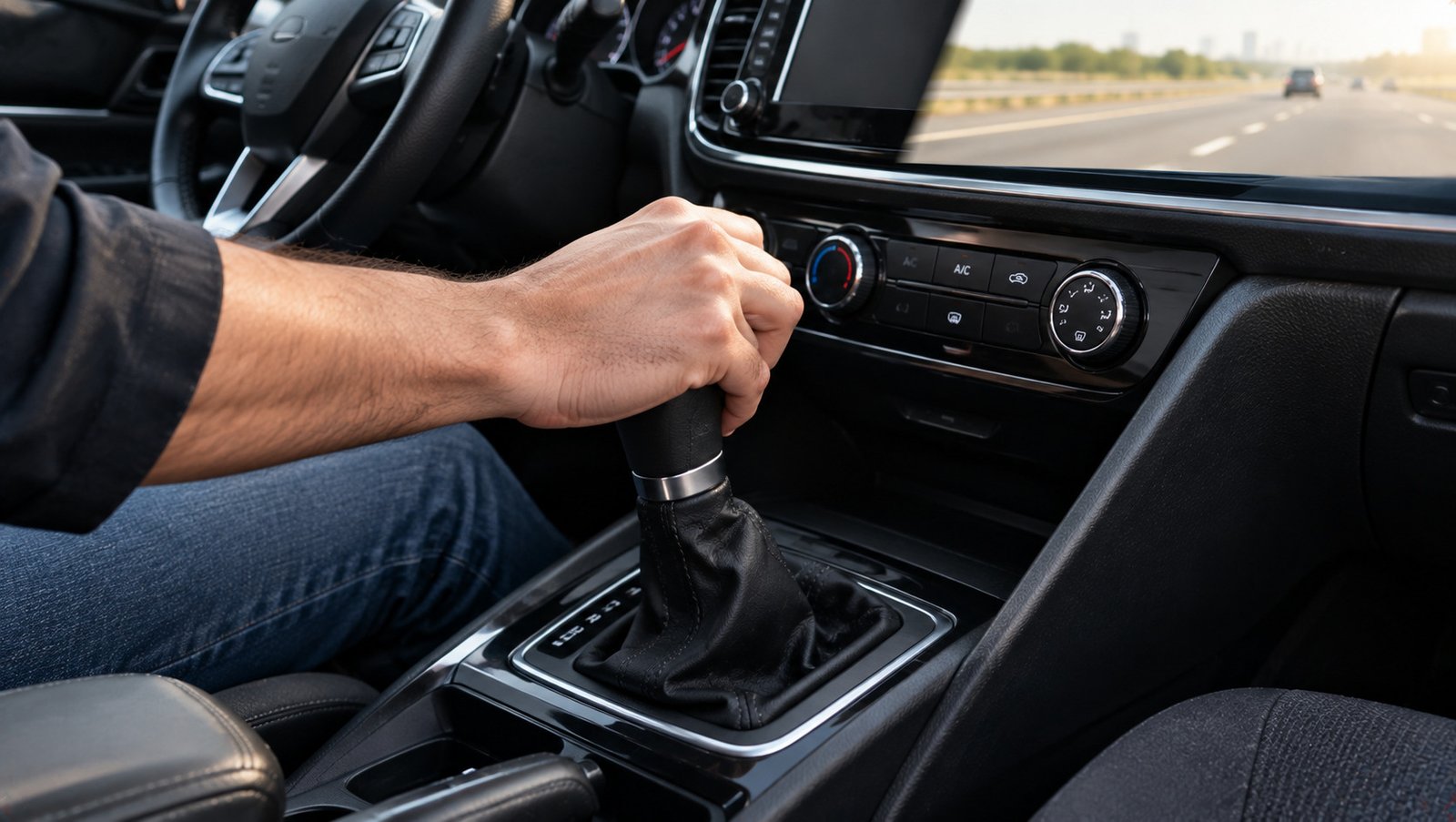
The first visible sign: the fluid darkens from red to brown. The first performance signal that old transmission fluid damage the gearbox has begun: harsher gear changes, particularly on the 2nd-to-3rd shift which is the most frequently executed in Dubai’s traffic.
Friction Modifier Depletion and Clutch Pack Damage
The clutch packs inside the transmission are multi-disc assemblies — alternating friction discs and steel plates that are clamped together by hydraulic pressure to engage each gear. The friction modifier additives in ATF control how smoothly this clamping occurs.
With fresh ATF, the clutch pack engages progressively — the friction coefficient builds gradually as the piston applies pressure. The driver feels a smooth, almost imperceptible gear change.
With depleted friction modifiers, the clutch pack grabs suddenly. The friction coefficient is either too high initially or inconsistent. The driver feels a jerk or shudder on the gear change. More importantly, every abrupt engagement removes friction material from the disc surface at a higher rate than a smooth engagement would.
This is the clutch-level mechanism of how old transmission fluid damage the gearbox. Every shift cycle with depleted ATF removes slightly more friction material than the same shift with fresh ATF. Over 50,000 shift cycles — entirely achievable in Dubai’s stop-start environment within a year — the cumulative material loss is significant. Our car service packages include an ATF condition check and clutch engagement quality assessment at every major service.
Anti-Wear Additive Loss and Gear Surface Damage
The anti-wear additives in ATF form a sacrificial film on metal surfaces — particularly on gear tooth faces, bearing surfaces, and the valve body components. This film absorbs the contact stress that would otherwise be shared between the metal surfaces directly.
As the anti-wear additives deplete, the film thins. At high contact pressures — during full-throttle acceleration or towing — the film breaks and metal-to-metal contact occurs. The gear surfaces and bearing races develop micro-pitting — tiny craters on the surface produced by repeated high-load contact without adequate film protection.
Micro-pitting is irreversible. The damaged surface cannot be smoothed by a fluid change — it continues to generate debris even with fresh ATF. The debris circulates through the fluid, contaminating it further and acting as an abrasive on every surface the fluid contacts.
This debris cascade shows exactly how old transmission fluid damage the gearbox beyond the point a fluid change can fix — a debris loop where the initial damage from fluid degradation generates particles that cause further damage even after the fluid is changed. Catching the fluid before this stage avoids the cascade entirely. For any roadside emergency from a transmission fault, our roadside assistance team covers Al Quoz and nearby Dubai areas.
Viscosity Breakdown in Dubai’s Heat
ATF is formulated to maintain a stable viscosity across a temperature range — typically from cold-start temperatures to peak operating temperatures under load. Viscosity modifiers in the fluid maintain this stability.
In Dubai’s conditions, the transmission operates at the upper end of its temperature range for extended periods. Stop-start traffic in 45°C ambient with the AC compressor adding load produces sustained high transmission temperatures.
At sustained high temperatures, the viscosity modifier molecules shear — they break apart under the mechanical stress of the pump and gear contact. The fluid becomes thinner at high temperature than it was when new. A thinner fluid provides a thinner film between moving surfaces — the same load on the same surface with a thinner film means higher contact stress.
Simultaneously, degraded viscosity modifiers cause the fluid to be thicker than normal at cold temperatures — making cold-start gear changes harsher until the fluid warms. Both extremes contribute to how old transmission fluid damage the gearbox across the operating temperature range.
Contamination — What Gets Into the Fluid Over Time
As ATF degrades and the components it protects experience increased wear, the fluid accumulates contamination.
Clutch friction material particles. Every clutch engagement deposits microscopic friction disc material into the fluid. Over time, this builds up and increases the fluid’s abrasive quality.
Metal particles from gear and bearing wear. Anti-wear additive depletion allows metal surfaces to contact and produce metal particles that circulate in the fluid.
Oxidation byproducts. Thermal oxidation of the base oil produces varnish and sludge that coat internal surfaces — particularly the valve body passages that control hydraulic pressure routing. A partially blocked valve body passage produces incorrect shift timing and pressure.
Water. In humid environments, water can enter the transmission through the breather. Water in ATF is particularly damaging because it destroys the fluid’s lubricating film at high temperatures. For any paint or body repairs needed alongside mechanical work, our car painting team handles colour-matched repairs at the same visit.
How Dubai’s Stop-Start Traffic Accelerates ATF Degradation
A transmission executing 60–80 shift cycles per commute — typical for Dubai city driving — depletes its friction modifier additives at a rate that a highway-dominated driving pattern never reaches.
European service intervals of 60,000 km for ATF changes are developed for markets where the majority of driving is at steady highway speeds with infrequent gear changes. A Dubai vehicle covering the same 60,000 km in city traffic has executed two to three times as many shift cycles. The friction modifiers are depleted in 30,000–40,000 km of Dubai city driving — not 60,000 km.
The heat adds a second acceleration mechanism. Each degree above the optimal operating temperature approximately halves the fluid’s remaining service life. Dubai’s sustained summer transmission temperatures mean the thermal degradation component alone would justify a shorter service interval than European specifications recommend.
The Warning Signs That ATF Has Already Caused Damage
Harsh or jerky gear changes. The most common first sign. Friction modifier depletion causes abrupt clutch engagement. The driver feels the gear change.
Gear change hesitation or delay. Clutch pack wear or valve body contamination producing incorrect shift pressure or timing. The transmission takes longer to complete the shift.
Transmission slip. The clutch pack is worn to the point where it cannot hold the gear under full load. Engine revs rise without proportional speed increase. This is advanced damage.
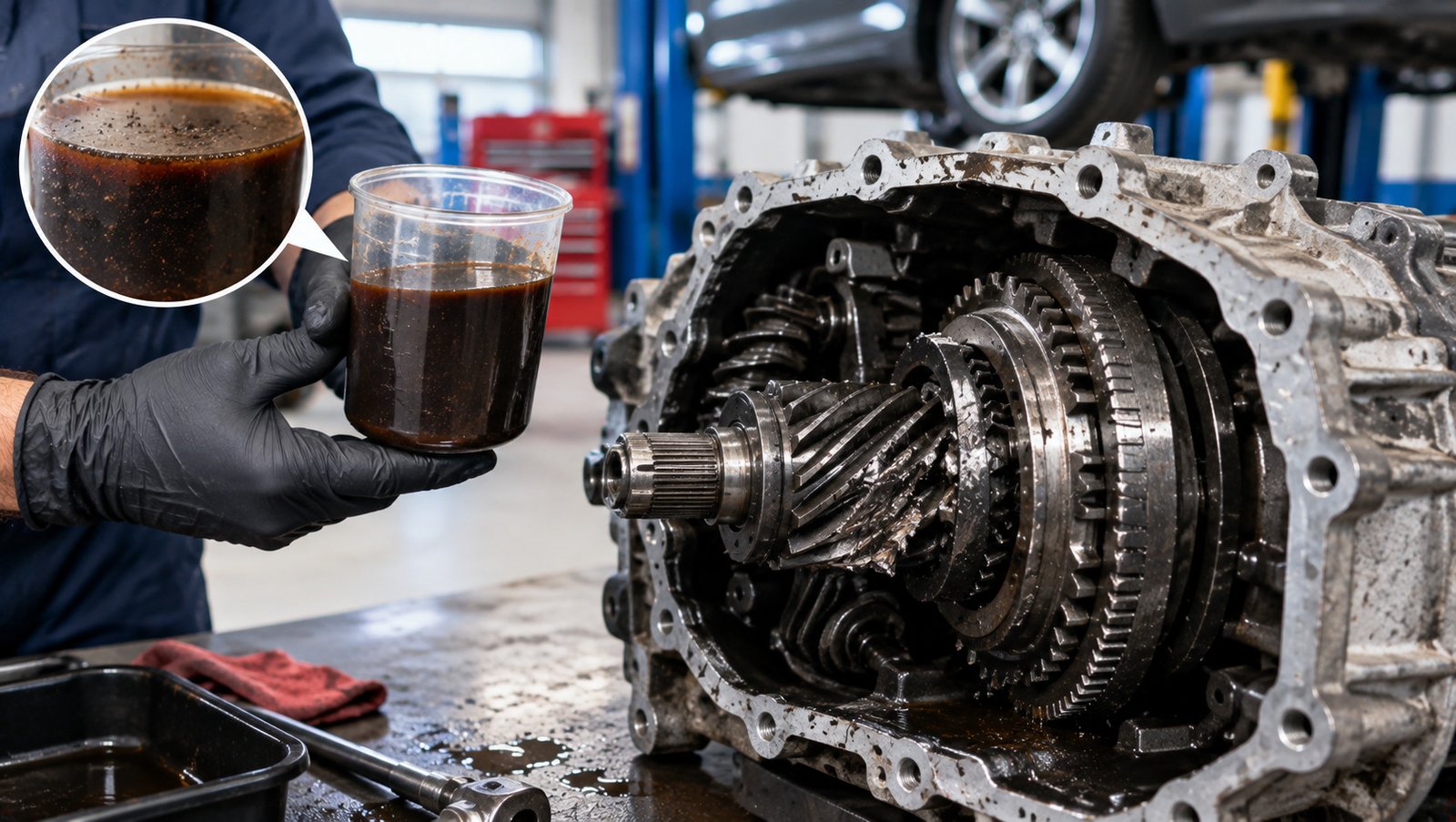
Dark, burnt-smelling ATF. The visual and olfactory confirmation that the fluid has been operated beyond its service life. Dark brown or black fluid with a burnt smell confirms significant thermal oxidation.
Transmission warning light. The transmission control module has detected a fault — temperature, pressure, or slip — that has exceeded its threshold.
Each of these signs appears further along the old transmission fluid damage the gearbox progression. The harsh gear change appears early. The transmission slip appears late. Acting at the harsh gear change stage costs an ATF service. Acting at the slip stage costs a rebuild.
How We Assess Transmission Fluid Condition at Rapid Rev Garage
Visual and olfactory assessment. ATF is checked on the dipstick or drawn from the drain plug. Colour — from red to brown to black — and smell — from mild to burnt — provide immediate condition indicators.
Particle contamination check. A magnet drawn through a sample of drained ATF confirms metal particle content. Significant metal particle accumulation confirms internal wear has already produced debris.
Shift quality road test. The transmission is assessed under different throttle conditions and through all gear changes. Harsh engagement, hesitation, or shudder is documented and its severity assessed against the fluid condition to determine whether the damage is fluid-only or component-level.
Transmission module scan. Fault codes, adaptive shift data, and clutch pack wear compensation values are read. High compensation values confirm the transmission control module has been adjusting for clutch pack wear over an extended period.
ATF Service vs Full Transmission Repair — The Cost Difference
| Intervention | Cost Range | When |
| ATF drain and refill | AED 500–900 | Before symptoms appear |
| Full ATF flush | AED 900–1,500 | At first harsh shift symptoms |
| Solenoid replacement | AED 600–2,000 | After valve body contamination |
| Clutch pack rebuild | AED 3,500–8,000 | After confirmed clutch wear |
| Full transmission rebuild | AED 6,000–15,000 | After advanced damage |
| Transmission replacement | AED 8,000–25,000 | After catastrophic failure |
The cost ratio between an ATF service and a full transmission rebuild is approximately 1:15. In Dubai, preventing old transmission fluid damage the gearbox requires an ATF service every 30,000–40,000 km is the correct preventive interval. Our mobile car mechanic covers Al Quoz and nearby Dubai areas for on-site ATF condition assessment. Our garage near me in Al Quoz serves drivers from Business Bay, Jumeirah, Barsha, Satwa, Downtown, and the Sheikh Zayed Road corridor.
What Does an ATF Service Cost in Dubai?
| Service | Cost Range |
| ATF drain and refill | AED 500–900 |
| Full transmission flush | AED 900–1,500 |
| ATF filter replacement (where applicable) | AED 200–600 |
Correct specification ATF — not a universal fluid — is used for every service. The correct friction modifier chemistry for each specific transmission is essential for clutch pack protection.
Why Rapid Rev Garage?
Old transmission fluid damage the gearbox progressively — and the damage is invisible until it produces a symptom. By the time the symptom appears, the cheapest intervention window has usually passed.
We assess ATF condition at every major service, document the shift quality, scan the transmission module for adaptive data, and recommend the correct service interval for the vehicle’s specific Dubai driving pattern — not the manufacturer’s European baseline.
FAQ — Old Transmission Fluid Damage the Gearbox
Here are the questions Dubai drivers ask us most about transmission fluid.
How often should ATF be changed in Dubai?
Every 30,000–40,000 km for stop-start Dubai city driving. The manufacturer's interval of 60,000 km assumes highway-dominated use with fewer shift cycles per kilometre. Dubai's traffic executes two to three times more shifts per kilometre — depleting friction modifiers faster.
Can topping up with fresh ATF replace a full service?
No. Topping up adds fresh fluid on top of degraded fluid — the mixture still contains depleted additives and contamination from the old fluid. Only a full drain removes the degraded fluid and contamination. Where the torque converter also contains a significant volume of old fluid, a flush is more complete than a drain.
Does dark ATF always mean damage has occurred?
Dark ATF confirms the fluid has been thermally degraded. It does not confirm component damage has already occurred. Catching the fluid at the dark-but-not-burnt stage — before the burnt smell appears — and changing it immediately often prevents component damage. Dark fluid with a burnt smell suggests component damage is more likely.
Is it safe to drive with harsh gear changes?
Short distances to a workshop — yes. Extended driving with harsh shifts accelerates clutch pack wear with every shift cycle. The harsh shift is already causing damage. Book within the week.
What ATF specification should I use?
The specification printed in the owner's manual or on the transmission dipstick. Different manufacturers use different friction modifier chemistries — Toyota WS, ZF Lifeguard, Honda DW-1, Mercon V, and others are not interchangeable. Using the wrong specification produces harsh shifts even with fresh fluid.
Conclusion
Old transmission fluid damage the gearbox through three simultaneous mechanisms — friction modifier depletion causing clutch pack wear, anti-wear additive loss causing gear surface damage, and viscosity breakdown reducing film protection across the temperature range. In Dubai’s stop-start environment, this degradation reaches the critical threshold at 30,000–40,000 km — not the 60,000 km European baseline.
Rapid Rev Garage in Al Quoz assesses ATF condition, shift quality, and transmission module data at every service — catching the degradation before it causes the component damage that an ATF service alone can no longer fix.
Rapid Rev Garage is in Al Quoz, serving Business Bay, Jumeirah, Downtown, Barsha, Satwa, and the Sheikh Zayed Road corridor. Book your appointment on WhatsApp or find us on Google Maps.
Rapid Rev Garage — Old Transmission Fluid Damage the Gearbox | Al Quoz, Dubai