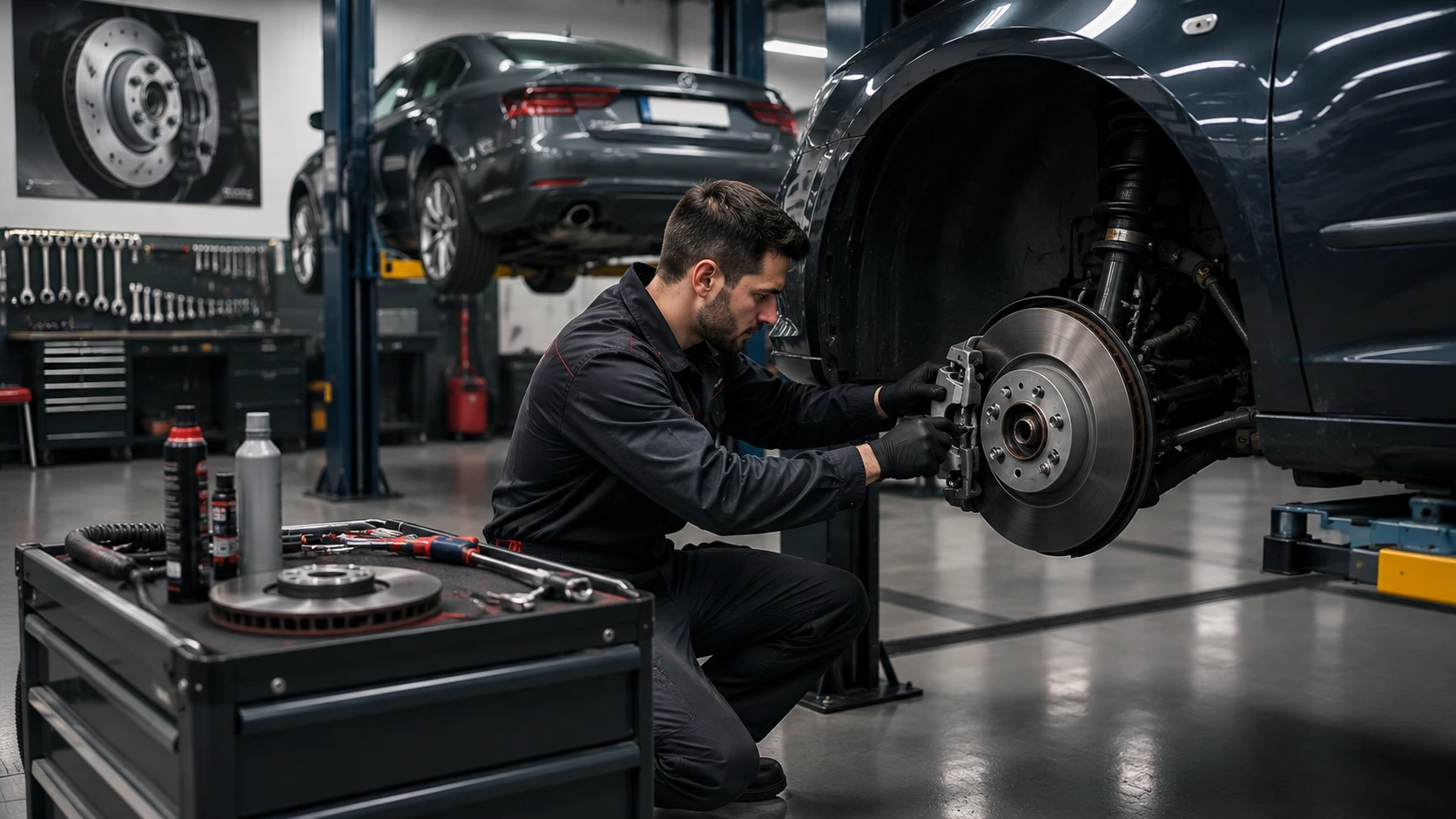
The service brake is the system you depend on every single time you slow down or stop — and in Dubai, that’s more frequently and more urgently than in most other cities. The combination of high highway speeds on Emirates Road and Sheikh Zayed Road, aggressive stop-start traffic through Deira and Business Bay, and speed bumps that appear with little warning across residential districts means the service brake system on a Dubai-driven car works harder than almost anywhere else. When it starts showing signs of wear or developing a fault, those signs deserve immediate attention — not a note to deal with it next week.
The problem is that service brake warning signs are easy to rationalise away. A slight squeal that only happens when the car is cold. A very subtle vibration under braking that’s been there for a month. A pedal that feels marginally softer than it used to. These don’t feel urgent because the brakes are still working — just not working as well as they should. The gap between “still working” and “failed when needed” closes faster in Dubai’s conditions than in milder climates, and the consequence of reaching that gap on a highway or in an emergency stop is immediate and serious.
Service Brake: Understanding What the System Actually Does
The service brake is the primary braking system operated by the brake pedal — distinct from the parking brake, which holds the vehicle stationary when parked. Every time you press the brake pedal, you’re engaging a hydraulic system that transfers pedal force through brake fluid to calipers at each wheel, which squeeze brake pads against rotating rotors to create the friction that slows the vehicle.
Every component in this chain — the master cylinder, the brake lines, the calipers, the pads, the rotors, and the fluid itself — contributes to how effectively the service brake performs. Wear or degradation in any single component affects the whole system’s performance, and in Dubai’s heat and humidity, every component in this chain is under more stress than manufacturer design assumptions typically account for.
A customer brought a Lexus RX to Rapid Rev Garage after noticing a very slight increase in braking distance over several weeks — nothing dramatic, just a feeling that the car wasn’t stopping quite as sharply as it had before. He’d dismissed it as imagination at first. Our full service brake inspection found brake fluid testing at over 4.5% moisture content — significantly above the 3% threshold where boiling point is meaningfully reduced — combined with rear brake pads at 2mm remaining and rear rotors measuring below minimum thickness from gradual wear. None of these had produced loud symptoms. All of them were contributing to the reduced braking performance the driver had noticed. Addressing all three fully restored the service brake performance to specification.
Service Brake Warning Signs: What Each One Means
Service Brake Squealing and Squeaking
The most common service brake complaint and the most commonly dismissed. A squeal on first brake application after the car has been parked overnight is usually surface rust on the rotors — normal and self-clearing within a few stops. A squeal that persists throughout a journey, or appears consistently under moderate braking, means something different.
Continuous service brake squealing typically indicates one of three things — brake pads worn to the wear indicator, which is a metal tab designed to contact the rotor and make noise when pad thickness is critically low; glazed brake pads from overheating that have hardened the pad surface and changed its friction characteristics; or a foreign object — a small stone or metal fragment — caught between the pad and rotor.
All three need attention. The wear indicator squeal is particularly urgent — it’s the final warning before metal-to-metal contact, which destroys rotors rapidly and requires more expensive repair than timely pad replacement would have. Our car mechanic team measures pad thickness at all four corners at every service brake inspection rather than waiting for the squeal to appear.
Service Brake Grinding A grinding sound under braking is almost always metal-to-metal contact — pads worn completely through, with the metal backing plate contacting the rotor directly. This is a service brake emergency. Every braking application at this stage scores deep grooves into the rotor, rapidly destroying what would have been a resurfaceable or borderline-thickness rotor and turning a pad replacement into a pad and rotor replacement. The grinding also indicates severely compromised braking performance.
If you hear grinding from the service brake system, the correct response is to reduce speed gently and get the car to a workshop immediately — not to continue driving with the intention of booking in later.
Vibration Through the Pedal or Steering Wheel A pulsing or vibration felt through the brake pedal or steering wheel under braking almost always indicates rotor thickness variation — commonly called warped rotors. As the rotor spins, the varying thickness causes the brake pads to alternately grip more and less firmly, creating a pulsing sensation that transmits through the caliper, into the steering geometry, and up through the pedal and steering wheel.
Dubai’s driving conditions are particularly hard on rotor flatness. Hard braking from high speeds followed by stationary idling with the brakes still warm concentrates heat in the rotor without the cooling airflow that comes from continued movement — creating the thermal stress that causes thickness variation over time. A proper service brake inspection measures rotor thickness at multiple points around the circumference to identify thickness variation accurately rather than just checking overall rotor thickness once.
Soft or Spongy Brake Pedal A brake pedal that travels further than usual before resistance builds, or feels softer and less firm than it used to, indicates either air in the service brake hydraulic system or brake fluid that has absorbed enough moisture to become compressible under high temperature. Air enters the system through a loose connection, a failed caliper seal, or a brake line issue. Moisture absorption is a gradual process that doesn’t announce itself — the pedal feels progressively softer over months as moisture content rises.
In Dubai’s humidity, brake fluid moisture absorption happens faster than in drier climates. A proper service brake service tests fluid moisture content with a dedicated tester at every inspection — not assuming the fluid is fine because the pedal still feels acceptable. Two-year brake fluid replacement is the correct standard here regardless of pedal feel or visual fluid appearance.
Pulling to One Side Under Braking A car that pulls noticeably to the left or right when the service brake is applied indicates uneven braking force between the two sides — either a sticking caliper on one side maintaining partial pad contact when released, a severely worn pad on one side compared to the other, or a brake line restriction affecting one side’s hydraulic pressure.
Caliper seizure from corroded slide pins is particularly common in Dubai’s dust environment. The slide pins allow the caliper to move as the pads wear — when they seize, the caliper can’t release fully and the pad drags on the rotor constantly. This causes the affected side to wear significantly faster than the other, produces the pulling sensation under braking, and generates heat that warps the rotor on the affected corner. Our car service team cleans and lubricates caliper slides at every service brake service as standard rather than waiting for pulling to develop.
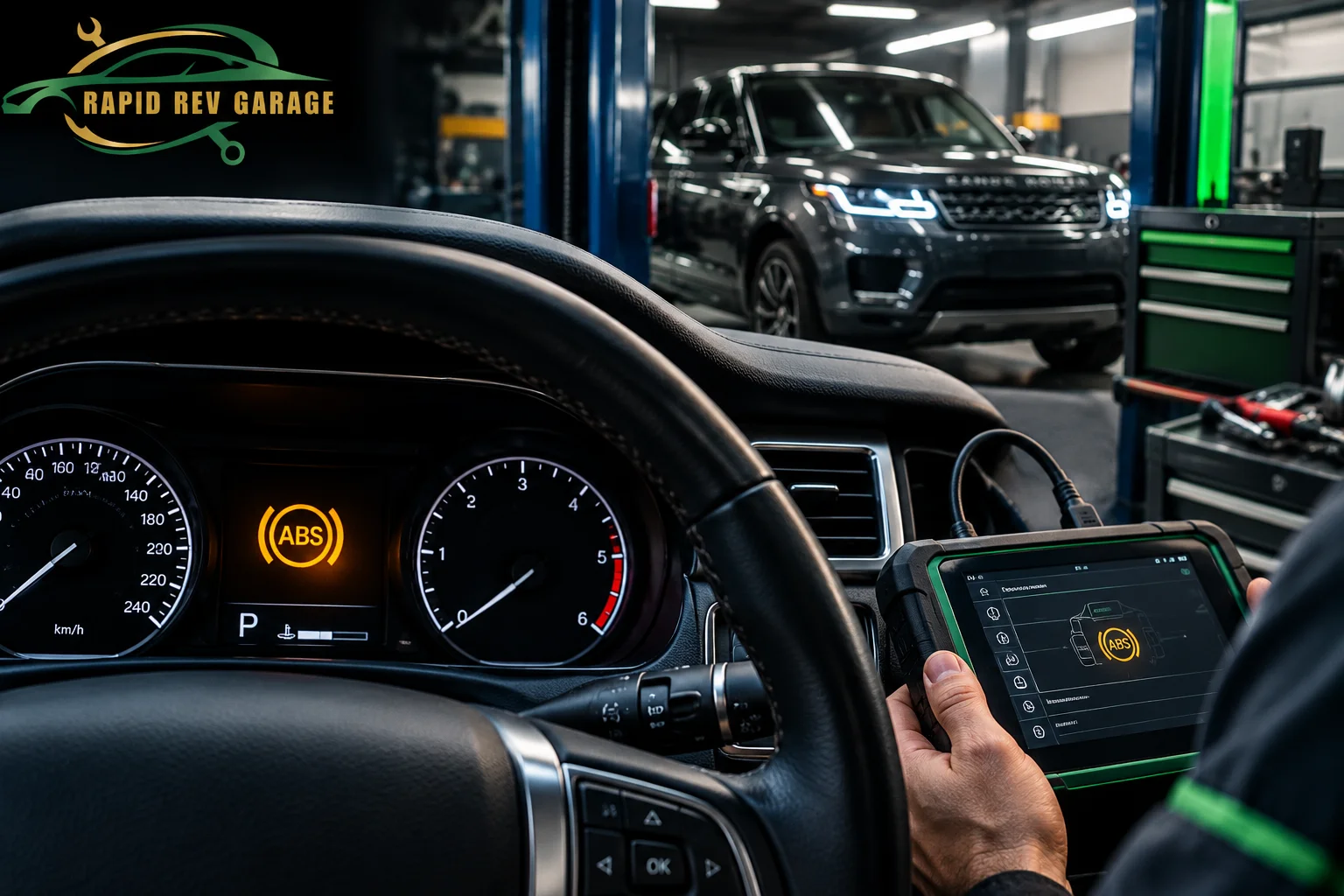
Dashboard Brake Warning Light A red brake warning light can indicate low brake fluid level — which means either a leak in the service brake hydraulic system or brake pads worn to the point where fluid has shifted from the reservoir into the caliper pistons to compensate. Either requires immediate investigation. An amber ABS warning light typically indicates a wheel speed sensor fault affecting the ABS system’s ability to function correctly under emergency braking.
Neither warning light should be dismissed or reset without understanding what triggered it. A proper service brake diagnostic scan identifies the specific fault code and the module that generated it before any repair is recommended.
Service Brake Maintenance That Prevents Warning Signs Developing
Most service brake warning signs are preventable through proper maintenance discipline. A few specific items matter more than the rest:
Brake fluid replacement every two years — non-negotiable in Dubai’s humidity. Moisture absorption happens regardless of how carefully the system is sealed, and testing at every service confirms whether replacement is due rather than assuming it isn’t.
Pad thickness measurement at every service — not waiting for the squeal to appear. A proper measurement at 4-5mm remaining gives time to plan the replacement. A squeal at 1-2mm remaining means the job is urgent rather than plannable.
Rotor thickness measurement at every service — minimum thickness specifications exist because rotors below that thickness can’t safely absorb and dissipate braking heat. Knowing rotor condition proactively avoids discovering they need replacement at the same time as pad replacement rather than on separate schedules.
Caliper slide inspection and lubrication annually — preventing seizure before it causes uneven wear, pulling, and rotor damage.
Our garage near me location in Al Quoz includes all of these checks in every comprehensive service brake inspection — not as separately billed add-ons.
Emergency Situations and Mobile Support
If your service brake system develops a fault that makes the car unsafe to drive, our roadside assistance team covers Al Quoz and surrounding Dubai areas with fast response and proper recovery — getting the car to the workshop safely without the risk of driving a vehicle with compromised braking.
For initial service brake assessments at your location — useful when a warning light has appeared and you need to understand the urgency before deciding to drive or call for recovery — our mobile car mechanic service provides on-site inspection and honest advice.
For vehicles needing paint touch-up or minor body repair alongside a service brake service, our car painting team coordinates both in the same visit where timing allows.
FAQ
What is the difference between a service brake and a parking brake?
The service brake is the primary braking system operated by the foot pedal used while driving — the parking brake holds the car stationary when parked and is a separate system.
How do I know if my brake fluid needs replacing without a workshop visit?
You can't accurately — moisture content doesn't change the fluid's appearance reliably. Only a dedicated moisture tester gives an accurate reading of boiling point reduction.
Why does my car pull to one side only when braking?
Most commonly a sticking caliper on one side maintaining more braking force than the opposite side — needs a service brake inspection to confirm and address the specific cause.
Can I drive with a grinding service brake noise to reach the workshop?
Only at very low speeds over a short distance — grinding means metal-to-metal contact that is destroying the rotor with every braking application and compromising stopping performance significantly.
How often should service brake pads be replaced in Dubai?
Typically every 30,000–40,000 km for front pads in Dubai's stop-start conditions, but measurement at every service is more reliable than mileage alone as an indicator.
In Conclusion
The service brake system is the one component on the car where ignoring warning signs directly creates risk to the driver, passengers, and everyone else on the road. In Dubai’s stop-start traffic, at the speeds Dubai’s highways carry, and under the thermal stress Dubai’s climate creates, a braking system that’s been allowed to degrade is a genuine hazard rather than a maintenance inconvenience. Every warning sign — the squeal, the vibration, the soft pedal, the pulling — is the system communicating that something needs attention before the situation becomes more serious.
Book your appointment with Rapid Rev Garage for a complete service brake inspection done honestly and thoroughly. We cover Al Quoz and nearby Dubai areas with full brake system diagnosis, pad and rotor service, fluid testing, and caliper maintenance for all makes and models. Find us on Google Maps — walk-ins welcome for urgent brake concerns, booking ahead for scheduled service.